Your team may be excellent at creating content, but if you can’t tie your social media work to measurable financial results, executives will view your department as a cost center rather than a growth engine.
To justify budgets and secure future investment, move beyond surface-level vanity metrics and focus on Return on Investment (ROI). This guide takes you beyond the basics to explore Total Cost of Ownership (TCO), revenue-generating tactics like social commerce, and the long-term value of unified analytics.
Social media ROI is a metric that demonstrates the value generated by your investments in social media. While typically measured in monetary value, it can also be quantified by non-monetary metrics (such as influence or lead generation) when direct revenue attribution is difficult.
There are four key steps to demonstrating your brand’s success on social media.
A major barrier to social media ROI is the siloed nature of large organizations. When marketing, customer care, and sales operate in isolation, they work with incomplete data.
It’s essential that you align your team on key objectives to deliver a seamless customer experience. For example, The University of Waterloo faced the challenge of telling cohesive, meaningful stories across dozens of departments with a very small central social team. By adopting Emplifi’s unified platform, they were able to centralize analytics, scale reporting, and streamline scheduling, which sped up reporting turnaround 4x and tripled the number of social media health reports they shared across campus.
To gain C-Suite approval, align your social goals with business objectives. Before launching your next campaign, start having strategic conversations with leadership on:
When social media is linked to real-world ROI, your leadership team will be more invested in its success.
To maximize ROI, prioritize strategies that drive operational efficiency and direct revenue like User-Generated Content (UGC) or live shopping experiences.
UGC is a financial powerhouse because it reduces production costs while increasing trust.
By partnering with Emplifi to curate authentic guest photos and videos, Center Parcs achieved a 15% increase in social engagement and a 40% uplift in positive brand sentiment, driving higher bookings.
Live video shopping bridges the gap between digital and in-store interactions, directly impacting Average Order Value (AOV). Real-time interaction helps overcome online shopping barriers, turning hesitant browsers into buyers.
Utilizing Emplifi’s Live Advisor solution, Bensons for Beds connected online shoppers to in-store experts. This resulted in a 20% rise in Average Order Value (AOV) for live shopping customers compared to standard online shoppers.
Access the complete executive toolkit including a full TCO worksheet, deep-dive case studies, and advanced benchmarks.
Integrating social customer care with traditional support channels is one of the fastest ways to prove ROI through cost reduction.
Social listening allows you to detect emerging issues before they escalate, protecting your brand reputation and looking after your customers.
During a viral incident in 2022, Hardee’s used Emplifi’s real-time listening to detect a spike in mentions. They took the opportunity to respond creatively, turning a potential crisis into a win, and generating 8 million impressions and a 300% increase in followers.

Most marketers calculate ROI based solely on ad spend and basic software fees. However, to present an accurate financial picture to the C-Suite, you need to calculate the Total Cost of Ownership (TCO).
TCO encompasses every expense associated with your operation. Without a clear grasp of these factors, a “cost-effective” social media marketing solution can turn into an expensive liability.
Here are the key components you should consider when you’re talking to vendors:
| TCO component | What to track | Critical vendor vetting questions |
| Initial costs | Setup, implementation, and onboarding fees. | Are there hidden fees for custom configurations or training? |
| Ongoing costs | Subscription fees, support, and data storage. | Is there a policy for data access and storage fees? |
| Scalability costs | Costs for adding user seats or features as you grow. | Are there usage-based costs (e.g., limits on API calls or posts)? |
| Opportunity costs | Productivity loss due to downtime or disjointed workflows. | Does the platform offer Service Level Agreements (SLAs)? |
Managing multiple, fragmented tools is costly. Consolidating tools into an all-in-one platform streamlines operations, reduces licensing fees, and enhances data sharing.
When Domino’s consolidated their social marketing, care, and listening into Emplifi’s unified platform, the results were immediate:
Finally, understanding ROI means looking at the long-term value chain. It’s not just about today’s sale; it is about Lifetime Value (CLV).
Proving social media ROI requires more than a spreadsheet of ‘likes’. It requires a strategic approach that calculates Total Cost of Ownership (TOV), leverages high-efficiency content like UGC, and unifies marketing and care to reduce operational waste.
By consolidating your tools and focusing on these high-impact areas, you can transform your social media operation from a cost center into a primary driver of business growth.
Get a demo of Emplifi’s unified platform to bring your team together and focus on the key metrics that lead to business growth.
Social media ROI measures the value your social activity generates, often in revenue but also in retention, efficiency, or influence. It’s important because it shows leadership the real impact of your efforts beyond likes and follows. By focusing on ROI, you can justify budgets and position social as a growth engine, not just a marketing expense.
Vanity metrics such as likes, comments, and impressions indicate activity but don’t drive business results. Instead, focus on KPIs that impact revenue, retention, and operational efficiency, such as conversion rate, customer lifetime value, and response time. This shift ensures your social strategy ties directly to measurable growth, making it easier to secure budget and leadership buy-in.
User-Generated Content (UGC) reduces production costs while increasing trust and engagement, often outperforming branded content in Click Through Rate (CTR) and Cost Per Acquisition (CPA). Live commerce connects shoppers directly with experts in real-time, boosting conversion and average order value (AOV). Using these high-ROI tactics with a unified social media management platform like Emplifi allows teams to track exactly how social content drives revenue.
Fragmented tools hide the true cost of social operations and make attribution messy. A unified platform consolidates marketing, social care, and analytics, capturing Total Cost of Ownership (TCO) and connecting every interaction to outcomes. This visibility helps you demonstrate savings, track conversions, and show the long-term value of social media to the C-Suite.
Discover how Emplifi boosts efficiency, increases revenue, and scales your social media management — whether you have a small team or a complex product. Let’s talk today.
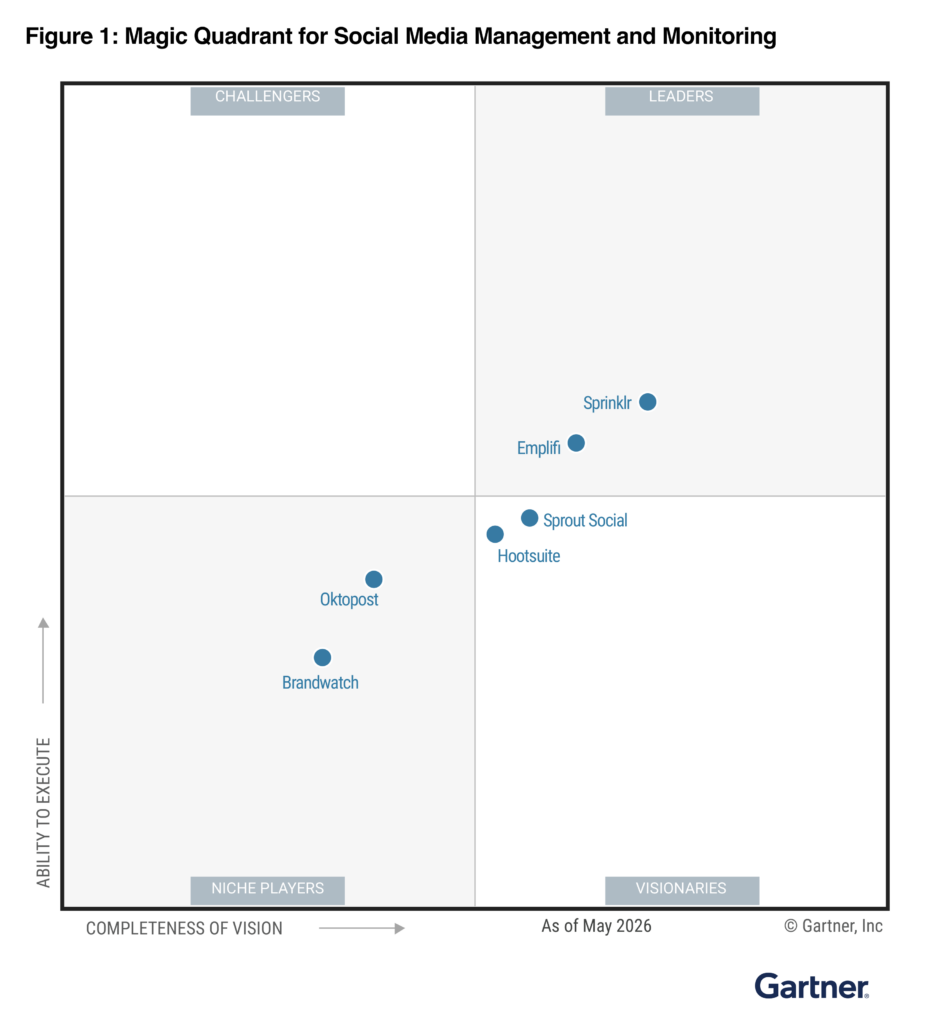
We’re recognized as a market leader in innovation, customer support, and ease of use from these organizations.