Blog
8 min read
Dec 27, 2025

How to measure social media success with KPIs that truly drive growth

Emplifi Team Social Media Marketing Experts
Social media marketer, understanding KPIs for social media growth

Key points:

  • To prove real impact, social teams must move beyond vanity metrics and focus on KPIs tied directly to revenue, retention, and efficiency.
  • When engagement, conversion, and customer care data live in separate tools, it’s impossible to show how social actually drives business outcomes.
  • ROI shows up in three places: Revenue you generate, customers you retain, and costs you reduce.
  • With Emplifi, brands can unify their analytics into one platform, helping them connect social performance to the bottom line.

Most marketing teams can easily report on likes, comments, and shares. But when it comes to connecting social media activity to sales, retention, or cost savings, the story often breaks down.

That’s because many teams are still relying on vanity metrics to justify their impact. These numbers might look good in a report, but they don’t hold up when leadership asks how social media is contributing to real business growth.

To secure budget and earn long-term buy-in, you need to prove your work moves the bottom line. That means shifting focus away from surface-level engagement and measuring social media the same way the business measures everything else: by its impact on revenue, retention, and efficiency.

In this guide, we’ll break down a simple three-step framework for measuring social media ROI and show you how Emplifi connects social performance directly to business outcomes, all in one unified view.

The “so what?” problem in social media reporting

Social media teams around the world face a familiar challenge. Engagement is up. Likes are flooding in. The content calendar is full. But when leadership looks at the report and asks, “So what?”, the room goes quiet. Unless you can show how that activity leads to growth, those numbers don’t mean much.

So, how do you prove that your social performance is going to make the business money?

The problem is that social data often lives in silos, such as:

  • Engagement metrics in native platform dashboards such as Facebook Analytics
  • Conversion data in analytics tools like Google Analytics
  • Customer care metrics in separate service platforms like Salesforce

When these systems don’t talk to each other, it becomes nearly impossible to trace a customer journey from:

A social post -> to a website visit -> to a purchase or resolved support issue

Without that overview, social media ROI stays vague and budgets stay vulnerable. A unified platform like Emplifi can highlight how prospects consume content, purchase products, and interact with your customer care team, all in one place. With customized dashboards, you can focus on what’s important within your organization and give your customers personalized support.

Jägermeister used Emplifi to centralize 150+ accounts across multiple markets, standardizing KPIs, and automating reporting. As a result, they gained clear visibility into performance while saving hundreds of hours each month, which transformed their social media from a siloed operation into a strategic growth engine.

Moving beyond vanity metrics

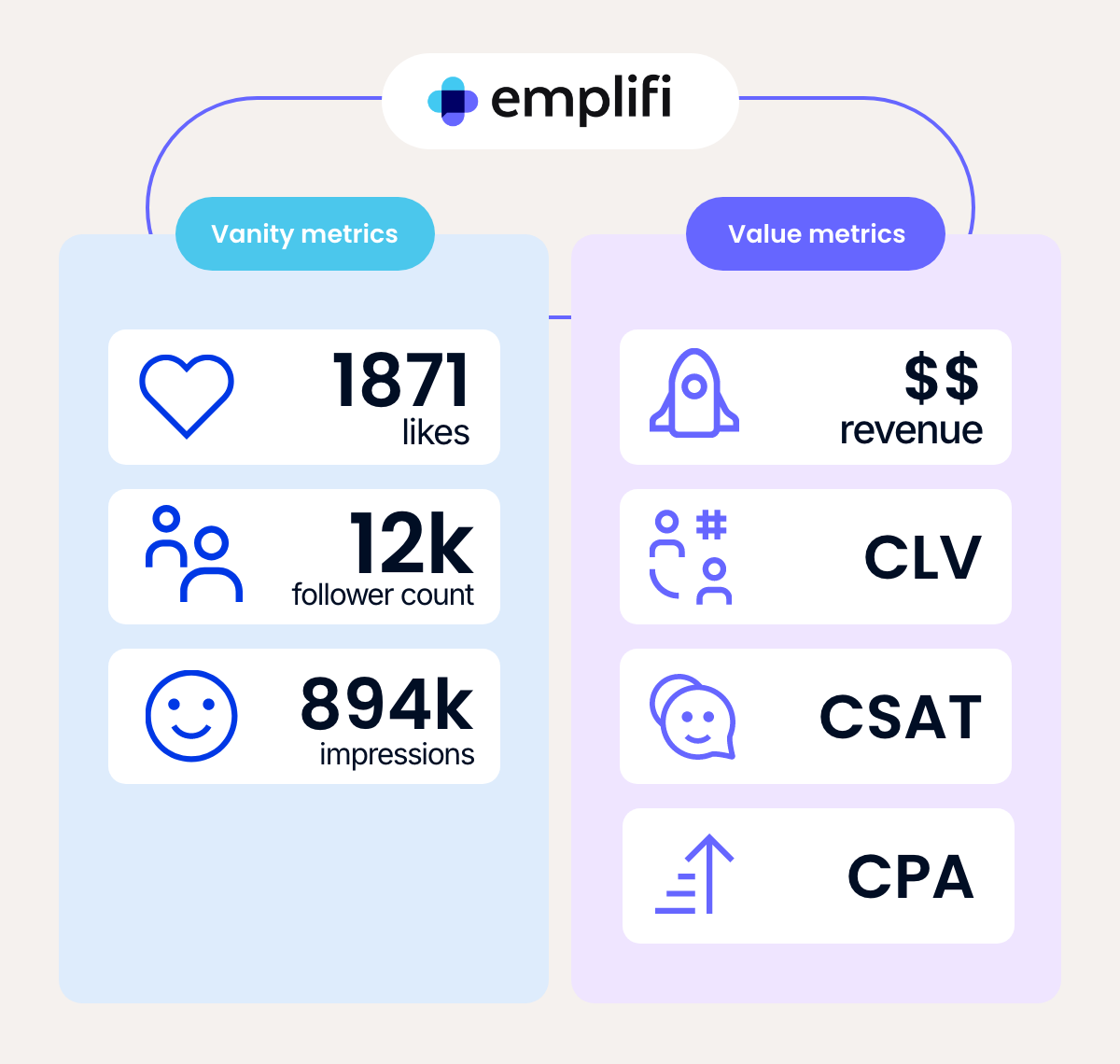
Vanity metrics are useful, but they don’t show you the whole picture.

You’re likely already measuring metrics such as:

  • Likes and reactions: Likes show whether content resonates emotionally and whether it fits the platform’s culture. They’re a quick pulse check on creative performance.
  • Comments: Comments suggest deeper engagement and conversation, especially when they include questions or opinions.
  • Shares: Shares increase reach and indicate that content is worth passing along. Hugely valuable for awareness, especially when the algorithm favours shares as a key metric.
  • Follower growth: Growing your audience can expand future reach. An engaged, smaller audience often delivers more value than a large, passive one.
  • Impressions and reach: These metrics show how many people potentially saw your content. They’re useful for understanding distribution.
  • Follower count: The total number of users who have subscribed to your social profile. This reflects the size of your owned audience and the potential baseline reach for organic content over time.
  • Reach: The number of unique users who see your content during a defined period. Reach shows how widely your content is distributed across social platforms.
  • Impressions: The total number of times your content is displayed, including multiple views by the same user. Impressions are commonly used to understand content frequency and exposure.
  • Share of voice: The percentage of total brand or industry conversations that include your brand compared to competitors. This metric places your visibility in a competitive context.
  • Profile visits: The number of users who navigate to your social profile after seeing your content. Profile visits indicate interest in learning more about your brand.
  • Web traffic from social: The number of website sessions generated from social platforms. This metric connects social visibility to owned digital properties.

These can be used as an indicator of brand visibility and awareness, demonstrating how your social media activity is performing. But they don’t tell you whether social media is actually driving revenue.

The risk of optimizing around these metrics alone is that teams mistake noise for real business impact, and social channels attract superficial engagement, not high-value customers.

To measure ROI properly, you need KPIs that map directly to business outcomes.

Graphic showing vanity metrics vs value metrics

A 3-step framework for demonstrating social media ROI

Real social media ROI shows up in three places:

  • Revenue: What social helps you earn
  • Retention: What social helps you keep
  • Efficiency: What social helps you save

These three pillars create a clear, defensible way to evaluate social performance – one that resonates in the boardroom as much as it does with marketing teams.

Let’s look at each one in detail.

Revenue: Generating income with conversion KPIs

Social media rarely works in isolation. It supports discovery, research, and consideration, often long before a purchase happens. That’s why measuring only last-click attribution underestimates its impact.

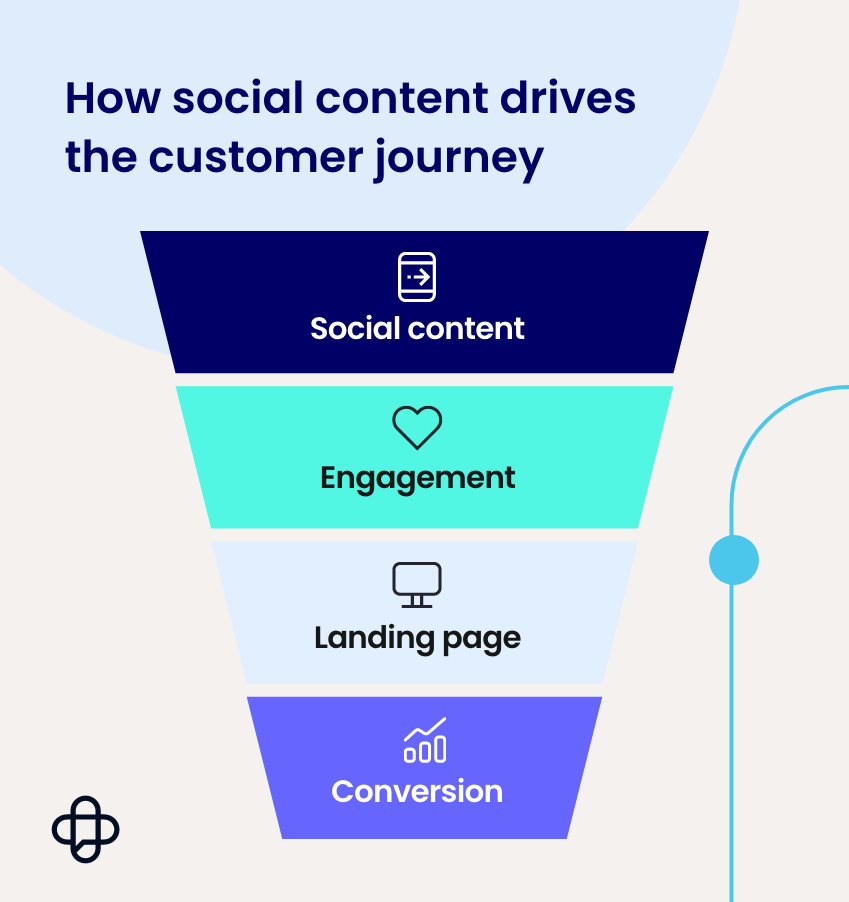
Instead, focus on KPIs that show how social contributes to conversion across the journey. This will show you what stops a customer scrolling and leads them to make a purchase, leading them from a social post to a landing page, and a conversion.

How social content drives the customer journey graphic showing funnel from social content to engagement to landing page to conversion

Key revenue-focused metrics include:

  • Conversion rate: The percentage of social visitors who complete a desired action like purchasing a product or submitting a form. This metric measures how effectively social traffic converts.
  • Lead conversion rate: The percentage of social-driven users who become qualified leads. Lead conversion rate connects social engagement to pipeline creation.
  • Average Order Value (AOV): How much social-driven customers spend compared to other channels.
  • Social commerce revenue: Direct sales from in-app shops on platforms like Instagram and TikTok. This can be an instant indicator of your most popular products.
  • Assisted conversions: Purchases influenced by social interactions earlier in the funnel.
  • Sales revenue from social: Revenue generated from purchases attributed to social media activity, including paid ads, organic posts, and in-platform commerce.
  • Non-revenue conversions: Completed actions that support future revenue, such as email signups, content downloads, or account registrations.

When you can tie your social metrics to solid business objectives, you’ll be able to answer the question leaders actually care about: Which social content drives real revenue? For instance, is it a paid ad on Facebook or a live shopping experience on TikTok?

A unified platform like Emplifi can help you understand the content that performs vs the posts that fall flat, making it easier to plan future campaigns. Automated reports make it easy to share key insights with leadership, so you can prove how invaluable your team is for business growth.

Turn social metrics into boardroom-ready results

Retention: Saving money with customer care KPIs

When it comes to measuring ROI, new business is only part of the picture. Your existing customer base will also play a key role in determining your success.

Social media has become a frontline customer care channel, with 55% of frequent social media users jumping straight to Facebook for customer service-related issues. When handled well, it reduces churn, lowers support costs, and strengthens long-term loyalty. When handled poorly, however, it can have a disastrous impact on your brand reputation, and customer retention.

That’s why it’s essential you build retention-focused KPIs into your social media ROI strategy.

Key metrics to track include:

  • Retention rate: The percentage of customers who continue doing business with your brand including repeat purchases. Retention rate reflects customer loyalty and repeat behavior.
  • Response time (SLA): Faster responses are strongly linked to higher satisfaction, with only 8% of customers willing to wait 48 hours for a DM reply.
  • Deflection rate: Issues resolved on social instead of through call centers or email
  • Customer satisfaction score (CSAT): A direct measurement of customer satisfaction following an interaction. CSAT is commonly used to assess service quality and loyalty signals.
  • Customer lifetime value (CLV): The estimated total revenue a customer generates throughout their relationship with your brand. CLV is used to understand long-term customer value.
  • Issues resolved: The total number of customer inquiries or complaints fully handled through social channels. This metric shows social media’s role in customer support.
  • First response time: The average time it takes to respond to an inbound social message or comment. This KPI measures responsiveness and service performance.
  • Average handle time: The average time required to resolve a customer issue from first contact to resolution, reflecting operational efficiency in social care.

These KPIs reveal how social care contributes to:

  • Lower operational costs: Resolving customer issues on social channels reduces reliance on expensive call centers and email queues, helping teams handle higher volumes without increasing headcount.
  • Improved customer experience: Faster response times and consistent, on-brand support lead to higher satisfaction and trust, especially when customers reach out publicly and expect quick answers.
  • Higher customer lifetime value: When issues are resolved quickly and empathetically via social media, customers are more likely to stay loyal and advocate for your brand, turning support interactions into long-term revenue drivers. 46% of customers won’t leave a brand if a bad experience is resolved well.

Emplifi’s social customer care capabilities use AI to prioritize, route, and respond to customer issues faster, helping teams resolve problems efficiently while keeping messaging consistent and on-brand.

When Coppel faced a sudden surge in customer inquiries, they turned to Emplifi. By centralizing social customer care across channels and using AI-powered routing and workflows, Coppel dramatically improved response times by 56% while keeping messaging consistent and on brand. Their team now sees every interaction in one unified view, reducing case resolution time, boosting customer satisfaction, and proving the value of social care as a core part of their operational strategy.

Efficiency: Gauging performance with acquisition KPIs

Efficiency metrics answer a different but equally important question: Is social media a smart use of budget?

With leadership scrutinizing every cost, these KPIs help teams evaluate how hard their spend is working, especially compared to other channels.

Key efficiency-focused metrics include:

  • Cost per acquisition (CPA): How much it costs to acquire a customer via social. This is used to compare acquisition efficiency across channels.
  • Click-through rate (CTR): The percentage of users who click on a post or ad after seeing it. A good measure of how effectively creative stops the scroll and drives action.
  • Paid vs. organic performance: A comparison of results generated from paid campaigns versus organic content. This KPI helps assess return across different investment types.
  • Earned media value (EMV): An estimated monetary value assigned to organic exposure generated through shares, mentions, and engagement. EMV approximates the value of unpaid visibility.

Tracking these KPIs allows teams to:

  • Reduce wasted spend on content that’s not moving the needle
  • Optimize creative faster to focus on the content that’s driving growth
  • Shift budget toward high-performing formats and channels

For example, Emplifi’s unified dashboards make it easy to compare paid and organic performance side by side so it’s easy to see what’s working and what’s not. You won’t waste time investing in strategies that don’t align with business objectives, and you’ll always be able to answer your CFO’s queries about leads generated via social media.

Final thoughts: Securing your budgets with social media data

When you want to justify your budgets for the year ahead, demonstrating ROI to your leadership team is essential. True social media ROI is about tracking the right metrics:

  • Revenue you can attribute: Track sales from social commerce posts, UGC campaigns, or paid social ads. For example, Instagram Shop or TikTok Shop purchases directly linked to a campaign show exactly which content drives revenue.
  • Retention you can protect: Measure repeat purchases and loyalty program engagement after social care interactions. Resolving customer complaints via social channels, for instance, can prevent churn and increase Customer Lifetime Value (CLV).
  • Efficiency you can prove: Quantify cost savings and workflow improvements from social automation. For example, routing inquiries automatically to the right team or using AI to triage questions reduces time spent per case and lowers support costs.

When those metrics are clear, social media stops being hard to justify. It becomes a measurable growth engine – one that earns its place in strategic planning and budget conversations.

Get a demo to see how Emplifi’s unified analytics platform helps you connect social performance to real business impact and make ROI impossible to ignore. 

Frequently Asked Questions

Social media ROI measures the real business value generated from your social media investments. While engagement can signal visibility, true ROI shows up in revenue earned, customers retained, or costs reduced. If a metric can’t be connected to one of those outcomes, it won’t hold up in budget conversations.

Vanity metrics show how visible your content is, not how valuable it is to the business. High engagement doesn’t automatically translate into sales, loyalty, or operational efficiency. Leadership needs proof that social media drives growth, not just activity.

You measure social media ROI by focusing on KPIs tied to revenue, retention, and efficiency. That includes metrics like conversion rate, customer satisfaction, cost per acquisition, and support cost savings. The key is connecting these KPIs across the entire customer journey rather than reporting on them in isolation.

Emplifi unifies social marketing, customer care, and analytics in a single platform. This makes it possible to track customers from first social touch through to purchase or resolution, clearly showing how social contributes to business outcomes. With everything in one view, teams can confidently prove ROI and secure long-term budget buy-in.

Insights from Emplifi

Explore our latest blogs and comprehensive guides designed to help you master customer experience strategies and drive growth.

Ready to fuel your CX and social media marketing?

Discover how Emplifi boosts efficiency, increases revenue, and scales your social media management — whether you have a small team or a complex product. Let’s talk today.

What can you expect?

  • A partner who cares about your strategy and objectives
  • Live demo showing how we differentiate from the pack
  • No pressure, just advice
Get a demo

Outpace your competition with easy-to-use, innovative solutions

We’re recognized as a market leader in innovation, customer support, and ease of use from these organizations.