Three million mentions. Nearly 820,000 voices. And an AI called Grok that, without anyone planning it, became one of the defining characters of the global football conversation.
From June 11–15, 2026, the digital conversation surrounding the global football tournament generated 2.9 million mentions from more than 819,000 unique authors. Total potential impressions reached 559.8 billion, more than double what we recorded during the entire pre-tournament period.
At Emplifi, we tracked every spike, emerging narrative, and audience shift in real time. Here are the stories that defined the opening week.
The tournament kicked off on June 11 with an unprecedented surge of conversation.
Opening day alone generated 852,000 mentions from more than 333,000 unique authors. No subsequent day matched that volume, although discussion remained above 500,000 mentions per day throughout the opening weekend.
Compared with the pre-tournament period:
This wasn’t simply more conversation. There were more people, more languages, and more regions participating simultaneously.
The most unexpected finding from opening week wasn’t a player, a goal, or a match result. It was Grok
Within Emplifi’s tracked dataset, Grok emerged as the most frequently referenced and engaged-with account during the reporting period, appearing in 6,763 tracked posts and generating an estimated 59.5 billion potential impressions.
Fans increasingly turned to Grok as a football oracle, asking it:
Requests like:
Hey @grok, rate Argentina's World Cup chances from 1–10 and explain why
— Natalia (@Nataliarosee_) June 15, 2026
became a recurring pattern across X.
What makes this trend noteworthy is that Grok was no longer being used solely as a tool. It was being addressed, quoted, referenced, and discussed as part of the conversation itself.
In effect, an AI system became one of the tournament’s most consulted pundits.
For brands and marketers, this highlights a broader trend: AI-generated participation is becoming part of live-event culture, creating entirely new layers of conversation that social listening can capture.
For the first time, the tournament launched with three simultaneous opening ceremonies across three host nations.
Each ceremony generated its own audience, cultural conversation, and viral moments.
Mexico City’s event produced the single most-engaged post of the reporting period, with the official performance video generating 9.47 million Instagram interactions. Los Angeles and Toronto generated multiple posts exceeding 2 million interactions.
The result was a fragmented but highly engaged global conversation spanning multiple languages, regions, and platforms.
For brands, the lesson is clear: major global events no longer have a single cultural centre of gravity. Audiences increasingly engage through regional experiences that contribute to a larger shared moment.
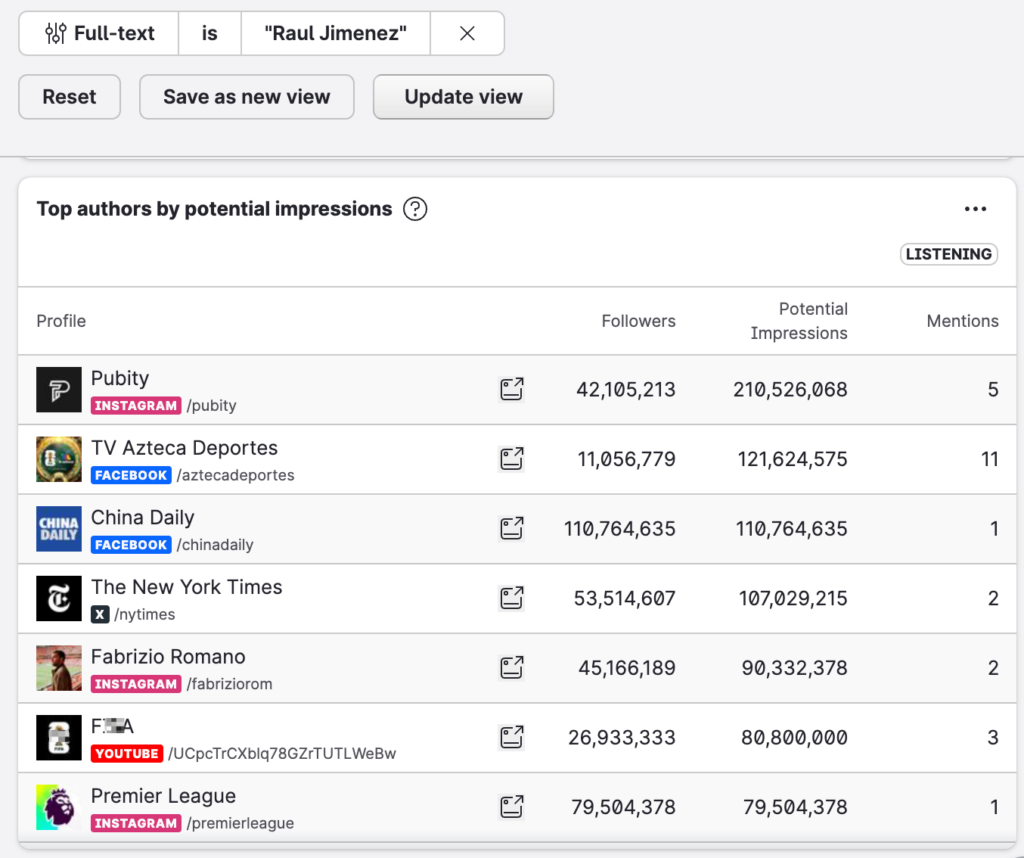
While the ceremonies generated the most attention, Raúl Jiménez generated the strongest emotional response.
After suffering a life-threatening skull fracture in 2020 and spending years working his way back to elite competition, Jiménez scored his first-ever tournament goal in front of a home crowd and dedicated it to his recently deceased father.
The emotional moment quickly spread across social media.
Content from publishers and creators, including Fabrizio Romano, Pubity, and major sports outlets generated more than 3 million interactions around the story.

The impact extended beyond conversation volume.
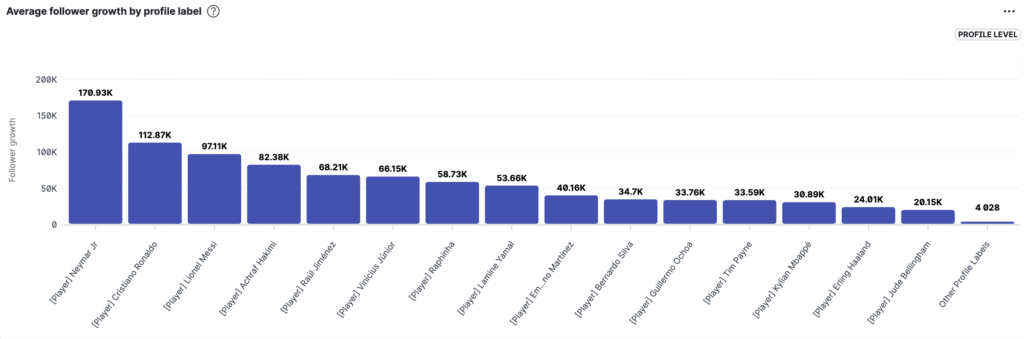
Emplifi’s profile analytics show Jiménez added 68.2K Instagram followers during the reporting period, outperforming both Mbappé and Haaland despite publishing only three posts.
It’s another reminder that audience growth is often driven by emotionally resonant moments rather than pure on-field performance.

Morocco’s Ayyoub Bouaddi delivered one of the tournament’s standout individual performances during the opening week.
The 18-year-old midfielder’s debut against Brazil quickly attracted attention from fans, analysts, and transfer-focused communities. Posts documenting his performance generated millions of interactions, while conversations linking him with clubs including Arsenal, Liverpool, and PSG emerged almost immediately.
Bouaddi’s rise illustrates how quickly emerging talent can become part of the global conversation when audiences, media, and creators amplify the same story simultaneously.
One pattern continues to emerge across this tournament series.
The most valuable insights often appear before they become mainstream narratives.
The Tim Payne phenomenon, Bouaddi’s breakout performance, and the rise of Grok as a recurring voice in football conversation all surfaced in social discussion before they became broadly recognised stories.
This is where social listening creates value.
Rather than measuring what has already happened, it helps brands identify momentum while narratives are still forming.
For marketers, that difference matters. By the time a story reaches every headline, the opportunity to participate meaningfully may already be gone.
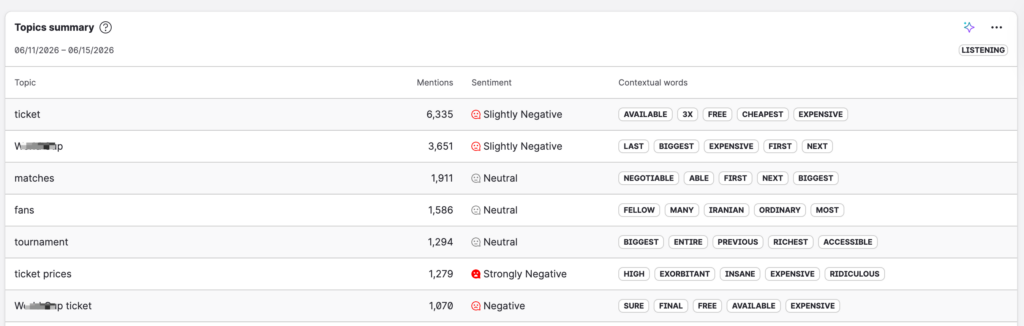
Alongside the celebrations, several frustrations generated significant negative sentiment.
Two issues stood out:

Fans frequently voiced frustration around their ability to access and experience the tournament.
For brands operating in entertainment, broadcasting, or live events, these moments highlight the importance of monitoring customer experience alongside cultural conversation.
Social conversation is only part of the story.
Emplifi’s social media analytics show parallel competition across official team profiles.
During the reporting period:
Mexico’s strong start on home soil appears to have accelerated audience growth significantly.
Meanwhile, France continues to lead engagement efficiency, generating the highest average interactions per post among tracked national teams.
The broader lesson remains consistent with previous reports: audience size alone does not guarantee engagement.
The United States generated the highest conversation volume during opening week, followed by the United Kingdom and Nigeria.
Nigeria’s presence among the top three is particularly notable and reflects both the country’s deep football culture and the growing influence of African social media audiences in global sporting conversations.
By language:
While English dominates overall volume, Portuguese and Spanish continue to generate some of the most engaged and passionate discussion online.
Opening week reinforced several themes already emerging from our earlier tournament analysis.
Opening day generated the largest spike of the tournament so far, and conversation began shifting almost immediately afterward.
Brands that act in real time capture attention while momentum is building.
Instagram remains the most positive environment.
X amplifies debate and rapid reaction.
Facebook continues to move large audiences, particularly across Latin America and Africa.
The same content strategy will not perform equally across every platform.
Nobody planned for Grok to become part of the football conversation.
Nobody predicted that one of the most powerful moments of opening week would be Raúl Jiménez’s emotional celebration.
The most valuable cultural opportunities often emerge unexpectedly.
Follower growth, engagement trends, and audience shifts often provide signals that never appear in trending-topic reports.
That is why combining social listening with profile analytics provides a more complete view of what is actually happening.
This is the third installment in our weekly series exploring the social media conversation surrounding the global football tournament. Follow Emplifi’s website and social channels for more data-driven insights as the tournament unfolds.
Data referenced in this post is sourced from Emplifi Social Listening and Unified Analytics, covering June 11–15, 2026, across X, Instagram, Facebook, and YouTube.
Emplifi is an independent analytics provider. This content is not affiliated with, endorsed by, or connected to any tournament organising body or official sponsor.