Once a social media crisis hits, it can spiral out of control in hours, and brands that can’t keep up risk their reputation being badly damaged.
With AI-generated content accelerating at the speed and scale of online conversations, traditional crisis plans simply can’t keep up.
Modern crisis response requires real-time detection and consistent communication – all powered by AI that can surface the signals humans can’t.
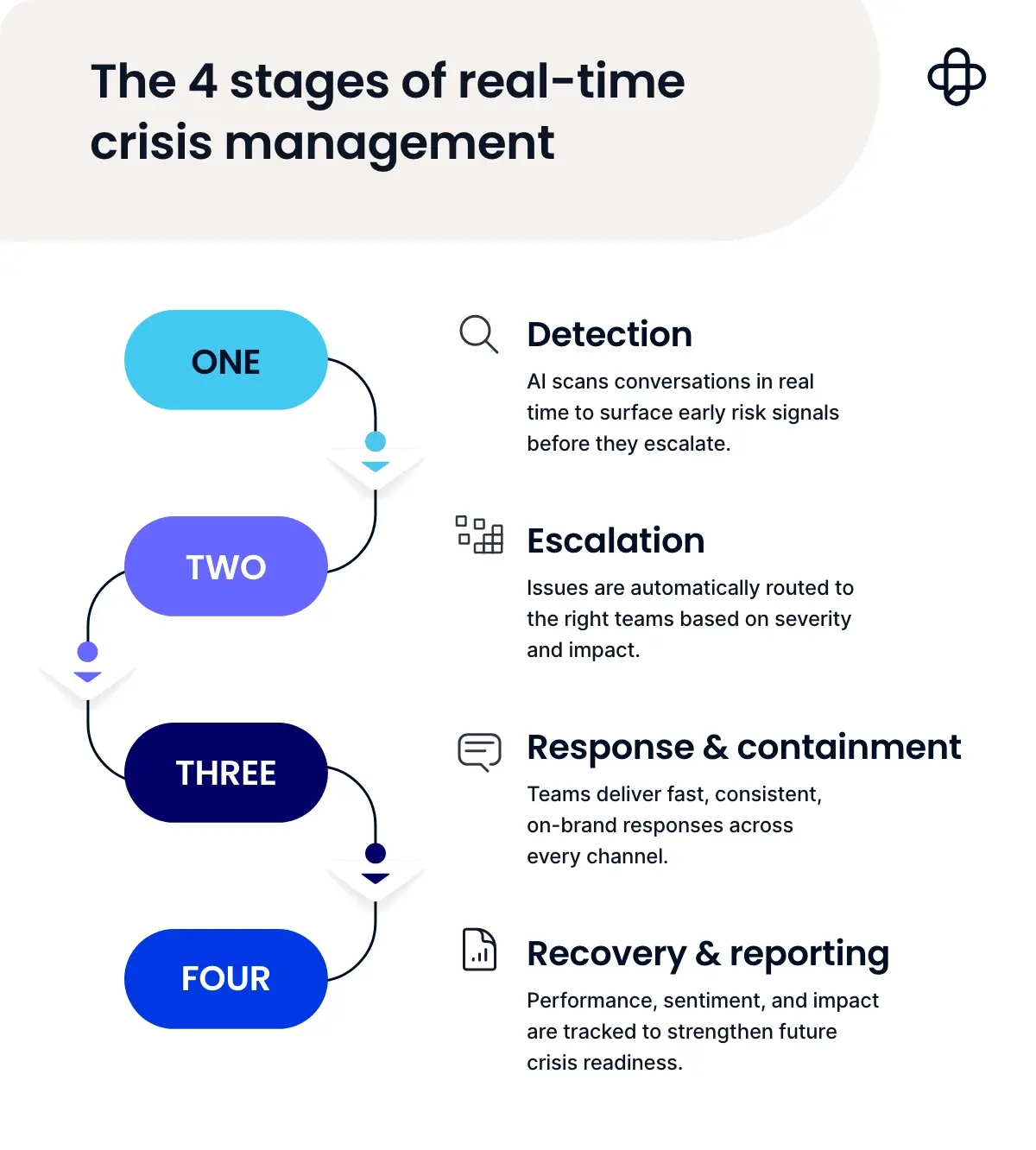
In this guide, we’ll take a look at the four stages of real-time crisis management, and how AI can give you the speed, context and coordination to protect your reputation when every minute counts.

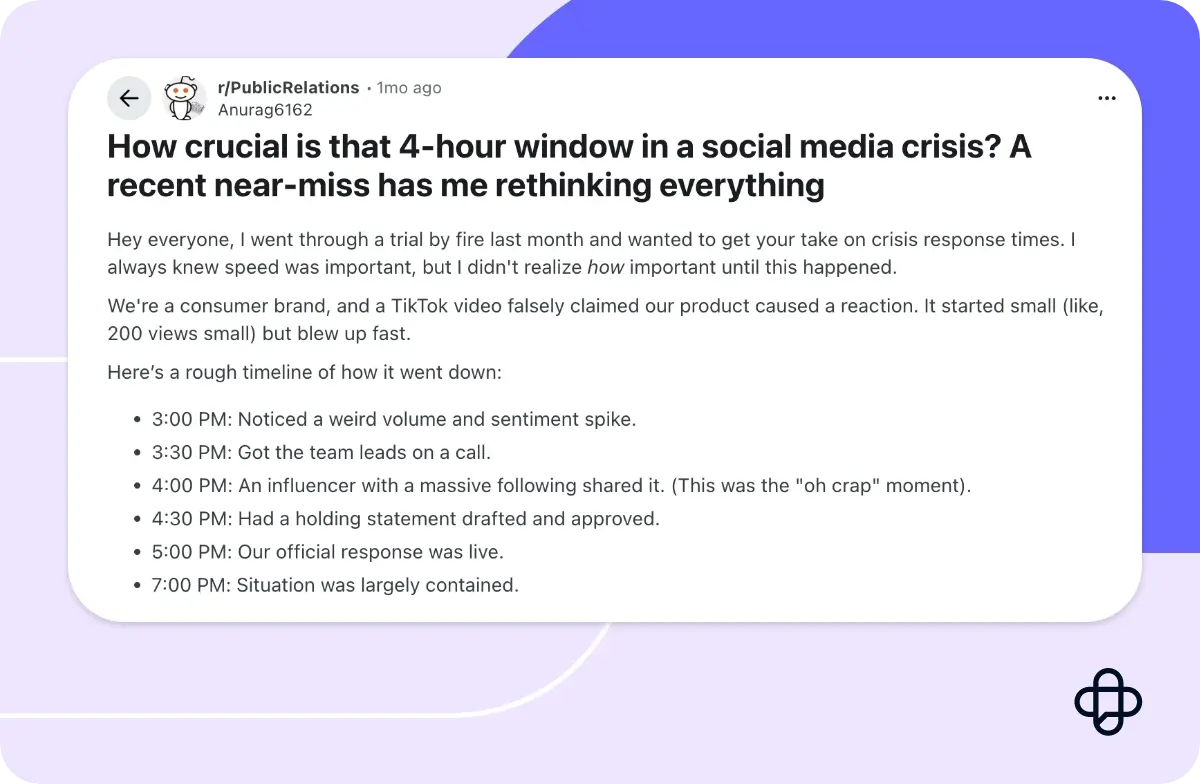
Most crises start quietly, with small warning signs that are easy to overlook, as this Reddit example shows, where a TikTok video with a small amount of views quickly became a serious reputational risk.

It might be a small drop in sentiment, a rise in customer complaints, a niche community raising concerns, or an influencer sharing a negative experience that sets the wheels in motion.
By the time these patterns are noticeable, the crisis is already spreading, and brands are on the back foot, scrambling to react instead of prevent.
Trying to catch these early signals without the right tools is nearly impossible. Conversations are scattered across multiple platforms, often using different language to describe the same issue.
You could spend hours online and still be overwhelmed with the sheer volume of posts, mentions, and comments throwing criticism at your brand. It’s because of this that teams often miss the small, critical signals that could prevent a full-blown crisis.
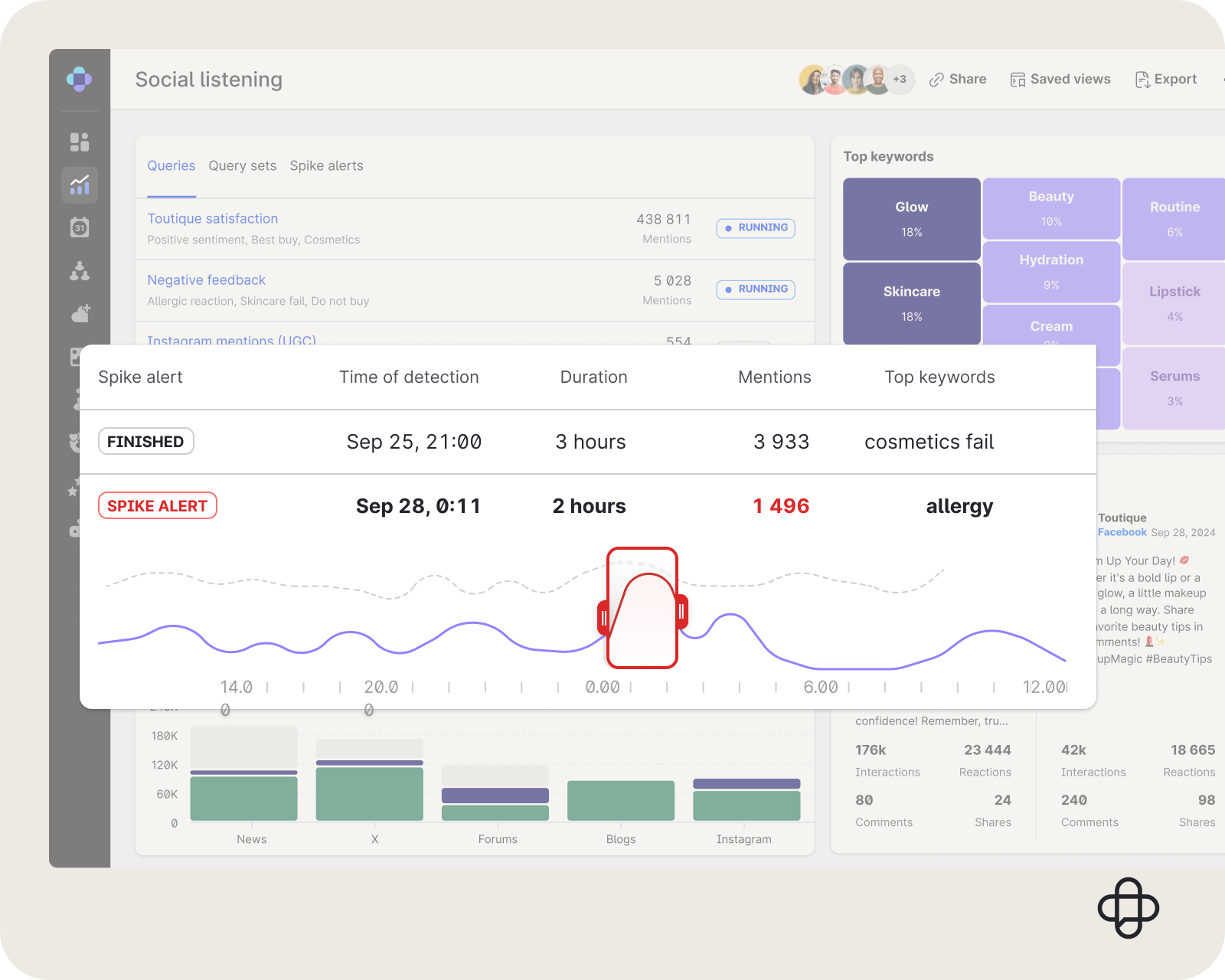
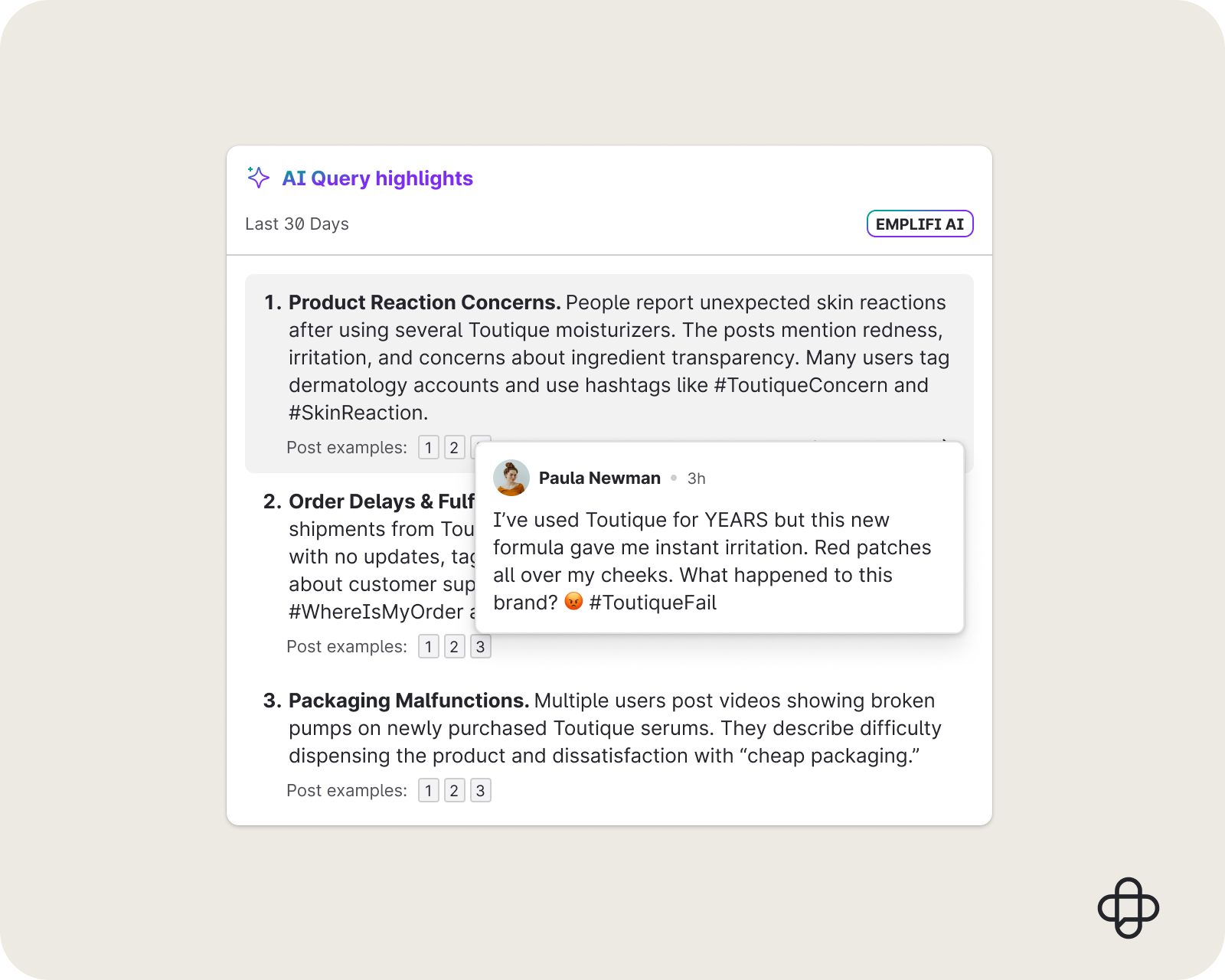
AI-powered social listening changes the game. It understands context, clustering thousands of conversations into actionable themes, and identifying patterns in real time. With a tool like Emplifi that uses AI for social listening, brands can:
Emplifi acts as your brand’s 24/7 radar. The platform continuously scans social media, forums, review sites, and news outlets to catch the earliest signs of trouble. It automatically:

This real-time intelligence alerts your brand instantly, allowing your team to respond as soon as they’re notified.
Terri Haffey, Manager of Customer Care at Domino’s says, “When a big name calls out Domino’s, for good or bad, Emplifi allows us to respond quickly. Timely responses ensure we’re tuned into our audience and able to maintain personalized relationships and provide positive customer experiences.”
With Emplifi, your team can act fast and protect your brand reputation before small signals become major headlines.
Spot early signals, act fast, and protect your brand with Emplifi’s AI-powered social listening.
Identifying a potential crisis is just the first step. Once an issue is flagged, teams need to move fast and work in sync to minimise any reputational damage. But this is easier said than done.
The trouble is that many organizations rely on fragmented workflows. PR sees one version of the story, Legal sees another, and Social sees a third. This misalignment slows escalation and increases the risk of miscommunication or delayed action.
A simple system for ranking severity can make a huge difference. Consider factors like:
Building a tiered system means that your team understands how to approach any crisis, whether you need a couple of people to work on crisis communications or get all hands on deck.
It could look something like this:
Tier 1: Monitoring
Severity Level: Low
Typical Signals:
Minor complaints
Isolated negative comments
Small dips in sentiment
Primary Teams Involved: Social Media, Community Management
AI’s Role:
Tracks baseline sentiment
Flags early changes
Monitors keyword trends before issues escalate
Recommended Response Time: Ongoing, real-time
Tier 2: Emerging Issue
Severity Level: Medium
Typical Signals:
Rising complaint volume
Repeated questions
Early influencer mentions
Primary Teams Involved: Social, Customer Support, Marketing
AI’s Role:
Detects volume spikes
Clusters recurring issues
Routes product-related feedback to Support
Recommended Response Time: Within 1–2 hours
Tier 3: Active Crisis
Severity Level: High
Typical Signals:
Viral negative posts
Press attention
Coordinated backlash
Primary Teams Involved: PR, Legal, Social, Customer Support, Leadership
AI’s Role:
Escalates issues in real time
Flags legal and regulatory risk
Supports on-brand response drafting
Monitors sentiment minute-by-minute
Recommended Response Time: Within minutes
Tier 4: Critical Escalation
Severity Level: Severe
Typical Signals:
Safety issues
Regulatory risk
National media coverage
Consumer harm
Primary Teams Involved: Executive Team, Legal, PR, Risk & Compliance
AI’s Role:
Prioritizes stakeholder and reputation threats
Tracks misinformation spread
Supports unified high-stakes communications
Recommended Response Time: Immediate
Tier 5: Recovery & Analysis
Severity Level: Post-crisis
Typical Signals:
Sentiment stabilizing
Declining volume
Media follow-ups
Primary Teams Involved: Marketing, PR, Insights, Product, Executive Team
AI’s Role:
Measures sentiment recovery
Maps the crisis timeline
Generates post-crisis intelligence reports
Recommended Response Time: Days to weeks
Escalation shouldn’t rely on one team constantly refreshing dashboards. It’s time consuming and could cost your business huge amounts in the long term.
With a tool like Emplifi, you can enable an AI workflow so that if a crisis hits, you’re automatically:

What used to take hours of back-and-forth communication now happens in minutes; if you’re not using AI, you could still be umm-ing and ahh-ing about your public response while your competitors are wrapping up the crisis and moving forward.
Pro Tip: Use Emplifi’s AI-generated summaries to cut through the noise. Automatically condense social listening insights and send them to the right stakeholders, keeping your team aligned and informed without the extra manual work.
When a crisis hits, staying silent is the riskiest move, with 35% of consumers expecting a brand response within an hour on social media. If the situation is urgent, consumers will likely want you to reply within minutes, if not seconds.
Gaps in communication create a vacuum – one that misinformation or speculation can quickly fill. But speaking too soon can be just as damaging. Vague or inconsistent messages simply won’t wash with concerned customers.
You might not be able to come up with a complete response right away but you should at least put a holding statement in place to show that you acknowledge your customers’ frustration.
Within minutes of confirming an issue, your response should be:
Keep it short to prevent creating more questions than answers, and be genuine in your approach. Early clarity prevents confusion and builds trust.
Crises often involve multiple teams responding at once, which can lead to conflicting posts, off-brand tone, overly defensive language, or premature promises.
But if you’re using an AI social listening platform like Emplifi, you’ll easily be able to align what you want to say with your brand tone. It can review phrasing for you, ensuring every message feels unified and on-brand.
That isn’t to say AI should be 100% responsible for your messaging at a time of crisis; 67% of consumers want a human response when engaging with a brand on social media.
Instead, it can be useful for producing a first draft as a starting point, and acting as a sounding board to check that what you’re saying is in line with your brand tone of voice, and to keep messaging consistent across all teams.
When customers are waiting on you to make a statement, it can be nerve-wracking to try and draft a public holding statement.
You can rely on Emplifi to:
With Emplifi, your team responds quickly and safely, delivering clear, empathetic communication that contains the issue without sacrificing brand integrity.
Every crisis has an arc. Once the situation stabilizes, the focus shifts from reaction to rebuilding trust and learning from the event.
By tracking the right metrics, you can analyse what went well and what didn’t, preparing you for any future crises.
A good place to start is by assessing how long it takes for customers to see you in a good light again. Track sentiment analysis to see how quickly:
These metrics show whether your response helped restore confidence, or if additional action is needed to bring positive sentiment back up.
Building out a timeline can help the entire team understand how long the entire process took, and what could be improved in the future.
You could include:
Emplifi can help you turn raw data into actionable insights that help you understand where the crisis started and how it played out across different social channels. Social listening dashboards help you analyse spikes in mentions and track their progress to see how long it took to get your brand back on track.
Starbucks’ 2025 holiday Bearista Cold Cup went viral and sold out almost immediately after launch. There was widespread social media chatter about stock levels and availability, including on Reddit where users reported extremely limited quantities and outrage at employees buying them first.
Starbucks publicly acknowledged the unexpected demand and apologised for disappointing fans, while promising further holiday offerings.
This situation shows how operational issues – even non-controversial ones like limited merchandise availability – can generate high-volume discussion that brands need to monitor.
Social listening tools like Emplifi can highlight rapid sentiment shifts and volume spikes across platforms like Reddit, TikTok, and Instagram, giving teams early warning to respond publicly and manage expectations before dissatisfaction spreads further.
In October 2025, Alaska Airlines experienced a significant IT outage that temporarily grounded flights across its network, leading to cancellations and travel disruptions.
The airline communicated the issue via social platforms, sharing updates as operations were restored and advising passengers to check flight status as systems came back online.
Alaska Airlines operations have been restored after a significant IT outage resulted in a system-wide ground stop of flights for Alaska and Horizon. The ground stop was lifted at 11:30 p.m. Pacific. We are working to get our operations back on track as quickly and safely as…
— Alaska Airlines News (@AlaskaAirNews) October 24, 2025
This operational mishap drove high volumes of social activity from affected travelers seeking information and expressing frustration.
Using social listening tools to detect emerging complaints and sentiment trends in real time can help teams like those at Alaska Airlines prioritize clear, consistent communications across channels, reducing confusion and reassuring customers as the situation evolves.
A social media crisis requires an almost instant response to stop it in its tracks, and minimize any reputational damage.
To protect your brand in a real-time world, you need:
With Emplifi’s social listening platform at the center, your team can count on a system that’s fast enough, smart enough, and scalable enough to meet the pace of today’s risks, helping you maintain trust, and act with confidence.
Discover how Emplifi can help your team spot early signals, coordinate responses, and protect your brand during a social media crisis – get a demo with our social media experts.
Crises now emerge and spread faster than any human team can manually track. AI detects sentiment shifts, volume spikes, and emerging risks in real time across thousands of channels. This gives brands the speed and early warning needed to respond before issues go viral.
AI removes manual bottlenecks by automatically routing issues to the right teams based on risk and severity. Legal, PR, support, and leadership all see the same real-time view of the crisis. This keeps responses aligned and dramatically reduces response time.
Yes – AI enhances human response rather than replacing it. It checks tone, and ensures message consistency across teams. The result is faster, safer communication that still feels authentic and human.
Emplifi unifies detection, escalation, response, and recovery in a single AI-powered platform. Brands gain real-time alerts, automated workflows, sentiment tracking, and executive-ready reporting in one system. This turns crisis management from reactive firefighting into a repeatable, scalable strategy.
Emplifi’s social listening software tracks relevant subreddits, threads, and comments to capture sentiment, trends, and user discussions about your brand or competitors. It surfaces emerging topics, unanswered questions, and shifting sentiment, giving you actionable insights in real time. Connecting these signals to your broader marketing metrics helps you understand how Reddit conversations influence awareness, engagement, and conversions.
Discover how Emplifi boosts efficiency, increases revenue, and scales your social media management — whether you have a small team or a complex product. Let’s talk today.
We’re recognized as a market leader in innovation, customer support, and ease of use from these organizations.