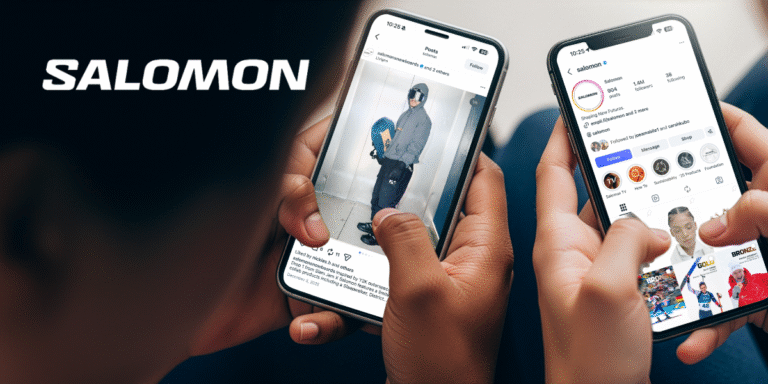
With over 80 social media accounts worldwide, Salomon, faced a massive challenge: maintaining a personal connection with customers while managing an influx of volume across dozens of global markets. Their teams were battling burnout, data silos, and the dreaded “screen juggle”.
We sat down with Salomé Mougel, Social Media Marketing Assistant at Salomon, to discuss how the iconic outdoor brand overhauled their Social CX approach. She explains how they centralized data to cut response times by nearly half, balanced automation with empathy, and turned service interactions into a loyalty engine.
Here’s Salomon’s playbook, and how you can apply the same principles to your own Social CX strategy:
Salomé: The friction was real. Imagine an agent trying to answer a simple DM about a missing order: the customer care team had to open a new tab, log into the CRM, search for the order, check a shipping tool, and then switch back to Instagram to reply. When you multiply that by thousands of messages, the result is burned-out teams and a fractured customer experience.
The “Golden Nugget” of our transformation was integrating our social management platform directly with Salesforce. By centralizing this data, we reduced our average response time by 45%. For the agent, it’s the end of juggling screens. The conversation shifts from “What is your order number?” to “I see your hiking boots are delayed, let me fix that”.
Salomé: We actually flipped that script. We realized that by not automating simple queries, we were too overwhelmed to provide human empathy where it actually mattered.
We implemented a two-tier strategy: Tier 1 handles FAQs like store hours and stock availability through automated flows or chatbots. This acts as a filter that clears the noise. It allows us to execute. Tier 2 reinvests that saved time into complex, high-emotion cases that require a personal touch. The goal isn’t to replace the team, but to focus experts on interactions that turn angry customers into brand ambassadors.
Salomé: It’s a governance nightmare if you are too rigid or too loose. We adopted a “Standardized Process, Localized Tone” approach.
On the global level, our SLAs, escalation processes, and response speed expectations are identical worldwide. But locally, the actual voice, cultural nuances, and language are adapted by local teams. This ensures that a customer in Tokyo gets the same quality of service as a customer in Annecy, even if the cultural delivery differs.
Salomé: Previously, collaborating meant taking screenshots of DMs and emailing them internally, which was slow and prone to error. We fixed this by implementing a unified routing workflow.
Now, with a single click, a social care agent can transfer a case to a product expert. Crucially, the full history of the conversation travels with the ticket. The product expert sees the context immediately, resolves it, and the social agent is notified to close the loop with the customer. It stops the team from acting like data-entry clerks and lets them be problem solvers.
Salomon didn’t get faster by working harder. They got faster by unifying their CX. Talk to an Emplifi expert to see how the same approach can help you cut response times, empower agents, and scale social support with confidence.
JD Sports shows how to win on social without losing your brand soul. Their approach proves that relevance comes from cultural connection, not just constant posting. Anastassia and her team walk the line between speed and strategy, using social as a cultural engine rather than a sales megaphone.
For brands looking to grow their social presence, JD offers a clear playbook: stay audience-obsessed, keep your brand filter tight, and let culture drive creativity. When you lead with authenticity, engagement and sales naturally follow.
Discover how Emplifi boosts efficiency, increases revenue, and scales your social media management — whether you have a small team or a complex product. Let’s talk today.
We’re recognized as a market leader in innovation, customer support, and ease of use from these organizations.