Every tournament produces an unexpected story. This summer, one of the biggest emerged before kickoff.

A few weeks ago, New Zealand defender Tim Payne had around 4,000 Instagram followers. As of this writing, that number has surpassed 5 million. Payne’s rise was fuelled by a simple community-driven campaign that transformed a relatively unknown player into one of the most talked-about names in the tournament conversation.

At Emplifi, we tracked the story as it unfolded across social media. The data offers a fascinating look at how online communities create momentum, amplify narratives, and shape global conversations in real time.

The story behind the spike

The story began with Argentine creator Valen Scarsini, who launched a campaign built around a simple idea: make one of the tournament’s least-followed players one of its most-followed.

The challenge spread quickly. Fans joined in. Content creators amplified the idea. Sports media picked up the story. Within days, what started as a niche social media challenge became a global conversation.

Coverage from outlets including BBC News, ESPN Argentina, TNT Sports Brasil, Diario Olé, TyC Sports, and the New Zealand Herald helped extend the story beyond its original audience and into mainstream sports media.

The conversation also expanded into broader internet communities. During the peak of activity, Emplifi’s listening data identified accounts and communities emerging around the phenomenon itself, highlighting how quickly online audiences began participating in and reshaping the narrative.

Between February 1 and June 4, 2026, mentions of Tim Payne across X, Instagram, Facebook, and YouTube generated an estimated 1.75 billion potential impressions from 1,926 tracked mentions. Much of that reach was driven by high-profile creators, sports publishers, and media outlets amplifying the story.

The engagement numbers tell a similar story: tracked posts mentioning Payne generated 8.9 million social interactions during the same period.

The moment the conversation ignited

The spike arrived almost overnight. Before May 27, Tim Payne generated relatively little social media activity. Then the conversation accelerated rapidly:

  • May 27: 33 mentions
  • May 28: 241 mentions
  • May 29: 436 mentions (peak volume)
  • May 30–June 3: sustained momentum, with between 192 and 313 mentions per day

At the height of the conversation, 252 unique authors were posting about Payne in a single day, compared with minimal activity in the weeks beforehand.

Importantly, the story did not disappear after its initial peak. Instead, it sustained attention across multiple days, allowing new audiences and creators to continue participating in the conversation.

Why did this story spread

The Tim Payne phenomenon did not go viral by chance. Four specific characteristics combined to make it unusually effective at generating organic reach, and each one carries implications beyond this particular moment.

  1. Near-zero friction. The campaign asked only one thing of its audience: follow an account. That simplicity removed almost every barrier to participation, allowing casual observers to become active contributors to the story. The result is visible in the data: at the height of the conversation, 252 unique authors were posting about Payne in a single day, many of them accounts with no prior connection to New Zealand football.
  2. Narrative clarity. The premise was immediately legible to anyone who encountered it: an obscure player, a playful challenge, a community behind it. Audiences did not need context or background knowledge to understand what was happening or why they might want to join. That accessibility is rare in sports storytelling, which often requires significant prior knowledge to follow.
  3. Collective ownership. As Payne’s follower count climbed publicly, participants could see the direct result of their own action. The campaign functioned as a live scoreboard, and every milestone became a new reason to share, recruit, and celebrate. This feedback loop sustained the conversation over multiple days rather than allowing it to fade after a single spike.
  4. Positive sentiment. Unlike many viral moments fuelled by controversy, this one was built on celebration and humour. Our analysis shows that the overwhelming majority of tracked mentions carried neutral or positive sentiment, a profile that consistently produces stronger long-term amplification than outrage-driven content. People shared the story because it made them feel good, not because it made them feel provoked.

Who drove the conversation

The Tim Payne story has a Latin American heart. 🇦🇷 Argentina generated the highest level of activity in Emplifi’s tracked dataset, producing 122 mentions and 470,185 interactions. This exceeded activity from the 🇺🇸 United States, 🇲🇽 Mexico, 🇦🇺 Australia, and 🇳🇿 New Zealand.

Language trends reveal a similar pattern.

Spanish was the dominant language in the conversation, accounting for 955 tracked mentions, compared with 875 in English and 66 in Portuguese. For a story centred around a New Zealand player, this is a remarkable result.

It reinforces a trend identified in our first analysis: Latin American audiences are not simply participating in football conversation online; they are often driving it.

Follow the tournament conversation in real time

The Tim Payne phenomenon is just one example of how quickly narratives can emerge during major sporting events. Track fan sentiment, trending topics, player conversations, and viral moments as they happen.

The hashtag that outperformed expectations

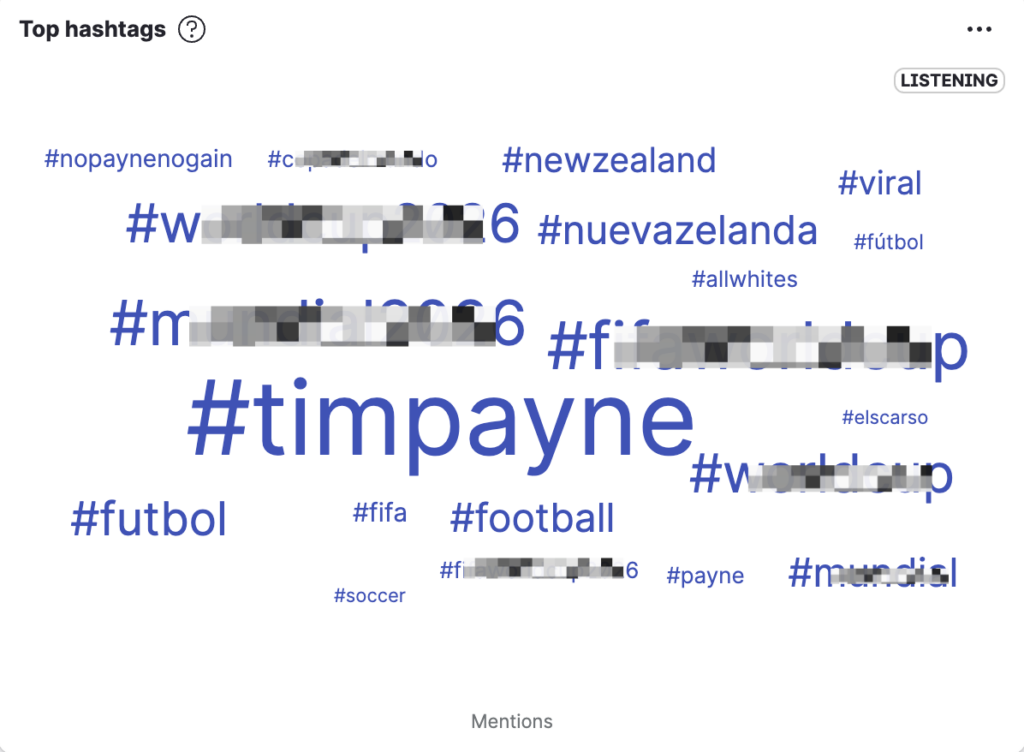
#timpayne became one of the most effective organic hashtags in the broader tournament conversation. Across 721 tracked posts, the hashtag generated:

1,115,881 interactions

163 million potential impressions

The hashtag frequently appeared alongside broader tournament-related tags such as #mundial2026, #football, and #nuevazelanda, helping integrate the story into larger football conversations rather than confining it to a standalone trend.

One reason for its performance is that participation was largely organic. Unlike scheduled campaigns or branded content initiatives, users actively chose to engage with and share the story, creating stronger engagement signals across platforms.

Tim Payne Hashtags

How Tim Payne compares with the tournament’s biggest stars

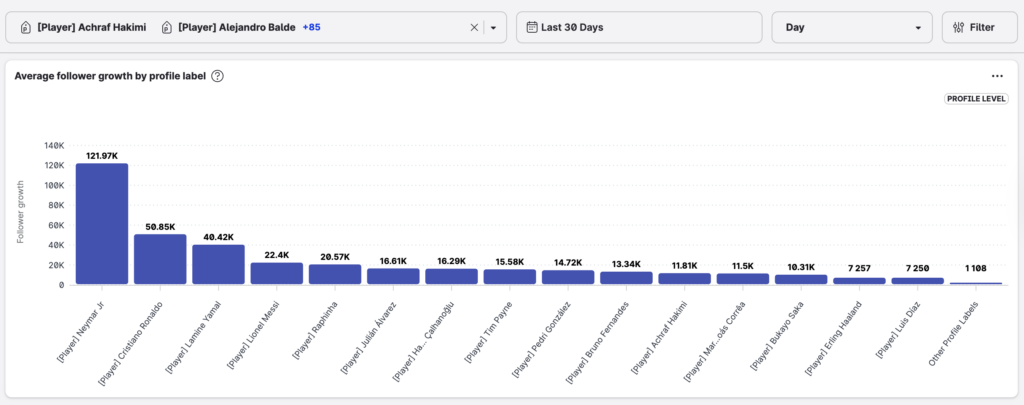
Emplifi’s social media analytics platform tracks Instagram performance across players representing all participating national teams.

Based on average follower growth during 2026, Tim Payne now ranks among the top-performing players in the dataset. What makes this growth notable is not simply the final follower count, but the starting point.

Payne entered the year with one of the smallest social audiences among tracked players. His subsequent growth trajectory represents one of the most dramatic audience expansion stories observed during the pre-tournament period.

IG Players Profiles by followers growth


What brands and marketers should take away

The Tim Payne story is more than an example of internet fame. It offers several valuable lessons for marketers, sports organisations, and content teams.

Community-driven narratives travel further

The reach and engagement generated by this story were not driven by advertising spend. They were driven by people who genuinely wanted to participate and share the story.

For brands, this reinforces the value of creating opportunities for audiences to contribute rather than simply consume.

Creators can reshape conversations

The campaign demonstrates how creators outside traditional celebrity circles can influence global conversations when they tap into a compelling idea and an engaged community.

For marketers, this highlights the importance of identifying emerging creators and cultural catalysts alongside larger influencer partnerships.

Latin America continues to shape football conversation

Our first tournament analysis identified Latin America as one of the most influential regions in football-related social media discussion.

The Tim Payne story reinforces that finding.

Argentina generated more engagement around the story than several larger football markets combined, while Spanish emerged as the dominant language in the conversation.

Brands looking to maximise impact during major football events should ensure their content, engagement, and community strategies reflect the importance of these audiences.

Positive storytelling continues to outperform

In our first tournament analysis, we found that positive content generated significantly more reach than negative content.

The Tim Payne phenomenon offers a real-world example of that trend.

The story gained momentum because it was inclusive, entertaining, and celebratory, qualities that consistently encourage sharing and participation.

Sometimes the social media story becomes the story

One of the most interesting findings in the data is that 502 tracked mentions referenced “social media” as a key topic.
People were not only discussing Tim Payne. They were discussing the phenomenon itself.

The conversation became self-reinforcing, with audiences increasingly fascinated by the speed and scale of the story’s growth.

That reflexive behaviour, the internet reacting to its own activity, remains one of the strongest amplification signals social listening can identify.

A bigger picture: the tournament’s digital momentum keeps growing

The Tim Payne story sits within a much larger conversation that continues to accelerate ahead of the tournament.

Since January 2026, Emplifi’s listening queries have captured +5 million tournament-related mentions from nearly 1.3 million unique authors, generating an estimated 1.1 trillion potential impressions.

With the tournament yet to begin, these numbers are likely to grow significantly. The Tim Payne phenomenon provides an early preview of the dynamics that often define major sporting events online: unexpected stories, rapid audience mobilisation, and community-driven narratives that emerge long before the action begins on the pitch.

These are exactly the kinds of signals that social listening helps brands identify and act on in real time.

Stay tuned

This is the second in our series of data-driven insights from the tournament’s social media conversation.

We will explore the trends, stories, and audience behaviours shaping the tournament online using insights from Emplifi’s AI-Powered Social Listening.

The Tim Payne-specific data in this report reflects public social media conversations tracked between February 1 and June 4, 2026. Broader tournament conversation data covers January 1 to June 4, 2026. Platform coverage includes X, Instagram, Facebook, and YouTube.

Emplifi is an independent analytics provider. This content is not affiliated with or endorsed by any tournament organiser or official sponsor.

Ready to fuel your teams with A-CX?

Discover what Emplifi can do for you. We turn small teams into large ones, and large teams into well oiled machines, but either way, we offer the rocket ship, you just need to jump on.

What can you expect?

  • A live walkthrough of Emplifi Fuel tailored to your specific social marketing, commerce, and care needs
  • A benchmark of how your brand performs against peers in your industry
  • A partner who understands your business, and 22,000 others
  • A concrete action plan to go from disjointed teams to A-CX
Get a demo