Social commerce is the practice of selling products directly within social media platforms, allowing consumers to discover, browse, and purchase without leaving the app. By the end of 2026, US social commerce sales are projected to surpass $100 billion.
Social commerce has moved well past the experimental phase. Now marketing leaders face a new question: how to build the infrastructure to succeed?
By the end of 2026, social commerce sales are projected to surpass $100 billion for the first time. Senior marketing leaders are increasingly expected to have a clear answer to how their teams are set up to capture a share of it.
This article outlines what a mature social commerce strategy looks like, where the biggest execution risks sit, and how AI is changing the execution model across the full commerce lifecycle.
Social commerce involves selling products directly within social platforms, without routing shoppers to an external site. It represents a fundamental shift in the purchase funnel as discovery, evaluation, and conversion all happen inside the same environment.
It’s key to remember that social commerce is not social media marketing.
Marketing builds awareness and drives traffic. Social commerce converts that audience in-platform, removing the handoff to your website entirely. Both have a role, but they require different content strategies, KPIs, and team resources.
Here are the main differences between the two:
| Social media marketing | Social commerce | |
|---|---|---|
| Primary goal | Build brand awareness, drive traffic, and increase engagement. | Drive in-platform conversions and generate revenue. |
| Where conversion happens | On your website or mobile app. | Directly within the social platform. |
| Key KPIs | Reach, impressions, click-through rate (CTR), and follower growth. | Conversion rate, revenue, average order value (AOV), and return on ad spend (ROAS). |
| Content role | Encourage users to click through to owned channels. | Enable product discovery and purchase within the social feed. |
| Customer service requirement | Community management and audience engagement. | Real-time support throughout the purchase journey. |
According to Emplifi’s consumer research, nearly half of social media users have made a purchase directly through a social platform in the past 90 days.
That makes social commerce a mainstream behavior, and it’s skewing younger.
Gen Z (53%) and Millennials (56%) lead in social commerce adoption, and their expectations for the experience are high. Frictionless checkout, fast responses to questions, and relevant product discovery are table stakes for these cohorts.
Here are the adoption rates and primary purchase drivers for each age group, based on Emplifi’s consumer research:
| Demographic | Social commerce adoption | Primary purchase drivers |
|---|---|---|
| Gen Z | 53% | User-generated content (UGC), humor, relatability, and peer influence. |
| Millennials | 56% | User-generated content (UGC), seamless checkout experiences, and brand authenticity. |
| Gen X / Boomers | Lower adoption | Discounts (60%) and customer reviews (55%). |
| Cross-generational insight | — | User-generated content (UGC) influences purchase decisions for 65% of consumers. |
For marketing leaders, this has two strategic implications.
First, your social commerce investment needs to be platform-native. A product catalog that’s been syndicated across platforms without audience-specific optimization will underperform.
Second, your customer service infrastructure needs to be integrated with your commerce stack. 58% of consumers say it’s important that brands respond to followers on social media, and one third expect a DM response within an hour.
If your social team isn’t resourced to support customer expectations during peak commerce activity, you’re creating churn at the bottom of the funnel.
Everything you need to turn social platforms into a revenue channel.
Replicating the same content and product mix across Instagram, TikTok, Facebook, and WhatsApp is one of the most common and costly mistakes senior marketing teams make.
Each platform has a distinct user intent, content format, and purchase trigger. For example:
The fix is audience segmentation by platform, not just by demographic. Build playbooks that reflect where each segment is in their buying journey and what content format is native to that environment.
AI accelerates this. Emplifi Fuel’s Content Orchestrator detects trends, optimizes content distribution, and runs automated workflows across platforms, so your team sets the strategy and the system handles the operational steps.
Brands operating social commerce across multiple platforms, alongside their own direct-to-consumer site, can sometimes run into inventory synchronization failures.
A sold-out product showing as available in a TikTok Shop creates a customer service problem, a returns risk, and a trust issue that’s difficult to recover from.
Unified inventory management that updates in real time across every sales channel is a must to mitigate this risk. If your martech stack doesn’t currently support this, it needs to be a near-term infrastructure priority.
Social commerce puts customer service at the point of sale in a way that traditional eCommerce doesn’t.
A comment on a shoppable post asking about sizing, availability, or shipping is more than a support ticket, it’s an active purchase in progress. A slow or absent response ends the transaction.
How this works in practice:
Here’s what that looks like at scale without agentic AI: a shopper comments on your TikTok Shop post asking whether a product is back in stock. That comment sits in a queue. By the time someone responds, the buyer has moved on, or worse, bought from a competitor.
Here’s what it looks like with agentic AI: Fuel AI’s Service Orchestrator identifies the purchase-intent signal in that comment in real time, responds with a relevant alternative that’s currently available.
When the original item is restocked, it sends a proactive notification. No human intervention required unless the case escalates. And when it does escalate, the full context is already assembled.
That’s the difference between social commerce that leaks at the bottom of the funnel and social commerce that retains it.
Here’s a summary of each risk and what the impact could be for your business:
| Execution risk | Business impact | Solution |
|---|---|---|
| Platform-agnostic content strategy | Lower conversion rates and inefficient marketing spend. | Develop platform-specific audience insights and tailored content playbooks. |
| Inventory fragmentation | Overselling, damaged customer trust, and increased returns. | Implement unified, real-time inventory management across all sales channels. |
| Under-resourced social customer service | Abandoned purchases and rising negative sentiment. | Use agentic AI to identify purchase intent, automate responses, and escalate complex issues with full customer context. |
Understanding where to focus your social commerce investment starts with understanding what each platform is actually built for.
Audience, content format, and buyer mindset vary significantly. Here’s how:
Instagram where social commerce is most mature. With an estimated $37.2 billion in commerce revenue in 2024 and 44% of users engaging with shopping features weekly, the infrastructure is well established.
Its algorithm actively surfaces shopping content, and for brands in fashion, beauty, lifestyle, and consumer goods, it remains the most direct path from discovery to purchase.
For UGC specifically, Instagram’s scale makes automated discovery essential. In 2024, 93% of Instagram profiles were mentioned in at least one story each quarter, according to Emplifi benchmark data.
That’s a significant volume of organic content that brands can activate, if they have the tools to surface and rights-manage it efficiently.
TikTok is built for impulse. Content moves fast, trends drive purchase decisions, and Gen Z is its core shopping demographic.
TikTok Shop has grown rapidly; 11% of US households have made a purchase through the platform since launch and the Shopify integration has made it significantly easier to operationalize. If your product has strong visual appeal or benefits from demonstration, TikTok rewards that.
The content velocity on TikTok also means that manual UGC curation is practically unworkable at enterprise scale. Automated discovery that surfaces purchase-intent content in real time is the only viable approach for brands running serious volume here.
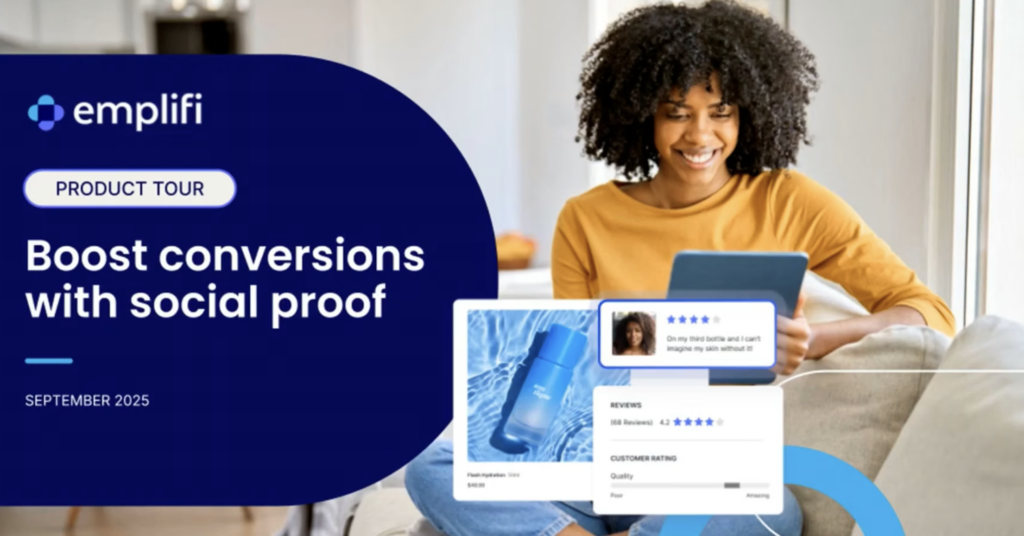
Click the image above to see how social proof can help you increase conversions across your social channels.
Facebook remains the right channel for Millennial and older demographics, particularly for live shopping and community-driven commerce. For brands already on Instagram, Meta Commerce Manager makes it straightforward to extend inventory and visibility across both platforms without duplicating effort.
YouTube suits considered purchases. With roughly 2.5 billion monthly active users and shoppable ad formats that sit alongside content rather than interrupting it, the platform works well for products that benefit from reviews, tutorials, or longer demonstrations before a buyer commits.
WhatsApp is primarily relevant for brands operating in markets where it functions as the default messaging channel, in particular, LATAM, EMEA, and Southeast Asia. For high-touch B2C segments, its built-in catalog, product messaging, and cart retention tools make it a practical conversational commerce layer.
Here’s how each platform stacks up:
| Platform | Commerce strength | Best content format | Primary audience |
|---|---|---|---|
| Product discovery and in-app purchasing. | Reels and shoppable posts. | Millennials and Gen Z. | |
| TikTok | Impulse purchases and product discovery. | Short-form video and live shopping. | Gen Z and younger Millennials. |
| Community engagement and live shopping. | Live video and Facebook Shops. | Gen X, Boomers, and Millennials. | |
| YouTube | Research-driven and considered purchases. | Tutorials, reviews, and long-form video. | Broad, cross-generational audience. |
| Conversational commerce and direct customer interactions. | Messaging and product catalogs. | Varies by market and region. |
The platforms, the content volume, and buyer response expectations have all shifted faster than manual execution can keep up with.
Monitoring comments, triaging DMs, sourcing UGC, and tracking performance across five platforms doesn’t scale.
This is where AI shifts from productivity tool to infrastructure.
UGC drives purchase decisions for 65% of consumers across all age groups and consistently outperforms brand-produced content in social commerce contexts.
But at the content velocity of TikTok and Instagram, manually identifying, rights-managing, and deploying UGC isn’t operationally viable for most enterprise teams.
Emplifi’s UGC platform automates discovery and rights management, surfacing relevant customer content, obtaining permissions, and making it shoppable without the manual overhead. According to Emplifi data, consumers who interact with UGC are 2.4x more likely to make a purchase, and shoppers who engage with UGC spend 11% more per transaction.
At scale, that’s a direct revenue lever and one that only works if the discovery layer is automated.
See how leading enterprises are shifting to agentic AI, autonomous CX, and care-to-commerce pipelines.
Fuel AI continuously synthesizes signals across voice of customer data, social performance, competitive activity, commerce behavior, and care interactions.
And it surfaces specific, actionable intelligence, telling you what to do next, not just what already happened.
For social commerce teams, this means knowing which products are generating purchase-intent signals in comments before your analytics team has pulled the weekly report and having the context to act on it.
The most underbuilt part of most social commerce programs is the connection between commerce activity and care response. They’re typically managed by different teams, in different tools, with different response SLAs.
Fuel AI closes that gap. The Service Orchestrator handles routine customer interactions autonomously including stock queries, sizing questions, and shipping timelines as well as escalating complex cases with full context already assembled. The team defines the goals, and the system handles the operational steps.
The result is a commerce program that doesn’t lose buyers at the moment of highest intent and a care team focused on the cases that actually need human judgment.
The brands performing at the top of this category share a few structural characteristics:
Ready to turn social into a revenue channel? See how Emplifi powers social commerce at scale.
eCommerce refers to the sale of products through a brand’s own website or app. Social commerce happens entirely within a social media platform where users discover, evaluate, and purchase without leaving the app. Social commerce removes the handoff to an external site, which reduces friction and typically improves conversion rates for impulse and low-consideration purchases.
Instagram and TikTok are the two highest-priority platforms for most brands. Instagram generated an estimated $37.2 billion in commerce revenue in 2024 and has the highest weekly shopping engagement. TikTok Shop reached $33.2 billion in global GMV in the same period, with US sales alone up 650% year-on-year, and is the dominant platform for Gen Z purchase behavior. The right platform depends on your audience demographics, product category, and content capabilities.
Critical. Social commerce places customer service at the point of sale; a question about sizing or availability in a post’s comments section is an active purchase in progress. According to Emplifi research, one third of consumers expect a DM response within an hour. Brands that can’t meet that expectation at scale lose sales that are essentially already won.
The core metrics are conversion rate by platform, revenue and average order value from social channels, and return on ad spend for shoppable content. Beyond those, purchase-blocking customer service response time and UGC conversion lift are two underutilized signals that indicate commerce program maturity. Engagement metrics like reach and impressions remain useful for top-of-funnel tracking but should not be the primary KPIs for commerce-oriented content.
AI is shifting social commerce from a manually managed channel to an autonomous revenue loop. On the content side, it enables automated UGC discovery, rights management, and platform-specific content optimization at a scale no team can match manually. On the care side, agentic AI identifies purchase-intent signals in comments and DMs, responds autonomously to routine queries, and escalates complex cases with full context already assembled. The practical result: fewer abandoned purchases, faster response times, and a care team focused on judgment calls rather than queue management. Emplifi Fuel’s intelligence layer connects every customer signal to every customer action continuously, across the full commerce lifecycle.
Discover what Emplifi can do for you. We turn small teams into large ones, and large teams into well oiled machines, but either way, we offer the rocket ship, you just need to jump on.
We’re recognized as a market leader in innovation, customer support, and ease of use from these organizations.