Social media analytics refers to the process of measuring and interpreting social performance data to improve marketing, customer experience, and business outcomes. The most effective analytics strategies unify paid, organic, customer care, and commerce data into one real-time view powered by AI-driven insights.
Your customers don’t experience your brand in silos.
They don’t separate your Instagram content from your customer care team. They don’t think about whether an interaction came from paid media, influencer content, a review platform, or a support conversation.
To them, it’s all part of the same experience, and their expectations carry across every interaction they have with your brand.
That’s why social media analytics have evolved far beyond tracking likes and impressions.
Social teams are now expected to track performance across:
Without unified visibility across engagement, customer sentiment, care performance, and campaign data, brands struggle to respond quickly enough to changing customer behavior.
Setting your social media analytics up right is crucial for delivering a superior customer experience.
Social media analytics refers to the process of collecting, measuring, and interpreting data from your social channels so teams can make smarter decisions across marketing, customer care, commerce, and brand strategy.
But the role analytics plays inside organizations has changed dramatically over the last few years.
A decade ago, most social media reports focused heavily on vanity metrics like follower counts, impressions, and likes.
Those metrics still exist, but on their own, they no longer provide enough context to support modern business decisions.
Today, social media analytics spans:
And the stakeholders relying on social analytics have changed too.
It’s no longer just social media managers pulling weekly reports for campaign recaps. Instead, it’s:
Essentially, it’s about helping teams answer business-critical questions quickly enough to act on them while the opportunity still exists.
For instance:
The amount of customer insight available through social channels today is enormous but only if brands know how to connect the dots.
Every interaction generates a signal. For example:
Individually, those signals may seem small but when they’re put together, they create a real-time picture of customer behavior, sentiment, preferences, and intent.
That’s why social media analytics has become such a strategic function inside modern organizations.
Social analytics helps brands understand what content resonates most, identify audience behavior shifts early, improve campaign performance faster, connect social activity directly to revenue, and strengthen customer care operations through real-time visibility.
The real challenge is fragmentation.
Many brands still manage reporting across disconnected systems:
That fragmentation slows decision-making and makes it difficult to understand the full customer journey.
A customer may discover a product through TikTok, read reviews on Instagram, message customer support on Facebook, and eventually purchase through social commerce.
If each of those touchpoints lives in a separate reporting system, teams never get a complete view of what actually influenced the outcome.
Modern analytics strategies solve that problem by creating a connected view across marketing, commerce, customer care, and customer experience.
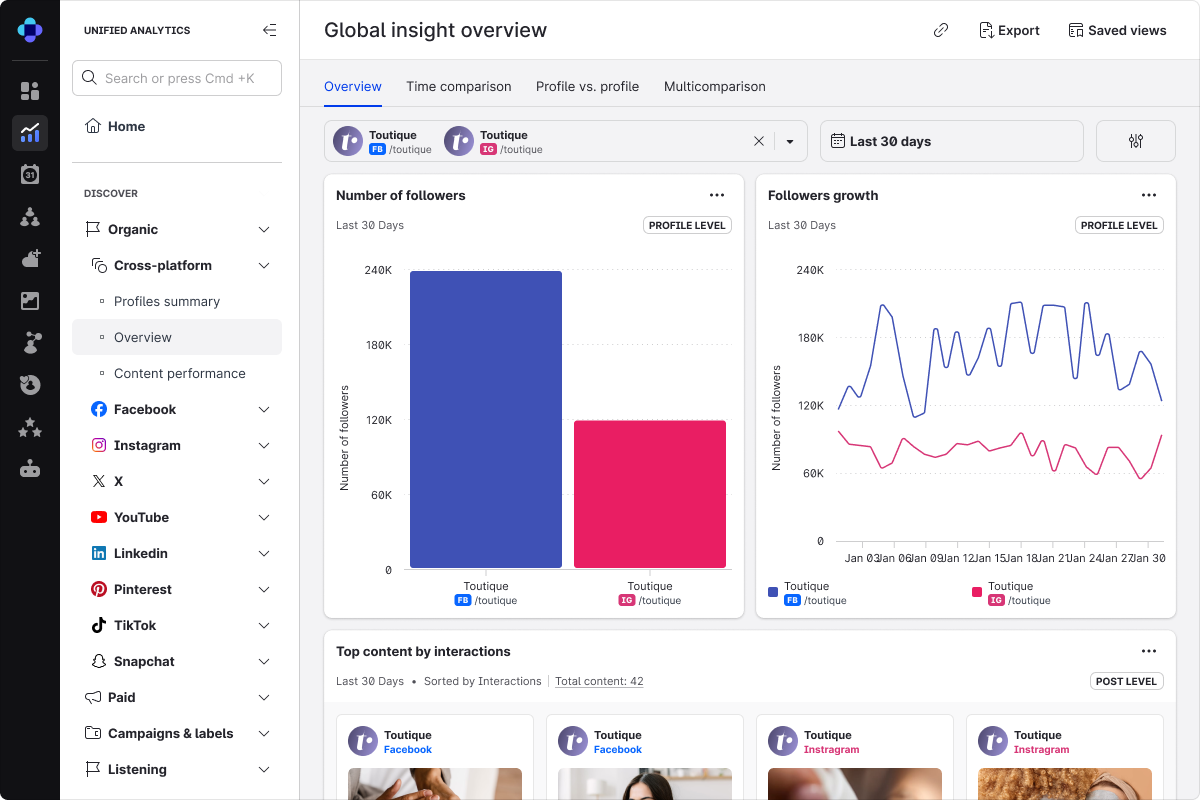
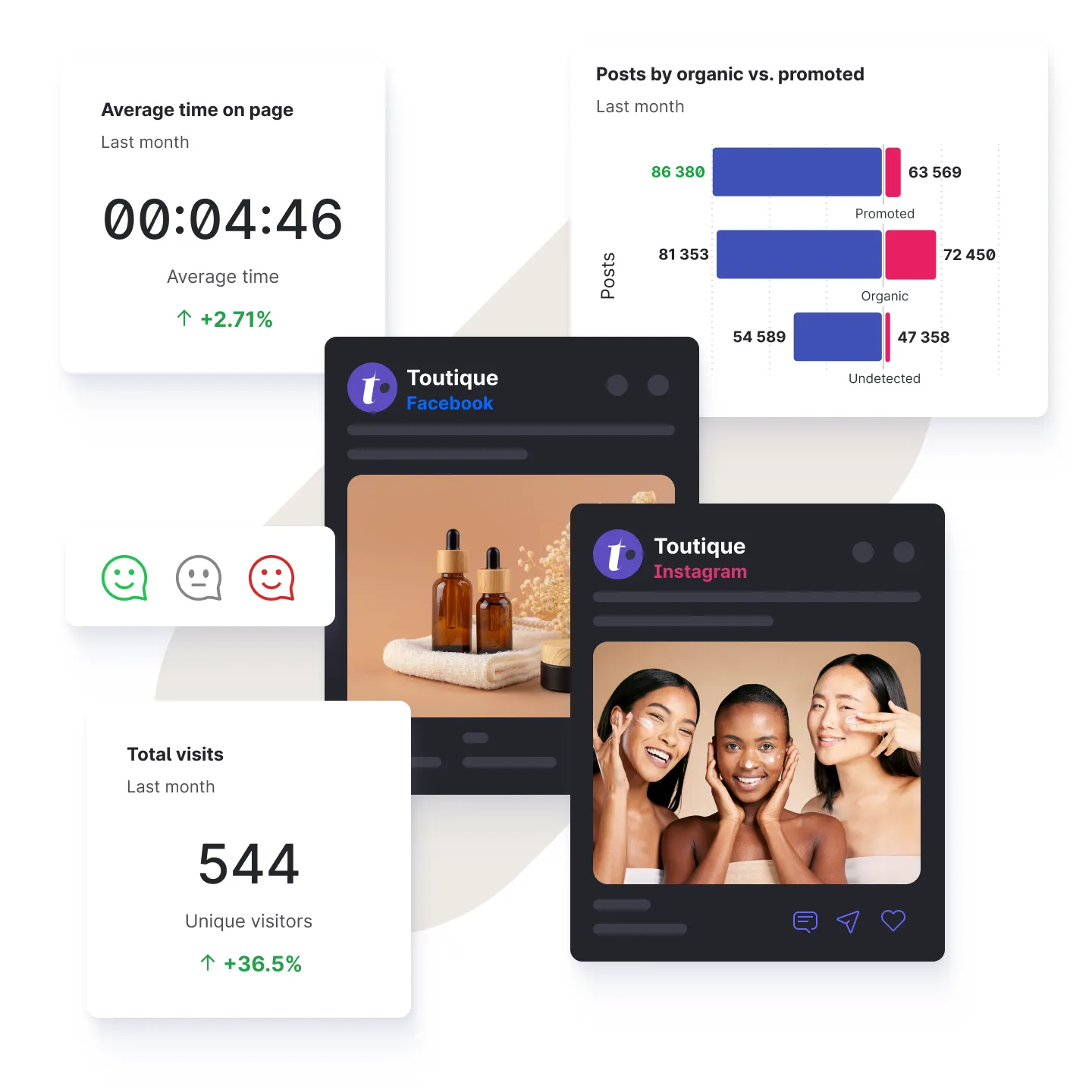
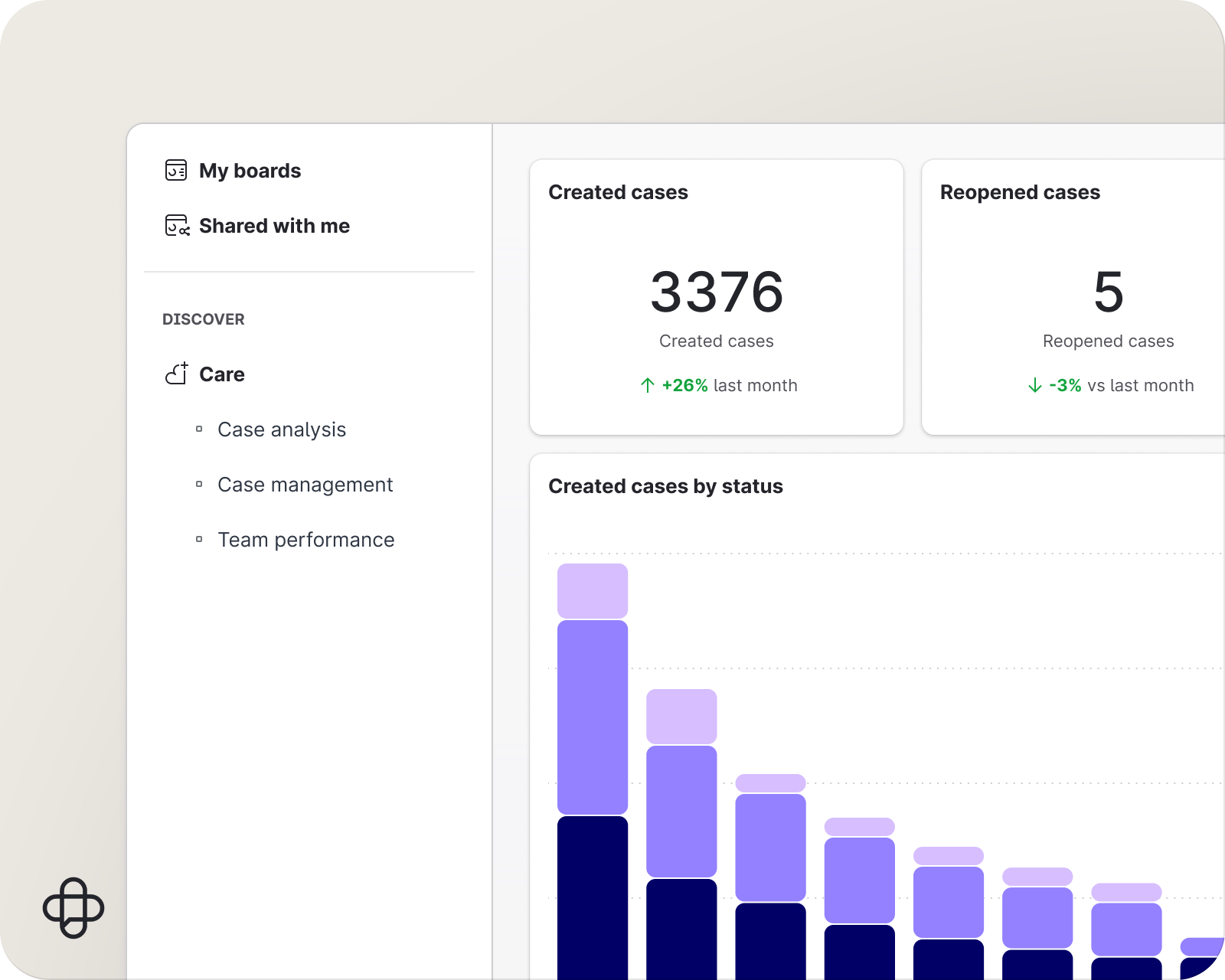
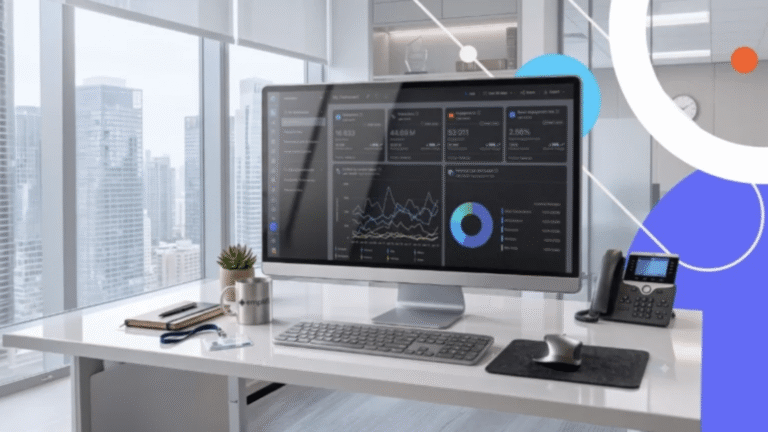
Emplifi brings all of these components together in one unified dashboard, making it easier to understand what marketing efforts are working, and what needs improvement.

Deep dive: Social media ROI guide – Learn how leading brands connect social engagement directly to revenue, customer retention, and customer lifetime value.
There’s no shortage of metrics available to marketers. The challenge is knowing which ones actually matter.
If you still prioritize surface-level performance metrics such as likes and impressions, you may not fully understand engagement quality or conversion performance.
The strongest analytics strategies focus on metrics tied directly to business outcomes. Here’s how:
Audience metrics still matter, but brands are increasingly prioritizing momentum indicators over static numbers.
Key audience metrics include:
Static audience size only tells you where your brand is today. Growth rate and share of voice help you understand where your brand is heading relative to competitors and category trends.
This becomes especially important as platform algorithms continue prioritizing relevance and engagement quality over pure audience size. A smaller but highly engaged audience is often significantly more valuable than a large passive following.
Strong audience analytics also help teams identify where momentum is building across platforms. That allows brands to invest resources more strategically instead of relying on assumptions about where engagement may be strongest.
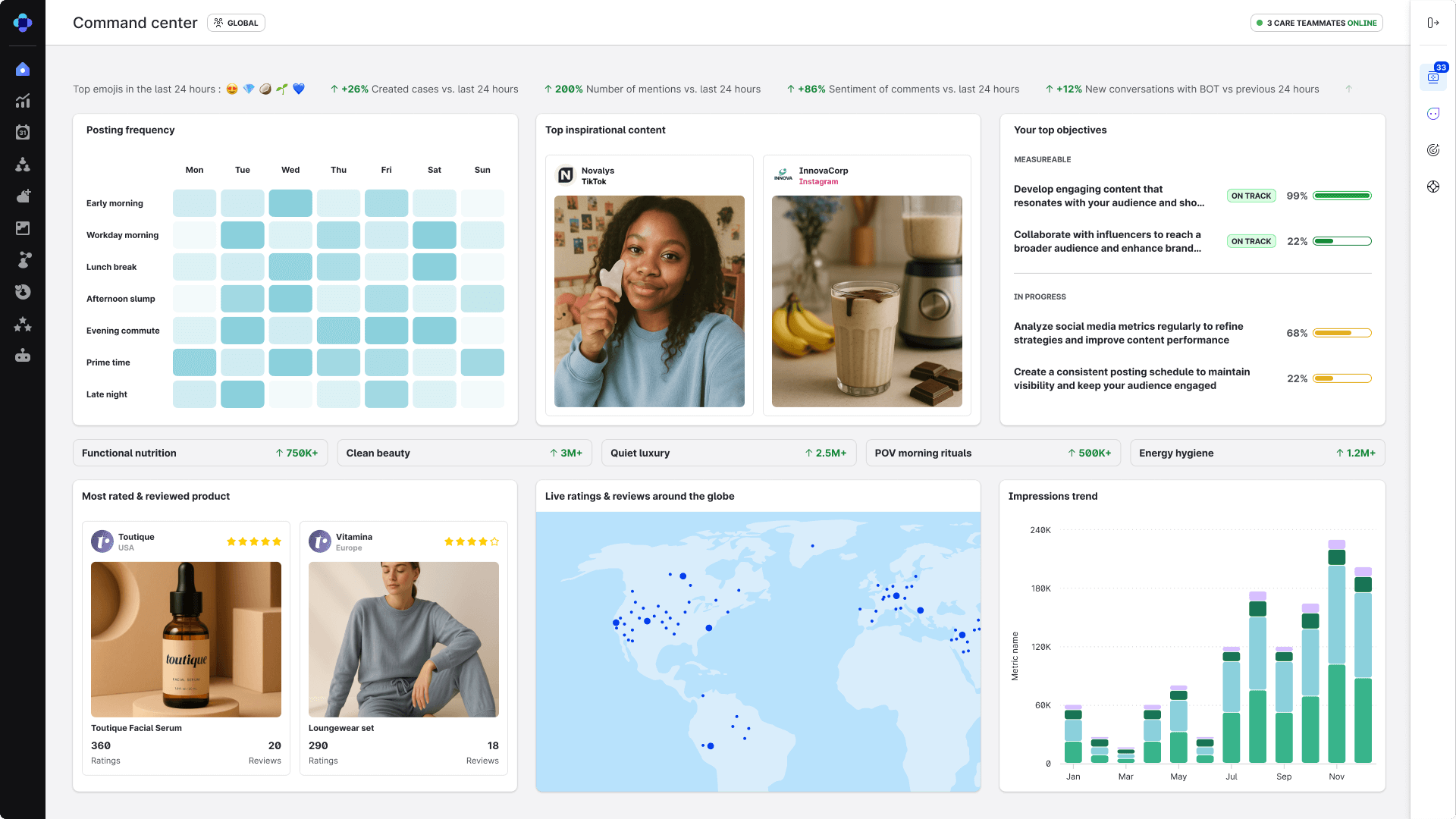
For example, with Emplifi, you can immediately see the content that’s resonating with your audience, where live ratings and reviews are coming from, how audience sentiment is leaning, and what your impressions look like month on month.

Engagement metrics have evolved significantly over the last few years.
Likes alone no longer tell brands very much. Recent algorithm updates place far greater weight on signals that indicate genuine audience interest and intent.
That’s why it’s best to focus on:
According to Emplifi benchmark data, TikTok continues to generate some of the highest median engagement rates across major platforms, with short-form video consistently outperforming static formats across industries.
These metrics help you understand not just whether people saw content, but whether they found it valuable enough to interact with meaningfully.
Saves and shares often provide a much stronger signal of purchase intent or content quality than passive engagement metrics. And completion rates can reveal whether creative storytelling is resonating, while content velocity helps teams understand how publishing consistency impacts overall performance.
It also helps to understand which media types are most popular with your audience, as displayed in the Emplifi dashboard.

Deep dive: Social media benchmarks report – Compare engagement rates, posting frequency, and content performance trends across TikTok, Instagram, Facebook, LinkedIn, and more.
This is where social analytics become business analytics.
Social teams are increasingly expected to demonstrate measurable business impact, not just engagement performance.
That means tracking:
For Carhartt, connecting UGC performance with commerce analytics helped the brand achieve:
But the biggest advantage wasn’t simply performance.
The team gained visibility into exactly which customer content experiences were driving conversions, allowing them to make faster and more confident content decisions without relying on disconnected reporting systems.
That kind of visibility is becoming increasingly important as social commerce continues to grow. Brands need to understand not just what drives engagement, but what drives action.
Without connected analytics, teams often struggle to prove the commercial impact of social investment. Unified analytics changes that by connecting engagement behavior directly to commerce outcomes.

One of the biggest shifts happening in social analytics is the growing overlap between marketing performance and customer care performance.
Customers don’t separate those experiences.
The person engaging with your Instagram Reel at 10am may be messaging customer support at 10:05am. To them, it’s all one relationship with your brand.
That’s why brands increasingly track:
According to Emplifi research:
Customer care metrics no longer belong in separate reporting workflows. They sit alongside engagement and revenue metrics because they directly impact retention, loyalty, and brand perception.
A modern analytics dashboard should allow teams to see engagement, customer care performance, paid media performance, and revenue impact side by side for the same campaign or customer journey.

Deep dive: Social customer care playbook – Learn how brands scale customer care across social channels with faster response times, better workflows, and unified analytics.
Social media analytics and social listening are closely connected, but they solve very different problems.
A social media analytics platform measures your brand’s own performance across owned channels and campaigns. A social listening platform measures public conversations happening around your brand, competitors, products, and industry across the wider web.
The two capabilities become most valuable when they work together.
Social listening surfaces the conversation while analytics helps brands understand the business impact behind it.
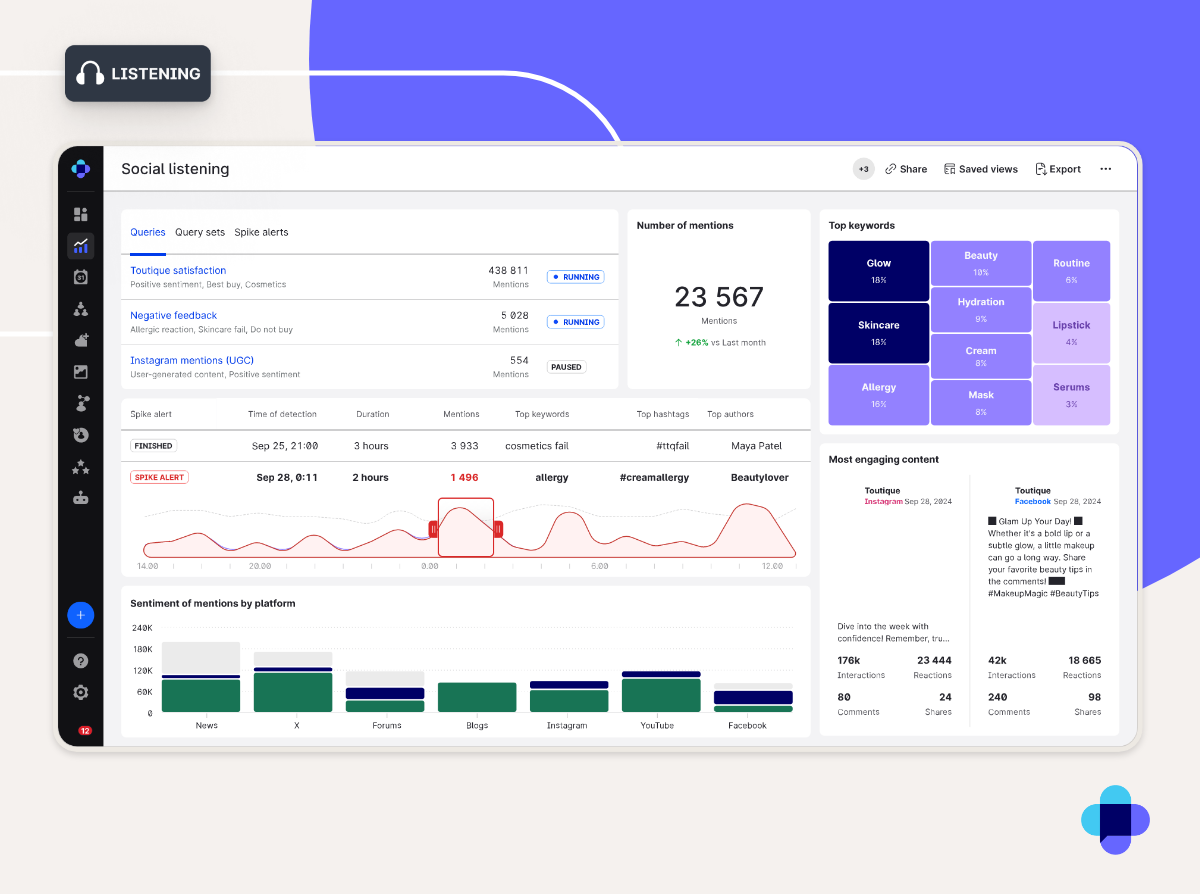
For instance, Emplifi identifies spikes in keywords and sentiment to pinpoint possible viral trends or crises, allowing your team to immediately jump into the data and respond appropriately.

Deep dive: Social listening guide – Explore how brands use social listening to monitor sentiment, identify emerging trends, and uncover customer insights in real time.
For example, listening may identify a spike in negative sentiment around delivery delays. Analytics then helps teams understand whether engagement, customer care volume, conversion rates, or retention changed alongside that conversation.
Without listening, brands miss important context around audience perception. Without analytics, brands struggle to connect those conversations to operational or commercial outcomes.
Used together, analytics and listening create a connected feedback loop that helps brands respond faster, prioritize more effectively, and make smarter customer experience decisions.
That connected view is becoming increasingly important as customer journeys grow more fragmented across channels and touchpoints.
Most legacy analytics dashboards simply display a chart of results. The user is left to interpret it, decide what to do, and rebuild the chart for the next stakeholder.
The modern generation of analytics tools closes that gap by turning the dashboard into a reasoning surface.
Three capabilities define an AI-powered analytics dashboard:
The user asks a business question in plain English and receives the visualized answer in seconds.
For example, inside Emplifi Unified Analytics, the AI Wizard turns text into charts. A head of commerce can type “which organic posts drove the highest average order value in Q4?” and the dashboard returns the chart, ranked, side by side with the paid equivalent.
The query engine reads data across social, web, and care because all three live in the same model.
Every dashboard auto-produces an executive brief describing what changed, what is significant, and what to investigate.
Stakeholders read the summary and analysts review the underlying chart only when they need to. This is the capability that gets reporting time down 80%, as Cheil Worldwide saw across Samsung’s global brand-client portfolio.
The dashboard forecasts engagement and revenue impact before a campaign runs and flags real-time anomalies in volume or sentiment.
For instance, Smart Spike Detection can alert a comms team to a viral wave they can ride or a brewing crisis before it shows up in a delayed weekly report.
This capability in particular makes the social analytics dashboard part of the broader Autonomous CX (A-CX) operating model.
Emplifi uses social media analytics to add context, plan or recommend an action, and operate across publishing, commerce, care, and listening. This transforms social analytics reporting from a passive report to a core system that recommends what the brand should do next.
Three categories cover almost every social analytics buying decision.
Native platform analytics are the free, built-in tools each platform provides such as Meta Business Suite or TikTok Studio. These are useful for channel-level checks, but siloed by design.
Standalone analytics tools are dedicated third-party platforms that connect several social channels in one place, but typically stop at social. They don’t pull in paid, commerce, or care data.
A unified dashboard, on the other hand, connects all of that into one data model. Here’s how they compare:
Here’s how to use each tool for your own social analytics:
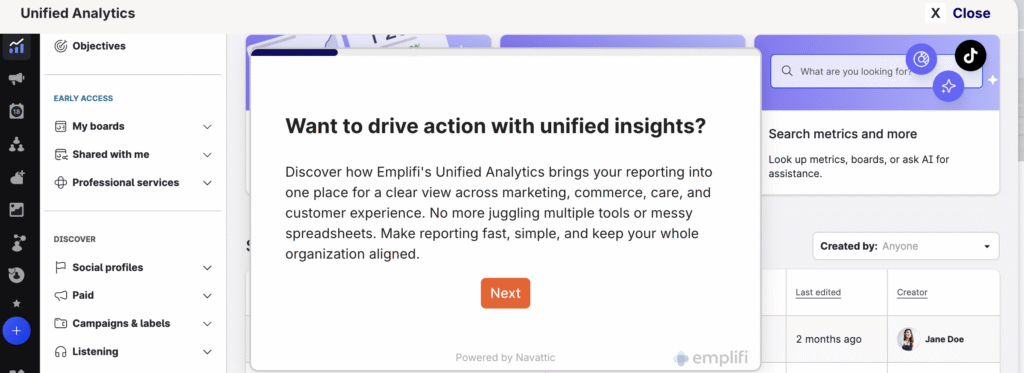
Click the image above to take an interactive demo of Emplifi’s Unified Analytics dashboard!
Most teams get this wrong because they add the tool before they fix the data. Here’s the right order so you don’t miss a crucial step:
Pick the 8 to 12 metrics the executive view will track, mapped to either:
Every metric on that list needs to connect to a decision the team will actually make. If it doesn’t, it belongs in a deep-dive view, not on the board where it slows your social motion down.
Your social motion is only as fast as the data underneath it. A dashboard built on siloed feeds will still give you a siloed picture, no matter how good the tool is.
Connect social, paid, web, commerce, listening, ratings and reviews, and care data into one place first. The 80% reporting-time reduction Cheil Worldwide saw across the Samsung portfolio only happened because the AI dashboard had unified data to work with.
Decide upfront which prompts agency and regional teams can run, which charts auto-generate executive briefs, and which alerts need a human in the loop. AI analytics without guardrails creates noise faster than it creates insight. Don’t learn that lesson the hard way.
Get those three things right and your social motion is up and running in weeks, not quarters.
Social media analytics only becomes valuable when it helps teams make faster, better decisions.
But when reporting lives across disconnected tools, teams spend more time building reports than acting on insights.
That’s why leading brands are moving toward unified analytics platforms that connect:
into one shared operational view.
A unified dashboard helps teams:
Instead of reacting to disconnected metrics, teams can make decisions with a complete picture of performance in real time.
That’s where platforms like Emplifi Unified Analytics come in.
By bringing content, paid, commerce, care, and listening data together in one environment, teams gain faster insights, stronger alignment, and a clearer connection between social activity and business outcomes.
Ready to see what unified social analytics looks like in practice? Book a demo to explore Emplifi in action.
Social media analytics is the process of collecting, measuring, and interpreting data from social channels to understand performance, audience behavior, customer sentiment, and overall business impact. Today, leading brands connect engagement, paid media, customer care, commerce, and listening data into one unified view so teams can make faster, more informed decisions. Platforms like Emplifi Unified Analytics help enterprise teams bring those disconnected data sources together to better understand the full customer journey across social and digital channels.
AI-powered analytics platforms are transforming how teams interpret and act on social data. Instead of manually pulling reports and searching for trends, AI can now automate reporting, surface anomalies in real time, generate executive summaries, and answer business questions using natural-language queries. With tools like Emplifi AI-powered analytics, brands can identify emerging trends earlier, understand shifts in customer sentiment, and uncover performance insights across engagement, commerce, and customer care workflows.
Unified analytics platforms help brands connect social engagement, paid media, customer care, commerce, and listening data into one centralized system. Without that connected view, teams often rely on fragmented reporting across separate tools, making it difficult to understand what’s actually influencing customer behavior and business outcomes. Unified platforms like Emplifi Unified Analytics give organizations real-time visibility across the customer journey, helping marketing, customer experience, and commerce teams align around the same performance data and make faster, more confident decisions.
Discover what Emplifi can do for you. We turn small teams into large ones, and large teams into well oiled machines, but either way, we offer the rocket ship, you just need to jump on.
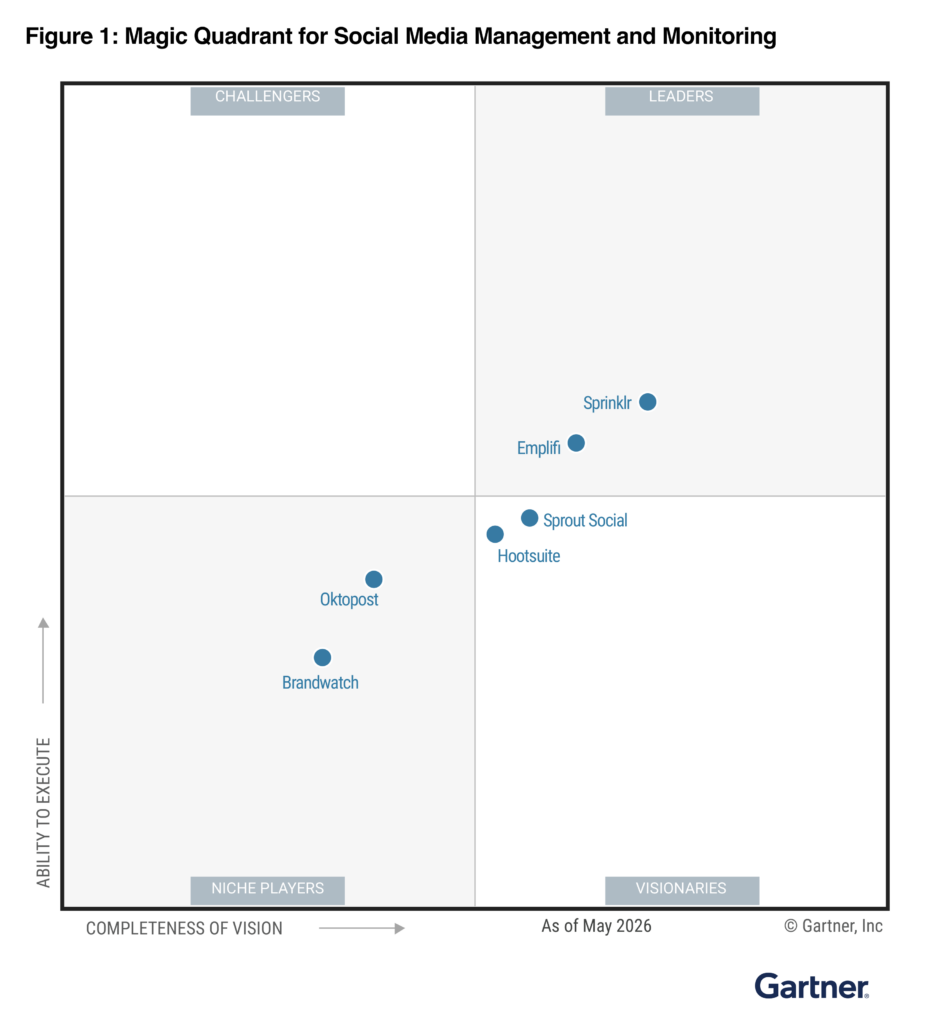
We’re recognized as a market leader in innovation, customer support, and ease of use from these organizations.