Social listening tools help brands monitor, analyze, and act on online conversations across social media and the web, turning unstructured data into actionable insights that improve marketing, customer experience, and business performance.
Somewhere online, a conversation about your brand is happening right now. It could be on TikTok, LinkedIn, Reddit, or in a private Facebook group.
Someone might be praising your customer service or comparing you to a competitor.

But are you listening?
Social listening gives you the ability to capture, analyze, and act on these conversations, even when there are thousands of conversations to sort through.
It turns scattered mentions into structured insight, helping you understand your audience and make informed decisions across marketing and customer care.
In this guide, we’ll look at how social listening can be used strategically to achieve your business goals, how it works, and what you should look for in a social listening platform.
Social listening helps you find meaningful insights in millions of online conversations. It cuts out hours of manual research, letting you focus on what matters.
When you understand what people are saying about your brand, you can incorporate that feedback into your social media marketing strategy and even repost customer content with permission.
The opportunity here is significant. Emplifi data shows that user-generated content contributes nearly $8 billion in annual revenue for social commerce brands, highlighting the value of understanding and acting on customer conversations.
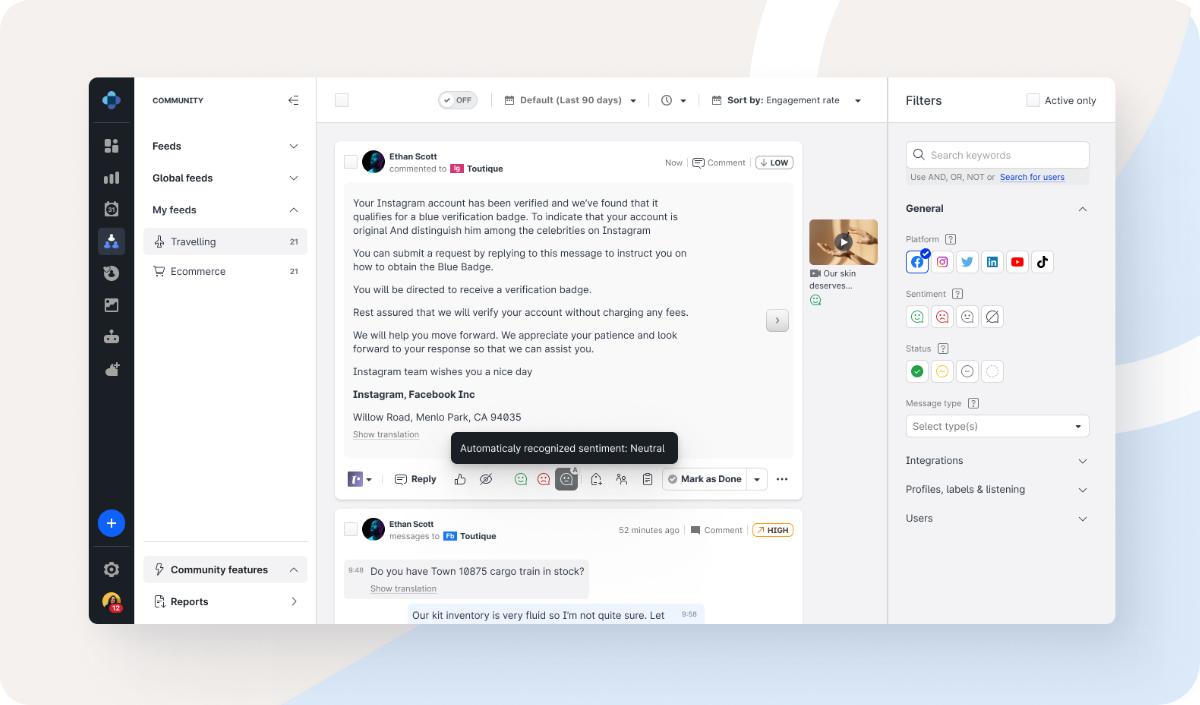
Emplifi is an all-in-one social media marketing platform with powerful social listening at its core.
It brings insights from every channel into one place, helping teams act faster and make confident decisions.
Key capabilities include:
Seamlessly integrated across marketing, commerce, and care, Emplifi turns insight into action at scale.
Here are five reasons why you should be using social listening for your business:
Social listening platforms detect patterns in conversations around specific keywords and hashtags, helping you see when topics are starting to gain traction.
And there’s no denying that being early to a trend helps your brand stay relevant and memorable. But timing alone isn’t enough. You need the insight to act with confidence.
With AI-powered social listening, you can proactively identify emerging conversations, shifts in sentiment, and cultural moments as they happen.
Social listening tools let you tap into authentic audience signals. By monitoring social media conversations, you can understand what topics resonate with your audience, what inspires them, and what frustrates them.
These insights fuel more relevant content and more empathetic customer care.
This is really important because customers trust each other more than brands. Emplifi research shows that 65% of consumers trust user-generated content, making it one of the most influential sources of insight and inspiration for marketers.
Our report reveals all about the positive impact of UGC
Social listening tools track every relevant brand mention, even when you’re not tagged. This means you can identify and address conversations that could harm your brand reputation and amplify conversations that cast you in a positive light.
Quick, thoughtful responses show customers you’re paying attention and that their opinions matter.

Social listening platforms help you spot revenue opportunities by highlighting relevant conversations from users who are actively seeking a solution you can provide.
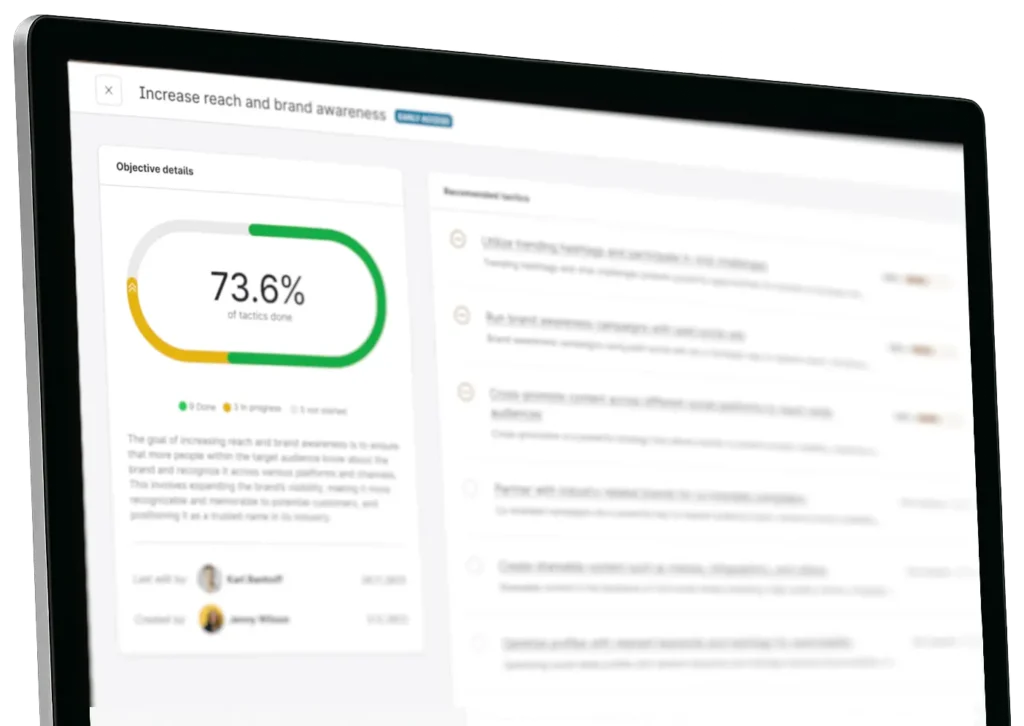
Identifying high-intent conversations early allows you to engage at the right moment and optimize conversion tactics.
When you track what audiences say about similar brands, you can see what’s hitting the mark and what’s missing it. These insights help you benchmark your brand performance and identify gaps in the market.
Reddit, in particular, can prove an invaluable source of competitive insight with customers sharing candid feedback and looking for alternative solutions.
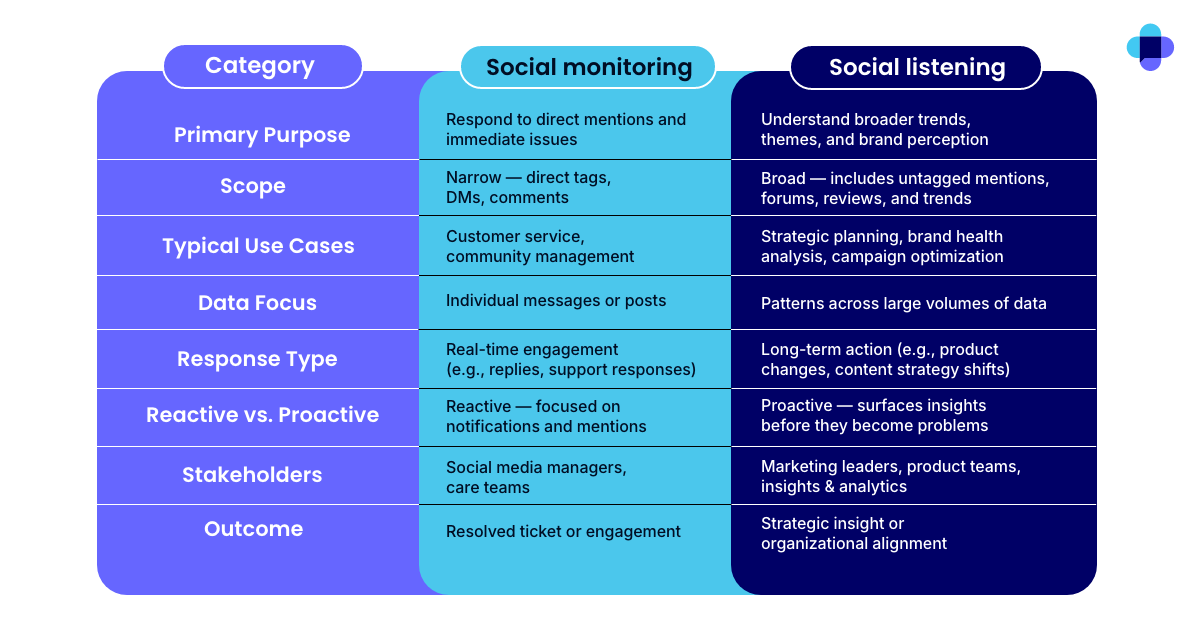
It’s easy to confuse social listening with social monitoring, and while they’re related, the difference is significant.

Only social listening gives you the context to understand why something is happening. For instance,
Listening delivers that broader insight, helping teams across marketing, care and product make more strategic decisions.
Social listening tools operate behind the scenes to turn raw online conversations into information that can be useful for your business.
Here’s how it works:
The tool scans a wide range of online sources like social media platforms, forums, blogs, news sites, and review platforms for mentions of selected keywords, phrases or brand names.
This includes:
Collected data is filtered and categorized using natural language processing (NLP) and machine learning.
This step removes irrelevant noise like spam or duplicate content, and sorts mentions by topic, sentiment, location, language, and platform. Custom filters can be applied to focus on specific regions, product lines, or customer segments.
AI-driven sentiment analysis goes beyond labeling mentions as positive or negative.
It detects emotional intensity, sarcasm, and shifting tone over time, adjusting based on evolving language and cultural cues. This enables a much more accurate and dynamic understanding of how people feel.

Cleaned and categorized data is translated into dashboards and reports that spotlight trends, spikes in conversation, influential voices, and engagement opportunities.
AI surfaces anomalies, highlights key topics, and prioritizes what deserves immediate attention. This level of analysis is increasingly important where resources are limited. In fact, 82% of marketers say AI has improved productivity and instances like this is where it can prove most effective.
The final step is where you’ll find the real value of social listening.
Integrating your social listening tool directly with publishing tools, care systems, and CRM platforms, allows your team to respond quickly and track the impact of your efforts in one connected system.
When you’re choosing a social listening tool, you should focus on platforms that help you understand the ‘why’ behind online conversations, giving you valuable insights into your customer base.
Look for:
A unified tool that pulls in data from across the entire customer journey including social platforms, forums, reviews, and support channels help create a full picture of how people experience your brand, in one place.
This makes it convenient for teams to collaborate and view key data, without having to scroll through fragmented tools and sprawling spreadsheets.
Data is only powerful if you know what to do with it. Look for a platform that makes it easy to connect the dots between customer feedback and business outcomes. For instance, flagging a product issue before it escalates, identifying new campaign themes, or sharing insights with service or product teams.
Built-in AI helps by automatically categorizing topics and highlighting unusual spikes in sentiment shifts. This lets teams quickly focus on what matters, whether that’s an emerging crisis or a surge in positive brand sentiment.

The ability to benchmark your brand’s performance, sentiment, and share of voice against competitors gives you vital context. Are you gaining ground or falling behind? Where are others succeeding that you’re not?
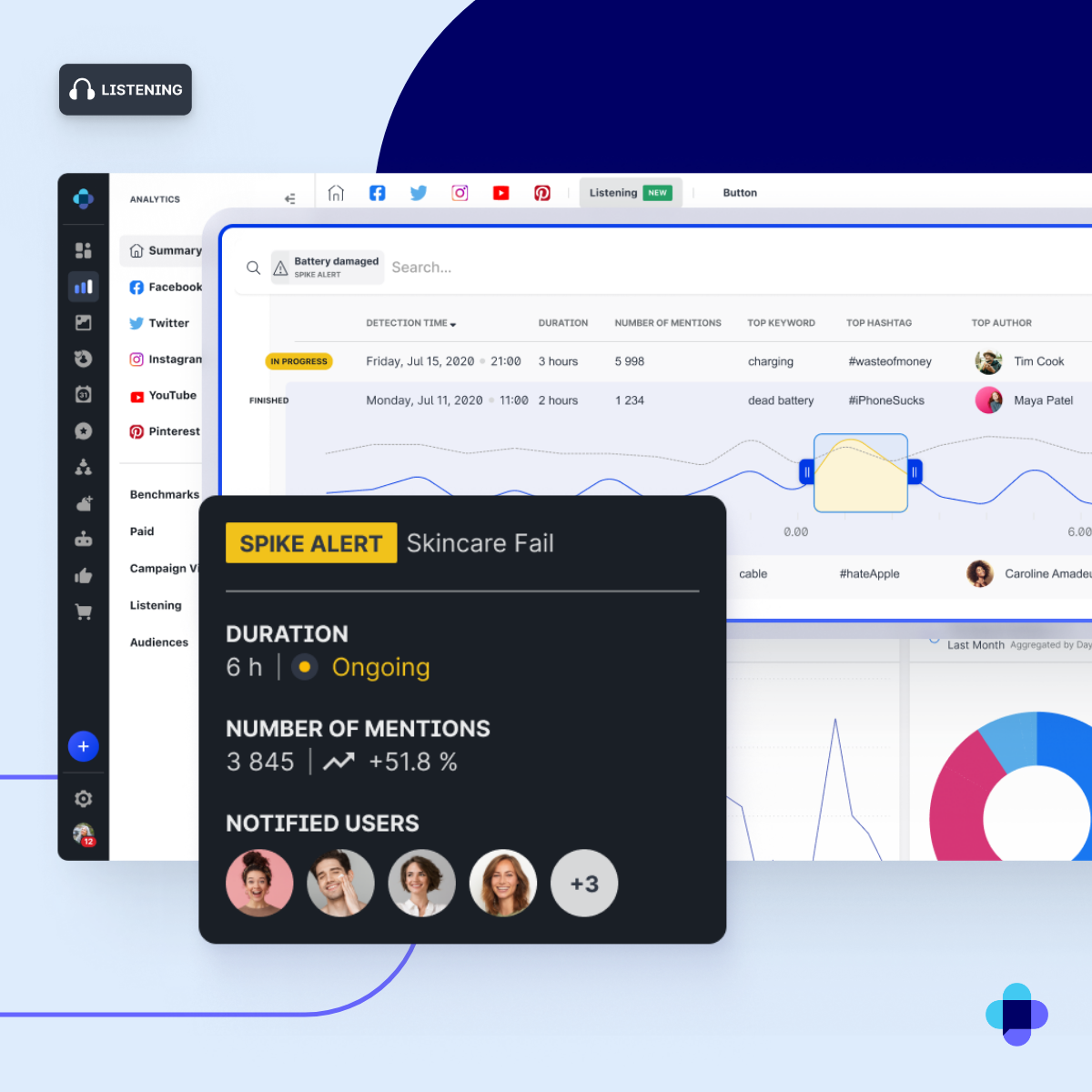
Real-time alerts ensure you don’t miss moments that matter like an emerging product concern or an influencer talking negatively about your brand.
This is essential for early crisis intervention and reputation management strategies.
Social listening works best when it’s part of your broader workflow. Your listening insights should feed directly into your content, care, and analytics processes to ensure they lead to real outcomes, not just reports.
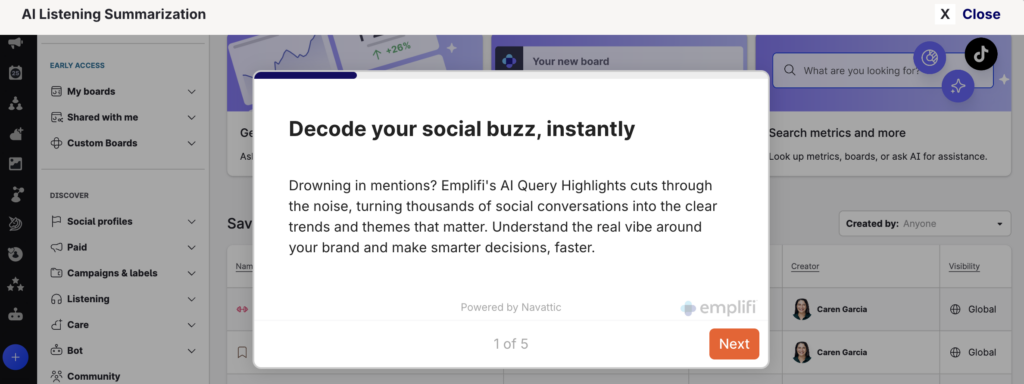
Click the image above to see how Emplifi’s AI social listening tool helps monitor conversations to understand what customers are saying about your brand, products, and industries.
| Tool | Best for | Key differentiator |
|---|---|---|
| Emplifi | Unified social marketing, care, and listening | Integrated workflows across marketing, commerce, and care |
| Hootsuite + Talkwalker | Social management + deep analytics | Combined publishing with Talkwalker-powered listening |
| Sprinklr | Large enterprise CXM | AI-driven, multi-channel customer experience platform |
| Sprout Social | Marketing + customer service teams | Ease of use + unified inbox |
| Meltwater | PR and earned media | Traditional + social media monitoring |
| Brandwatch | Social intelligence | Historical depth + 100M+ sources |
| Mention | SMBs and agencies | Affordable real-time monitoring |
| Brand24 | SMBs and consultants | Cost-effective reach analytics |
| YouScan | Visual brand monitoring | Image and video recognition |
| BuzzSumo | Content marketers | Trending content + influencer discovery |
| Awario | Social selling | Lead identification from social conversations |
| Google Alerts | Budget monitoring | Free web-wide alerts |
| Keyhole | Influencer + real-time tracking | Real-time campaign tracking |
| Agorapulse | Community management | Unified inbox + team workflows |
Emplifi is a comprehensive, all-in-one social media marketing platform with a best-in-class social listening tool built in.
Notable strengths:
Ideal for: Marketing, customer care, and communications teams of all sizes who want listening fully integrated into their existing social media workflows.
Price: Plans available at multiple tiers; contact Emplifi for enterprise pricing.
Limitations: As an all-in-one platform, Emplifi’s breadth of features may require onboarding time for smaller teams who only need basic monitoring.

Hootsuite combines its intuitive publishing and engagement features with Talkwalker’s deep analytics and AI-driven insights.
Strengths: Centralized dashboard, AI-powered summaries, customizable streams, wide multi-channel monitoring.
Limitations: TikTok monitoring is restricted to owned Business accounts and LinkedIn monitoring is restricted to owned Company Pages only (Super Admin access required); public/competitor LinkedIn monitoring is not available. Full Talkwalker-powered listening requires an Enterprise plan add-on.
An enterprise-grade platform designed for large organizations, unifying customer experience across 30+ social channels.
Strengths: Advanced AI for crisis detection and sentiment/emotion analysis (10B+ predictions per day), workflow automation, strong compliance features, highly customisable dashboards.
Limitations: High complexity and cost; custom enterprise pricing only. No technical support on self-service plans. Setup requires dedicated training. Less suitable for SMBs or teams needing standalone social listening rather than a full CXM suite.
A well-rounded social media management and listening tool highly regarded for its user-friendly interface and comprehensive reporting.
Strengths: Unified platform combining publishing, engagement, analytics and social listening with strong AI-powered insights and automation.
Limitations: Social listening is a paid add-on and per-user pricing can become costly at scale. Historical data availability varies and may require additional setup or cost.
Popular with PR teams for its media intelligence capabilities, extending beyond social to include online news, blogs, and broadcast media.
Strengths: Broad media monitoring across social and traditional channels, with access to historical media and social data (varies by source and plan), and customizable alerts.
Limitations: Social data access is constrained by platform APIs, particularly Facebook and Instagram, LinkedIn and TikTok monitoring are limited.
An enterprise-level platform focused on consumer intelligence and understanding the voice of the customer through deep insights.
Strengths: Extensive data coverage across over 100 million online sources, strong historical data with archives going back to 2010, and AI-powered query building and categorisation.
Limitations: Some datasets may be sampled or limited depending on source and access level, TikTok monitoring is restricted and varies based on available data access.
An affordable social listening tool suited to small to medium-sized businesses and agencies.
Strengths: Real-time alerts and monitoring across web and social sources, multi-language support, and intuitive dashboards with basic benchmarking and sentiment analysis.
Limitations: Limited depth of analytics and insight compared to enterprise platforms, with less comprehensive data coverage and fewer capabilities for complex, cross-channel analysis.
An all-in-one monitoring tool known for its sentiment analysis and brand protection features at an accessible price point.
Strengths: Broad coverage across millions of online sources, strong sentiment analysis, automated reporting and real-time alerts, social media reach and engagement tracking.
Limitations: Less suited to high-volume or complex monitoring requirements, with more limited analytics depth and scalability compared to enterprise platforms.
A user-friendly social media management and listening platform well-regarded for its unified inbox and customer support.
Strengths: Intuitive design, centralised inbox for managing social interactions, strong customer support, team collaboration tools including task assignment and approval workflows.
Limitations: Social listening is available as an add-on rather than a core feature, with less advanced analytics and customisation compared to dedicated listening platforms.
A social listening platform known for its visual insights and image recognition capabilities.
Strengths: AI-powered visual content analysis that detects logos, objects, and scenes in images, flexible query capabilities, automated audience and consumer insight generation.
Limitations: Smaller overall data coverage and less historical depth compared to some enterprise platforms and less established presence in some Western markets.
A content research and discovery platform with social listening features for tracking trends, topics, and brand mentions.
Strengths: Strong at identifying trending content and topics across the web, useful for influencer discovery and competitive content analysis and user-friendly interface.
Limitations: Not a dedicated social listening platform, with listening features secondary to content research, more limited real-time monitoring and analytics depth.
A social listening and media monitoring tool known for its affordability and social selling features.
Strengths: “Leads” feature for identifying potential customers from online conversations, competitor monitoring, cost-effective option for businesses starting with social listening.
Limitations: Data coverage and analytics depth are more limited compared to enterprise platforms, fewer advanced features for large-scale or complex analysis,.
A free, simple tool for monitoring mentions of specific keywords and brands across the web.
Strengths: Completely free, easy to set up, wide web coverage including news sites and blogs.
Limitations: No social media coverage, no sentiment analysis, very basic functionality.
A social media analytics and listening platform focused on real-time monitoring, influencer tracking, and campaign insights.
Strengths: Real-time brand and hashtag tracking, influencer identification and campaign tracking, audience insights, predictive metrics for estimating reach and engagement trends.
Limitations: More limited analytics depth and data coverage compared to enterprise listening platforms, less suited to complex or large-scale analysis needs.
Choosing the right social listening tool comes down to the needs of your business, and what will be the best fit for your team.
Here’s what you should consider when deliberating between social listening platforms:
Different industries need different listening capabilities. Healthcare organizations need compliance-aware platforms. Retail brands require real-time monitoring for customer service. Financial services companies need robust filtering for regulatory requirements.
Choose a platform that focuses on the features that are most important to you.
Most tools cover major English-language platforms well, but international coverage and non-English language analysis differ significantly.
You should consider your geographic markets and language needs when evaluating options. Also look for seamless integration with your existing systems such as robust API access, pre-built integrations with popular marketing tools, and flexible data export capabilities.
Sentiment analysis ranges from basic positive/negative classifications to advanced emotion detection.
More sophisticated platforms can identify sarcasm, detect nuanced emotions, and provide multilingual analysis with higher accuracy. Look for customizable dashboards and automated reporting features that present complex data in clear, visual formats.
Before committing to a platform, ask:
Getting started doesn’t require an overhaul of your entire marketing operation, but it does require a thoughtful plan.
Too often, brands jump in with a tool before they’ve identified what they want to learn or what they’ll do with the insights.
Here’s a step-by-step approach that actually drives impact:
Set clear goals before collecting data. Whether that’s brand awareness, customer engagement, lead generation, or reputation management, know what you’re monitoring and how you’ll interpret what you find.
Select a social listening tool that aligns with your business goals, target audience, and budget. Take time to research and compare options rather than rushing in.
Build queries using keywords, #hashtags, and @mentions that capture relevant conversations and filter out irrelevant noise. Effective queries help you track competitors and stay ahead of emerging trends.
Use AI to interpret large volumes of data without manual sorting. Once keywords are set, AI can cluster feedback into categories, surface patterns, and identify sentiment anomalies that human teams might otherwise overlook.
Don’t stop at gathering data. Change your messaging, refine your content, adjust your targeting, and measure the results. Social listening is an ongoing process so revisit your goals and strategies regularly to ensure they remain aligned with your business objectives.

To analyze your brand’s impact on social media, measure these five key aspects using your social listening tool:
Using Emplifi’s social listening capabilities, Hardee’s identified a surge in online conversations about the brand and acted quickly to capitalize on the moment. Their social team responded with a timely, relevant tweet that generated over 8 million impressions, nearly 18K retweets, and 8K new followers.
By turning real-time insight into immediate action, Hardee’s was able to significantly increase visibility and engagement without relying on paid media.
Domino’s uses Emplifi’s social listening tool to manage and respond to customer feedback across Facebook, X (Twitter), and Instagram in real time. By combining automated keyword tracking with AI-powered filtering, the team is able to reduce noise and focus on the interactions that matter most.
In fact, Domino’s can filter out up to 97% of irrelevant posts, allowing their team to prioritize high-value conversations and respond more efficiently at scale.
Social media listening is a necessity for any brand that wants to thrive. It allows brands to respond faster and connect more authentically with their customers.
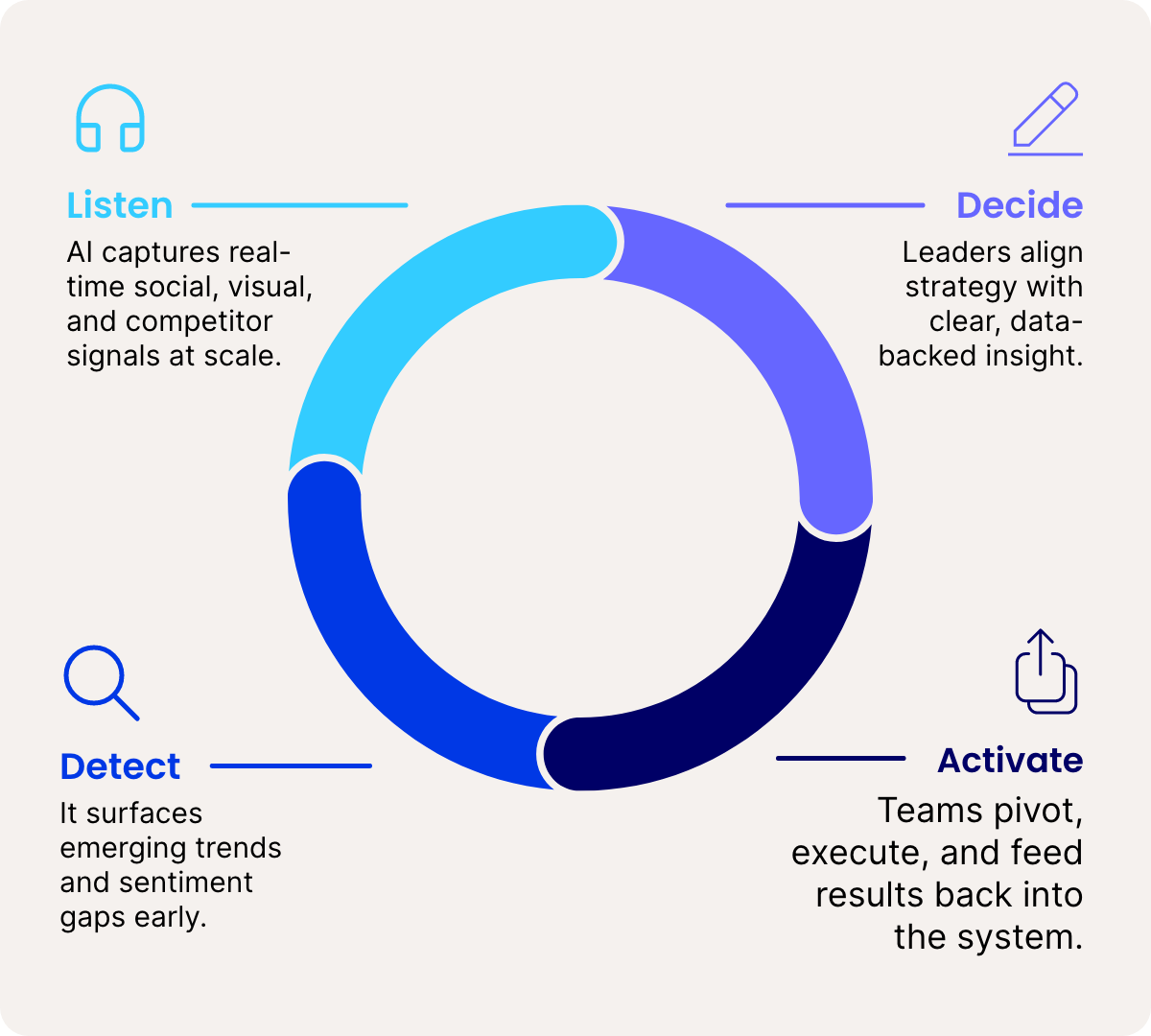
As social conversations grow more complex and fast-moving, AI is an essential part of getting listening right.
With expectations this high, social listening becomes essential not just for reactive service, but for proactive experience delivery across the entire customer journey.
Ready to see Emplifi in action? Our all-in-one social listening tool brings data from every channel into one place, so you can spot trends, manage conversations, and act fast. Book a demo today and see how Emplifi can power your brand’s listening strategy.
Social media listening is the process of monitoring and analyzing online conversations about your brand, competitors, and industry — not just direct mentions. It helps businesses understand customer sentiment, spot trends, and identify opportunities or risks early. This proactive insight enables smarter, more authentic engagement and improves customer loyalty.
Social media monitoring is reactive and focuses on tracking direct brand mentions for timely responses. In contrast, social media listening is proactive and strategic, capturing broader conversations, sentiment trends, and emerging issues even without direct mentions. Monitoring handles the “who’s talking to me?” while listening answers “what are people saying about me and my market?”
Businesses using social media listening platforms can detect problems before they escalate, enhance customer service responsiveness, uncover new market trends, optimize marketing campaigns, and strengthen brand loyalty. It’s especially valuable for engaging younger audiences who expect quick, personalized interactions on social media platforms.
Look for tools offering comprehensive cross-channel data aggregation, AI-powered filtering and sentiment analysis, real-time alerts, competitor benchmarking, and integration with existing workflows. These features ensure you gain actionable insights rather than just data, enabling timely and informed business decisions.
Begin by setting clear listening goals aligned with your business objectives. Choose the right tool for your needs and budget, then define relevant keywords and topics to monitor. Use AI to filter and analyze the data, and most importantly, act on insights to improve products, messaging, and customer engagement. Regularly review and adjust your strategy to stay aligned with evolving goals.
AI processes vast amounts of data automatically by categorizing topics, flagging sentiment shifts, detecting sarcasm and emotional nuance, and routing insights to the right teams for immediate action.
Discover how Emplifi boosts efficiency, increases revenue, and scales your social media marketing — whether you have a small team or a complex product. Let’s talk today.
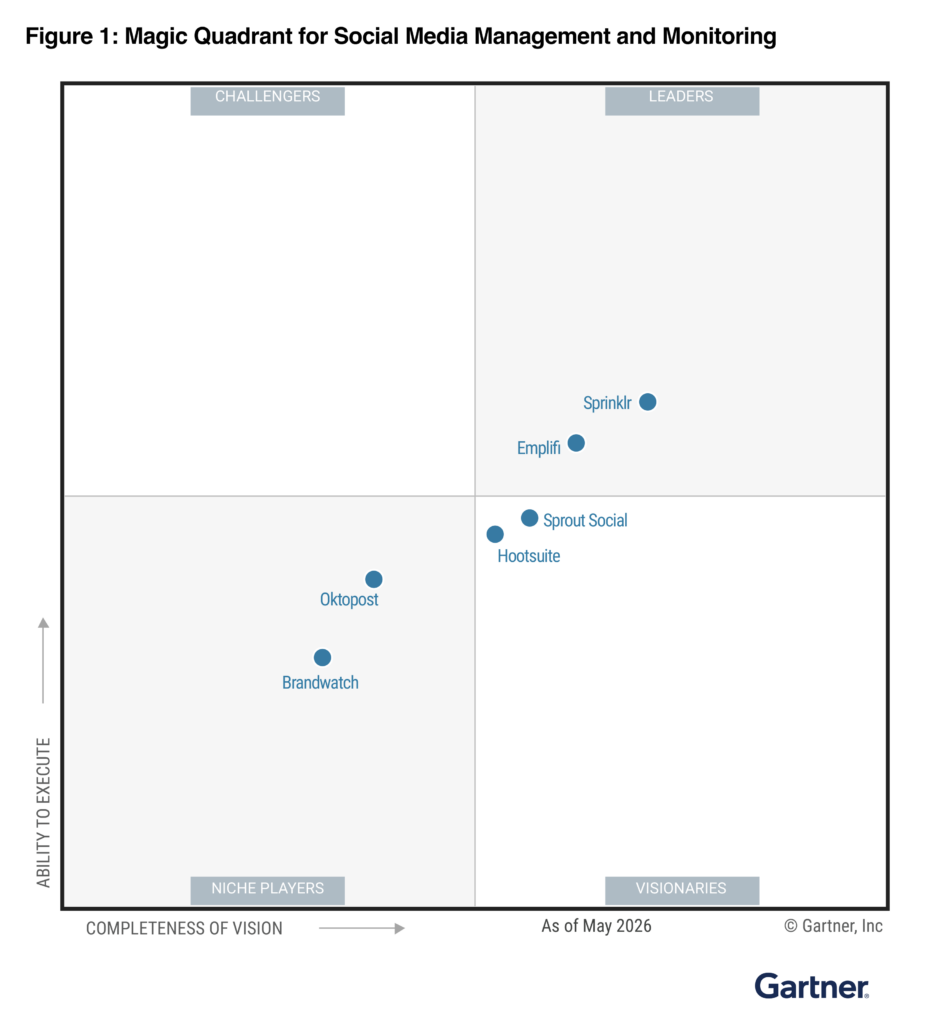
We’re recognized as a market leader in innovation, customer support, and ease of use from these organizations.