Blog
9 min read
Apr 27, 2026

The complete guide to AI in social media marketing

AI in social media marketing enables brands to scale content creation, optimize advertising, and extract real-time audience insights by automating repetitive tasks while allowing marketers to focus on strategy, creativity, and performance.

Emplifi Team Social Media Marketing Experts
Team in office

Key points:

  • AI for social media marketing delivers the most value when applied as a connected system across content, listening, and performance, not as isolated tools
  • It enables teams to scale content production and campaign execution while maintaining consistency, quality, and brand voice
  • AI-powered insights shift social media from reactive posting to predictive, data-driven decision-making
  • When combined with authentic content and clear workflows, AI drives measurable improvements in engagement, conversion, and revenue

From content creation and campaign execution to performance analysis and audience insights, AI has become a vital part of the entire marketing workflow.

Reshaping the way marketers work, AI removes repetitive, time-intensive tasks, so teams can focus on higher-value activities like strategy or creative direction.

What was once experimental is now expected, and even mandatory, in some companies.

But the real competitive advantage lies in how effectively AI is applied.

While 82% of marketers say AI has improved productivity, only 35% report significant impact. At the same time, tension remains. Concerns around job security, brand authenticity, and content quality are still top of mind.

This guide explores how to operationalize AI across your social media marketing strategy, from content creation and listening to advertising and performance, without losing control of your brand voice.

In this guide, you’ll learn

  • How to scale content production without sacrificing quality or voice
  • How to use AI-driven social listening to inform strategy
  • How AI improves targeting, personalization, and ad performance
  • A repeatable workflow for operationalizing AI in marketing
  • Real-world examples of AI delivering measurable ROI
  • What to look for in an AI-powered social media platform

How AI works across the social media marketing workflow

At every stage of your social media workflow, you can use AI to speed up processes, brainstorm ideas, and even analyze performance.

Here’s where it can have the most impact:

The AI social media workflow explained

Stage What happens Outcome
Listen Analyze conversations, trends, and sentiment in real time Audience insight
Generate Create content ideas, drafts, and variations Content at scale
Refine Apply brand voice, messaging, and creative direction Quality and consistency
Distribute Publish across channels at optimal times Reach and visibility
Optimize Analyze performance and iterate continuously Improved ROI

Using AI in this way creates a repeatable workflow, shifting your social media strategy from straightforward scheduled posts to a continuous, data-driven system.

How to scale social media content creation with AI (without losing brand voice)

AI has fundamentally changed how content is created. Marketers can use it to speed up content creation processes by using it to draft posts or for image creation.

Where it really adds fuel is in the amount of content it can produce at scale.

Social teams are under pressure to produce more content across more formats, often with limited resources. This stress to do more with less contributes to 76% of marketers experiencing burnout, at least occasionally.

At the same time, demand continues to increase, driven by audience expectations with 32% of consumers wanting brands to post multiple times per day.

This always-on environment requires social teams to move faster while maintaining consistency.

AI enables this by allowing teams to:

  • Generate multiple content variations quickly
  • Adapt messaging across formats and platforms almost instantly
  • Test creative approaches simultaneously to determine best performing posts

As well as being an integral part of the process, AI ensures that content reflects platform behavior, audience expectations, and optimal timing.

This means that content is consistent with brand messaging so that audiences aren’t confused by a sudden change in tone.

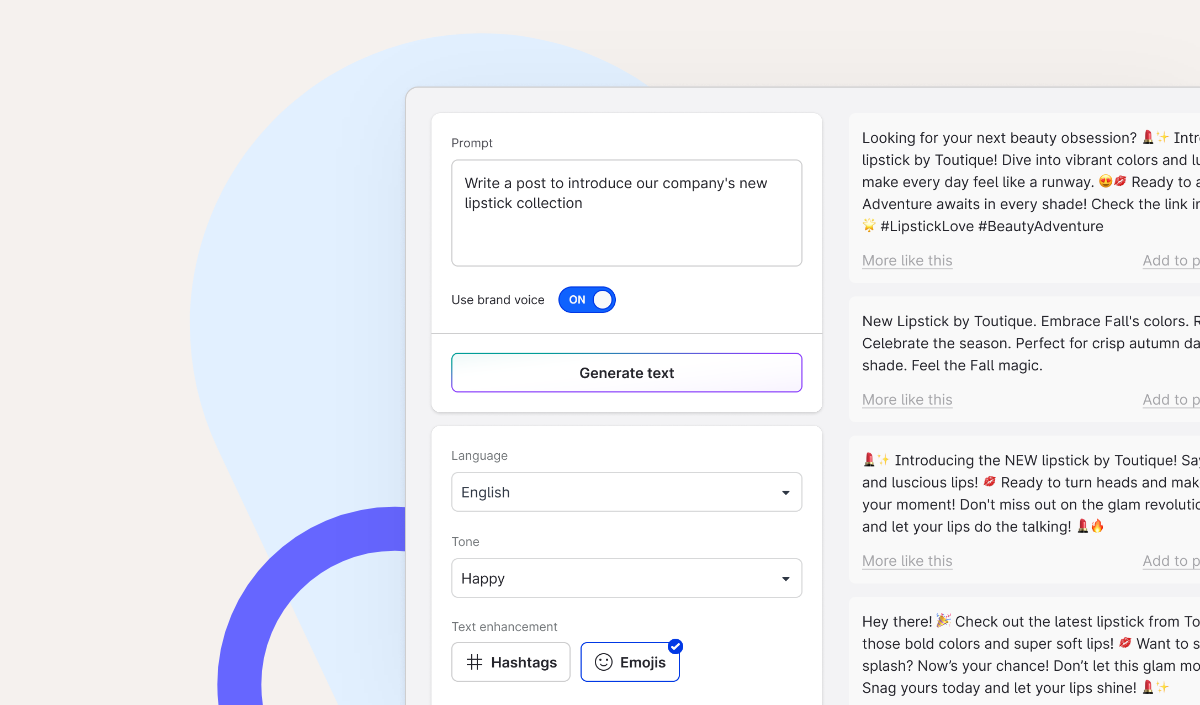
Screenshot of Emplifi AI Composer

How AI-powered social listening improves audience insights and strategy

Social media is a goldmine of audience insight, but without AI, that data is often unstructured and difficult to act on.

AI-powered social listening transforms these conversations into clear, actionable insights, allowing brands to anticipate trends rather than react to them.

With AI, teams can:

  • Identify emerging conversations early
  • Track audience sentiment in real time
  • Monitor competitor positioning

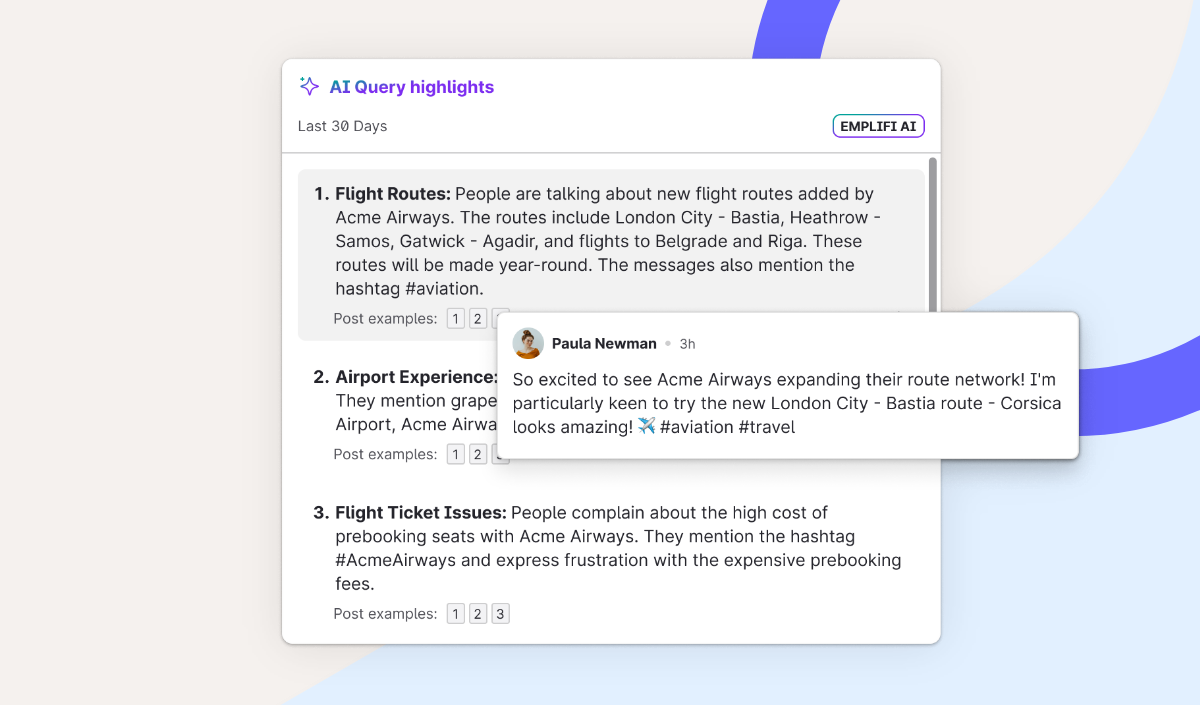
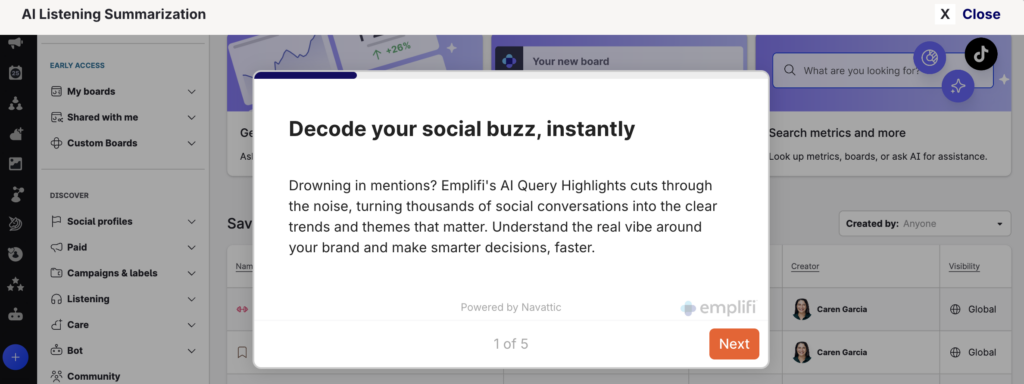
AI query highlights

This is increasingly important as platforms evolve toward more community-driven interactions, where language can change quickly and niche interests may emerge unexpectedly.

For example, 20% of marketers are increasing investment in Reddit, where each sub-community operates with its own behaviors and cultural context.

AI social listening for Reddit allows you to:

  • Filter meaningful signals from noise by isolating high-intent conversations and relevant discussions across niche communities
  • Group conversations into themes by identifying recurring topics, patterns, and shared audience concerns
  • Translate insights into content strategy by turning real audience language and trends into relevant, high-performing content

Rather than acting as a purely reactive channel, social media then becomes an important part of the decision-making process, and aligned with your audience’s priorities.

How can you tap into high-value conversations on Reddit?

Watch our joint webinar with Reddit to discover best marketing practices and more

How AI improves social media advertising, targeting, and personalization

AI is also redefining paid social by turning it into a continuously optimized system.

Instead of static targeting, campaigns now evolve based on real-time data, allowing marketers to refine performance continuously.

With AI, marketers can:

  • Refine audiences dynamically based on behavior and engagement signals
  • Test creative variations automatically to identify top-performing content
  • Allocate budget toward the highest-performing assets in real time

It’s an efficient and effective way to get results quickly. Because of AI’s more precise approach to personalization, targeting, and creative are continuously optimized together.

For example, ASUS used Emplifi’s AI-powered platform to bring structure and scalability to its global social media strategy.

Managing multiple markets and high content volumes, the team needed a way to move faster without sacrificing consistency. By applying AI-driven insights, ASUS was able to identify what content performed best, optimize publishing based on real audience behaviour, and scale output across regions.

This shift moved the team away from manual, reactive processes toward a more efficient, data-driven workflow, turning social media into a more predictable system.

Emplifi lets us monitor our competitive position quickly, from a single dashboard. That means less time pulling reports, more time making content that lands.
Jeff Lee
Global Head of Community & Digital Strategy at ASUS

How UGC can work alongside AI optimization

However, performance is not driven by targeting alone. The type of content used within these campaigns plays a critical role. It’s become more important than ever to show authentic customer content in marketing campaigns with 85% of consumers willing to pay more for brands they perceive as authentic.

This is where user-generated content (UGC) becomes especially relevant, with 63% of consumers saying it’s a top source of authenticity.

When combined with AI-driven optimization, UGC becomes a powerful performance lever within paid social.

  • UGC-based ads have been shown to drive a 4x higher CTR than traditional brand ads
  • Testimonials can increase CTR by 20%
  • Consumers who engage with UGC are 2.4x more likely to convert

And the impact extends beyond clicks with:

This demonstrates that personalization is no longer just about targeting the right audience. It’s about delivering credible, relevant content that builds trust and drives action.

Download a copy of the report on the impact of UGC on social commerce

Boost your AOV by up to 15%

Discover how UGC can transform your marketing strategy

Download now

AI vs human marketers: what changes and what stays the same

AI isn’t replacing marketers. But it is changing how they operate.

The most effective teams combine both AI and human skills. AI handles execution at scale, while humans ensure relevance and differentiation. Here’s how:

AI strengths Human strengths
Speed and scale Strategy and positioning
Data processing Creative direction
Pattern recognition Brand voice
Automation Emotional intelligence

Humans are still a key part of social marketing teams. According to Emplifi data, 52% of consumers believe AI-generated responses feel inauthentic while EMARKETER research reveals 65% of US adults feel at least somewhat uncomfortable about AI-generated ads.

While AI clearly has its benefits, consumers expect brands to be transparent about its usage with 90% expecting brands to disclose whether they’ve used AI in their marketing.

Losing the human touch, or being opaque about AI usage, could push consumers towards brands they feel are more authentic.

Why authenticity is now a growth driver

Learn how real customer connections influence trust, purchasing decisions, and brand loyalty in our latest report

What are the biggest challenges of using AI in social media marketing?

While AI adoption is becoming the norm in marketing, there are several barriers that make it difficult to use to its full potential.

Emplifi data highlights that the biggest barriers to AI adoption are not about access to tools, but actually about implementation. The most common challenges include:

  • Data privacy concerns (27%), particularly around how customer data is collected, stored, and used within AI systems
  • Integration complexity (23%), with many teams struggling to connect AI tools into existing marketing stacks and workflows
  • Skills gaps (21%), as teams lack the training or expertise to fully leverage AI capabilities

Organizational alignment is also a factor. Only 42% of marketers report strong leadership support for adopting new technologies, while others cite inconsistent direction and limited cross-team collaboration.

The issue, therefore, is not only the technology itself. It must be implemented and operationalized in a way that fits with existing workflows and current in-house levels of expertise.

Without this, AI remains underutilized and teams stay stagnant.

Click the image above to see how AI listening could be the perfect solution for your business. 

Real-world success with AI

Domino’s provides a clear example of how AI can be used to improve marketing efficiency and drive measurable results at scale.

As customer expectations around speed, relevance, and personalization increased, the brand needed a way to manage high volumes of social interactions while maintaining consistency across its digital channels.

By using Emplifi’s AI-powered social media marketing platform, Domino’s was able to streamline its social media operations and respond to customers more efficiently, while also gaining deeper insight into audience behavior and engagement patterns.

This allowed the team to:

  • Centralize and manage large volumes of customer interactions across social channels
  • Reduce response times while maintaining consistent brand voice
  • Use AI-driven insights to inform content and engagement strategies
  • Improve coordination between marketing and customer-facing teams

The impact was significant:

  • 128% increase in social media volume
  • 53% reduction in social case handling time
  • 10 minute reduction in average handling time
Emplifi makes it much easier to find and engage with customers just as they're getting ready to order a pizza, so our contact center is becoming a real-time marketing operation. For example, when a customer tweets, 'Who should I order pizza from today?' we're able to quickly respond and win the sale.
Terri Haffey
Manager of Customer Care at Domino’s

What types of AI tools do you actually need?

Not all AI tools serve the same purpose, and fragmentation is a common challenge when you’re bringing AI into the marketing team.

Here are the tools you need to integrate AI into every part of your social media marketing strategy:

Tool type Purpose
Content generation Create posts, captions, and variations
Social listening Track conversations and trends
Analytics Measure performance and insights
Execution platforms Publish, automate, and scale workflows

A unified social media marketing platform like Emplifi connects insight, execution, and performance to bring all of these tools into one location. This makes it easier for teams to streamline processes and work collaboratively on every social media post.

Common mistakes when using AI in social media marketing

Without a clear strategy and structured workflow, AI can become a wasted tool in your stack.

Here’s what not to do:

  1. Treat AI as a shortcut rather than a system: Using AI to quickly generate content without integrating it into a broader workflow limits its impact. Instead, use AI as part of a connected process that links insight, creation, and optimization.
  2. Publishing AI-generated content without refinement: AI can accelerate production, but without human oversight, content often lacks nuance, brand voice, and relevance. This can lead to generic output that underperforms.
  3. Relying on disconnected tools: Using multiple standalone AI tools across content, analytics, and publishing can create fragmented workflows. This slows execution and makes it difficult to turn insights into action.
  4. Prioritizing volume over relevance: Increasing content output without aligning it to audience needs or real-time insights often leads to diminishing returns. Performance is driven by relevance, not volume.
  5. Failing to connect activity to measurable outcomes: Without clear KPIs, it becomes difficult to assess whether AI is actually improving performance. Teams risk focusing on efficiency gains rather than business impact.

Avoiding these pitfalls can make your team efforts more effective, enabling better decisions and sustained growth.

The buyer’s checklist: Choosing the right AI platform

Before investing in an AI-powered social media marketing platform, ensure it can:

  • Connect content, listening, and analytics in one unified workflow
  • Deliver real-time insights that are clear and actionable
  • Enable automation beyond analysis, supporting execution at scale
  • Scale across multiple teams, markets, and channels without adding complexity
  • Maintain control over brand voice, with built-in governance and refinement
  • Tie activity to measurable outcomes, including engagement, conversion, and revenue

A platform that meets these criteria will enable a more connected and performance-driven marketing system.

Final thoughts: AI is redefining how marketing works

AI is not a replacement for creativity, but a multiplier of it. Brands that apply AI effectively can:

  • Align content with real-time audience insight
  • Continuously optimize campaigns based on performance signals
  • Connect strategy directly to measurable business outcomes

The advantage lies in execution. With the right system in place, AI becomes a competitive edge for marketing teams who want to scale their content production and tap into customer conversations.

Build a scalable, data-driven, and performance-focused social media strategy with Emplifi’s AI powered social media marketing platform. Get a demo today.

AI in social media marketing refers to the use of artificial intelligence to automate, analyze, and optimize activities across the entire marketing workflow. This includes generating and refining content, analyzing audience conversations through social listening, improving ad targeting and personalization, and measuring performance in real time. 

AI improves performance by enabling continuous optimization across every stage of a campaign. Instead of relying on static plans, marketers can use AI to dynamically adjust targeting, test multiple creative variations, and allocate budget toward the highest-performing assets in real time. 

AI is not a replacement for social media marketers, but a tool that changes how they work. While AI excels at processing data, generating content at scale, and automating repetitive tasks, it lacks the strategic thinking, creativity, and emotional intelligence required to build meaningful brand connections. Human marketers remain essential for defining brand voice, shaping messaging, and ensuring content resonates with real audiences. 


Many teams struggle with integrating AI tools into existing workflows, leading to fragmented processes and limited impact. Skills gaps can also prevent teams from fully leveraging AI capabilities, while data privacy concerns add complexity around how information is used and managed. To overcome these challenges, AI must be embedded into a structured workflow, connected directly to execution, and aligned with clear business outcomes.

Insights from Emplifi

Explore our latest blogs and comprehensive guides designed to help you master customer experience strategies and drive growth.

Ready to fuel your CX and social media marketing?

Discover how Emplifi boosts efficiency, increases revenue, and scales your social media marketing — whether you have a small team or a complex product. Let’s talk today.

What can you expect?

  • A partner who cares about your strategy and objectives
  • Live demo showing how we differentiate from the pack
  • No pressure, just advice
Get a demo