One of the most interesting marketing stories from this week’s tournament conversation wasn’t created by an official sponsor.
It wasn’t driven by a paid campaign, a celebrity partnership, or a branded activation.
Instead, brands like Levi’s and Gillette became part of the conversation simply because fans, journalists, and creators continued using the venue names they already knew.
That’s one of the clearest lessons from this week’s data: at an event of this scale, visibility doesn’t always belong to the brands with official rights. Sometimes it belongs to the brands audiences choose to talk about.
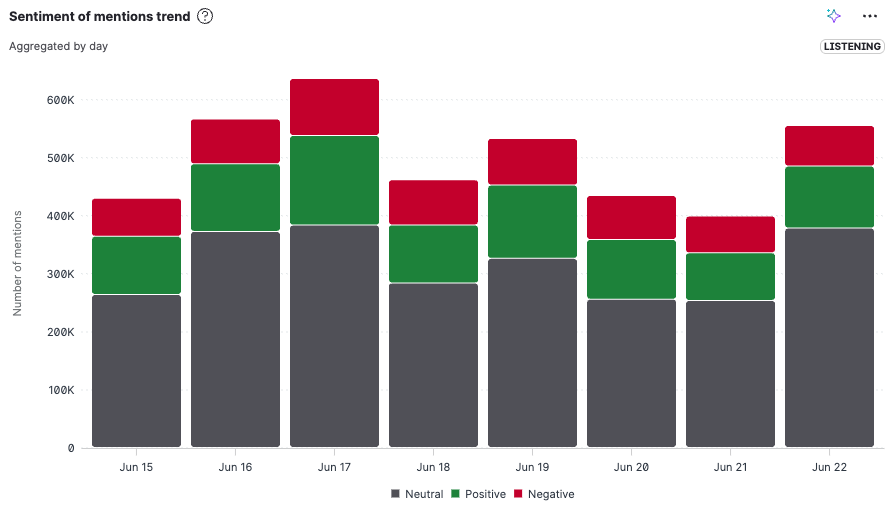
Between June 15 and June 22, Emplifi captured 3.96 million mentions generated by more than 1.02 million unique authors worldwide, creating an estimated 855 billion potential impressions.
This analysis is powered by Emplifi’s Social Listening and Social Media Analytics solutions, helping brands uncover emerging trends, audience behaviour, and competitive insights in real time.
If you’re joining us for the first time, explore the earlier editions of our tournament social intelligence series:
One of the strongest signals in this week’s data is that brands do not need to be official sponsors to become part of the tournament conversation.
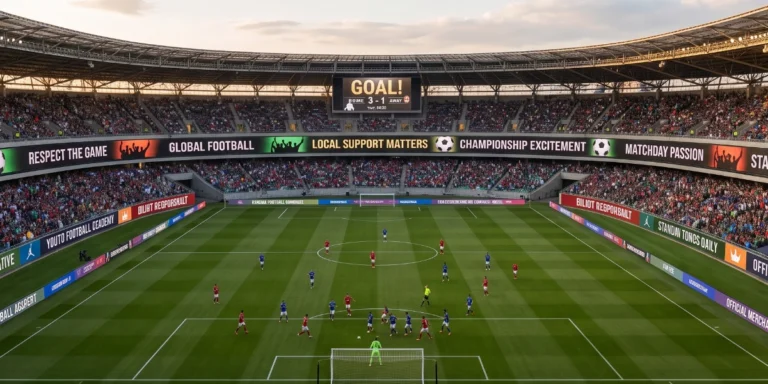
Tournament venues carrying commercial names cannot use those names in official event communications. The San Francisco Bay Area venue is referenced officially as “San Francisco Bay Area Stadium.” The Boston venue is referred to simply as “Boston Stadium.”
But social media rarely follows official naming conventions.
Fans, creators, journalists, and publishers continued using the names they already recognised: Levi’s Stadium and Gillette Stadium.
The result was significant organic brand visibility without direct tournament activation.
For marketers, this highlights an important reality of modern social media: audience behaviour often matters more than official naming structures.
Levi’s generated 3,090 mentions during the reporting period, peaking on June 16 when Austria defeated Jordan at the San Francisco Bay Area venue.
Interestingly, many of those conversations were not simply about football.
Social media users actively discussed Levi’s decision to cover its stadium branding during the tournament. Images of the covered signage circulated widely and generated positive reactions, with many users viewing the move as creative and self-aware.
As it wasn't an official sponsor of the FIFA World Cup, Levi's was asked to hide its logo on Levi's Stadium (Santa Clara, California).
— Matthieu Lamoureux (@LLLLITL) June 12, 2026
And they did it in the smartest way possible. #WorldCup #FIFAWorldCup #Levis pic.twitter.com/pryLbZR3dW
The lesson is not about sponsorship.
It’s about cultural participation.
Sometimes the conversation forms around how a brand responds to an event rather than how it advertises during one.
This is exactly the kind of emerging trend that real-time social listening is designed to surface before it becomes mainstream.
Gillette experienced a similar effect.
The brand generated 2,574 mentions during the week, with conversation spikes aligning closely with matches played at the Boston venue.
Most discussions focused on attendance, ticketing, venue logistics, and the stadium itself rather than on Gillette’s products.
Yet the result was still brand visibility at scale.
Both examples demonstrate how audience habits can create value that exists outside traditional sponsorship frameworks.
While brand visibility emerged as a major theme, geography delivered one of the week’s most surprising findings.
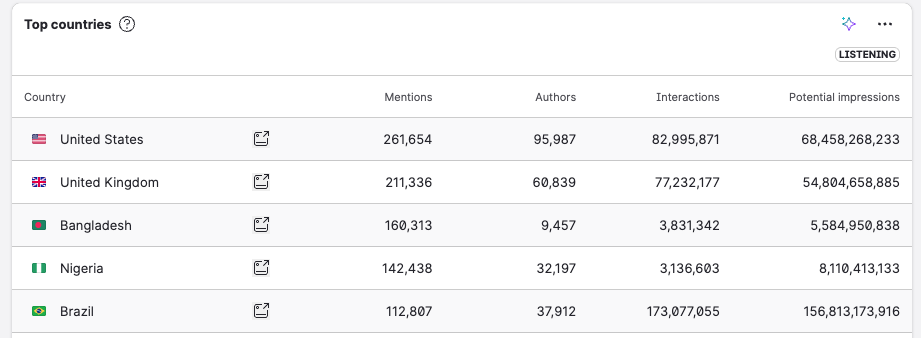
The largest conversation markets were:
Bangladesh’s presence ahead of markets such as Brazil and Mexico highlights the scale of football engagement across South Asia, a region that is often underrepresented in global football marketing discussions.

Nigeria and Brazil rounded out the top five, while Brazil generated the highest interaction volume of any market, producing 173 million interactions from just over 112,000 mentions.
This is exactly the type of audience insight surfaced through advanced social media analytics.
Several themes dominated the conversation throughout the week.
Argentina, France, Messi, Senegal, and Austria generated the highest mention volumes.
One of the more interesting findings was Austria’s appearance among the top topics.
The data suggests that Austria’s visibility was driven less by standalone interest and more by its connection to one of the week’s busiest match days, which featured several high-profile fixtures occurring simultaneously.
Messi also remained one of the tournament’s most discussed figures. Interestingly, conversation around him continues to blend current performance with legacy debates, with words such as “greatest,” “best,” and “old” frequently appearing alongside mentions.
Across all tracked conversations:

Instagram generated the strongest positive sentiment profile, with 36% of mentions classified as positive.
This continues a trend identified throughout the series: visual content, emotional moments, and community participation consistently generate stronger positive reactions than text-based debate.
Sponsor visibility during the tournament is not uniform.
Some brands generate conversation through association with teams and results.
Others benefit from audience questions, travel discussions, or broader cultural debates.
Aramco generated 868 mentions during the reporting period, with sentiment remaining predominantly neutral (74%), alongside 17.2% positive and 8.7% negative mentions. A significant increase in conversation was observed on June 18, which accounted for 52.6% of the week’s total mentions.
The spike coincided with one of the tournament’s most discussed match days, driving broader conversations around the competition and its commercial ecosystem, including official sponsors. As a result, interactions associated with Aramco mentions increased by 582% week-over-week, while potential reach grew by 516%, from 191.5 million to 1.18 billion impressions, demonstrating strong sponsor visibility during a peak engagement period.
Qatar Airways recorded 135 mentions during the week and experienced one of the strongest reach increases among the sponsors analyzed. Potential reach rose from 5.97 million to 208 million impressions, representing a 35-fold increase week-over-week.A notable contributor to this growth was exposure through Grok, X’s AI assistant, which referenced Qatar Airways 21 times while responding to user questions related to tournament travel, host cities, and fan logistics. Conversation themes centered around travel, hospitality, connectivity, and the fan experience, reinforcing Qatar Airways’ association as the tournament’s official airline and highlighting its visibility within tournament-related discussions.
Among the sponsors with available data this week, AB InBev has the highest organic presence in the tournament conversation. With 3,351 mentions and 1,494 unique authors, Budweiser and Michelob ULTRA appear consistently in the context of the match-watching experience. Social interactions grew 69% week-over-week, and potential reach nearly doubled, from 2.52 billion to 5.02 billion potential impressions.
Brazil was the market with the highest interaction concentration for the brand: 723,865 interactions from just 189 mentions, an exceptional engagement ratio that reflects the Brazilian audience’s responsiveness to Budweiser content tied to the tournament.
For the second consecutive week, Grok remained one of the most influential accounts in the tournament conversation. The AI assistant appeared in 8,658 tracked mentions and generated an estimated 76.3 billion potential impressions.
Hey @grok, suggest a player who you think will reach the final of the World Cup competition!! pic.twitter.com/nyL8iFeZc9
— Eugine (@amars1983) June 18, 2026
What began as an unexpected trend in opening week now appears to be a sustained behavioural pattern. Fans are increasingly using AI tools to ask questions, compare teams, discuss travel logistics, and explore tournament storylines.
For brands, that raises a new question: how often is your brand appearing in AI-generated responses, and in what context?
Monitoring AI-driven conversations is becoming an increasingly important part of the modern social listening ecosystem.
This week’s data highlights several important trends.
Levi’s and Gillette became part of the tournament conversation without running major tournament-related campaigns.
How people talk about brands can matter as much as how brands talk about themselves.
Bangladesh’s presence among the largest conversion markets demonstrates the importance of looking beyond traditional football powerhouses.
Instagram continues to generate stronger positive sentiment than text-heavy environments.
For the second consecutive week, Grok remained one of the most visible participants in the conversation.
Monitoring AI-generated discussion is becoming an increasingly important component of social intelligence.
The stories shaping this tournament are changing by the hour. Explore Emplifi’s Live Social Intelligence Hub to track fan sentiment, emerging narratives, trending players, and brand visibility as the conversation evolves.
Want to understand how our team identified the Tim Payne phenomenon, tracked Grok’s rise, and surfaced unexpected brand opportunities during the tournament?
Take a guided tour of Emplifi’s Social Listening platform and see how brands monitor conversations, identify cultural moments, and act on real-time audience insights.
You can also explore Emplifi’s complete Social Marketing solution and Social Media Analytics platform to understand how leading brands turn social intelligence into action.
Data in this article covers June 15–22, 2026, captured via Emplifi Social Listening and Unified Analytics, monitoring public conversations on X, Instagram, Facebook and YouTube.
Emplifi is an independent analytics provider. This content is not affiliated with, endorsed by, or connected to any tournament organising body or its official sponsors.