Blog
6 min read
Apr 14, 2026

Experience Orchestration: A 2026 guide to unified customer experience

Experience orchestration is the AI-driven coordination of every customer interaction, across marketing, commerce, and customer care in real time. It enables brands to deliver unified, personalized experiences based on continuously evolving customer context rather than predefined journeys.

Gabriel Tay Director of Business Consulting at Emplifi
Man working on his content orchestration strategy

Key points:

  • Experience orchestration replaces predefined journeys with real-time, AI-driven decision-making across all customer touchpoints.
  • Traditional journey orchestration fails because it relies on rigid rules and siloed channels in a non-linear customer world.
  • Unified data is essential to create a single, continuously updated view of each customer.
  • AI determines the next best action for every individual, enabling true one-to-one personalization at scale.
  • Continuous learning ensures every interaction improves future experiences, making the system smarter over time.

Customer journey orchestration was the goal of the 2010s. Experience orchestration is the imperative of 2026.

That distinction isn’t just semantic. It reflects a fundamental shift in how companies understand and manage customer experience.

For the past two decades, the trajectory has been clear:

  • CRM systems helped companies store customer data
  • CXM platforms helped them measure customer experience
  • Journey orchestration helped them automate predefined flows

Each step added sophistication. But each was still constrained by the same limitation: they operated on predefined paths.

Experience orchestration breaks that model.

Instead of guiding customers through fixed journeys, it coordinates every interaction in real time across marketing, commerce, and customer care, based on a continuously evolving understanding of the customer.

This is not an incremental improvement. It’s a different paradigm.

What you’ll learn in this guide

  • The shift from journey orchestration to real-time, AI-driven experience orchestration
  • Why traditional, rules-based journeys fail in today’s multi-channel environment
  • How unified data, AI decisioning, and cross-channel execution work together
  • Practical ways organizations can start adopting experience orchestration

What is experience orchestration?

Experience orchestration is the use of AI to coordinate all customer touchpoints across marketing, commerce, and customer care in real time to deliver unified, adaptive experiences.

The difference is not just scale. It’s decision-making. Journey orchestration systems execute logic you define: If a customer does X, trigger Y.

Experience orchestration systems determine what should happen. For example, ‘Given everything we know about this customer right now, what is the optimal action?’

That shift from predefined logic to dynamic decisioning is what defines the category.

Why journey orchestration breaks down

Journey orchestration was a meaningful step forward. It introduced automation, improved targeting, and enabled more sophisticated customer flows.

But it breaks under modern conditions.

First, it assumes that customer behavior can be mapped into clean, linear journeys. In reality, customers move unpredictably across channels, discovering products on social, researching elsewhere, purchasing later, and interacting with support at any point.

Second, it relies on predefined rules. Those rules work in controlled scenarios but fail to capture nuance. Edge cases multiply. Maintenance becomes complex. Adaptation slows down.

Third, it operates in silos. Most systems are confined to specific channels email, web, or paid media without a unified view of the customer.

The result is an experience that is technically optimized, but practically fragmented. This is the gap that experience orchestration closes.

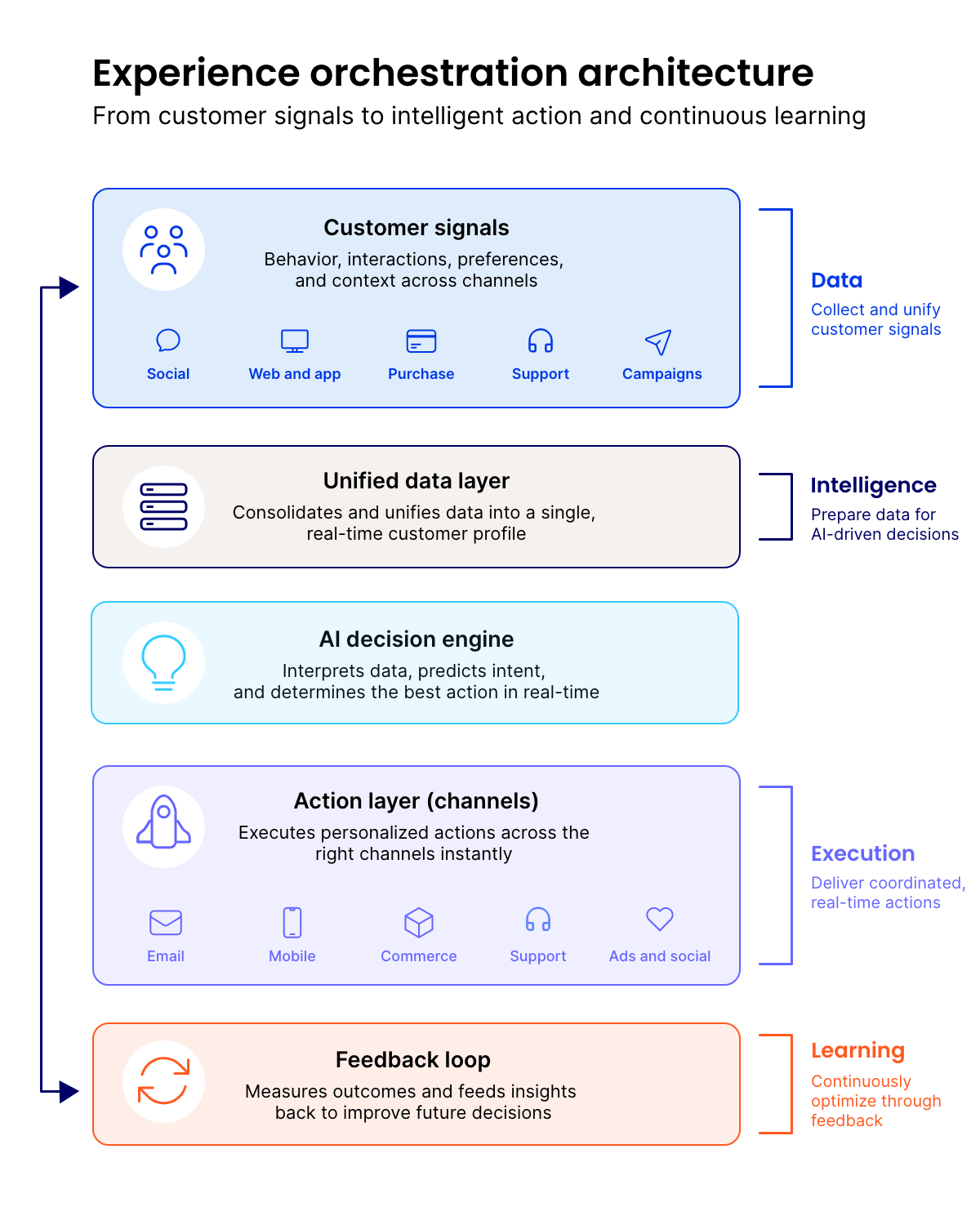
Experience orchestration architecture workflow

Experience orchestration vs. journey orchestration

The difference between the two is not a matter of degree, it’s a difference in architecture.

Aspect Journey Orchestration Experience Orchestration
Scope Defined journeys Entire customer experience
Logic Rules-based AI-driven
Personalization Segment-level Individual, real-time
Channels Limited, often siloed Unified across all touchpoints
Adaptation Between journeys Within interactions
Learning Periodic optimization Continuous learning
Time scale Sequential Instantaneous

Journey orchestration optimizes paths. Experience orchestration optimizes outcomes.

How experience orchestration works

At a high level, experience orchestration brings together four capabilities into a single system.

Unified data provides a complete, real-time view of the customer across all touchpoints, behavioral, transactional, and interactional.

AI decisioning (often powered by AI orchestration systems that coordinate models, data, and execution across environments) interprets that data to predict intent, evaluate possible actions, and determine what should happen next for each individual.

Cross-channel execution ensures that decisions can be acted on immediately, whether that means publishing content, triggering an offer, routing a support interaction, or doing nothing.

Continuous learning closes the loop. Every action produces an outcome, and those outcomes refine future decisions.

The system is not following a script. It is continuously adjusting its behavior based on new information.

Team members looking at laptop, checking their customer feedback

Build better customer journeys with real-time insights

Download our roadmap template to plan, prioritize, and scale

Download template

Experience orchestration is a foundational step toward Autonomous CX.

As systems become more capable of interpreting context, making decisions, and executing actions in real time, the role of human-defined workflows continues to diminish.

Experience orchestration enables this shift by centralizing decisioning and execution. Autonomous CX extends it further, where systems not only recommend and execute actions, but operate independently, continuously optimizing the entire customer experience without manual intervention.

A practical example

Consider a customer who purchased 18 months ago and has been inactive since.

In a journey orchestration model, they are placed into a predefined re-engagement flow, three emails over two weeks with escalating offers. In an experience orchestration model, the system continuously evaluates context.

It may detect that the customer has recently engaged with a competitor’s product on social, a signal of renewed intent. Instead of waiting for a scheduled email, it responds immediately, delivering a targeted offer through the channel where the customer is most active, at the moment they are most likely to engage.

If the customer responds, the system adapts in real time, adjusting messaging, timing, and channel. If they don’t, it recalibrates and tests a different approach.

The interaction is not predefined. It is continuously optimized based on live signals.

Instead of following a fixed sequence, the system adjusts in real time, responding to behavior as it happens and refining its approach with each interaction. The first approach follows a plan. The second responds to reality.

Make every interaction count

With Emplifi, connect every customer touchpoint into a single, coordinated experience powered by real-time data and AI.

Where experience orchestration shows up in practice

Experience orchestration is not theoretical, it is already shaping how organizations operate across industries.

In retail, it enables dynamic social commerce. A customer who engages with a product on Instagram can be served a personalized offer, see relevant content, and move into a frictionless purchase flow, all coordinated in the moment.

In e-commerce, it allows organizations to act on intent signals instantly. Browsing behavior and cart activity can trigger tailored offers or interventions before a customer drops off.

In financial services, it connects behavioral signals with communication. Changes in engagement or sentiment can trigger proactive outreach, adjusting messaging and timing based on customer context.

In SaaS, it shifts retention from reactive to predictive. Declining usage patterns can trigger coordinated interventions across marketing, product messaging, and customer success.

In travel and hospitality, it enables real-time disruption management. Delays or cancellations trigger coordinated updates, support actions, and rebooking options across channels.

Across industries, the shift is consistent: from isolated workflows to coordinated experiences.

The four pillars of experience orchestration

Experience orchestration depends on four foundational components:

  1. Unified data: A single, coherent view of the customer across all systems and channels.
  2. AI intelligence: Models that can interpret context, predict behavior, and recommend actions at the individual level.
  3. Cross-channel execution: The ability to act across marketing, commerce, and customer care in a coordinated way.
  4. Continuous learning: Feedback loops that ensure the system improves over time.

Without all four, orchestration breaks down.

Why experience orchestration matters in 2026

Three forces make this shift urgent.

Customer expectations have changed. People expect fast, consistent, and personalized experiences across every channel they use.

Plus, business complexity has increased. Organizations now manage more channels, more data, and more interactions than ever before.

And technology has matured. AI, data infrastructure, and platform capabilities have reached a point where real-time coordination at scale is actually feasible.

This convergence is what makes experience orchestration possible and necessary.

It also sets the foundation for Autonomous CX (A-CX), where systems move beyond coordination to fully self-optimizing execution.

Experience orchestration vs. marketing automation

Marketing automation focuses on automating marketing workflows — campaigns, email sequences, and lead nurturing.

It improves efficiency within marketing.

Experience orchestration operates at a different level. It coordinates decisions across marketing, commerce, and customer care simultaneously.

Marketing automation is a component. Experience orchestration is the system.

Capability Marketing Automation Experience Orchestration
Scope Marketing only Full CX (marketing, commerce, care)
Logic Rules-based AI-driven
Timing Scheduled Real-time
Personalization Segment-level Individual-level
Coordination Channel-specific Cross-channel

How Emplifi delivers Experience Orchestration

Most platforms approach customer experience from a single angle:

  • Marketing clouds optimize campaigns
  • Commerce platforms optimize transactions
  • Customer care systems optimize support

The problem is that customers don’t experience these as separate functions. They experience a brand as a single, continuous interaction. Experience orchestration requires those systems to operate as one.

That’s where Emplifi is positioned differently.

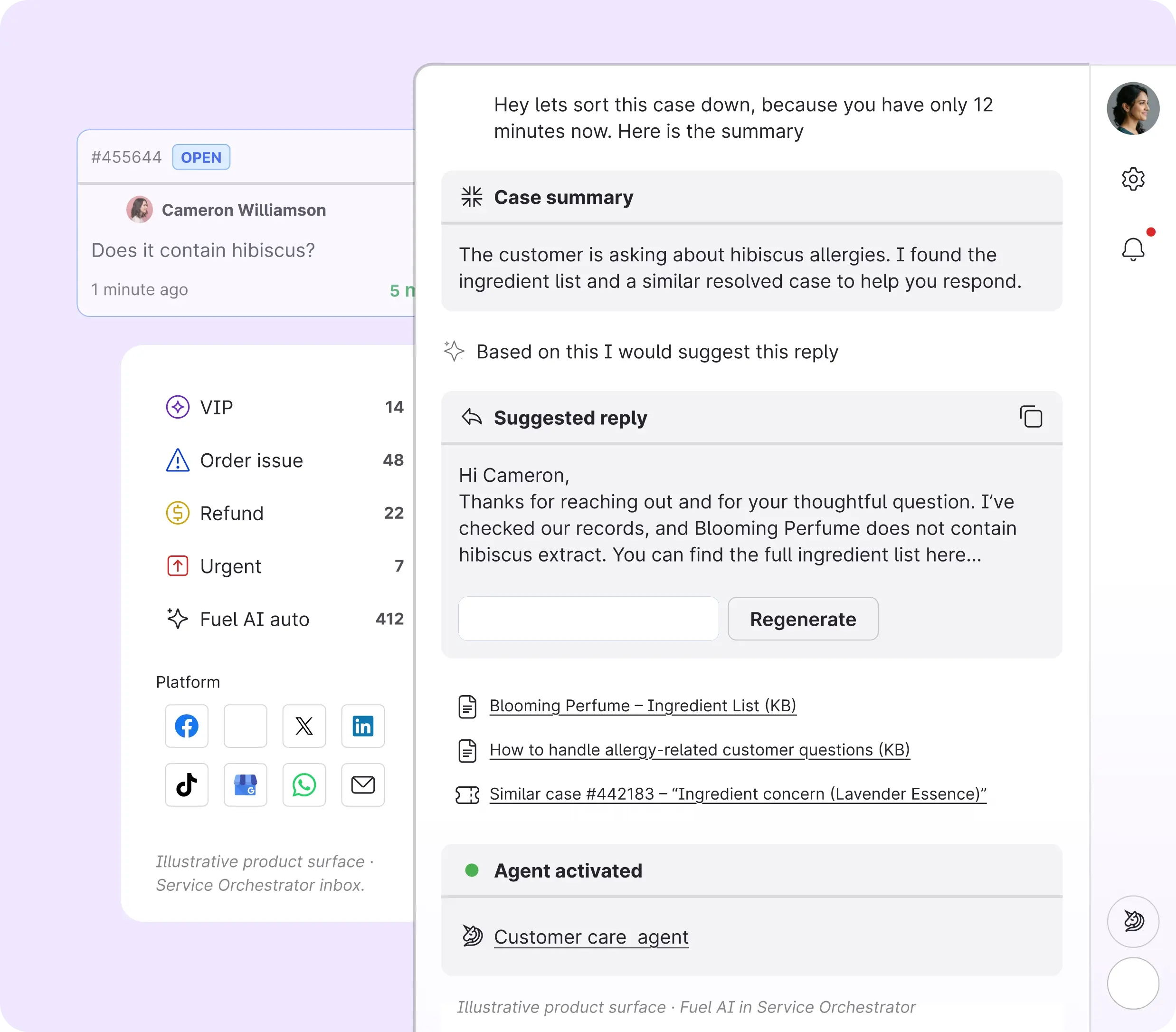
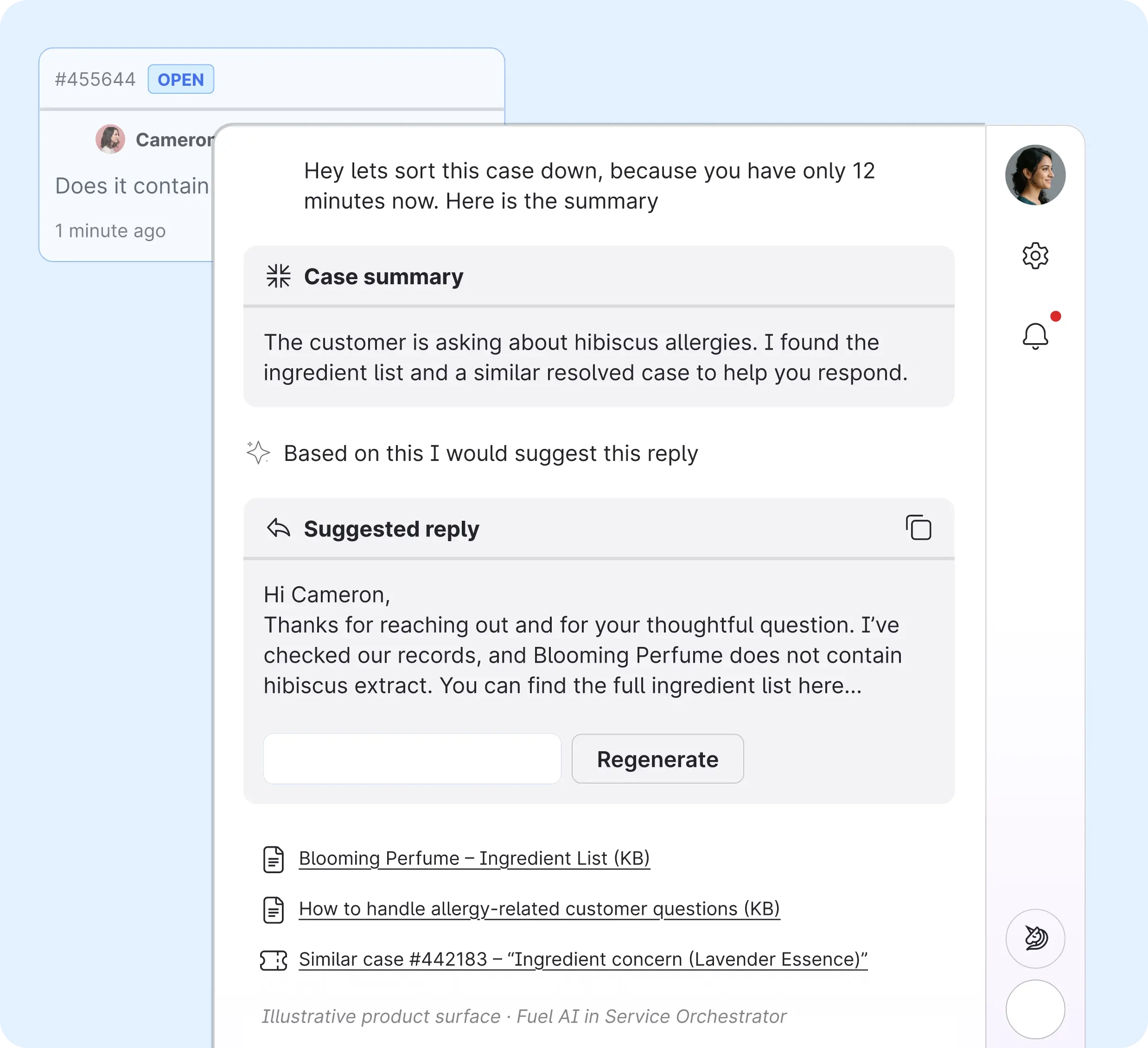
Emplifi is built to coordinate customer experience across social marketing, social commerce, and customer care, three areas that increasingly converge on the same channels.

Woman working on her social media strategy for beauty brands

Turn social customer care into your competitive edge

Our 20 minute product tour will show you how

Take a product tour

Instead of treating social as just another distribution channel, it treats it as a primary interaction layer where discovery, engagement, purchasing, and support all happen in real time.

Underneath that is a unified system:

  • A shared data layer that connects interactions across marketing, commerce, and care
  • An AI decisioning layer that interprets context and determines next actions
  • Native execution across social platforms, messaging, and commerce integrations
  • Continuous learning from every interaction, improving decisions over time

The result is not just better performance within individual functions, it’s the coordination across them:

  • Marketing actions reflect customer history
  • Commerce experiences adapt to real-time intent
  • Customer care operates with the full context of the relationship

That’s the difference between managing touchpoints and orchestrating experience.

Getting started

Experience orchestration doesn’t require a full transformation on day one.

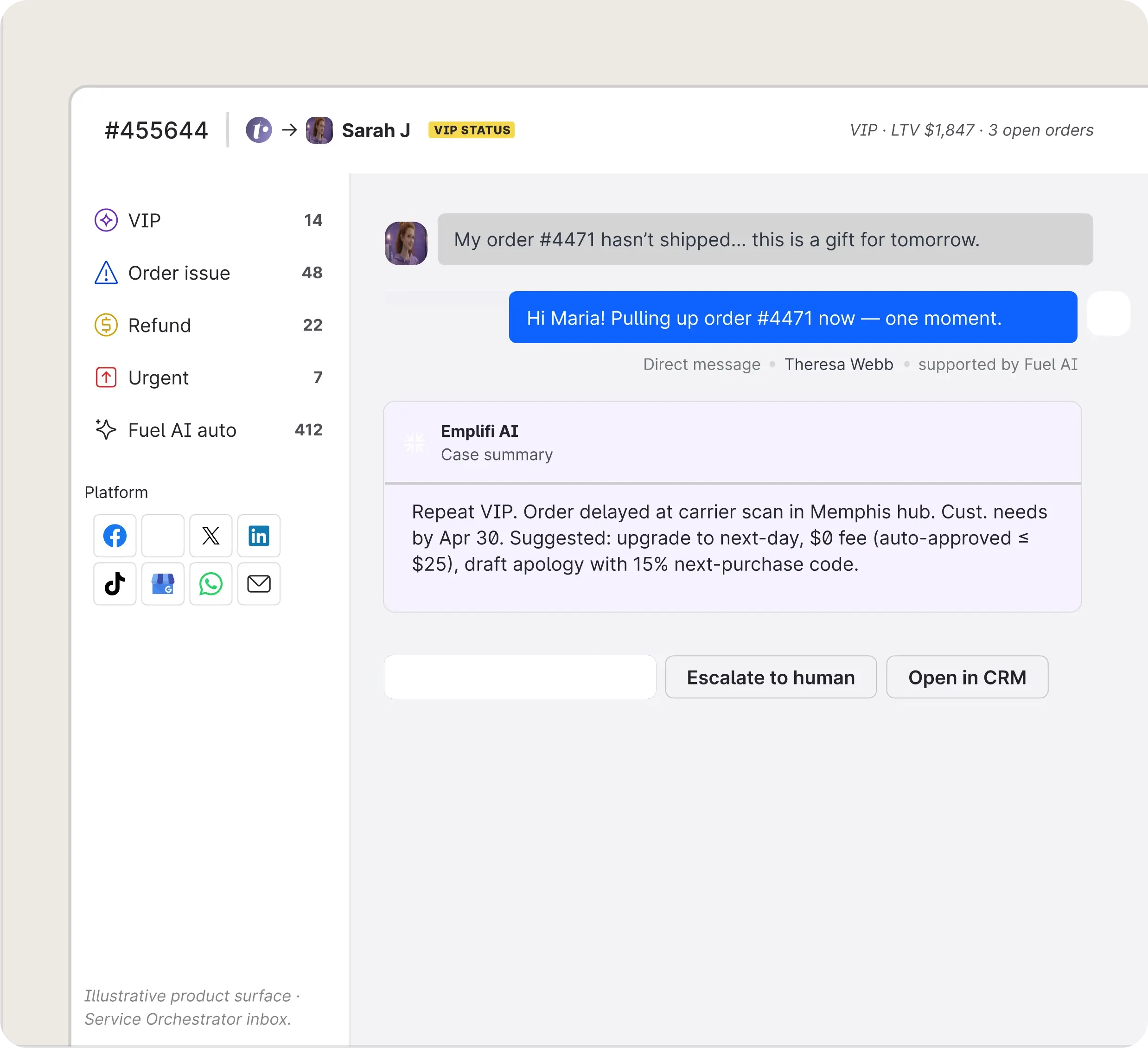
A practical starting point is connecting social interactions with customer care. This alone creates immediate value by improving response times, adding context to conversations, and reducing fragmentation.

From there, organizations can expand into commerce and broader orchestration.

The key is not to build everything at once, but to begin with a unified view of the customer and layer capabilities over time.

Move from managing touchpoints to orchestrating experience.

Discover how Emplifi brings your data, AI, and execution together to deliver unified customer experiences in real time. Get a demo today. 

Experience orchestration is the use of AI to coordinate all customer touchpoints across marketing, commerce, and customer care, and in real time to deliver unified, adaptive experiences based on continuously evolving customer context.

Journey orchestration follows predefined paths based on rules, while experience orchestration uses AI to determine the best action in real time based on current customer context, allowing interactions to adapt dynamically rather than follow fixed flows.

AI analyzes real-time customer data, predicts intent, evaluates possible actions, and determines the optimal next step for each individual, often powered by AI orchestration systems that coordinate models, data, and execution across environments.


Autonomous customer experience is the next stage beyond experience orchestration, where AI systems independently manage and optimize customer interactions without predefined workflows, continuously improving outcomes over time. These capabilities are typically delivered through an autonomous customer experience platform, which coordinates data, decisioning, and execution across channels in real time.

It is used across industries like retail, e-commerce, SaaS, finance, and travel to deliver real-time personalization, improve retention, and enable coordinated experiences such as social customer experience, where interactions across social channels, commerce, and customer care are managed in real time.

Insights from Emplifi

Explore our latest blogs and comprehensive guides designed to help you master customer experience strategies and drive growth.

Ready to fuel your CX and social media marketing?

Discover how Emplifi boosts efficiency, increases revenue, and scales your social media marketing — whether you have a small team or a complex product. Let’s talk today.

What can you expect?

  • A partner who cares about your strategy and objectives
  • Live demo showing how we differentiate from the pack
  • No pressure, just advice
Get a demo