Creator-published Instagram collabs (especially Reels) deliver the strongest organic engagement, shares, and reposts, making them a high-impact way for brands to reach new communities while brand-led collabs remain best for tighter message control.
Organic reach on Instagram is increasingly difficult to earn consistently. For brands, the question is no longer simply whether to work with creators, but how to structure those partnerships so content reaches the right audiences and drives meaningful engagement.
Our H1 2026 analysis of Instagram brand profiles shows that collaborative posts are associated with stronger organic performance versus standard brand posts across industries, profile sizes, and formats.
The biggest gains come from accepted collaborations, where a creator or partner publishes the post and invites the brand to join as a co-author.
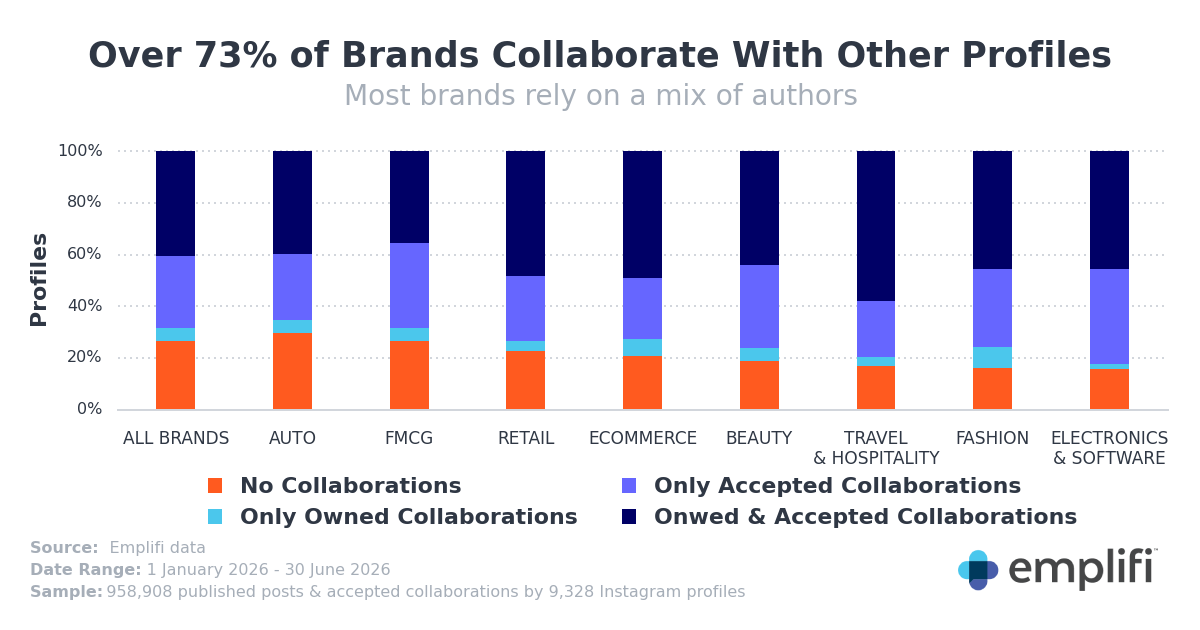
More than 73% of brands in our dataset used Instagram collaborations. Most combined two approaches:
Owned collaborations: The brand publishes the post and invites a creator or partner profile to collaborate.
Accepted collaborations: A creator or partner publishes the post and invites the brand to collaborate.
Bottom line: Both formats allow a post to appear across the audiences of the profiles that accept the collaboration. The difference is in who leads the content. Owned collaborations give teams more control over messaging and execution, while accepted collaborations can feel more native to the creator’s established audience.
Brands that publish collab posts also tend to have larger audiences, higher median engagement, and greater publishing activity overall than brands that do not use collaborations as part of their social strategy. This does not mean collaboration alone drives those outcomes. More established brands may have larger creator networks, bigger content budgets, or more mature social programs.
Still, the pattern holds across industries: collaboration is a common part of how socially mature brands extend their reach beyond their owned audience.

Fashion, Travel & Hospitality, and Electronics & Software show particularly high adoption of collaboration, but they are not relying on the same playbook. Electronics & Software brands lean more heavily on accepted collaborations, while Fashion brands publish a greater share of owned collabs. Travel & Hospitality stands out for using both models: nearly 60% of profiles in the sector publish a mix of owned and accepted collaborations.
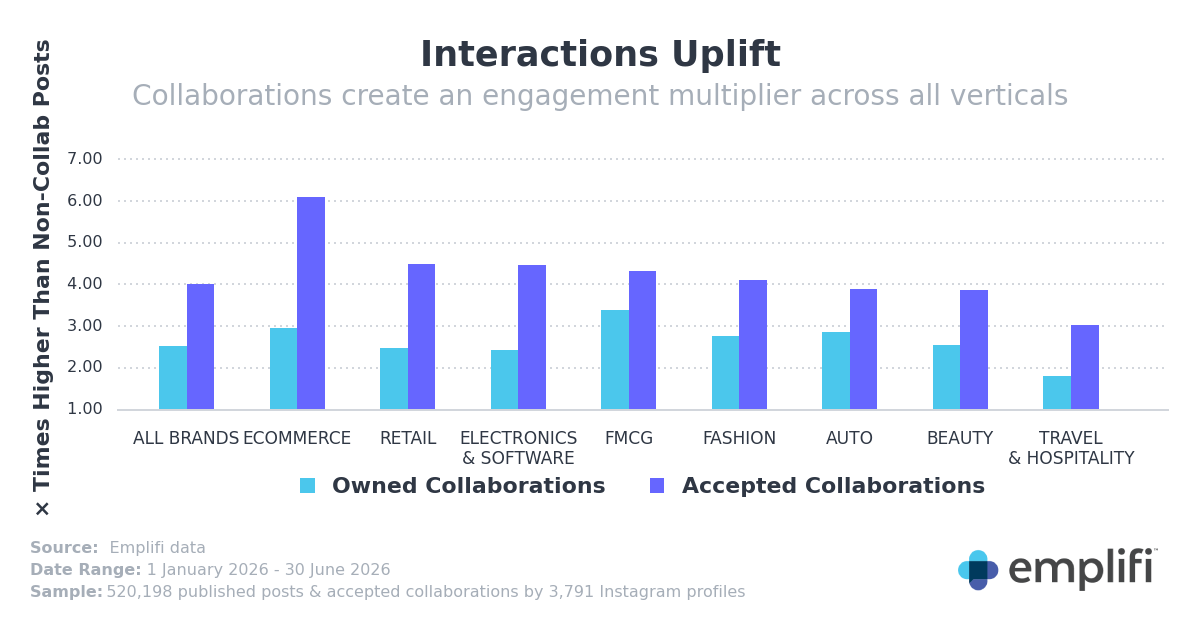
Across the dataset, both types of collab posts outperform standard posts from the same brand. Accepted collaborations consistently deliver the larger uplift.

For brands, the takeaway is not that one model should replace the other. Owned collaborations remain useful when message control, product detail, or campaign consistency matter most. Accepted collaborations are a valuable complement when the goal is to introduce the brand through a creator’s own voice and audience.
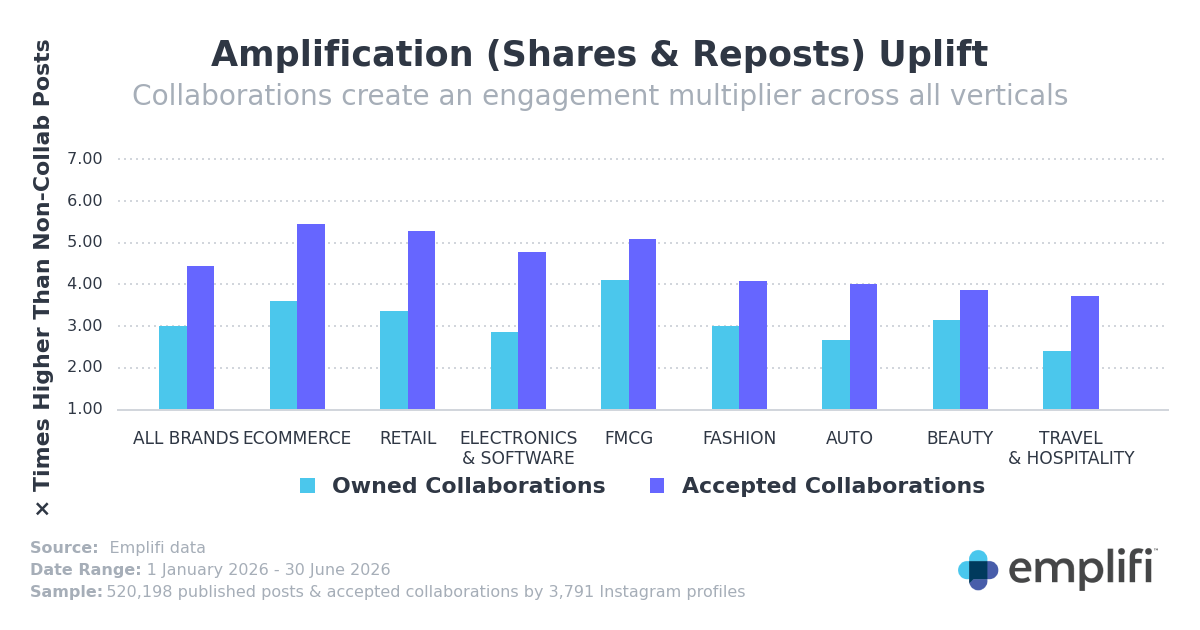
The performance advantage extends beyond likes and comments. Collab posts also generate substantially more shares and reposts across every vertical we analyzed.

Accepted collaborations again deliver the strongest results, reaching more than 5x the amplification of non-collab posts in ecommerce and retail. Even in verticals with comparatively lower uplift, both collaboration types generate significantly more shares and reposts than standard brand posts.
This matters because shares and reposts help content reach people beyond a brand’s existing audience. They’re an important measure of whether a collaboration is helping content travel, rather than simply generating engagement from people who already follow the brand.
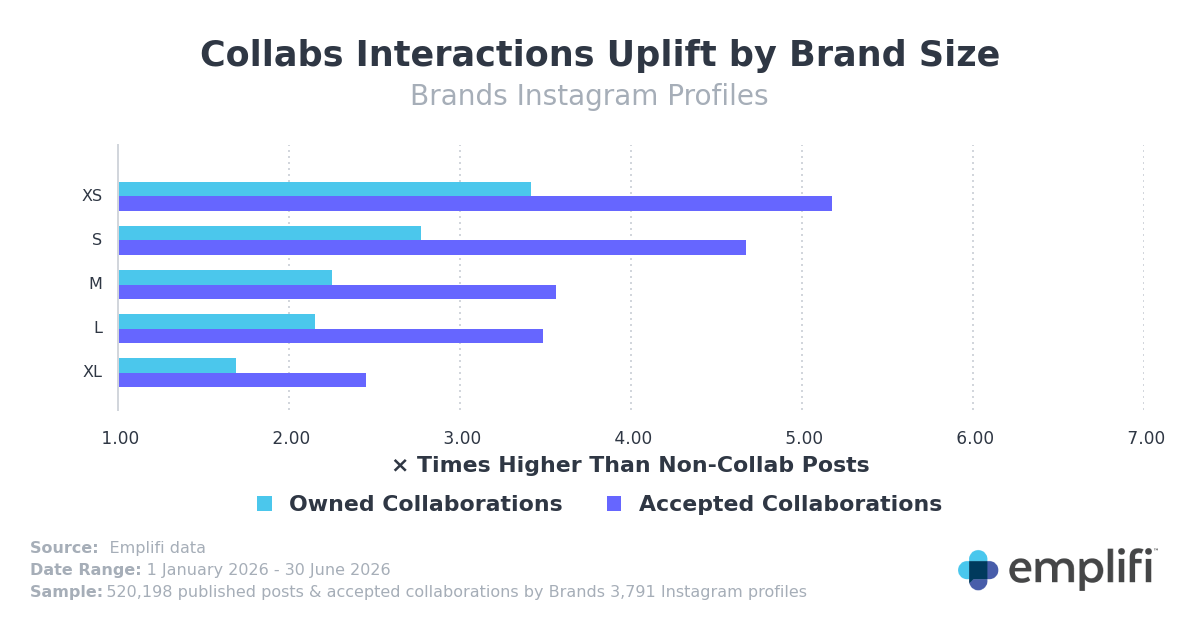
Collaboration lifts engagement across every profile-size category, but the strategy shifts as brands grow.
For this analysis, profile size is based on follower count: XS profiles have fewer than 10,000 followers; S profiles have 10,000 to 49,999; M profiles have 50,000 to 99,999; L profiles have 100,000 to 999,999; and XL profiles have more than 1 million followers.
Smaller profiles see the largest relative interaction uplift. Accepted collab posts from XS brands earn 5x more interactions than their standard non-collab posts. For brands with a limited established audience, this can be an effective way to introduce content to a creator’s audience.

For larger brands, the opportunity is less about overcoming a limited audience and more about extending reach into new communities. XL brands publish more collab content overall and are more likely to lead the post themselves. Yet accepted collaborations still deliver stronger uplift.

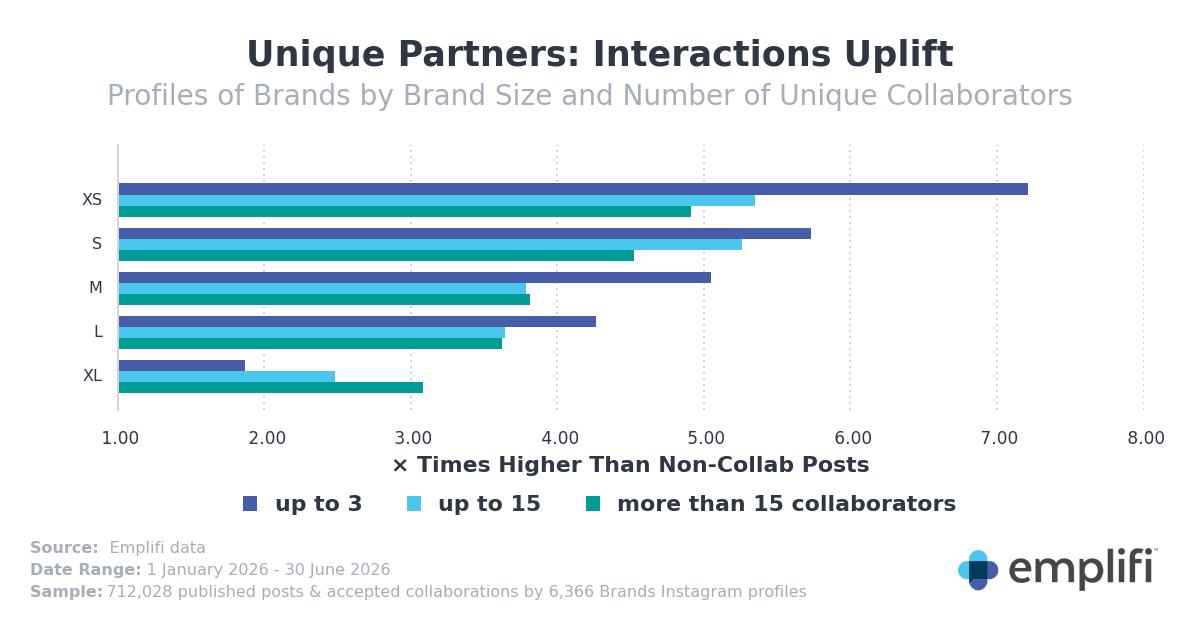
The number of collaborators matters, too. Smaller brands working with a limited number of carefully selected partners tend to see the strongest uplift. Larger brands see better results when they work with a broader group of collaborators, which may help reduce audience overlap and expand discovery.
For enterprise teams, this reinforces the need to look beyond creator reach alone. The most effective program is not necessarily the one with the most collaborators. It is the one that matches creators, audiences, and content formats to a clear business objective.
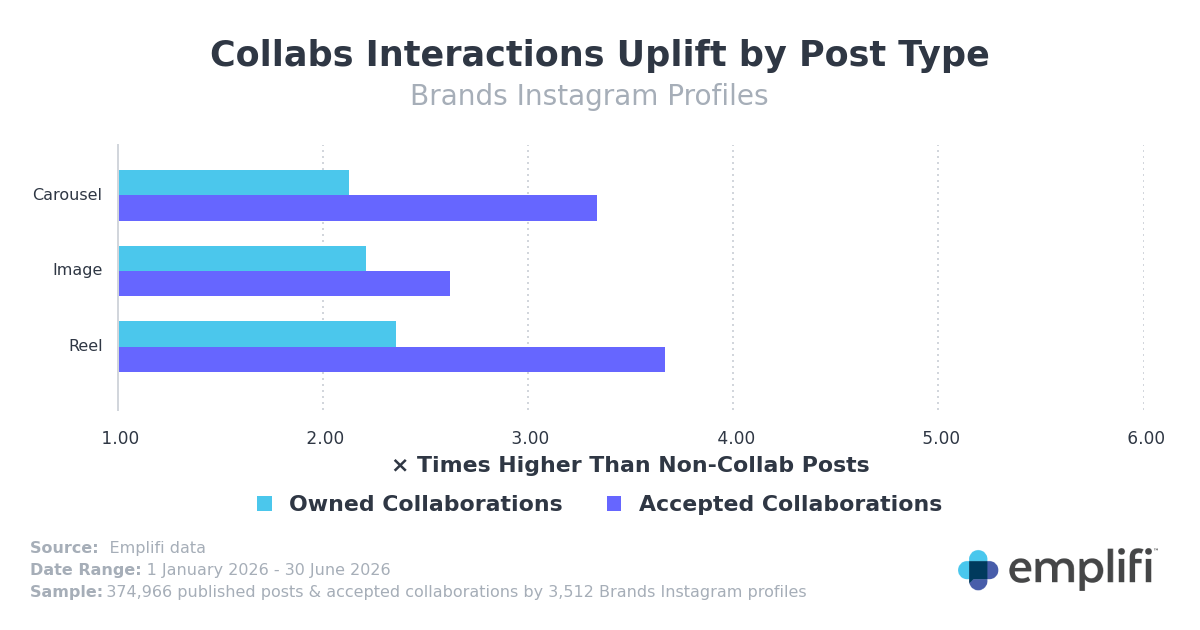
Format still matters. Collaboration lifts performance across post types, but Reels see the strongest gains, particularly when they are accepted collaborations.

Reels stand out as the strongest format for collab posts, particularly accepted collaborations. They are built to reach beyond a brand’s existing audience, and a creator’s familiar style can make the partnership feel more relevant to the people already following them.
Owned carousel collaborations see the smallest lift. That does not mean brands should stop using carousels. They are still useful for product education, campaign storytelling, and content that needs more room to explain a message. But they may not be the best format when the goal is to tap into the reach and credibility of a creator partnership.
For brands, the takeaway is straightforward: start with Reels when the priority is discovery and engagement. Use carousels when the campaign needs more context, then measure whether adding a collaborator improves performance over your usual brand content.
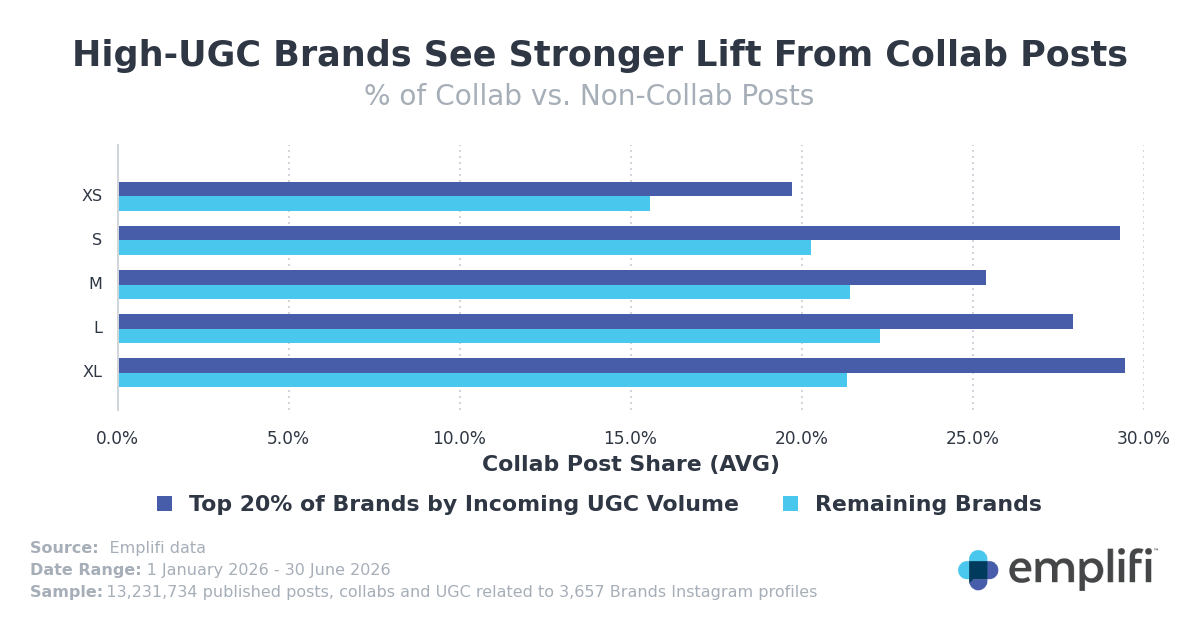
Brands with the highest UGC share of voice, measured by the volume of posts and Stories that tag the brand, also publish a higher share of collab posts. More importantly, they see stronger engagement across both collab and non-collab content, with the biggest gap appearing on collab posts.

This suggests that the strongest creator partnerships do not operate in isolation. They work within a wider community that is already talking about, tagging, and sharing the brand. When a creator adds the brand as a collaborator, the content has more than the creator’s audience behind it. It enters a conversation that the brand’s own community is already helping to sustain.
For brands, that means creator strategy and UGC strategy should be planned together. The content, creators, and communities that generate organic tags can help teams identify who to partner with, what resonates with their audience, and where a collaboration has the best chance to travel.
The data does not prove that collab posts cause more organic UGC, or that high UGC share of voice directly causes better collab performance. But the relationship is meaningful: brands that consistently earn audience participation appear better positioned to turn creator partnerships into broader community engagement.
The data does not point to one universal collaboration formula. It does show several practical ways brands can make creator partnerships work harder.
Use accepted collaborations when credibility and discovery are the priority. Creator-led posts consistently deliver the strongest engagement and amplification uplift. Give the right partners enough creative room to make the content feel native to their audience.
Use owned collaborations when control matters. Brand-led posts are still valuable for product launches, regulated categories, campaign messaging, and content that needs a clear brand point of view. The opportunity is to pair that control with partners whose audiences are genuinely relevant.
Make Reels the starting point for testing. Reels deliver the strongest lift from collaboration in this analysis. Test both owned and accepted collabs in the format, then compare performance against your usual non-collab Reels.
Measure shares and reposts, not just likes and comments. Engagement is useful, but amplification shows whether content is actually reaching beyond the audience your brand already owns. Build shares, reposts, reach, and follower growth into creator reporting alongside interactions.
Match the size of your creator network to your audience strategy. Larger brands may need a broader range of collaborators to reach new communities and reduce audience overlap. Smaller or more niche brands may see more value from deeper, repeat partnerships with a select group of well-matched creators.
Connect creator partnerships to your wider community strategy. The brands with stronger UGC share of voice also see stronger collab-post engagement. Track the conversations, tags, and community response a partnership generates, then use those insights to inform future creator selection and content planning.
Instagram collaborations are not a shortcut to organic growth. They work best when brands treat them as part of a broader content, creator, and community strategy.
For enterprise teams, the opportunity is to balance the control of owned content with the reach and credibility of accepted collaborations, then use performance data to refine the mix. The strongest programs do more than put a brand in front of a new audience. They create content that people want to engage with, share, and bring into their own communities.
Methodology: Analysis based on Emplifi client data from January 1 to June 30, 2026. The amplification analysis includes 520,198 published posts and accepted collaborations across 3,791 Instagram profiles. Sample sizes vary by metric and include only profiles meeting the conditions required for each comparison. Profile size categories: XS, 0–9,999 followers; S, 10,000–49,999; M, 50,000–99,999; L, 100,000–999,999; XL, 1M+.
An Instagram collab post is one post shared by two accounts. The lead publisher invites another account to collaborate, and the post appears to audiences of the accounts that accept the invitation.
With an owned collaboration, the brand publishes and invites a creator or partner to join. With an accepted collaboration, the creator or partner publishes first and invites the brand.
In Emplifi’s H1 2026 analysis, accepted collaborations delivered the strongest engagement uplift versus a brand’s standard posts. Creator-led posts are more likely to feel native to the creator’s audience.
In this analysis, Reels showed the strongest collaboration gains, especially for accepted collaborations. Carousels remain useful when a campaign needs product education or more context.
Measure interactions alongside shares, reposts, reach, follower growth, and the business objective behind the campaign. Compare owned and accepted collaborations against the brand’s usual non-collab posts in the same format.
The strongest programs connect creator partnerships with the broader community already tagging, sharing, and talking about the brand. Those patterns inform creator selection and future content planning.