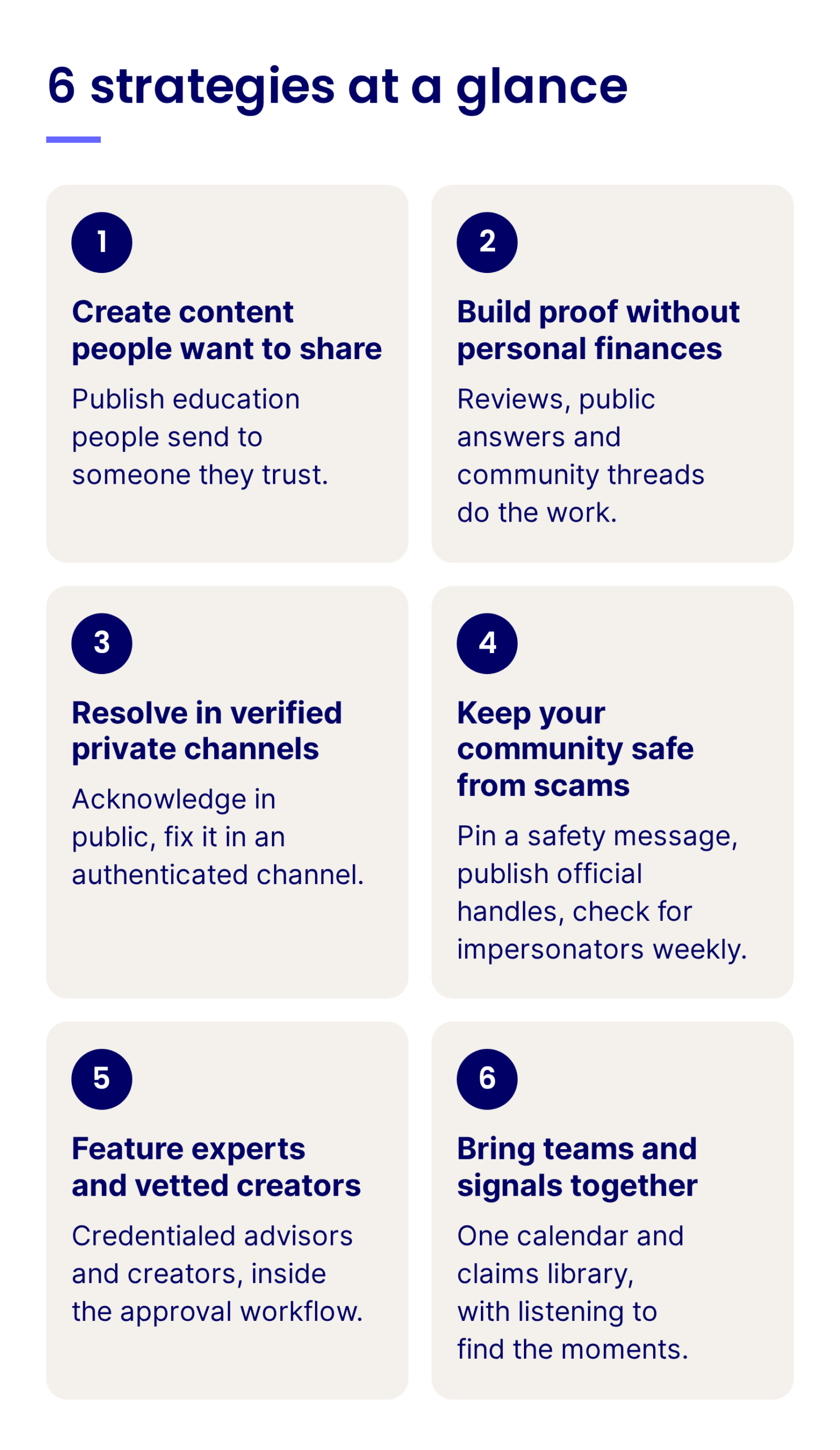
Financial brands grow their social media audience by publishing education people want to forward, then earning trust through reviews and public answers rather than customer posts. Six strategies do the work: shareable education, proof from reviews, public answers with secure private follow-up, scam protection, credentialed experts and vetted creators, and one system for the calendar, approvals and listening.
Growing a social audience in financial services looks different from growing one in retail or travel. Customers are unlikely to post about a loan application or a retirement balance, but they are still looking for answers, comparing experiences and sharing useful guidance in private conversations.
That gap between public and private is the heart of financial services social media, and it creates a different opportunity for financial brands: build trust with clear, helpful education; make it easy for customers to find safe support; and connect social, care and fraud teams around the moments that matter most.
Much of that guidance now comes from other people on social. In the FINRA Foundation’s investor study released Dec. 4, 2025, 26% of US investors said they use social media influencers’ recommendations when making investment decisions, and among investors under 35 the figure was 61%.
For financial brands willing to show up with patient, useful answers, that is good news. This guide walks through six strategies, drawn from banks and fintechs already doing this well:
It’s written for social media leaders and heads of digital marketing at retail and digital banks, fintechs, card issuers, credit unions, and wealth and insurance brands. Everything here is marketing guidance, so bring your compliance team in on anything that touches a regulated product. The US and UK regulators mentioned along the way are examples to adapt to your own market.
You’ll also find why social works differently in finance, the channels and formats that carry the work, how to measure progress, and a 30/60/90-day plan to get started.
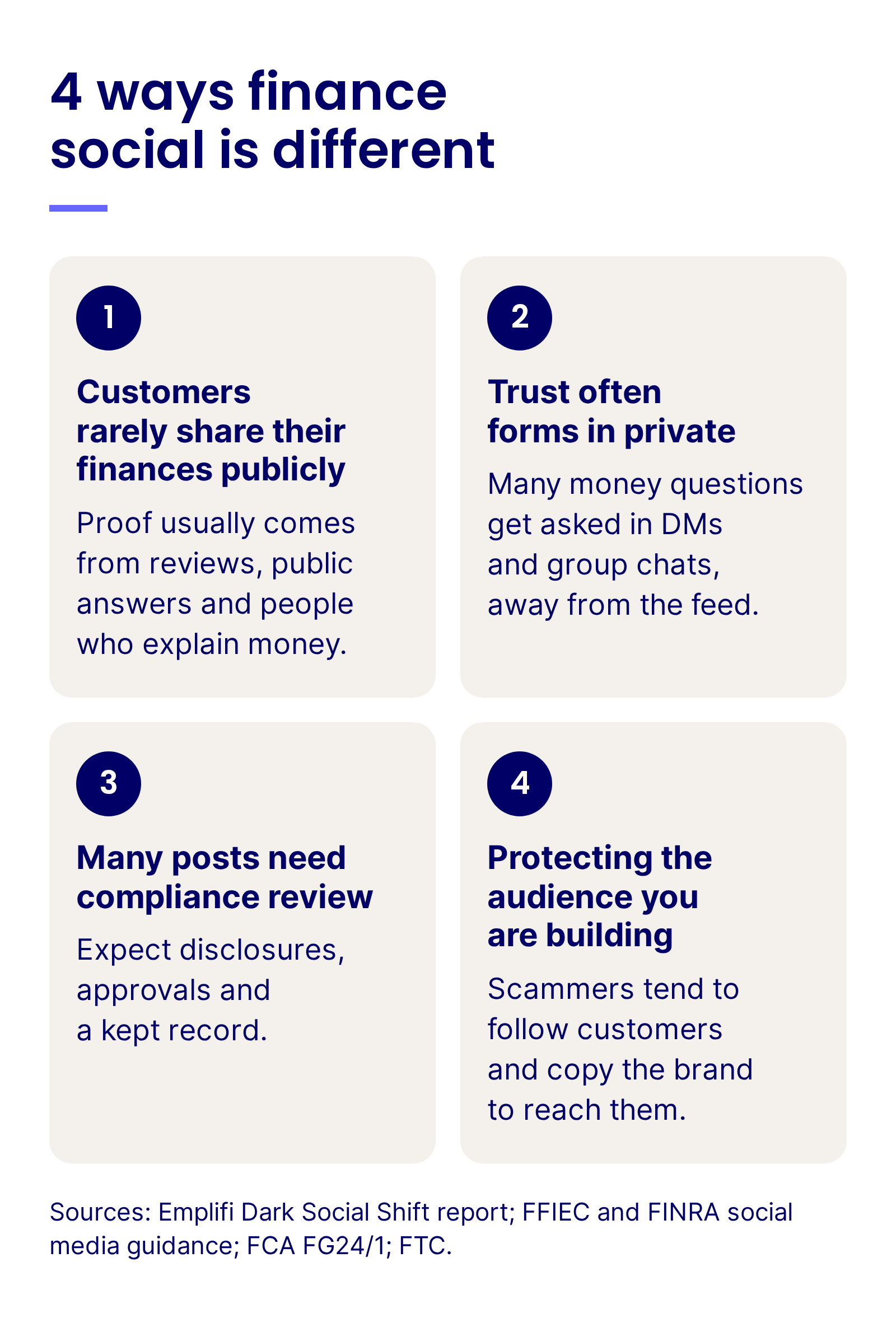
Four things set financial brands apart from most other categories on social, and each one changes how a growth program works.

1. Customers rarely share their finances publicly. A traveler will happily post a photo of a hotel pool without being asked. Very few people do the same with an overdraft, a loan approval or a retirement balance, and that’s completely understandable. Because the customer-photo playbook from retail and travel rarely transfers, proof in finance usually comes from reviews, public answers and people who explain money well.
2. Trust often forms in private. Many money questions get asked in DMs and group chats, away from the public feed. Emplifi’s Dark Social Shift report found inbound DMs rose 76% year over year as buyer conversations moved private, while Instagram median engagement fell sharply. So the public metrics most teams report on tell only part of the story, usually the part where the least trust forms.
3. Many posts need compliance review. In the US, banks, credit unions and card issuers follow the FFIEC’s social media guidance, which applies existing consumer-protection and disclosure rules to social, so in practice a post that names a rate needs the same disclosures as any other ad. Broker-dealers and wealth or investment arms also follow FINRA’s social media guidance: a registered principal approves most static content before it goes live, the firm reviews interactive posts the way it reviews correspondence, and records are kept for at least three years. In the UK, the FCA’s FG24/1 guidance reminds firms that promotions on social must be fair, clear and not misleading, and warns that unauthorized influencers promoting a regulated product without approval may be committing a criminal offense.
4. Protecting the audience you are building. Scammers tend to go where customers are, and copying a trusted brand’s name and logo is a common way in. The FTC’s data for 2025 shows nearly three in 10 people who reported losing money to a scam said it started on social media. For a financial brand, keeping followers safe is part of growing the audience.
The same four challenges come up again and again in bank, fintech and insurance social programs. Most of them come from how the work is organized, which makes them fixable.
Reporting leans on public metrics. Most finance reports lead with reach and likes, largely because those are the numbers the platforms hand over. The signals closer to an account opening sit a layer deeper: a post sent to a partner, a DM asking how a fee works, a review answered late at night. When those signals go unmeasured, teams naturally stop making content for them.
Finance has room to grow on Instagram. In Emplifi’s Worldwide Social Media Benchmarks: Finance Q2 2026, finance brands earned 6.1% of all brand interactions on Facebook, the fourth-highest share of any industry, and 1.0% on Instagram. The followers finance brands do have there engage well, as the channels section below shows, so the opportunity lies in share of attention. Closing that gap usually takes more than rate promotions and stock photography, which is where education and real voices come in.
Compliance review comes late in many programs. When a post needs three sign-offs over email, the moment it was written for can pass before approval arrives. Understandably, teams respond by posting less, and the feed ends up recycling whatever cleared last quarter. Moving review into the calendar keeps the same compliance bar while giving timely posts a fair chance.
Service, marketing and fraud often work separately. Social sees the complaint, care owns the fix, and fraud knows about the fake profile answering in the replies. When those teams work from different information, a customer who asks a public question can receive a scammer’s DM before the bank’s reply arrives, and that experience shapes how they feel about your brand.
The six strategies below build on each other. Starting with one or two and adding the rest as the workflow matures is a perfectly good way in.
The Dark Social Shift report cited above found conversations moving into DMs, which makes the private send one of the most useful signals to design for in finance. People tend to forward things that make a money decision easier: a clear fee explanation, a scam warning or a first-credit-card checklist, sent to the person they make those decisions with. Emplifi’s Social Pulse survey of nearly 1,000 US social media users points the same way, finding consumers care most about content that is informative and honest.
Banco del Pacífico in Ecuador puts credit education into short video, and the format has paid off. Carlos Coloma, the bank’s Digital Marketing Analyst, explains: “We sustained a 43% retention rate by the first half of the video and reached up to 6.95K users informing about credits in one video of 16 seconds long.”
Banco del Pacífico’s Spanish-language Reel starts from a call its viewers recognize, an offer of a preapproved loan, and walks through practical tips to check before accepting. It is the kind of credit explainer someone sends to a relative who just got that call.
Across 3,220 Instagram profiles in Emplifi’s Q2 2026 Finance benchmarks, Reels earned a median of 33 interactions per post, Carousels 27 and single images 17. As a rule of thumb, a Reel suits an answer someone needs to watch, like a process, and a Carousel suits a comparison someone wants to keep.
Your care team is a great source of topics, because it already answers the same questions every week. Build the calendar around them:
Keep each claim within what compliance has already approved, and repeat the answer in the caption’s first line for people who read before they watch.
Banco del Pacífico opens this Spanish-language scam check with the rule itself: its advisors never ask customers to validate personal details by message or email. Then it lists the official channels, the part worth forwarding to a parent.
Measure this: Track shares and sends per reach alongside impressions in each content review. A post that one follower sends to their family can do more for trust than one that reaches thousands of people who keep scrolling.
Many retail brands grow on customer photos. In finance, the proof people look for is public and impersonal: app store ratings, Google reviews, answered questions and community threads where people compare notes.
People read that proof closely. Emplifi’s 2026 Digital Authenticity survey of 1,650 US and UK consumers found 63% consider user-generated ratings and reviews the most authentic type of online content. For a bank, the app store listing is often the last page someone reads before they download.
Nationwide announces its Which? Banking Brand of the Year award with a Halloween twist, two witches and a cauldron. Recognition from an independent consumer group is proof a prospect can check without anyone sharing their finances.
Grupo Petersen, which runs four regional banks in Argentina, treats reviews as part of social. Its team labels and answers reviews across the Apple App Store, Google My Business, Reddit and other platforms, tagging each one as general or product-specific and positive or negative. Over time, the tags show the banks which products generate the complaints.
A practical way to start is to bring reviews into the same inbox as your social comments, with the same response targets, and then build a public answer library:
A one-star review answered well, with the fix confirmed in public and the detail kept private, does more to reassure the next reader than an unanswered five-star one.
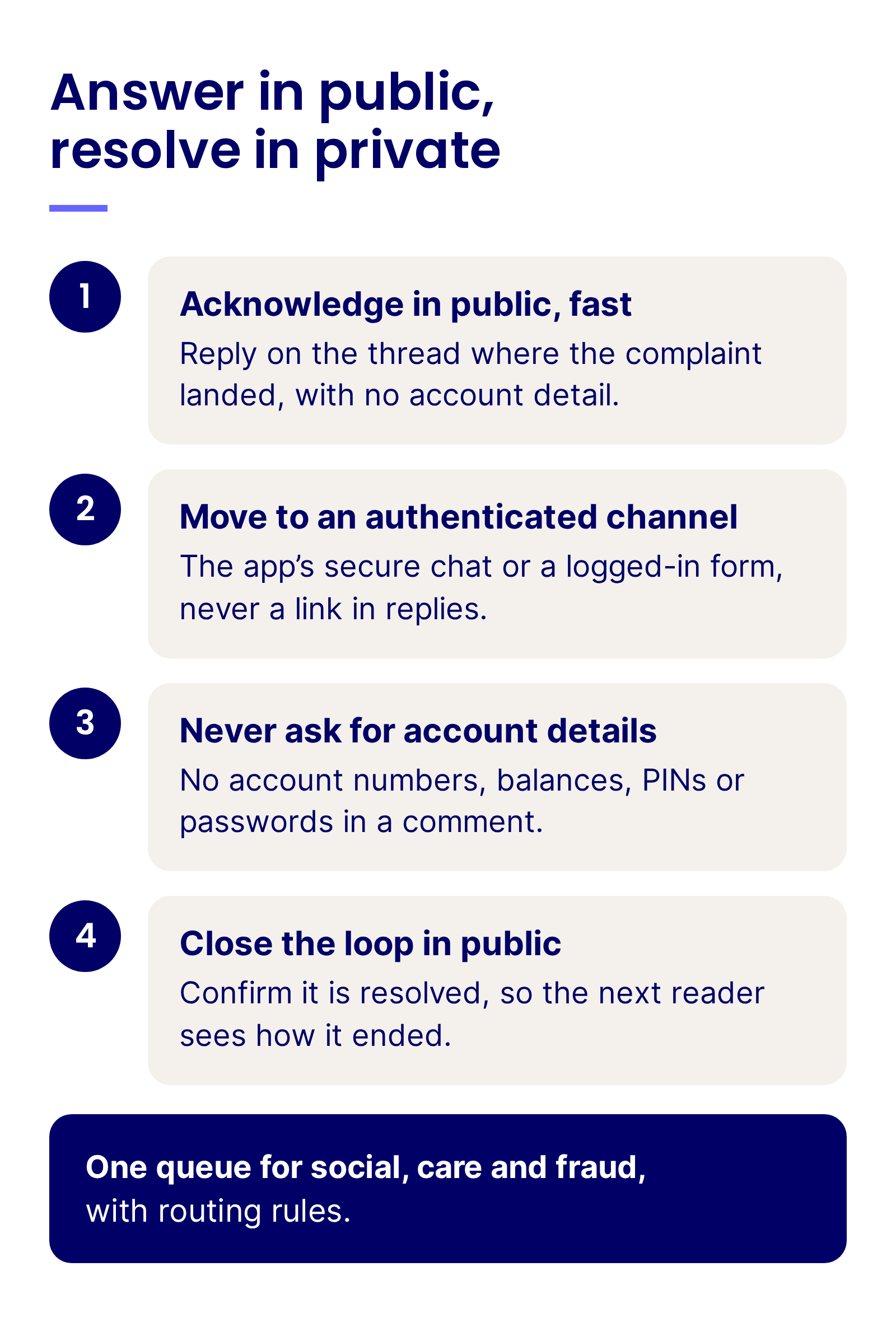
In hospitality, a service recovery can play out in public, and everyone watching sees the brand make it right. Finance needs a different route, because the detail that resolves a banking complaint (an account number, a transaction, a date of birth) belongs out of public view. It is also exactly what a scammer watching the replies hopes to see.
Speed still matters here. The same Social Pulse survey found one-third of consumers expect a reply to a direct message within an hour, and only 8% will wait 48 hours. When the official answer is slow, fake support accounts are quick to step into the gap.
It helps to write the protocol down before the next outage, so everyone on the queue handles it the same way:

The queue works best with two kinds of knowledge on it: social managers who know the platforms, and branch and care staff who know the products and the policy. Put both in one shared care workspace with routing rules, so a card dispute reaches the team that can close it and fraud reports reach fraud first.
Grupo Petersen: More than 30,000 customer inquiries handled at a 98% response rate during the pandemic surge, with branch customer service staff and social media managers working as one team. Engagement rose 23% and positive sentiment 18%.
Banco San Juan, one of the Grupo Petersen banks, states the rule in plain Spanish: it never sends links asking for personal or banking details, and never asks for passwords, verification codes or full card numbers by phone, WhatsApp or social media. When customers have already seen the bank say what it will never ask for, a reply inviting them into the app’s secure chat feels familiar and safe.
Agree on escalation in advance, too: what goes to fraud, what counts as a formal complaint under your regulator’s rules, and what a social agent can resolve alone. Working through the standard replies with your compliance team once means the person on the late shift can answer right away.
As a financial brand’s audience grows, it also becomes more attractive to scammers, since each new follower is someone a fake account can message while pretending to be you. The scale is significant: the FTC’s 2025 figures put reported losses to scams that started on social media at $2.1 billion, about eight times the 2020 level, and investment scams accounted for $1.1 billion of that, more than half.
Regulators point in the same direction. FINRA’s 2026 Annual Regulatory Oversight Report lists monitoring social media for accounts impersonating firm personnel, and keeping written procedures for responding to imposter domains and social accounts, among the effective practices it has seen at member firms. For banks and credit unions, the FFIEC’s social media guidance says institutions should have policies to monitor and address fraudulent use of their brand, such as phishing and spoofing, in a timely manner.
Listening is how many teams spot a problem first. Banco del Pacífico runs social listening and AI sentiment analysis on incoming posts and conversations to catch fraud complaints early, before they escalate.
Customers respond to this content, too. In Emplifi’s Q2 2026 Bank benchmarks, the two most-interacted Facebook posts from any bank worldwide were scam-awareness posts from State Bank of India. A few habits make protection a regular part of the calendar:
In this Spanish-language post, Stori reminds followers that not everything carrying its name is Stori, and to check the profile for the verified badge before replying.
Many people learn about money on social from other people. The FINRA Foundation study behind the finfluencer figures at the top of this guide also found 29% of US investors rely on social media for information, with YouTube the channel they use most for investing. Marketers are following the audience: in Emplifi’s State of Social Media Marketing 2026, 67% of more than 560 marketers said they plan to raise influencer budgets.
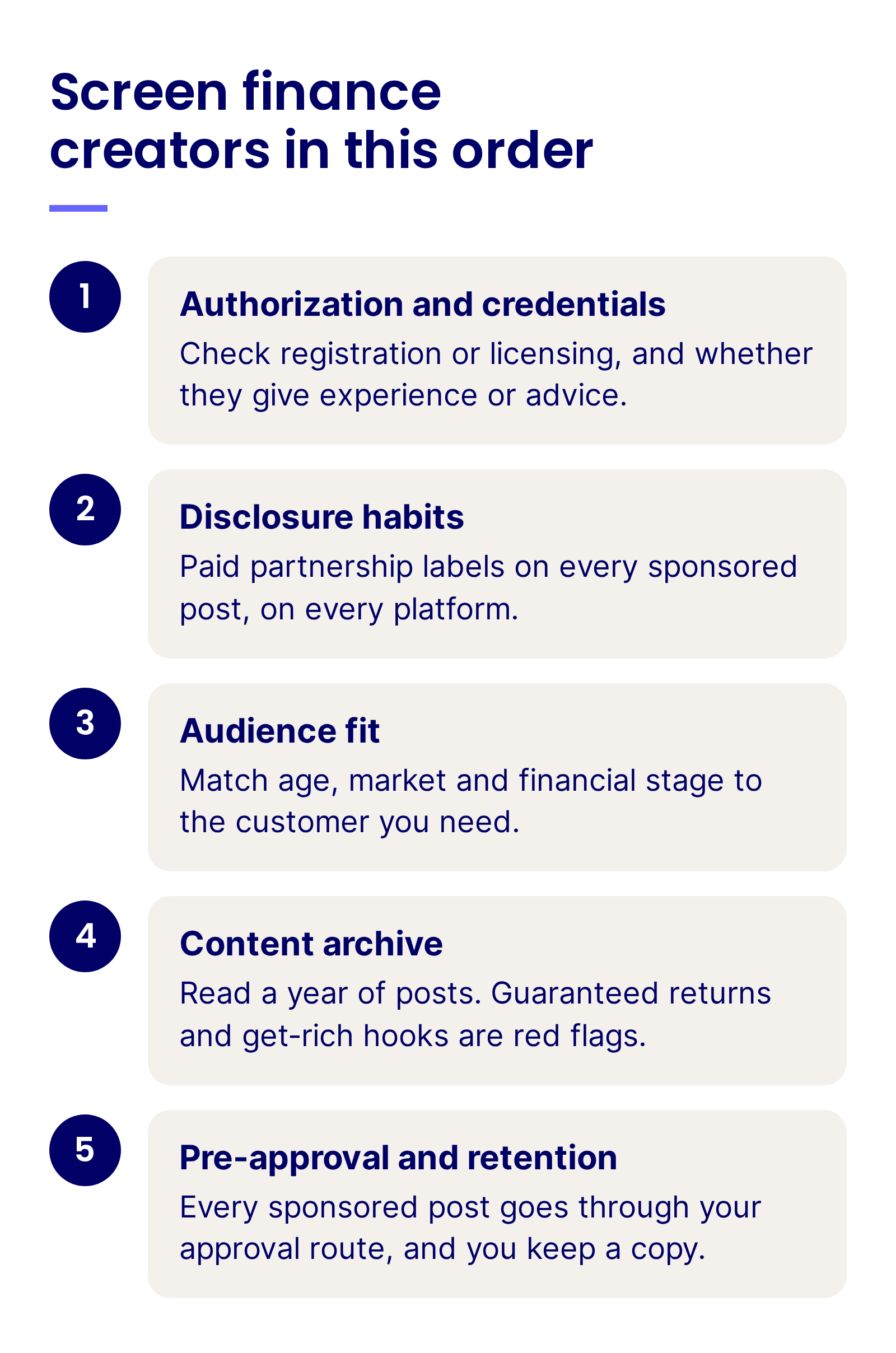
In finance, working with creators also means your team reviews and approves what they post for you, and keeps a copy. FINRA’s 2026 findings on communications with the public flag member firms that failed to supervise influencers posting on their behalf, approve influencers’ static content before it went live, or keep copies of those posts. In the UK, the FCA’s FG24/1 guidance expects firms to take proactive responsibility for how affiliates and influencers communicate their promotions, and keeps the firm responsible for every promotion it makes or causes to be made.
A consistent screening order keeps this manageable. Run each creator through the same steps inside your compliance workflow before anyone films anything:

External creator programs call for the closest oversight of anything you run, and some of your most credible voices are already on your payroll. An advisor, an economist or a fraud specialist explaining one thing well gives the brand a human face people remember. FINRA requires its member firms to train staff on the difference between personal and business use of social media, which makes a sensible starting point for any financial brand: short training, an approved content library and a clear list of topics to keep off personal accounts. Emplifi’s guide to social media advocacy covers how to set up the program.
Barclays UK stages a press-room interview in which a named Barclays representative clears up myths about social engineering scams, one question at a time. A named person answering plain questions on camera is the in-house version of the expert voice this section describes.
Grupo Petersen publishes for four banks from one calendar. Sofia Giordano, its Digital Marketing Analyst, says the calendar lets the team “have an order” across every bank’s profiles, and a shared approval route and claims library keep four brands consistent from one setup. National Bank of Kuwait ran its “Let’s Be Aware” campaign to build financial awareness through educational content, with PR and marketing publishing from one platform.
Banco Santa Fe and Banco San Juan, both Grupo Petersen banks, published this Spanish-language Reel about choosing a personalized account alias on the same day, each with its own name on the video. This is what one calendar across several bank brands looks like from the customer’s side.
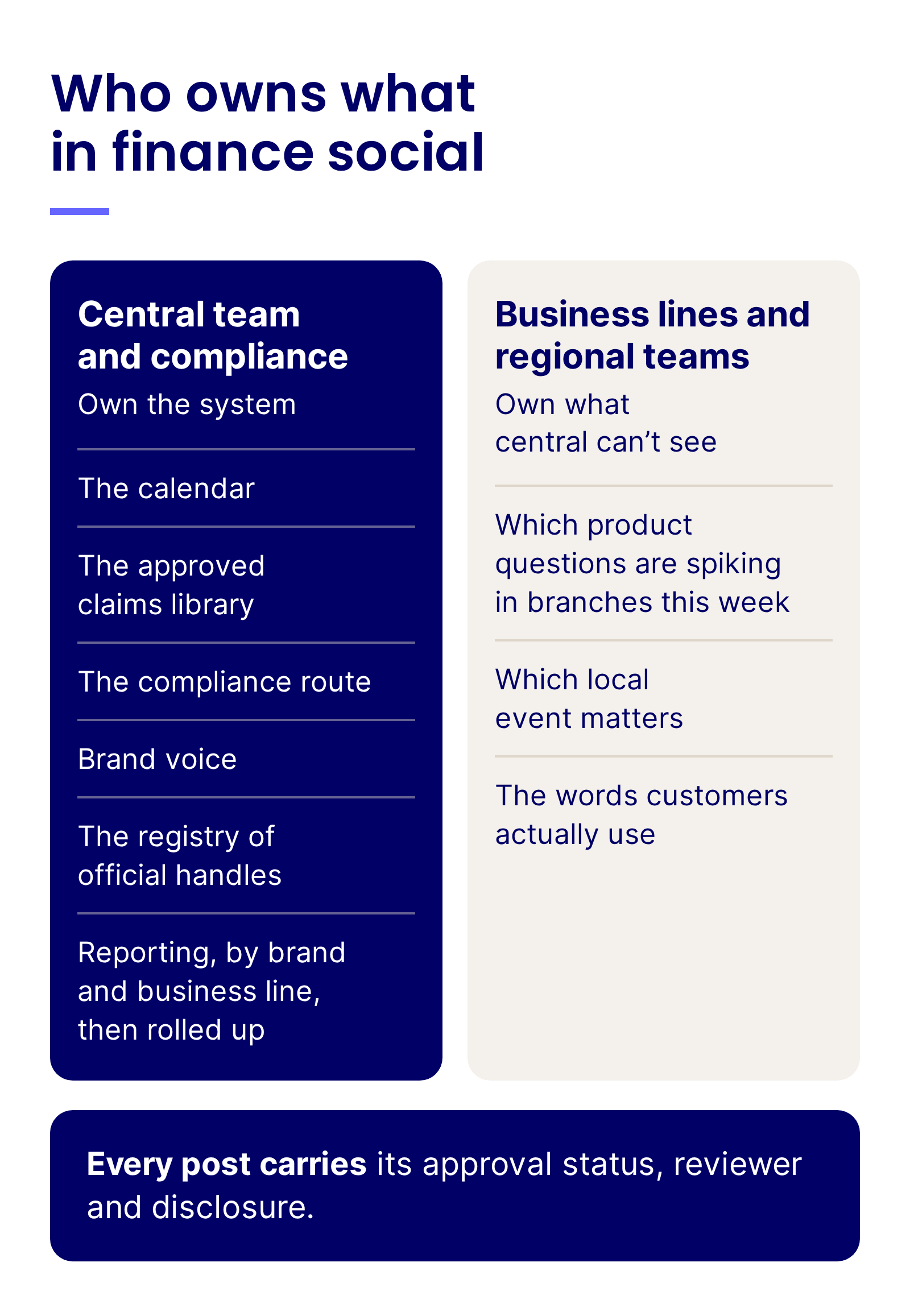
Agreeing who owns what, in writing, saves a lot of back-and-forth. The central team usually owns the calendar, the approved claims library, the compliance route, brand voice, the registry of official handles and reporting. Business lines and regional teams bring what the center is too far away to see: which product questions are spiking in branches this week, which local event matters, and the words customers actually use.

Building compliance review into the calendar itself saves everyone time. When each post carries its approval status, reviewer and disclosure, an evergreen explainer clears once and gets reused, and timely posts move through a fast lane of pre-approved templates. Keeping approvals, scheduling and the record in one publishing workflow also gives compliance the audit trail it needs.
Keep the claims library current, too, since rates, fees and eligibility change regularly and a post that was accurate last quarter can be out of date today.
Working from one system also shortens reporting and makes paid spend go further.
Compartamos Banco, the Mexican microfinance bank managing more than a million followers, cut reporting time by more than 90% and, on a reduced budget, lowered cost per click by 15% by using performance prediction to choose which posts to promote.
Listening brings in the other signal: what your audience is talking about right now. Stori tagged its conversations by topic, urgency and trend to find the cultural moments its audience cared about, and the case study below shows how that played out.
For reporting, start by brand and business line, then roll everything up into one cross-brand view. A group total on its own can hide both the brand carrying the number and the one that has quietly fallen behind on its DMs.

Each platform plays a slightly different role for a financial brand. The table maps each channel to its main job, the formats that perform well and a common pitfall to watch for.
| Platform | Primary role | Best formats | Common pitfall |
|---|---|---|---|
| Discovery, education, private sends | Reels, Carousels | Leaning on rate promotions and stock photos; reporting likes without sends | |
| Community, visible service, live Q&A | Live video, Status posts | Leaving service questions in the comments unanswered | |
| Leaders, advisors, business and wealth audiences | Employee and advisor posts | Posting only from the corporate page | |
| YouTube and TikTok | Search-led education, creator reach | Short explainers, how-to video, creator content | Running creator deals outside the approval and record-keeping workflow |
| Review platforms and communities (app stores, Google, Reddit) | Proof at the comparison stage | Review replies, answered threads | Managing them outside the social queue |
| Private messaging | Service and trust | In-app secure chat; DMs from verified handles for handoff only | Using DMs for service with no protocol for moving customers to authenticated channels, or leaving them unstaffed |
Instagram is usually the main discovery and education surface, and the place where sends matter most. In Emplifi’s Finance benchmarks, worldwide finance brands posted a median engagement rate near 2.85% on Instagram in Q2 2026, against roughly 1.35% on Facebook. Focusing each Reel or Carousel on one money question keeps it easy to follow and easy to share.
Facebook still carries community and visible service in many markets. In Emplifi’s Bank benchmarks, Live Video led organic Facebook performance for banks worldwide in Q2 2026, at a median of 40 interactions per post, so a monthly live Q&A with a fraud specialist is well worth a slot in the calendar.
LinkedIn is where leaders, advisors and business customers build credibility. In The State of Social Media Marketing 2026, 37% of marketers named it a top platform for 2026, second only to Instagram. For wealth, insurance and business banking audiences it is often the highest-intent channel in the mix, since many clients check the advisor or relationship manager before they look at the product. That makes it a natural place to start advisor advocacy.
YouTube and TikTok carry the search-led education younger investors already look for. Compartamos Banco used real-time analytics to adjust campaigns mid-flight and improve engagement on TikTok. Creator content on either platform goes through the same approval as any other promotion.
Review platforms and communities work best in the same queue as social comments, answered with the same care and speed. People often read them when they’re one decision away from downloading, and one in five marketers in the same survey plan to increase their focus on Reddit.
Private messaging is where many money questions end up, as the DM growth in Emplifi’s Dark Social Shift report shows. It pays to staff and measure each private channel, keep account conversations in logged-in ones, and make it easy to tell which accounts are yours.
A common gap in finance social programs is publishing the same product post to everyone, whatever stage of the decision they are in. Someone just learning about a product needs something different from someone ready to apply, and the table below maps content to each stage.
| Decision stage | What the customer needs | Best content type | Primary channel |
|---|---|---|---|
| Learning | Plain-language answers to money questions | Explainers, scam checks, advisor and creator education | Instagram, YouTube, TikTok |
| Comparing | Proof from people like them | Review replies, answered community threads, fee comparisons | App stores, Google, Reddit |
| Applying or opening | Reassurance that the process is safe and quick | Step-by-step walkthroughs, what-you’ll-need checklists, in-app chat support | Instagram, private messaging |
| Onboarded and staying | Help using the product and fast fixes | “What happens when” posts, feature tips, service in authenticated channels | Private messaging, Facebook, in-app |
The comparing stage is where many financial brands have the most to gain. Emplifi’s 2026 Digital Authenticity survey found 79% of consumers read three or more reviews before buying, so many of the people reading app store reviews and Reddit threads are one decision away from an account. The brand’s reply is frequently the last thing they read. Grupo Petersen sets a strong example: a 98% response rate on customer inquiries, with its banks’ reviews labeled and answered in the same workflow.
Financial brands start from a lower level of trust in AI than most industries. In Emplifi’s AI in Social Media: Consumer Expectations report, a 2025 survey of nearly 900 US consumers, financial services ranked last of seven industries people would trust with AI recommendations, and 47% said they would rather wait longer for a more human, empathetic response. That makes careful, visible use of AI especially important in finance.
Regulators are paying attention, too. For broker-dealers, FINRA’s 2026 oversight report lists supervising AI-assisted customer communications and keeping records of chatbot sessions among its effective practices. Emplifi’s approach for regulated industries, Governed Autonomy, keeps account access, identity checks, money movement and regulated advice on fixed rules, masks personal data before it reaches the model, and logs every action.
Customers also want to know when AI is involved. Emplifi’s 2026 Digital Authenticity survey found 91% of consumers expect brands to disclose AI use in marketing.
Starling calls Scam Intelligence an AI tool in the opening frames of this Reel, then shows how it works: upload a screenshot of a listing, let the tool review it, and see any red flags. Naming the AI and saying what it does is the same plain disclosure customers expect when AI helps answer them.
Where AI works well in a financial services social program:
Banco del Pacífico used Emplifi’s AI-powered content grading to decide which posts to promote, and became 2.75 times more efficient with its promoted posts year over year.
Paid reach comes with its own rules. Ads on Meta that promote financial products and services to US audiences must run under its Special Ad Category for financial products and services, which limits or removes targeting by age, gender, ZIP code and lookalike audiences. That’s one more reason content grading is useful, because it points you to the organic posts already earning attention before you pay to extend them.
What stays with people: Advice, anything irreversible, and any customer who is frightened or in trouble. A helpful rule of thumb is that if a wrong answer would cost a customer money or break a rule, a person handles it.
On disclosure: Agreeing on the wording before launch saves time later. A short line in the reply works well: “Our team uses AI to help us answer quickly. A person reviews anything about your account, and we will never ask for your PIN or password here.” Once compliance approves it, you can use it everywhere.
Follower counts are a useful start. Business line leaders usually want to see how social connects to accounts and service, and a fuller report also captures the private signals where trust forms. The tiers below run from audience to business outcome.
| Metric tier | What to measure | Benchmark to use |
|---|---|---|
| Audience growth | Net new followers by brand, market and platform | Finance benchmarks for your region |
| Engagement quality | Engagement rate and interactions per post by format | ~2.55% Instagram and ~1.05% Facebook median engagement (Bank, Q2 2026) |
| Private-channel signal | Inbound DM volume, shares and sends per reach | Your own trend line, read against the Dark Social Shift report |
| Care performance | First response time, share of cases moved to authenticated channels, resolution rate | One-hour DM target |
| Trust and safety | Impersonating accounts found and removed, time to takedown | Your own weekly baseline, trending down |
| Business outcome | Account openings, applications and app installs attributed to social; cost per click on promoted posts | Compartamos Banco: lower CPC with performance prediction |
Stori’s results below track audience growth and care volume together: followers gained and conversations managed in the same year. Add account openings and applications attributed to social, the tier a head of retail banking is likely to ask about first.
The challenge. Stori, the Mexican fintech founded in 2020, grew past three million users and expanded into Colombia faster than its social team could keep up. Analysis was manual, each platform’s native analytics told a different story, and the team couldn’t see which content worked or what users were asking.
What they did. Stori brought its conversations into Emplifi Community and Emplifi Listening and tagged its interactions by topic, urgency or trend. The team could finally prioritize. The same tags tracked sentiment and surfaced the cultural moments its audience cared about, while benchmarks measured the response to new products such as its deposits account.
Stori timed this post to Buen Fin, Mexico’s annual shopping event and its equivalent of Black Friday, and opened it with “Lo pediste” (you asked for it) to announce interest-free installments at Mercado Libre on every Stori card. The feature is presented as a reply to customer requests, posted while people were shopping.
The result. A 5x increase in operational speed. More than 70,000 new followers and more than 140,000 conversations managed in one year.
First 30 days: map what you have
Before building anything new, it’s worth learning what your audience forwards and where your service conversations end up. Most finance programs already have this data somewhere, so the first month is about bringing it to the surface.
Days 31–60: build the engine
With the gaps mapped, the second month focuses on workflow: the systems that let a regulated team keep pace with social.
Days 61–90: show the results
The third month translates what you’ve built into the language the business lines use: accounts, applications and cost.
Most customers will keep their money conversations private, and that’s fine. Growth comes from being the brand those conversations point to: the explainer someone forwards to a partner, the reply that fixed a card problem without exposing a single detail, the handle a parent checks before answering a message.
Much of the work is operational: compliance review moves into the calendar, fraud and care share a queue with social, and the monthly report starts with sends, resolved cases and account openings.
Start with the first 30 days of the plan above, and bring what you find to the next budget conversation with the business lines.
The money conversations are already happening in DMs and group chats, even while many bank calendars still lean on rate promotions. Meeting people there with clear, helpful answers is how a brand becomes the one those conversations pass along.
Already an Emplifi customer? Talk to your Customer Success Manager.
Financial brands usually grow their audience on social media by publishing education people want to forward and by building trust through reviews and public answers, since most customers prefer to keep their money matters private. From there, the next steps are resolving service in verified private channels, protecting followers from impersonators, featuring credentialed experts and vetted creators inside the approval workflow, and bringing social, care and fraud teams together around shared signals.
Social media for banks is different because customers rarely post about their finances, many posts need compliance review, and scammers often target a bank’s followers. In the US, bank posts fall under the FFIEC’s social media guidance and the same disclosure rules as any ad. That’s why proof comes mostly from reviews and public answers, service moves to authenticated channels, and compliance review works best as a step in the content calendar.
Instagram is usually the best platform for banks to prioritize, because finance holds a small share of attention there while its posts engage well. In Emplifi’s Bank benchmarks, banks’ median engagement rate on Instagram leads their Facebook rate, and Reels and Carousels outperform single images for finance brands. Facebook remains valuable for live Q&A and visible service, and YouTube and TikTok carry search-led explainers. App store reviews, Google and Reddit belong in the same program.
Yes, financial brands can work with finfluencers, as long as creators go through the same approval and record-keeping workflow as the brand’s own posts. A good screening order is authorization and credentials, disclosure habits, audience fit and a year of the creator’s archive. From there, pre-approve static content, review interactive posts and keep copies. The UK’s FCA guidance keeps the firm responsible for promotions it causes to be made, and FINRA’s findings point the same way for US broker-dealers.
Yes, banks can answer customer service questions in public, as long as the reply keeps account details out of view. Acknowledge the issue on the thread, move the customer to an authenticated channel such as the app’s secure chat or a logged-in contact form, and come back to the thread to confirm it is resolved. Saying in the reply that the bank will never ask for account numbers, balances, PINs or passwords in a comment reassures customers, too.
Yes, financial brands can use AI for customer service on social for triage, routing, scam detection and first drafts built from approved answers, with a person reviewing before anything is sent. People stay in charge of advice, disputes, hardship, fraud claims and anything that moves money. It’s also good practice to disclose the assistance in the reply itself, in plain words, and keep chatbot records like any other customer communication.
A useful financial services social media report includes follower growth by brand and market, engagement against the Finance or Bank benchmark for your region, shares and sends per reach, inbound DM volume, first response time, the share of cases moved to authenticated channels, impersonating accounts removed, and account openings attributed to social. Together, those measures show leaders how social connects to trust, service and new accounts.
Discover what Emplifi can do for you. We turn small teams into large ones, and large teams into well oiled machines, but either way, we offer the rocket ship, you just need to jump on.