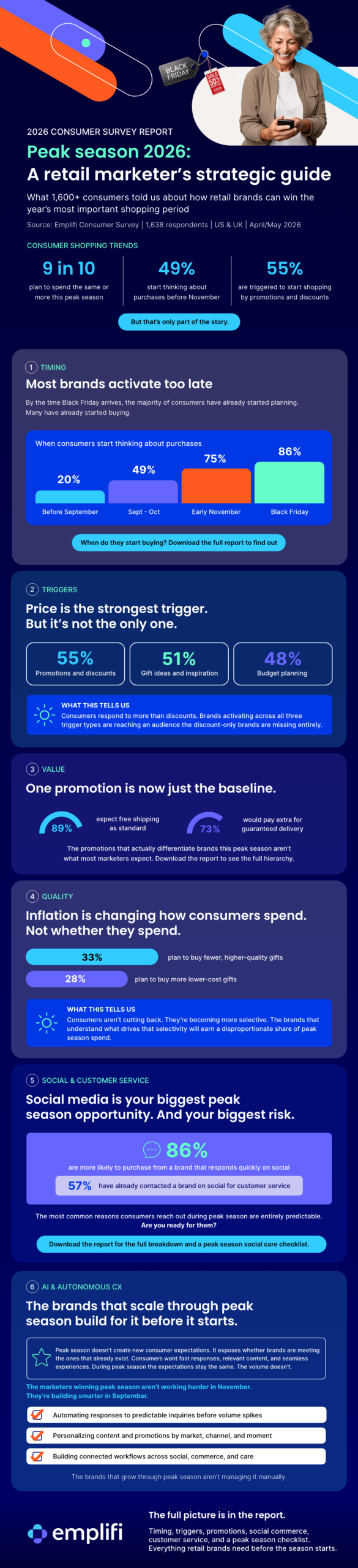
Retailers should begin planning and launching peak season marketing campaigns in September, not Black Friday. Emplifi’s consumer research found that 49% of shoppers start thinking about holiday purchases before November, meaning brands that engage customers early with gift inspiration, personalized content, and responsive social customer care are better positioned to influence purchase decisions before promotional competition intensifies.
Black Friday may still dominate retail calendars, but it’s no longer where peak season begins.
According to Emplifi’s 2026 Consumer Peak Season Survey, based on responses from 1,638 consumers across the US and UK, nearly half of shoppers (49%) start thinking about holiday purchases before November, and one in five (20%) begins before September.
That means many consumers have already researched products, compared brands, and created a shortlist before the first major Black Friday promotion appears.
For marketers, the takeaway is clear: if your holiday strategy starts in November, you’re already competing for decisions that have largely been made.
Download the full report for more stats, tips, and tricks.

| Consumer insight | Why it matters for marketers |
|---|---|
| 49% start thinking about purchases before November | Brand awareness and consideration campaigns need to start earlier. |
| 20% begin before September | Peak season planning should begin in late summer. |
| 55% are influenced by promotions and discounts | Price remains important—but it’s not enough on its own. |
| 51% respond to gift ideas and inspiration | Content marketing plays a critical role before shoppers are ready to buy. |
| 48% value budgeting guidance | Educational content helps brands build trust early. |
| 89% expect free shipping | Shipping is now a baseline expectation, not a differentiator. |
| 73% would pay extra for guaranteed delivery | Convenience and reliability can outperform deeper discounts. |
| 86% are more likely to purchase from brands that respond quickly on social media | Customer service directly impacts revenue during peak season. |
The research shows that consumer demand builds gradually—not all at once during Black Friday week.
Shoppers move through three distinct stages:
Most retail marketing focuses almost entirely on the third stage. But by then, many consumers already know what they want to buy.
Winning peak season increasingly depends on influencing shoppers during the planning phase, not just converting them during promotional periods.
Promotions remain the single biggest purchase trigger, influencing 55% of consumers.
However, the gap between discounts and other motivations is much smaller than many marketers expect.
This suggests that successful peak season campaigns combine promotional offers with helpful, relevant content.
Gift guides, buying advice, curated collections, creator recommendations, and educational content all help brands earn consideration before shoppers are ready to click “Buy.”
Economic pressure is changing how consumers shop rather than eliminating demand.
The survey found:
Rather than assuming shoppers only want bigger discounts, brands should communicate value, durability, quality, and thoughtful purchasing decisions.
For premium brands especially, this represents an opportunity to compete on experience instead of price alone.
Price may attract shoppers, but the overall experience increasingly determines where they purchase.
Consumers told us they expect:
Meanwhile, 57% have already contacted a brand through social media for customer service.
For retailers, peak season is no longer just a marketing challenge—it is also a customer service challenge.
Brands that invest in responsive social care, connected customer support, and accurate delivery communications are more likely to convert demand they’ve already created.
Instead of concentrating activity around Black Friday, consider building campaigns across the entire purchase journey.
The brands that perform best during peak season aren’t simply working harder in November—they’re preparing smarter months in advance.
Leading retailers are already using AI to:
Preparation, rather than reaction, increasingly separates high-performing retail teams.
Peak season success isn’t determined by who offers the biggest discount. It’s determined by who earns attention earliest, builds trust fastest, and delivers the experience consumers expect when they’re ready to buy.
Retailers that begin planning in September have more opportunities to influence purchase decisions, personalize experiences, and build stronger customer relationships before promotional competition reaches its peak.
Want the full picture?
Download Emplifi’s The retail marketer’s guide to peak season 2026 for deeper insights into consumer buying timelines, promotion preferences, social commerce trends, customer service expectations, and an AI readiness checklist to help your team prepare for the busiest retail season of the year.
Emplifi’s research found that 49% of shoppers begin thinking about holiday purchases before November, with 20% starting before September.
Promotions remain the strongest purchase trigger (55%), but gift inspiration (51%) and budgeting guidance (48%) are almost equally influential.
No. Consumers also value free shipping, guaranteed delivery, responsive customer service, and helpful buying advice. Experience is becoming just as important as price.
Brands should begin awareness and inspiration campaigns in September, expand consideration efforts through October, and use Black Friday to convert demand that has already been building for weeks.