Blog
8 min read
Jun 01, 2026

How Agentic AI is reinventing the chatbot

Traditional chatbots rely on rigid decision trees and scripted dialogue flows to deflect queries, leading to high escalation rates and low customer satisfaction. Agentic CX replaces static scripts with dynamic reasoning powered by Large Language Models, allowing bots to understand intent in real time, maintain conversational context across channels, and execute actions directly in backend systems.

Emplifi Team Social Media Marketing Experts
Team working in office

Key points

  • Legacy chatbots rely on rigid decision trees that break the moment customers go off-script
  • Agentic CX replaces scripted dialogue with dynamic reasoning to understand intent, not just keywords
  • On social channels like Instagram and WhatsApp, poor bot experiences can quickly impact customer perception and brand trust
  • Emplifi’s agentic AI combines dynamic reasoning, RAG-grounded knowledge, and sentiment-driven escalation to deliver conversational, on-brand resolutions across channels like Instagram and WhatsApp

What is agentic CX?

Agentic CX is a customer experience model in which AI systems go beyond retrieving and surfacing information to actively reasoning about customer intent, maintaining conversational context, and executing tasks directly in connected backend systems, all without pre-written scripts.

Unlike legacy chatbots that follow fixed decision trees, agentic AI resolves issues end-to-end in real time, across channels like Instagram, WhatsApp, and Messenger.

Legacy chatbots promised businesses 24/7 customer support, delivering instant responses to common customer questions to take the pressure off human agents.

But for many customers, the experience has fallen short. In fact, 50% of consumers say they often feel frustrated during chatbot interactions.

The value proposition behind chatbots was always clear: an always-on support layer capable of handling repetitive, low-complexity enquiries while extending customer care beyond business hours.

The challenge was the technology itself. Legacy chatbots relied on rigid workflows and scripted decision trees that struggled the moment conversations moved beyond predefined paths.

That’s now changing.

Today’s AI agents operate very differently from the rule-based bots that came before them. Instead of following static scripts, agentic CX systems can understand intent, maintain conversational context, access backend systems, and resolve customer issues across channels in real time, plus Emplifi research shows 34% of consumers say 24/7 availability is AI’s biggest benefit, while 27% value faster responses.

It results in a more connected customer experience, improving customer satisfaction rates. Here’s what changed, why it matters for customer care teams, and how agentic AI is reshaping the customer experience.

What you’ll learn in this guide:

  • Why legacy chatbots fail and where specifically they break down
  • Why social channels make the stakes higher than a website widget ever did
  • How dynamic reasoning works and why it outperforms scripted dialogue
  • What “read-write” integration means and why it’s the real unlock
  • How to audit your current bot and know when it’s time to upgrade

Why legacy bots break (and where)

At its core, a traditional chatbot operates like a decision tree, with every conversation path mapped out in advance.

For example, a customer asks, “How can I send a return?” and the bot walks them through a predefined workflow. That works well, as long as customers ask the exact questions the system was designed to handle.

The challenge starts when conversations become more nuanced or unpredictable. In fact, 73% of customers agree that chatbots can’t handle complex questions.

Give your customer care team the full picture

Connect community engagement and customer care in a single platform.

Watch now

That’s because legacy bots rely on keyword matching and rigid Natural Language Processing (NLP), scanning for trigger words rather than understanding meaning. When the conversation veers in another direction, the customer is routed to the wrong flow, gets an irrelevant answer, and either abandons or escalates to a human.

According to Gartner, only 14% of customer service issues are fully resolved through self-service, meaning the vast majority of customers who hit a wall with your chatbot still need a human. And the most common reason for self-service failure is that customers couldn’t find content relevant to their issue.

Failure mode What happens Customer experience
Off-script queries The bot can’t match the request to a predefined dialogue path. Customers hit loops, dead ends, or irrelevant responses.
Compound questions The bot resolves one issue but ignores the rest of the request. Customers receive a partial answer and need to contact support again.
Slang or natural language Keyword matching fails to understand customer intent. Responses default to “I didn’t quite catch that” or similar prompts.
Context switching The bot loses track of previous messages and conversation history. Customers have to repeat information multiple times.
Emotional tone The bot fails to recognise frustration, urgency, or sentiment shifts. Escalations happen too late, increasing customer dissatisfaction.

Why the stakes are higher on Instagram than they are on your website

When a customer contacts you via your website, the communication is largely contained and private.

But with 47% of frequent social media users turning to Instagram for customer service, the goalposts have changed. These customers expect a conversation, not a scripted response, and only 8% are willing to wait 48 hours for a DM reply. In fact, brands that take longer than 24 hours to respond risk losing a third of customers entirely.

The stakes aren’t just operational. Emplifi’s Digital Authenticity research found that 84% of consumers say customer service interactions should feel authentic, and 81% say a human tone matters in service interactions. This signals that robotic, scripted bot responses can actively damage brand trust.

Agentic AI helps you deliver the fast, conversational support experiences customers increasingly expect across social channels. Instead of relying on rigid menus or scripted prompts, the interaction feels conversational, contextual, and aligned to the brand voice. The bot understands what they’re asking, not just which keyword they used.

Capability Legacy chatbot on social Agentic CX on social
Tone Scripted, transactional responses Conversational, contextual, and aligned with brand voice
Context Limited memory and resets between interactions Maintains context throughout the customer journey
Compound queries Handles a single intent at a time Understands and resolves multiple intents simultaneously
Off-script requests Loops, fails, or escalates to a human Adapts to new information and works toward resolution
Brand risk Higher risk of visible customer frustration and poor experiences Governed responses help maintain brand consistency and trust

When social customer care feels conversational rather than scripted, customers get to a resolution faster.

After implementing Emplifi Agent, The Cheesecake Factory reduced handling time by 20% and cut the average time to close a customer case by 50%. By giving agents access to the right context in a single platform, the brand was able to deliver the fast, personalized experiences guests expect across every channel.

Using Emplifi Agent, we can offer a quick, appropriate solution when our guests have questions. Then, we get the chance to write a truly 'memorable chapter' of every guest experience story. We love to show empathy toward all of our guests, and with Emplifi Agent, it's easier for us to do.
Linda Candioty
Vice President of Guest Experience, The Cheesecake Factory

Dynamic reasoning vs. static scripts

Whereas a legacy chatbot follows a pre-set map, agentic AI can reason with a customer to fully understand their issue. It reads the customer’s message in full, understands their intent, checks what it knows, and formulates a response in real time.

This is powered by Large Language Models (LLMs) combined with Retrieval-Augmented Generation (RAG). The AI reasons dynamically but draws only from your approved knowledge base, keeping responses accurate and on-brand.

The difference in performance is significant. When Solo Brands migrated to a generative AI chatbot, resolution rates jumped from 40% to 75%, according to a Gartner case study.

Consumer appetite for AI support is also growing: Emplifi research found 71% of consumers are satisfied with AI support experiences but 66% now expect immediate replies from AI, compared to just 33% who expected it previously, a bar that legacy bots simply can’t clear.

Capability Dialogue flows (legacy) Dynamic reasoning (Autonomous CX)
How responses are generated Pre-written scripts and decision trees Real-time reasoning using approved knowledge and business rules
Handles new phrasing Keyword-dependent and highly structured Understands customer intent, even when wording changes
Context across conversation Limited or no memory between interactions Maintains conversational context throughout the journey
Personalization Template-driven responses Responses generated dynamically for each customer and situation
Improves over time Requires manual flow updates and maintenance Continuously optimized through knowledge updates and performance insights
Resolution capability Best suited to simple, predictable requests Capable of resolving complex, multi-step customer issues

Moving from read-only to read-write

Legacy chatbots were, at their best, sophisticated search engines. They could find information and surface it. But if customers wanted something done such as a refund processed, a subscription cancelled, or a flight rebooked, they waited for a human.

Agentic AI enhances this model by acting on its answers. By integrating directly with backend systems such as your CRM, order management platform, returns portal, and booking system, it can fully resolve customer queries in just minutes.

Customer task Read-only (legacy) Read-write (Autonomous CX)
Order status Retrieves and displays information Retrieves, updates, and confirms changes when permitted
Refund request Explains policy and next steps Processes refunds within predefined approval limits
Address change Directs the customer to complete the task themselves Updates details and confirms the change in conversation
Flight rebooking Redirects customers to a booking portal or agent Checks availability and completes eligible rebookings
Subscription change Escalates the request to a human agent Modifies subscription settings within approved workflows

Here’s what that looks like in practice:

A customer messages a retail brand on WhatsApp: “My order arrived damaged and I need a replacement before Friday.”

A legacy bot surfaces the returns policy and escalates.

An agentic bot pulls the order history, confirms the damage claim, checks replacement stock and delivery windows, processes the replacement, and sends confirmation inside the same conversation.

91% of consumers want brands to disclose when they use AI

See more stats like this in our latest report

Download now

When to escalate and how to do it without the customer noticing

The agentic upgrade doesn’t mean removing humans from the equation altogether. It means deploying them where they’re actually needed.

Well-governed agentic bots use two mechanisms to know when to hand off:

Confidence scoring: If the bot’s confidence in the correct resolution falls below a defined threshold, it pauses and routes the request to a human agent, with the full conversation context intact. The customer sees no gap.

Sentiment analysis: If the customer’s tone shifts — escalating frustration, all caps, language that signals a complaint or legal concern — the bot stops and silently escalates.

The quality of the handoff experience has a major impact on overall customer satisfaction, with only 15% of consumers reporting a seamless handoff from AI to human agents. Emplifi’s authenticity research found 84% of consumers say fast response times matter more than personalisation when judging whether a service interaction feels authentic, making the quality of the AI-to-human handoff a direct trust signal, not just an operational metric.

A unified inbox, such as the one provided by Emplifi, ensures customers are routed to the right agent in real time via Spike Alerts that grade incoming messages by emotional tone, complaint type, and urgency.

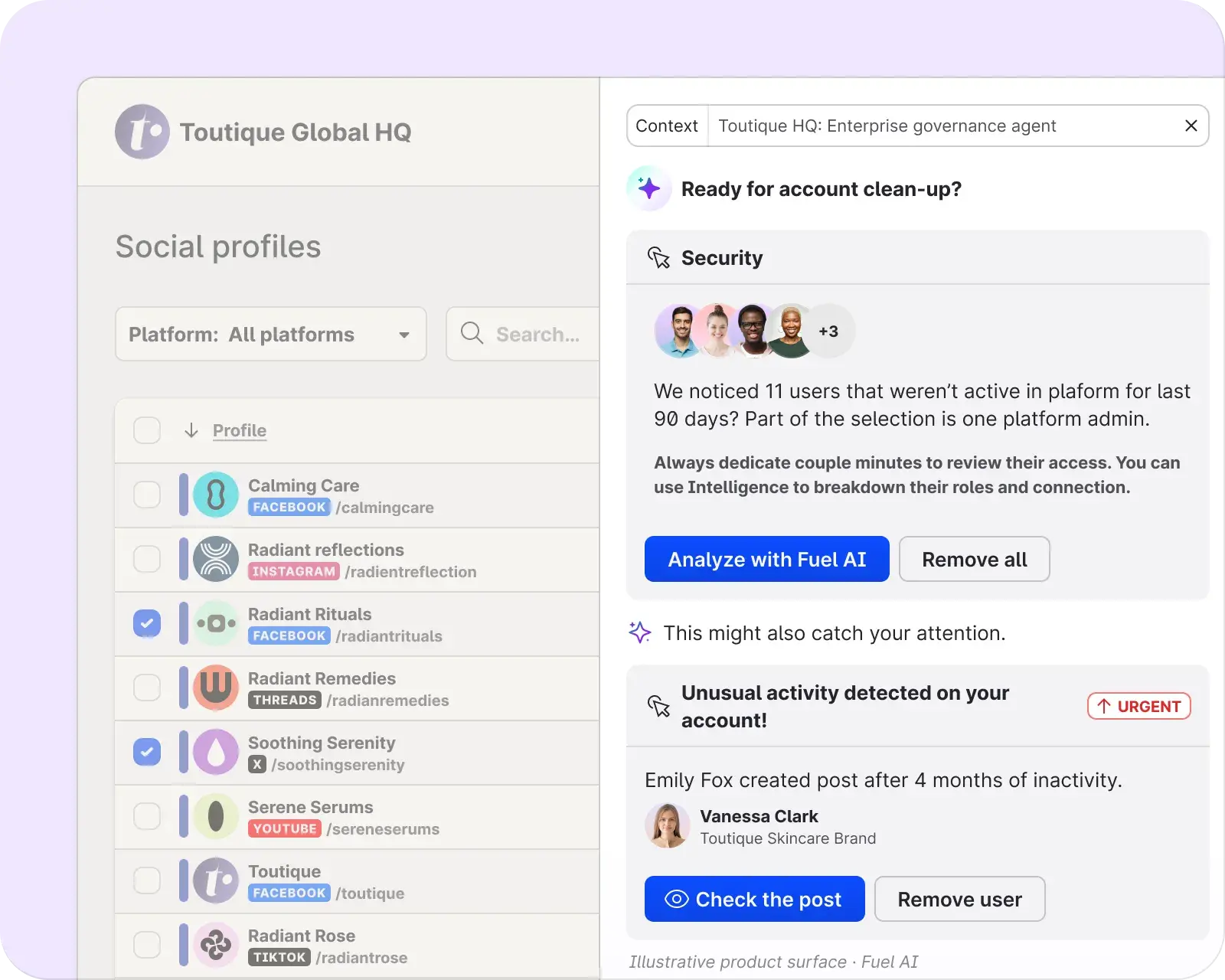
Security and compliance dashboard within the Emplifi Autonomous CX Platform.

Autonomous Governance interface highlighting scalable security, PII redaction, and crisis detection features.

How to audit your current chatbot

Before you upgrade to an agentic AI model, know where you stand. These metrics help customer care teams evaluate how effectively their current chatbot is performing:

Leading indicators that catch problems early:

  • Conversation abandonment rate
  • Repeat contact within 48 hours (same issue, different session)
  • Escalation request volume
  • Average messages before resolution
  • “Rage inputs” (customers repeating the same phrase multiple times)

Lagging indicators that confirm the impact:

  • Post-interaction CSAT
  • NPS movement among bot-interacted customers vs. human-interacted customers
  • Customer effort score
  • Churn rate correlation with bot exposure

If your escalation volume is high and your CSAT among bot-interacted customers significantly trails your human-handled score, your legacy bot could be costing you customers.

Final thoughts: Your chatbot is due an upgrade

The original promise behind chatbots was simple: faster responses, always-on support, and reduced pressure on customer care teams.

But scripted, rule-based systems were never designed to manage the complexity of modern customer conversations across multiple channels.

Agentic AI changes that.

By combining dynamic reasoning, conversational context, and connected backend systems, agentic CX allows brands to move beyond scripted interactions and deliver faster, more effective customer support at scale.

That matters more and more on channels like Instagram, WhatsApp, and Messenger, where customers expect support experiences to feel conversational and connected across every interaction.

Ready to see what an agentic upgrade could look like for your customer care operation? Book a strategy session with the Emplifi team to evaluate your current chatbot performance. 

Frequently Asked Questions

A legacy chatbot uses pre-defined decision trees and scripted dialogue flows to route customers toward fixed outcomes. Agentic CX uses Large Language Models to dynamically reason about customer intent in real time, maintain conversational context, execute actions in connected backend systems, and resolve issues end-to-end without pre-written scripts.

Social messaging channels carry an expectation of natural, fluid conversation. Legacy bots, with their structured menus and keyword-matching logic, feel jarring in that context. A bot that responds to an Instagram DM with “Please select from the following options” creates a brand moment that plays out publicly. Agentic CX bots are conversational by design, maintaining brand voice and contextual understanding across the interaction.

Legacy chatbots are read-only; they retrieve and display information but cannot take action. Agentic AI is read-write; it connects to backend systems such as CRMs, order management platforms, and returns portals to execute tasks directly within the conversation. This means processing refunds, updating orders, rebooking flights, or modifying subscriptions without requiring a human agent to step in.

Track your conversation abandonment rate, escalation request volume, repeat contact rate within 48 hours, and post-interaction CSAT. If your bot-interacted CSAT is significantly lower than your human-handled CSAT, and your escalation rate is above 30%, your legacy bot is actively costing you customers rather than serving them.

Insights from Emplifi

Explore our latest blogs and comprehensive guides designed to help you master customer experience strategies and drive growth.

Ready to fuel your teams with A-CX?

Discover what Emplifi can do for you. We turn small teams into large ones, and large teams into well oiled machines, but either way, we offer the rocket ship, you just need to jump on.

What can you expect?

  • A live walkthrough of Emplifi Fuel tailored to your specific social marketing, commerce, and care needs
  • A benchmark of how your brand performs against peers in your industry
  • A partner who understands your business, and 22,000 others
  • A concrete action plan to go from disjointed teams to A-CX
Get a demo

Outpace your competition with easy-to-use, innovative solutions

We’re recognized as a market leader in innovation, customer support, and ease of use from these organizations.