Blog
15 min read
May 06, 2026

Social media management: The ultimate guide for brands

A social media strategy is a structured, goal-driven plan that defines how a brand uses content, platforms, data, and tools (including AI agents) to reach the right audience, drive engagement, and achieve measurable business outcomes, making it essential for effective marketing in 2026.

Jordan Lukes Director of Content and Corporate Marketing

Key points

  • AI agents can now handle tier-1 community management, freeing marketers to focus on high-value creative work
  • Emplifi customers saw a 4.5% increase in median post engagement rate on Instagram and a 5.3% lift in median post reach after adopting the platform
  • TikTok brand follower counts grew 200% year-over-year in 2025; it’s no longer a side experiment
  • The right social media management tool isn’t necessarily the one with the most features, but the one that fits your team’s workflow and gives you confidence that it supports your success
  • Human-AI collaboration is becoming the new operating model for high-performing social teams

There are more than 5 billion active social media users worldwide.

Your audience is out there. But reaching them depends on having the right strategy in place.

A social media strategy gives you the roadmap to achieve your goals, whether it’s brand awareness or increased sales.

In 2026, you don’t need a huge team or a massive budget. What you do need is a smart strategy combined with intelligent tools like AI that can automate low-value repetitive tasks.

This guide covers both. You’ll get a practical framework for building a successful social media strategy, a breakdown of the best social media management tools on the market, and, importantly, how to design Human-AI collaboration workflows that actually work.

What you’ll learn in this guide:

  • How to build a modern social media strategy that drives business outcomes
  • How to create platform-specific content that performs
  • Where AI adds real value and how to integrate it into your workflow
  • Which metrics matter and how to measure real impact
  • How to scale social into a full-funnel growth channel

What is a social media strategy (and why does it still matter)?

A social media strategy is a structured plan that defines how your brand will use social platforms to achieve specific business objectives.

Without a clear strategy, you’re producing content that serves no one.

It identifies your target audience, sets measurable goals, and maps out the content and channels needed to get there.

Every post and every community interaction has a purpose tied to business outcomes. That could be brand awareness, lead generation, customer retention, or direct revenue.

There’s also an additional layer to consider: your strategy needs to define how AI fits into your execution. For instance:

  • Which tasks does AI handle?
  • Where does a human stay in the loop?
  • How do you train AI agents to sound like your brand?
Build a smarter social strategy for 2026

Get our free marketing roadmap template and create a strategy that drives results

The key components of a modern social media strategy


1. SMART goals tied to business outcomes

Your goals should follow the SMART framework:

  • Specific
  • Measurable
  • Achievable
  • Relevant
  • Time-bound.

For example, “get more followers” isn’t a goal. But “increase Instagram engagement rate by 15% in Q1 by shifting to Reel-first content” is.

Once you’ve defined what you want to achieve, connect every social KPI back to a business metric. Engagement rate, click-through rate, and conversion data are the indicators that matter.

Follower count is a vanity metric unless you can prove it’s moving revenue.

2. Audience research that goes beyond demographics

You need to understand how your audience behaves on each platform, what content they stop to watch, and what problems they’re trying to solve.

Platform analytics, social listening data, and customer feedback all feed into this to create a detailed picture of your audience.

Unified social management tools like Emplifi consolidate intelligence from your earned, owned, paid, competitive, and voice-of-the-customer channels in one place, making it easier to understand exactly who your customers are and what’s important to them.

3. A content strategy built for each platform

One-size-fits-all content is a fast track to irrelevance.

Instagram rewards Reels and Carousels. TikTok rewards consistency and native creativity. LinkedIn rewards genuine thought leadership.

Facebook Live still generates four times as many interactions as any other format on the platform, according to Emplifi’s 2026 benchmark data.

Your content strategy needs to be platform-native and format-aware, with different briefs, production processes, and KPIs for each channel, ensuring relevance and engagement across platforms.

4. The right platform mix

Focus your energy on where your audience is most active, rather than spreading yourself too thin across every channel.

Here’s what each channel is best for and how often you should be posting on each one:

Platform Best for Median engagement rate (Q4 2025)* Recommended posting frequency
TikTok Brand growth, entertainment, Gen Z 27.6% 1–3x daily
Instagram Visual storytelling, community, and shopping 9.7% 1–2x daily (feed) + Stories
LinkedIn B2B, thought leadership, talent Strong double-digit follower growth 2–5x weekly
Facebook Broad reach, live video, paid amplification 1.4–2.5% 1–2x daily
X (Twitter) Real-time, news, brand personality Varies 1–5x daily

*Source: Emplifi 2026 Social Media Benchmark Report

TikTok is the standout story. Emplifi data shows brand follower counts on TikTok grew 200% year-over-year in 2025, generating twice the median number of interactions on Instagram and 20 times more than on Facebook.

Emplifi social engagement tool

5. Metrics that reflect real impact

Track core metrics that move the needle, such as:

  • Engagement rate (interactions ÷ reach): The truest measure of content resonance
  • Click-through rate: Are people taking the next step?
  • Conversion rate: Is social driving actual revenue?
  • Response time: Over a third of consumers expect a reply within an hour, according to Emplifi research.
  • Sentiment score: What do people actually think of your brand?
Metric TikTok Instagram Facebook
Median engagement rate (Q4 2025) 27.6% ~9.7% ~1.4–2.5%
Median interactions vs others 2× higher than Instagram Baseline ~20× lower than TikTok
Brand follower growth YoY +200% (median) Slower growth vs TikTok Slower growth vs TikTok
Top-performing content format Short-form video Reels and carousels Live video

AI in social media strategy: From assistant to agent

AI has moved well beyond generating captions. AI agents can now execute entire workflows such as scheduling posts, routing community management cases, responding to tier-1 enquiries, and surfacing insights, without human intervention on each task.

This is a significant shift. And it changes what social media marketers should be spending their time on.

According to Emplifi data, its customers generated an average of more than 53,000 AI-powered interactions per month in 2025 and published nearly 600,000 social posts per month. That volume isn’t possible with manual execution; AI is the layer that helps you to scale.

Here’s where AI adds the most value across a modern social strategy:

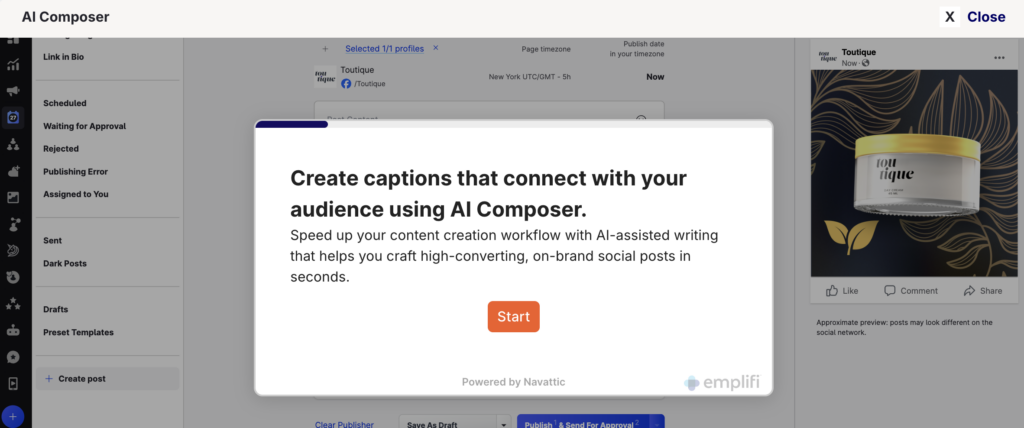
  • Content creation and personalization: AI assists with caption writing, hashtag strategy, format recommendations, and audience-specific personalization, adjusting messaging based on user behavior patterns to increase relevance.
  • Predictive analytics: AI analyzes past performance data to identify emerging trends before they peak, recommends optimal posting times, and surfaces content formats most likely to perform on each platform.
  • Automated community management: AI agents can handle tier-1 community interactions: acknowledging comments, answering common questions, routing complex cases to human agents, and flagging sensitive content for review.
  • Advertising optimization: AI continuously refines audience targeting, adjusts bids in real time, and reallocates spend toward the highest-performing creative, improving ROAS without constant manual intervention.
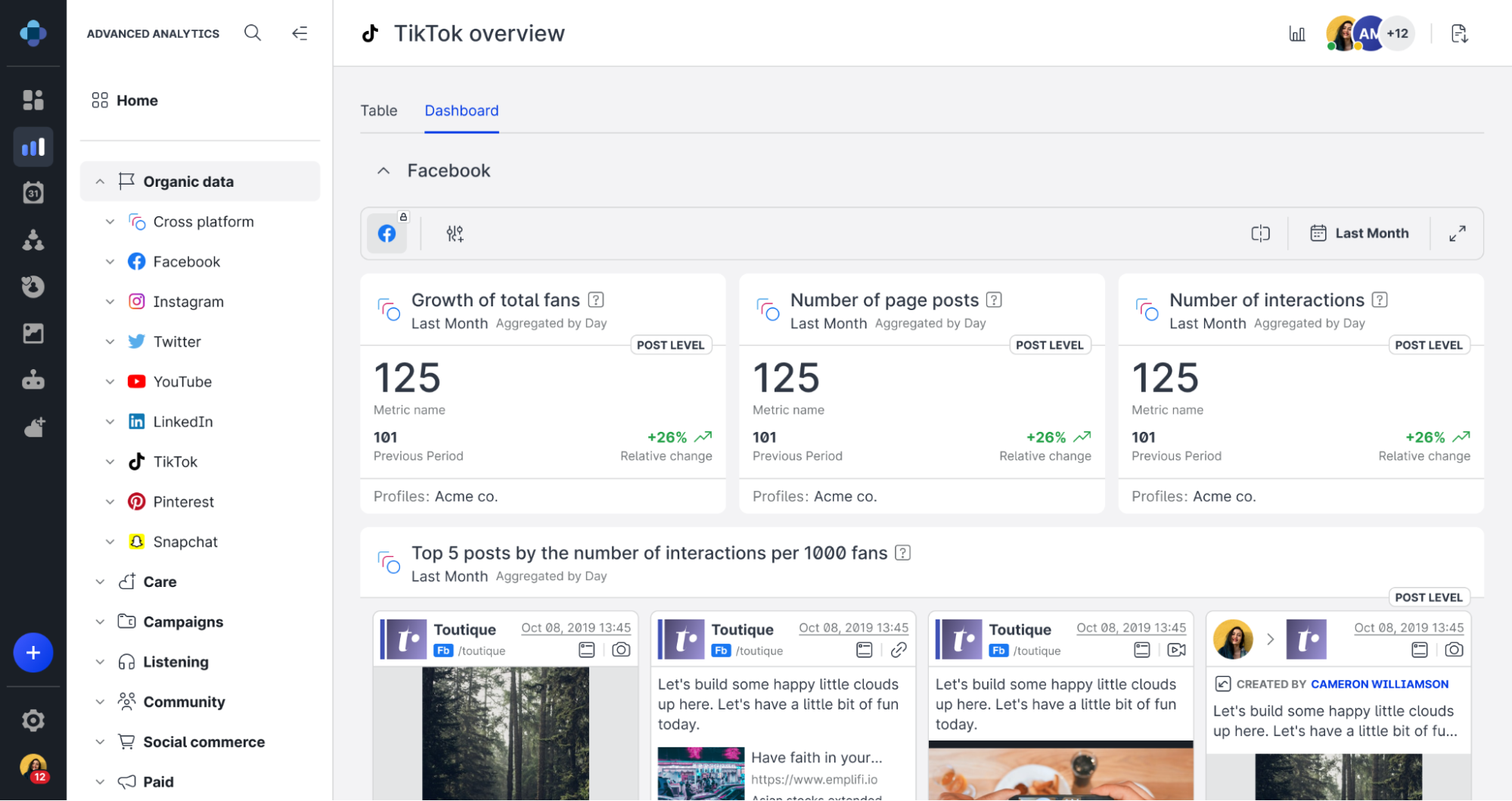
  • Reporting: Automated reporting eliminates the hours spent pulling data from multiple platforms. Emplifi creates custom dashboards and automates KPI views, enabling teams to make faster, smarter decisions.

Designing workflows for human-AI collaboration

This is where most brands get stuck. They adopt AI tools but don’t redesign their workflows around them.

But that simply results in AI sitting on the side, doing the occasional task, while teams still operate manually.

The fix is to treat AI as a co-pilot with a specific role in your operation. Here’s how to build that structure:

Step 1: Define the tier system for community management

Not every social interaction is equal. Build a triage model:

Tier Type of interaction Handler
Tier 1 FAQs, greetings, low-complexity comments AI agent (automated)
Tier 2 Complaints, product questions, moderate complexity AI-assisted human review
Tier 3 Crises, sensitive cases, influencer relationships Human-only

Your AI agent handles Tier 1 at speed and volume. Your team owns Tier 3 with full creative and strategic judgment. Tier 2 is the handoff layer where AI drafts a response but a human reviews and publishes.

Step 2: Train your AI agent on brand voice

An AI agent left to its own devices will sound generic. And with 67% of consumers preferring a human response, you don’t want to instantly give them a negative experience.

While humans might be irreplaceable here, AI can be properly trained to make it indistinguishable from your brand. That training involves:

  • Providing a brand voice guide as part of the agent’s system prompt. Include tone descriptors, prohibited phrases, example approved responses, and the brand’s communication principles.
  • Creating a response library: Feed the agent a curated set of on-brand community management replies that cover your most common scenarios.
  • Setting guardrails for escalation: Define the triggers that should always route to a human, such as mentions of legal issues, product recalls, media enquiries, and any content that requires judgment rather than pattern recognition.
  • Running regular audits: Review a sample of AI-generated responses weekly. Correct any drift immediately and update the training data.

Aeromexico used Emplifi to streamline community management and reduce its response time from 4 days to a couple of hours per day. Their social team was then free to focus on content creation and campaign strategy – the work that requires genuine creativity and cultural insight.

Implementing Emplifi in my daily life has allowed me to automate tasks that were previously performed manually. My team has been able to prioritize topics of inspiration and creativity, spending time creating more valuable content for our audience. It's incredible how easily we can get detailed insights from our posts.
Anaya Monserrat
Senior Social Media Analyst

Step 3: Build clear human-AI handoff protocols

Every workflow needs clear handoff points. Define:

  • When does an AI-handled conversation get flagged for human review?
  • What information does the AI pass to the human agent to preserve context?
  • How quickly must a human agent respond after a flag?

Freshpet is a case in point. Their AI-powered chatbot named “Scout” answered 97% of consumer enquiries automatically and correctly. That capability freed their consumer care team to focus exclusively on complex, high-impact cases. The result was a 40% reduction in call volume and a 29% drop in live-agent wait times.

The humans on Freshpet’s care team became specialists in complex cases, not administrators of routine ones.

Emplifi supports us every day, in everything that we do. Our spokes on the wheel are integrated with (Emplifi) Agent, making it easy for our teams to enter the correct data, which in turn helps with accurate reporting. Many critical decisions within our organization are made based on the information collected, and being able to run accurate reporting. The integrated Emplifi tools help us do that easily.
Lisa Diehl
Consumer Care

Step 4: Define human-led creative strategy

AI is excellent at execution. But it still needs humans for genuine cultural insight, brand intuition, or creative risk-taking. 

In a well-designed Human-AI collaboration model, the social media marketer’s role evolves from execution to direction. For example:

  • Setting the creative brief that AI works from
  • Making judgment calls on cultural moments and brand positioning
  • Leading influencer and creator relationships
  • Developing platform strategy and campaign architecture
  • Reviewing AI performance and iterating on training

This is a better use of skilled marketers. And it produces better output than either humans or AI working alone.

Proven social media strategy examples

Aeromexico: From analytics to emotional connection

When Aeromexico needed to reposition itself as a beloved travel brand in Mexico, it used Emplifi to consolidate social analytics and competitive intelligence.

The team launched a World Dog Day campaign using emotional video content, achieving 75% positive sentiment and 41,000 organic Instagram views. Their “This is Flying” campaign generated 90% positive sentiment and over 2.4 million impressions in a single week.

Emplifi’s community management tools let the team respond at scale with personalized, on-brand replies, building the emotional connection the campaign intended.

Salomon: Speed and structure in support

Sports equipment brand Salomon used Emplifi to cut response times by 45% and accelerate case handoff by 70%.

The result was a support system that could operate at a competitive speed without sacrificing the empathy their customers expect.

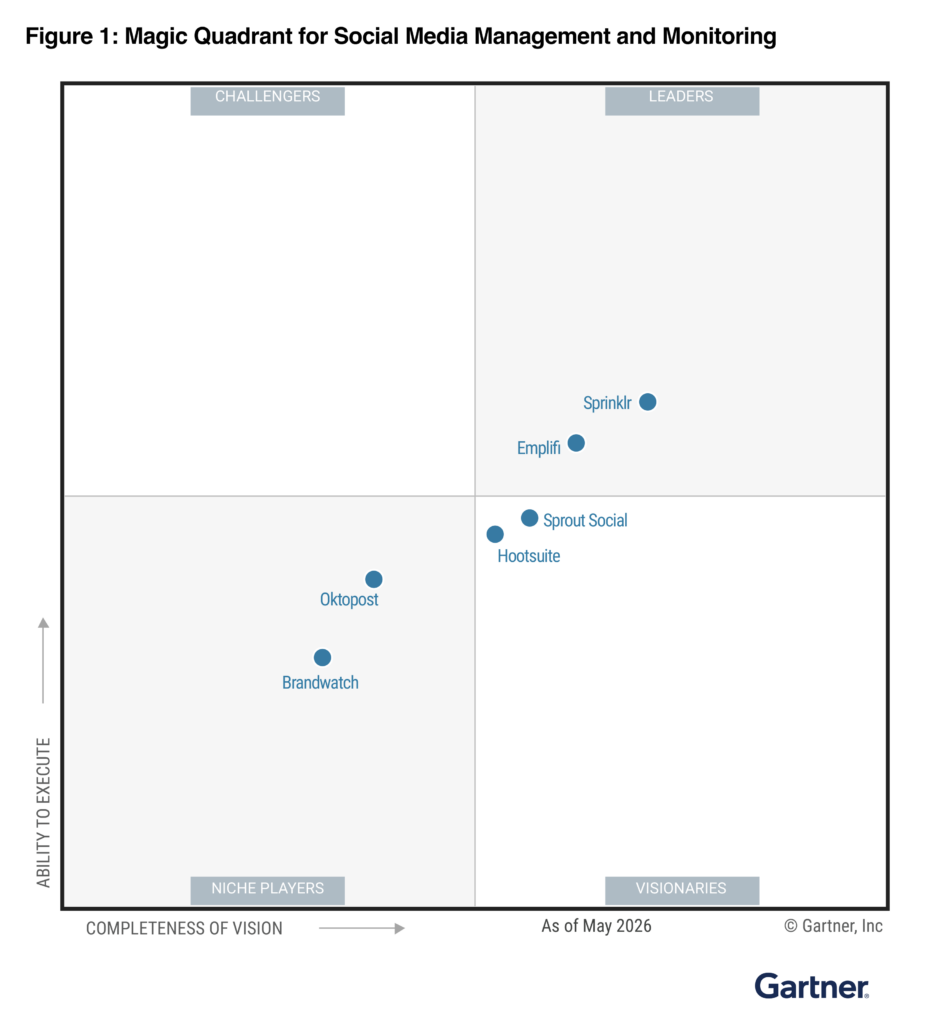
The best social media management tools in 2026

Strategy is only as good as the infrastructure that executes it.

Here’s a clear breakdown of the leading social media management platforms, what they do well, and who they’re built for.

Tool Best for Key strengths Considerations
Emplifi Mid-market to enterprise brands looking to unify social and customer experience End-to-end platform (publishing, analytics, care, UGC, influencers), strong CX + commerce integrations, AI-powered insights May offer more depth than smaller teams require
Hootsuite SMBs to mid-market teams building social maturity Scheduling, wide integration ecosystem, strong training resources Limited depth in customer care, listening, and enterprise CX
Sprout Social SMBs and scaling teams Intuitive UX, strong publishing and reporting, reliable core feature set Advanced capabilities (listening, advocacy) require additional investment
Sprinklr Global enterprises with complex, multi-market needs Omnichannel CX, deep customization, strong governance and AI capabilities High implementation complexity; requires significant internal resources
Buffer Small businesses, startups, and creators Simple, user-friendly interface, flexible pricing, efficient scheduling Limited scalability for larger teams or complex workflows
Dash Hudson Visual-first brands (e.g. fashion, beauty, lifestyle) Predictive performance insights, visual intelligence, content benchmarking Less comprehensive for full social media management and cross-channel reporting
Khoros Enterprises prioritising customer service and community Scalable care solutions, strong community management capabilities Heavier setup and typically used alongside other tools
Meltwater PR, communications, and social listening teams Media monitoring, journalist database, robust listening capabilities Not designed for end-to-end social media management
Oktopost B2B organisations focused on pipeline and attribution Lead tracking, employee advocacy, compliance-focused workflows Narrower scope; less suited to B2C or content-led strategies

1. Emplifi: The all-in-one platform

Trusted by thousands of brands globally, Emplifi enables teams to plan, publish, engage, listen, analyze, and manage customer care across social channels.

The platform is designed for modern marketing teams managing high-volume, multi-channel operations, with AI and automation embedded throughout workflows rather than added as separate layers.

What sets it apart:

  • Unified analytics that bring together earned, owned, paid, competitive, and voice-of-customer data into a single view
  • AI-powered publishing with content recommendations, optimal posting times, and performance insights
  • Community management tools including smart routing, automated responses, and human escalation workflows
  • Social care capabilities adopted across a wide range of enterprise customers to support high-volume interactions
  • Integrated UGC and influencer marketing, managed alongside core social publishing workflows
  • Localized customer support, with regional expertise for global teams

Across its customer base, brands using Emplifi report significant improvements in content performance during platform adoption periods, even as broader social engagement trends fluctuate.

2. Buffer: Simple and effective for smaller teams

Buffer focuses on the fundamentals: scheduling, analytics, and content planning within a clean, intuitive interface.

For small businesses, startups, or solo social managers looking to maintain consistency without added complexity, it remains a practical and accessible starting point.

3. Hootsuite: A flexible foundation for growing teams

As one of the earliest social media management platforms, Hootsuite continues to support teams building and scaling their social strategy.

Its extensive integration ecosystem helps extend functionality across tools, while its knowledge base and training resources provide a strong foundation for developing in-house expertise.

While it offers capabilities across publishing, engagement, and listening, organizations with more advanced customer care or CX requirements often supplement it with additional platforms.

4. Khoros: Built for large-scale community and care

Khoros is designed for enterprise organizations, particularly those running contact centers alongside social operations.

Its strengths lie in community management and customer service at scale, enabling teams to manage high volumes of complex interactions. This level of capability typically comes with a higher implementation investment and longer setup time.

5. Sprinklr: Maximum flexibility, maximum investment

Sprinklr can be configured to support a wide range of enterprise use cases, spanning social media management, paid advertising, insights, and customer service.

That flexibility makes it a powerful option for global organizations but it also introduces complexity, often requiring dedicated platform ownership and significant onboarding.

6. Sprout Social: Clean UX for growing teams

Sprout Social offers an intuitive experience across publishing, community management, and analytics.

Its core product is well suited to growing teams, with more advanced capabilities such as social listening, employee advocacy, and deeper analytics, available through higher-tier plans.

7. Dash Hudson: For visual-first brands

Dash Hudson is particularly strong for brands where visual performance drives decision-making, such as fashion, beauty, and lifestyle.

Its visual intelligence and predictive insights help teams understand what content is likely to perform, while its commerce integrations connect social content performance to eCommerce outcomes.

For organizations needing broader cross-channel reporting or full-suite management, additional tools may still be required.

8. Meltwater: Media intelligence with a social layer

Meltwater is rooted in media monitoring and PR intelligence with its abilities to track news coverage, manage journalist relationships, and support crisis communications.

While it includes social listening and some social management capabilities, it’s not primarily designed as an end-to-end social media execution platform, making it better suited to communications teams than dedicated social marketing functions.

9. Oktopost: B2B social with compliance built in

Oktopost is purpose-built for B2B organizations, with a focus on employee advocacy, social ROI measurement, and compliance, particularly in regulated industries.

For teams prioritizing pipeline impact and attribution, it offers clear strengths. For broader brand-led or consumer-focused social strategies, its scope is more specialized than full-suite enterprise platforms.

12 questions to ask when evaluating social media management tools

Before you commit to a platform, ask these questions. Most providers will give polished demos and these questions cut through to what actually matters for your team.

# Area Key questions
1 Ease of use How long does onboarding take? Can new users get productive in days, not months?
2 Integrations Does it connect with your CRM, analytics tools, and ad platforms?
3 Content management Does it support UGC, influencers, and ratings/reviews alongside owned content?
4 Customer care Can it route and manage social inbox cases? Does it integrate with Salesforce or your helpdesk?
5 Analytics Does it cover paid, earned, owned, and competitive data in one unified view?
6 Pricing What’s included in the base price? What triggers additional costs?
7 Support Is support localized? Is there a dedicated account manager?
8 Social listening Does it surface brand mentions, sentiment trends, and competitor activity in real time?
9 Security & compliance What data security standards does it meet? Does AI usage comply with your internal policies?
10 Scalability Can it grow with your team as volumes, channels, and complexity increase?
11 Extended capabilities Does it go beyond social into ratings/reviews, influencer management, and social commerce?
12 Trial or demo Can you test the full feature set before committing?

Paid social: The amplification layer

Organic reach is limited because social algorithms limit how many of your followers see any given post.

Paid advertising solves that and when integrated with your organic strategy, it amplifies your best content to the audiences most likely to convert.

Here are the key principles for paid social to bear in mind in 2026:

  • Retargeting can be great for conversions. Users who’ve already engaged with your brand are 150% more likely to convert than cold audiences. Build retargeting segments that capture website visitors, video viewers, and engaged social users.
  • Let AI optimize your campaigns. Modern ad platforms use machine learning to adjust targeting, creative, and bids in real time. Set your business objective and let the algorithm find efficiency then review and iterate based on outcome data, not just impression counts.
  • Invest in Reels on Instagram. Emplifi data shows Instagram Reels ad spend tripled between Q1 2024 and Q4 2025. The format works.
  • Test before you scale. Run A/B tests on creative, audience, and objective before committing the full budget. Keep in mind that works on TikTok will not automatically translate to Facebook.

How social media strategy drives sales

Social media is an end-to-end funnel. It creates awareness at the top, builds consideration in the middle, and drives conversion at the bottom.

Making it work as a revenue channel requires intentional design at each stage:

  • Awareness: Reach new audiences through organic content, influencer partnerships, and paid discovery campaigns
  • Consideration: Build trust with UGC, customer reviews, thought leadership, and educational content
  • Conversion: Use shoppable posts on Instagram and TikTok, retargeting ads, and time-limited offers to drive purchase
  • Retention: Build community through responsive engagement, exclusive content, and loyalty-focused campaigns

Emplifi’s research found that 46% of consumers will abandon a brand after just two negative experiences. And a quarter will leave after one. Your social channels aren’t separate from the customer experience; they are the customer experience, in real time.

Common mistakes to avoid:

  • Chasing vanity metrics. Follower count tells you almost nothing about business impact. Focus on engagement rate, click-through rate, and conversion data.
  • Being on too many platforms. A mediocre presence on six channels is worse than a strong presence on two. Concentrate resources where your audience is most active.
  • Ignoring analytics. The data will tell you what’s working. Most brands don’t read it closely enough or act on it fast enough.
  • Sounding like a brand, not a person. Real engagement comes from a conversational tone, authentic storytelling, and genuine responsiveness.
  • Using AI without brand training. Deploying an AI agent without giving it brand voice guidelines, guardrails, and a curated response library is how you end up with generic, off-tone community management. Train it like you’d train a new team member.

Not responding fast enough. A third of consumers expect a brand to reply to tags or DMs within an hour. Slow responses signal that you don’t care.

Strategy by business objective

A simple way to get started is to break your objectives down to see where your focus should live:

Objective Priority platforms Content focus KPIs
Brand awareness TikTok, Instagram, YouTube Short-form video, shareable content, influencer partnerships Reach, impressions, share rate, follower growth
Lead generation LinkedIn, Meta Gated content, educational resources, lead magnets Cost per lead (CPL), conversion rate, landing page traffic
Customer retention Instagram, Facebook Groups Community-led content, loyalty exclusives, personalized DMs Engagement rate, DM response rate, repeat purchase rate
Social commerce TikTok Shop, Instagram Shopping Shoppable posts, user-generated content (UGC), product demos Click-to-purchase rate, return on ad spend (ROAS), add-to-cart rate
Customer care Facebook, Instagram, X Fast responses, proactive FAQs, resolution-focused content Response time, customer satisfaction (CSAT), resolution rate

Final thoughts: Build for success with a strategy that scales

A winning social media strategy is built on an intelligent system with clear goals, the right platforms, a tool stack that automates what it should, and humans focused on the decisions that require genuine judgment.

Emplifi powers that system for leading brands like Aeromexico, Freshpet, and Salomon.

Whether you’re building from scratch or optimizing what you have, book a demo today and see what the right infrastructure makes possible.

Frequently Asked Questions

A social media strategy is a structured, goal-driven plan that defines how a brand uses content, platforms, data, and tools to reach the right audience, drive engagement, and achieve specific business outcomes.

Start with your business objective. Then define your target audience and which platforms they use most. Set SMART goals, build a content plan suited to each platform, select the right management tools, and establish a measurement framework. Review and iterate every quarter.

AI can automate content scheduling, generate and personalize content, handle tier-1 community management, optimize paid advertising in real time, and surface performance insights. The key is deploying AI with proper brand training and clear human oversight at the right escalation points.

Emplifi is the leading social media management tool for medium- to large-sized brands that need unified analytics, AI-powered community management, social care, UGC, and influencer management on a single platform. Leading brands like Aeromexico, Freshpet, and Salomon use it for that reason. 

The ideal best times to post on social media varies depending on your audience preferences, platform norms, and content resources. However, consistency is crucial—regularly sharing high-quality, relevant content keeps your brand top of mind and encourages ongoing engagement. For example, daily posts may work well on fast-moving platforms like Twitter or Instagram, while LinkedIn might require fewer but more in-depth updates. Monitoring your analytics can help you find the optimal cadence that maintains audience interest without overwhelming them.

Insights from Emplifi

Explore our latest blogs and comprehensive guides designed to help you master customer experience strategies and drive growth.

Ready to fuel your CX and social media marketing?

Discover how Emplifi boosts efficiency, increases revenue, and scales your social media marketing — whether you have a small team or a complex product. Let’s talk today.

What can you expect?

  • A partner who cares about your strategy and objectives
  • Live demo showing how we differentiate from the pack
  • No pressure, just advice
Get a demo