Enterprise social teams operating across dozens of brands, hundreds of locations, and multiple regional markets face a fundamentally different challenge than teams managing a handful of accounts. After years of acquisitions, expansion, franchise growth, and agency transitions, social ecosystems often grow faster than the governance systems designed to support them.
At enterprise scale, social media management stops being a scheduling problem and becomes an organizational systems challenge.
The resulting complexity is rarely a tooling problem alone. It is a governance architecture problem. Shared credentials, disconnected reporting, manually maintained permissions, and spreadsheet-based oversight create operational debt that compounds over time.
Organizations rarely fail because of a single bad decision. They struggle because operational complexity accumulates faster than governance maturity.
In this guide you will learn:
- Why enterprise social operations become fragmented
- The operational costs of managing social without governance
- What governance maturity looks like in enterprise organizations
- How governance-focused platforms operationalize distributed social operations at scale
What is enterprise social media governance?
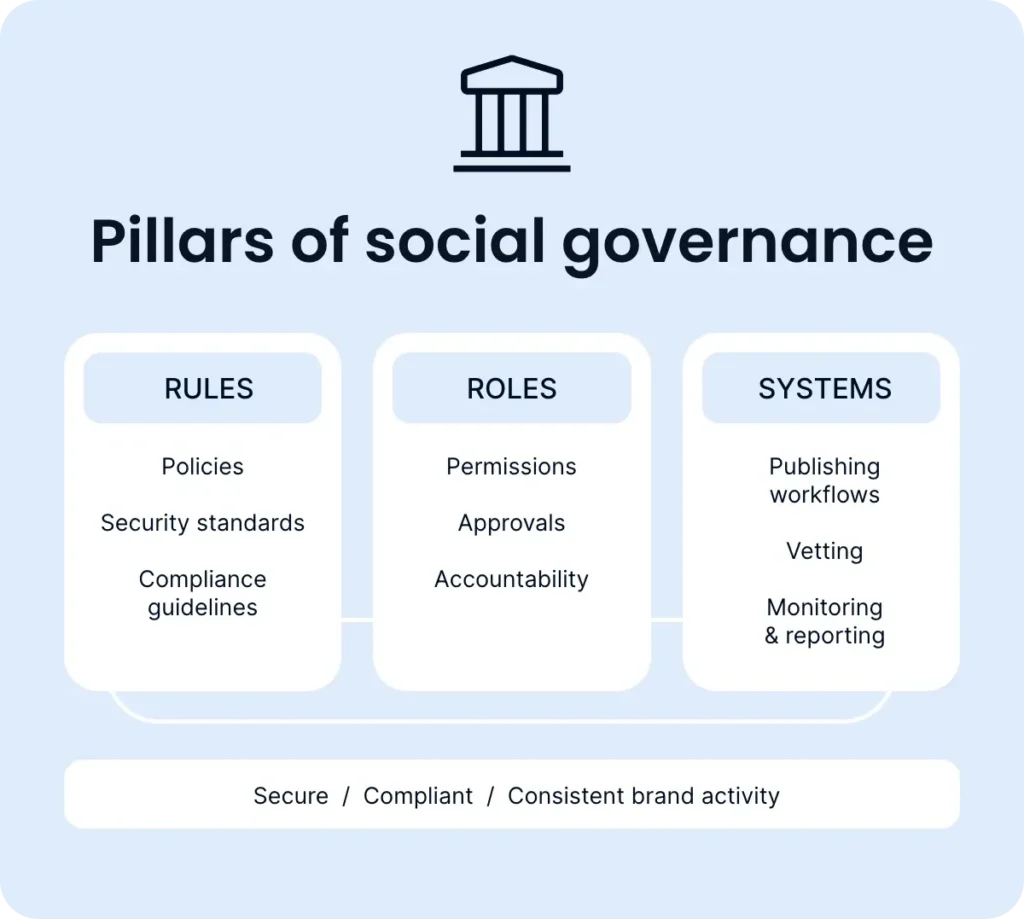
Enterprise social media governance is the operational framework organizations use to manage access, permissions, workflows, reporting, compliance, and brand consistency across distributed social teams.
At smaller organizations, governance is often informal. A handful of employees manage publishing, approvals happen manually, and visibility exists naturally because teams are small.
Enterprise environments operate differently.
As organizations expand across regions, brands, business units, franchises, and agency partnerships, social operations become structurally more complex. Governance becomes the system that keeps that complexity manageable.
Mature social governance defines:
- Who can access accounts
- How permissions are granted
- How approvals operate
- How reporting rolls up across regions
- How compliance is maintained
- How brand standards are enforced
- How teams collaborate without creating operational fragmentation
Without governance, enterprise social operations become increasingly dependent on manual coordination, institutional knowledge, spreadsheets, and inconsistent processes that fail to scale as the organization grows.
Governance is not simply about restricting access or enforcing policy. At enterprise scale, governance enables distributed execution. It creates the operational structure that allows regional, local, and brand teams to move independently while maintaining centralized visibility, accountability, and consistency.
The operating-model problem enterprises keep misdiagnosing
The most expensive mistake enterprise social teams make is treating complexity as a tooling problem.
When reporting becomes inconsistent, organizations add another analytics layer. When access becomes difficult to track, they build spreadsheets. When brand inconsistency appears, they revise governance documents. Each intervention treats a symptom. None changes the structure producing the symptom.
Managing five accounts is a publishing problem. Managing hundreds of accounts across brands, franchises, acquisitions, agencies, and regions is categorically different. The limiting factor is no longer publishing capability. It is a governance architecture.
Organizations that fail to redesign their operating model as they grow accumulate governance debt: structural complexity that compounds with every acquisition, market launch, and agency engagement.
In Zapier’s 2025 survey of more than 500 enterprise leaders on AI and software orchestration, 90% said centralized orchestration across tools was critical. Only 35% had invested in or seriously considered the infrastructure required to support it.
The result is familiar to most enterprise social leaders:
- Fragmented reporting
- Inconsistent brand execution
- Unmanaged permissions
- Duplicated workflows
- Limited visibility across regions
- Rising compliance exposure
The challenge is rarely one catastrophic failure. It is the cumulative effect of growth without operational redesign.
Symptoms vs root governance problems
| Operational symptom |
Typical response |
Root governance issue |
| Inconsistent reporting |
Add another analytics tool |
Fragmented data ownership |
| Brand inconsistency |
Revise brand guidelines |
Weak governance controls |
| Access confusion |
Maintain spreadsheets manually |
No centralized permissions |
| Slow expansion |
Add operational headcount |
Governance does not scale |
| Compliance exposure |
Run manual audits |
Limited auditability |
What is enterprise social media account sprawl?
Social media account sprawl is the unmanaged accumulation of accounts, permissions, workflows, reporting structures, and ownership models across an enterprise.
It is a predictable outcome of:
- Acquisitions
- Regional expansion
- Franchise growth
- Decentralized teams
- Rotating agency relationships
Over time, organizations inherit disconnected Meta Business Managers, regional publishing systems, outdated permissions, duplicated workflows, and inconsistent reporting structures that nobody fully owns or controls.
According to Okta’s Businesses at Work 2025 report, organizations now use an average of 101 business applications per company. Zylo’s SaaS management research suggests the broader enterprise SaaS footprint is substantially larger, with enterprises managing hundreds of SaaS applications across departments and teams.
Social management ecosystems expand through the same pattern: new teams, tools, agencies, and markets are added faster than governance structures evolve.
The issue is not operational inconvenience alone. Fragmentation affects:
- Reporting credibility
- Customer experience consistency
- Compliance readiness
- Security posture
- Long-term scalability
Without governance, complexity compounds faster than teams can manually manage it.
How enterprise social operations become fragmented
Account sprawl rarely originates from poor decisions. It emerges when organizational growth outpaces governance redesign.
Common fragmentation triggers
| Growth event |
What enterprises inherit |
Governance consequence |
| Acquisition |
Legacy permissions, disconnected tools, agency contracts |
Fragmented reporting and inconsistent access control |
| Regional expansion |
Local workflows and KPI definitions |
Limited enterprise visibility |
| Franchise growth |
Hundreds of independently managed pages |
Brand inconsistency at scale |
| Agency turnover |
Persistent third-party permissions |
Security and compliance exposure |
Acquisitions
Acquisitions introduce far more than social accounts. Organizations inherit:
- Agency relationships
- Legacy permissions
- Publishing workflows
- Reporting models
- Regional operating structures
- Disconnected platform stacks
In the months following acquisition, continuity usually matters more than standardization. Years later, many enterprises are still operating fragmented governance systems originally designed for entirely different organizations. Operational friction after mergers often concentrates in governance mismatches that were never fully rationalized.
Regional expansion
Local teams optimize for local execution. Over time, regional variations create inconsistent KPI definitions, fragmented reporting structures, and limited enterprise visibility.
A global retailer, for example, may operate separate approval structures across EMEA, North America, and APAC while measuring engagement, response time, and campaign attribution differently in each market. Reporting becomes as much reconciliation work as analysis.
Franchise and multi-location growth
Retail, hospitality, automotive, and franchise organizations face especially difficult governance challenges at scale. Hundreds of location-level pages can publish inconsistent promotions, outdated creative, or messaging that conflicts with national campaigns.
At that scale, governance cannot rely on manual oversight alone. Without platform-enforced controls, inconsistency becomes structural.
Agency access persistence
Agencies require operational access to publish, moderate, and report. Without mature governance, those permissions are often granted broadly and reviewed inconsistently.
Many enterprises eventually discover former agencies retaining active social permissions years after engagements ended. At enterprise scale, unmanaged access is not simply inefficient. It is a compliance and security liability.
The five operational costs of managing social without governance
1. Operational inefficiency
Disconnected social stacks create shadow processes. Approvals move into Slack threads and email chains. Access management lives in spreadsheets that quickly become outdated. Teams spend increasing amounts of time coordinating systems instead of executing strategy.
The cost is strategic as much as operational.
2. Data fragmentation and reporting credibility
Publishing, customer care, analytics, and listening data frequently live in separate systems. Executive reporting requires manual exports, reconciliation work, and inconsistent attribution modeling.
Over time, leadership begins questioning the reliability of the reporting itself.
3. Compliance and security risk
Shared credentials are usually a sign that governance has already broken down.
Without named-user access:
- Audit trails become unreliable
- Offboarding becomes inconsistent
- Accountability disappears
- Permissions become difficult to verify
In Zapier’s 2025 enterprise orchestration survey, 31% of leaders reported discovering unauthorized tools monthly, while 14% said they lacked visibility into which tools employees actively used.
The same governance failures that create SaaS visibility risk across the enterprise frequently exist inside social account infrastructure as well.
4. Brand inconsistency
Without platform-enforced governance, consistency depends on individuals manually following processes correctly every time. Over time:
- Regional interpretations drift
- Outdated creative persists
- Messaging diverges
- Customer experience fragments
Customers experience this as organizational inconsistency, not regional nuance.
5. Integration debt
Every acquisition, market launch, and agency onboarding introduces additional complexity. Without a scalable governance architecture, enterprises repeatedly rebuild permissions, reporting structures, approval models, and operational workflows from scratch.
Adding more tools often deepens the problem. Each additional platform introduces another reporting environment, another integration dependency, and another access layer to govern.
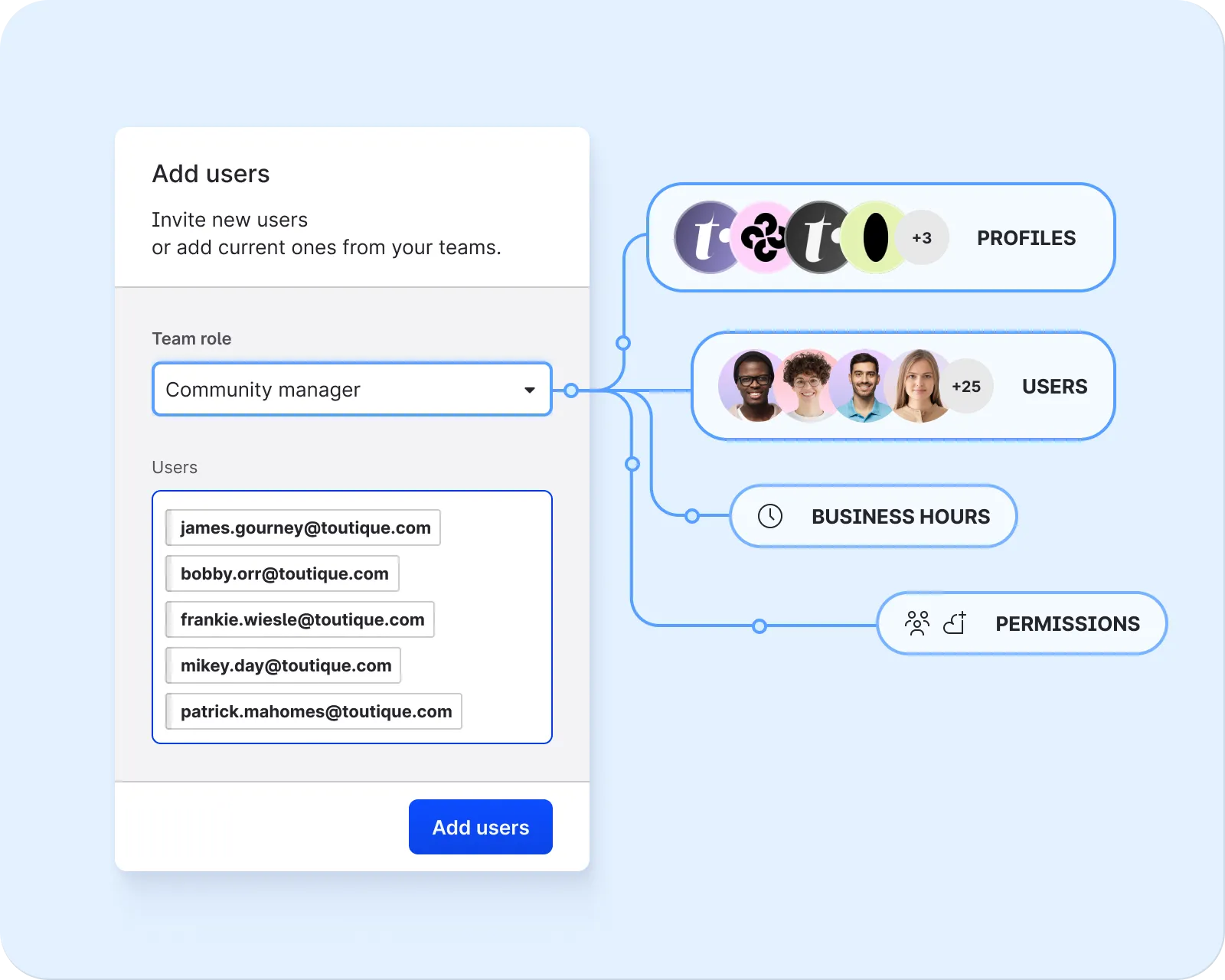
Still managing access and reporting manually? Emplifi Teams replaces spreadsheet-based governance with a team-based access model designed for enterprise social complexity. Request a governance assessment to evaluate where operational risk is accumulating across your current structure.
What governance maturity actually looks like
Organizations that scale social operations successfully tend to share one principle: systems mirror the organization itself.
- Access structures reflect business structures
- Permissions reflect reporting relationships
- Reporting reflects organizational hierarchy
- Governance reflects operational ownership
When systems mirror the organization, acquisitions, market launches, and agency transitions become manageable rather than disruptive.
Governance architecture ultimately determines how efficiently an organization can scale.
Enterprise governance models
Most enterprise organizations operate within one of three governance models:
Centralized models prioritize brand consistency, compliance control, and centralized decision-making. They work well for smaller organizations or heavily regulated industries, but often create operational bottlenecks as the business expands.
Federated models give regional or business-unit teams greater autonomy and execution speed. While this improves agility, it can also introduce fragmented reporting, inconsistent governance, and duplicated operational processes.
Governed distributed models balance centralized oversight with local flexibility. Enterprise teams maintain governance standards and visibility, while regional and brand teams operate independently within defined guardrails. This model tends to scale best for large multi-brand organizations, although it requires significantly more mature governance architecture.