In 2026, customer experience is driven by three essentials: authenticity, fast responses, and transparent AI use—brands that deliver them earn trust, loyalty, and revenue, while poor or inauthentic experiences quickly drive customers away.
In the era of the customer, brands must adapt to survive and thrive. A customer-centric mindset is no longer a nice-to-have; it’s a competitive necessity. And in 2026, the bar is higher than ever.
Today’s consumers expect speed, personalization, and transparency. They want brands that engage authentically, respond in real time, and use emerging technology in ways that feel human — not hollow. The customer experience statistics in this article reflect that reality, drawn from Emplifi’s latest research alongside the most current third-party data available.
Whether you’re a CX leader benchmarking your strategy, a social media manager making the case for investment, or a marketing director planning for H2, these customer experience statistics will give you the evidence you need.
Exceptional customer experience has always mattered, but the data now shows just how directly it moves the needle on revenue, retention, and brand trust.
The message is clear: CX either earns loyalty or destroys it. There is very little middle ground.
The consequences of getting CX wrong are immediate and measurable.
Brand loyalty is not what it was. Consumers, particularly younger ones are increasingly willing to switch, and the trigger is often a single interaction that falls short.
The financial case for investing in customer experience has never been stronger. Brands that consistently deliver quality experiences see measurable returns.
Good CX in 2026 isn’t just fast — it’s genuine. Consumers can increasingly tell the difference between a brand that has built systems to serve them and one that simply appears to do so. Speed matters, but it only lands well when it’s paired with honest, human engagement.
The shift from personalization to authenticity is one of the defining CX trends of 2026. Consumers don’t just want experiences tailored to them — they want brands that feel real.
Social commerce is accelerating this dynamic. Consumers increasingly make purchase decisions based on peer content rather than branded messaging:
For brands, this is both a challenge and an opportunity. The consumers who trust you most are already creating content about you, surface it, amplify it, and build it into the experience.
Social media is no longer just a marketing channel. For a significant proportion of consumers, it’s the primary channel for customer service, complaints, and brand interaction. These customer experience statistics show just how high the stakes are.
The speed gap between expectation and reality is striking, and it’s where brands lose customers silently.
High-performing brands are closing this gap. Mature brands respond to DMs within two hours and close conversations within eight hours — far ahead of the industry average of 15.5 hours. (Emplifi, Social Maturity Journey Guide)
Considering that your customers spend a significant portion of their journey on social, having the right social media strategy is essential to serving them where they are.
AI is now embedded in the customer experience at every stage, from discovery through to resolution. But consumers are watching closely, and their expectations around disclosure are rising fast.
Disclosure is becoming a baseline expectation, not a differentiator:
Enterprise adoption of agentic AI is accelerating in parallel:
AI isn’t replacing CX — it’s raising the bar for speed, transparency, and resolution. Brands that disclose AI use and ensure human escalation paths are available will build, not break, trust.
Customers want access to the information they need, right now, wherever they are. The mobile-first, self-serve expectation isn’t a trend, it’s the baseline.
Brands that don’t invest in mobile experience and self-service aren’t just behind the curve — they’re actively creating friction in the customer journey.
Delivering positive experiences post-purchase is where customer loyalty is truly won or lost. These customer experience statistics show that great care isn’t one-size-fits-all; it requires understanding what different customers expect from delivering care on social and beyond.
Generational expectations around human versus AI service vary significantly:
There’s also a significant performance gap between industry leaders and the average:
The gap between what consumers expect and what most brands actually deliver is significant, and closeable. Brands that invest in the right platforms, workflows, and talent to meet customers in their preferred channels will pull ahead.
Customer experience in 2026 is defined by three non-negotiables: authenticity, AI transparency, and real-time responsiveness across channels.
Consumers are more informed, more mobile, and more willing to switch than ever before. They trust peer content over brand messaging. They expect AI to be disclosed. They want issues resolved quickly — and they want to feel like a human being is paying attention, even when technology is doing the heavy lifting.
The brands winning on CX aren’t doing more — they’re doing it smarter. They’re surfacing the right content, in the right channel, at the right moment. They’re using AI to scale without losing the human tone their customers expect. And they’re tracking the gap between what they promise and what they actually deliver.
The social media customer service strategies that worked in 2022 won’t cut it in 2026. The data shows where the bar is. The question is whether your platform, your team, and your workflows are set up to meet it.
Book a demo to see how Emplifi can help your brand deliver outstanding customer experiences across every channel.
Sources: Emplifi Consumer Survey: Digital Authenticity in the Age of AI; Emplifi Social Pulse: State of Consumer Engagement; Emplifi Generational Report; Emplifi AI in Social Media: Consumer Expectations; Emplifi Social Maturity Model; Emplifi Peak Season Playbook; Salesforce via EMARKETER; NLX and QuestionPro; SPAR Group via EMARKETER.
Research from Emplifi’s Social Pulse shows that one in four consumers will leave a brand after a single bad experience, and nearly half (46%) will leave after two. However, the picture isn’t entirely bleak — 46% of consumers say they won’t leave if the issue is resolved well. This makes service recovery one of the most high-value investments in a CX strategy.
Response time is the single most important factor in authentic CX according to Emplifi’s Consumer Survey, with 84% of consumers ranking it above personalisation. On social media specifically, one in three consumers expects a reply to a direct message within an hour — and only 8% will wait as long as 48 hours before disengaging or switching to a competitor.
AI is now central to how consumers discover, evaluate, and interact with brands — 73% use AI tools like ChatGPT for brand discovery. Satisfaction with AI support is high (71%), but 56% still prefer human interaction for service. Critically, 83% of consumers want brands to disclose when AI is being used, and 91% expect this specifically in marketing contexts. Transparency is not optional.
Authenticity is the defining CX theme of 2026. According to Emplifi’s Consumer Survey on digital authenticity, 93% of consumers say authentic engagement builds trust. The top three markers of authenticity consumers look for are: honest communication without exaggeration (58%), keeping promises (44%), and feeling genuine rather than polished (39%). Notably, 63% say user-generated ratings and reviews are the most authentic type of online content — more trusted than branded content or influencer posts.
Facebook remains the dominant channel for social customer service, with 55% of frequent social media users turning to it for service issues, according to Emplifi’s Social Pulse. Instagram follows at 47%. For brands serving younger audiences, DMs are increasingly the primary service touchpoint — 30% of Gen Z will DM a brand for service, compared to just 8% of Boomers.
Discover what Emplifi can do for you. We turn small teams into large ones, and large teams into well oiled machines, but either way, we offer the rocket ship, you just need to jump on.
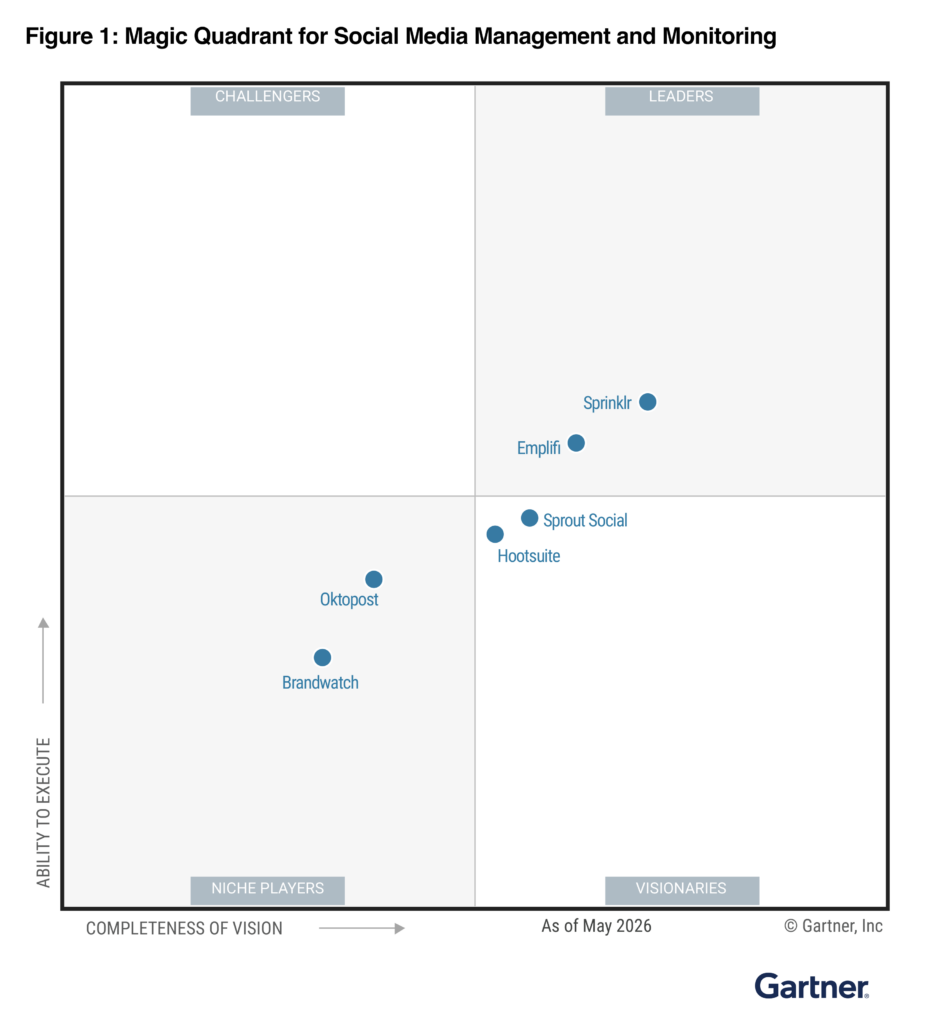
We’re recognized as a market leader in innovation, customer support, and ease of use from these organizations.