2026 Gartner® Magic Quadrant™

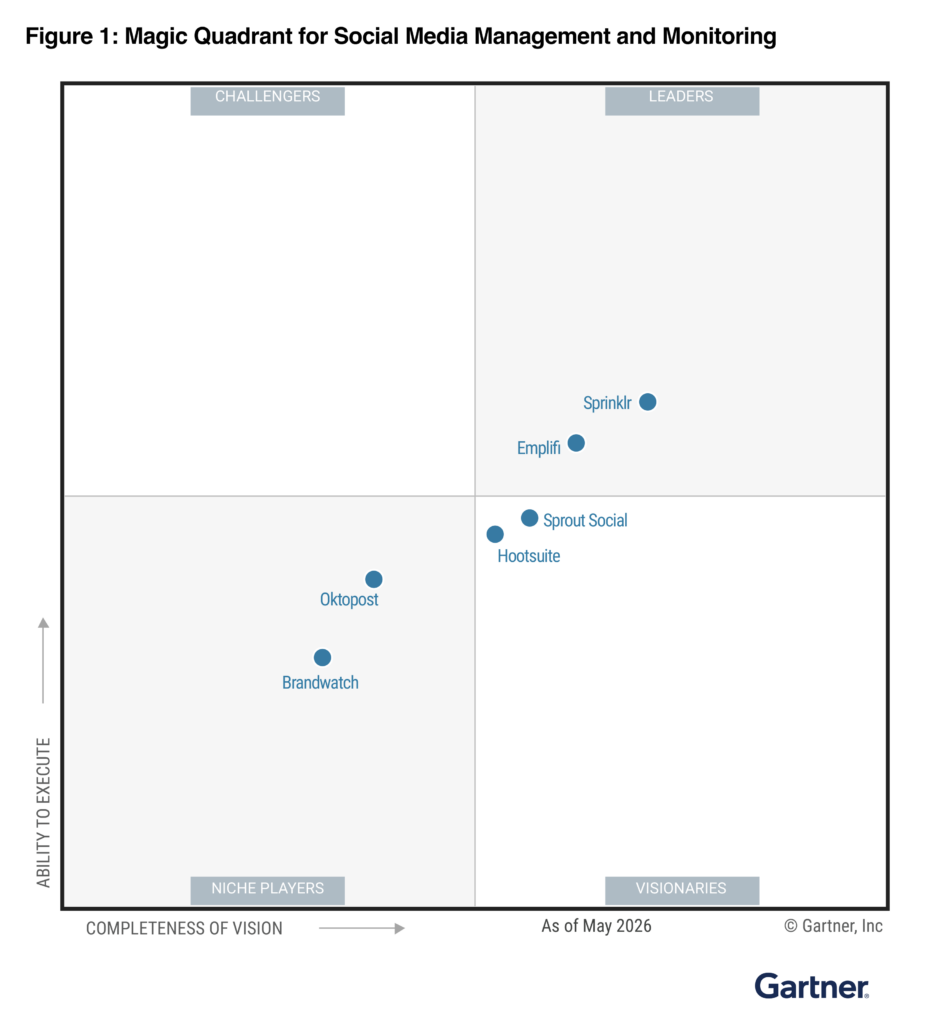
Emplifi named a Leader in the 2026 Gartner® Magic Quadrant™ for Social Media Management and Listening

Get the Report

Emplifi named a Leader in the 2026 Gartner® Magic Quadrant™ for Social Media Management and Listening Get the Report

Blog
11 min read
Aug 04, 2026

Content orchestration vs. content management: Why the distinction matters for enterprise brands in 2026

Neither a CMS (Content Management System) nor a DAM (Digital Asset Management System) coordinates the response across marketing, commerce, and care when content actually goes live. Content orchestration sits on top of these tools, reading what they publish and coordinating what happens next across every function in real time.

Gabriel Tay Director of Business Consulting at Emplifi
Content orchestration vs content management

Key points:

  • Content orchestration is an additive coordination layer, not a replacement for your CMS or DAM
  • The gap isn’t in the tools, it’s in what happens between them once content goes live
  • Four specific scenarios show exactly where existing tools stop and orchestration needs to start
  • Evaluating a platform means checking integration depth and governance model, not just feature lists
  • Emplifi’s Fuel AI reads cross-channel data natively, letting Content Orchestrator and Service Orchestrator coordinate without replacing the CMS or DAM you already run

If you’ve integrated your CMS with your DAM, and a social scheduling tool, your content is likely organized, on-brand, and publishing on time.

And yet…your customer experience might still be fragmented.

For example, a promotional campaign could be running on social while the commerce site still shows last month’s featured products, and the care team fields inbound questions about the promotion with no briefing at all.

The tools are working, but the coordination between them isn’t.

That’s the problem content orchestration solves, and Emplifi can help you get there.

In this guide, you’ll learn:

  • What a CMS, a DAM, and content orchestration each actually do, and where the line between them sits
  • The four specific gaps where existing tools stop, and coordination needs to start
  • How content orchestration works with your existing stack, not instead of it
  • What to check for when evaluating a content orchestration platform

What does each tool in your content stack actually do?

Before getting into where the coordination actually breaks down, it helps to see all four types of content tools side by side.

The gap only becomes obvious once you can see what each tool was actually built to do:

Tool What it does Where it stops
CMS Manages web content: pages, blog posts, landing pages. Stores structured content, handles versions and approval workflows, and delivers content to your site. Never designed to coordinate content across marketing, commerce, and care functions.
DAM Stores, organizes, and distributes creative assets: images, videos, brand guidelines, templates. Keeps brand consistency intact and makes assets accessible to the teams that need them. Never designed to activate those assets dynamically based on a real-time signal.
Social scheduling and publishing tools Plan, schedule, and publish social content across channels, with their own approval workflows for social posts. Not designed to connect a published social post to a simultaneous update in the commerce or care layer.
Content orchestration Publishes, measures, and manages content across every channel while coordinating marketing, commerce, and care in real time. Activated by a signal (a campaign going live, a sentiment spike, a product launch) rather than a person managing handoffs manually. Built specifically to do the one thing none of the above do: connect what goes out to what happens everywhere else.

Each of the first three tools is excellent at its own job. None of them was ever asked to do what the fourth one does.

Your existing stack isn’t the problem:

  • A CMS is more useful when its content can be triggered and surfaced dynamically
  • A DAM is more useful when its assets can be activated automatically across connected channels

If you already have these tools built out, you’re closer to orchestration than you might think; you just need the coordination layer on top.

AI changing social care

Trending insight: Digital Authenticity in the Age of AI

See what 1,650 consumers say about brand responsiveness, AI transparency, and what actually builds trust in customer care.

Download now

Where does the coordination gap actually show up?

These four scenarios show exactly where your existing stack stops and orchestration needs to start:

Scenario 1: The campaign launch gap

Marketing schedules a campaign in the social publishing tool. Commerce updates product listings manually two days later. Care gets no briefing at all.

A customer sees the campaign on Tuesday, visits the product page on Wednesday (still showing pre-campaign content), and contacts care on Thursday, who has no context for any of it.

Each tool did its job correctly, but nobody coordinated the sequence between them.

How content orchestration changes this: Content orchestration triggers the commerce update and the care briefing as soon as that campaign clears approval, not two days later, not manually, and not by a project manager chasing three separate teams.

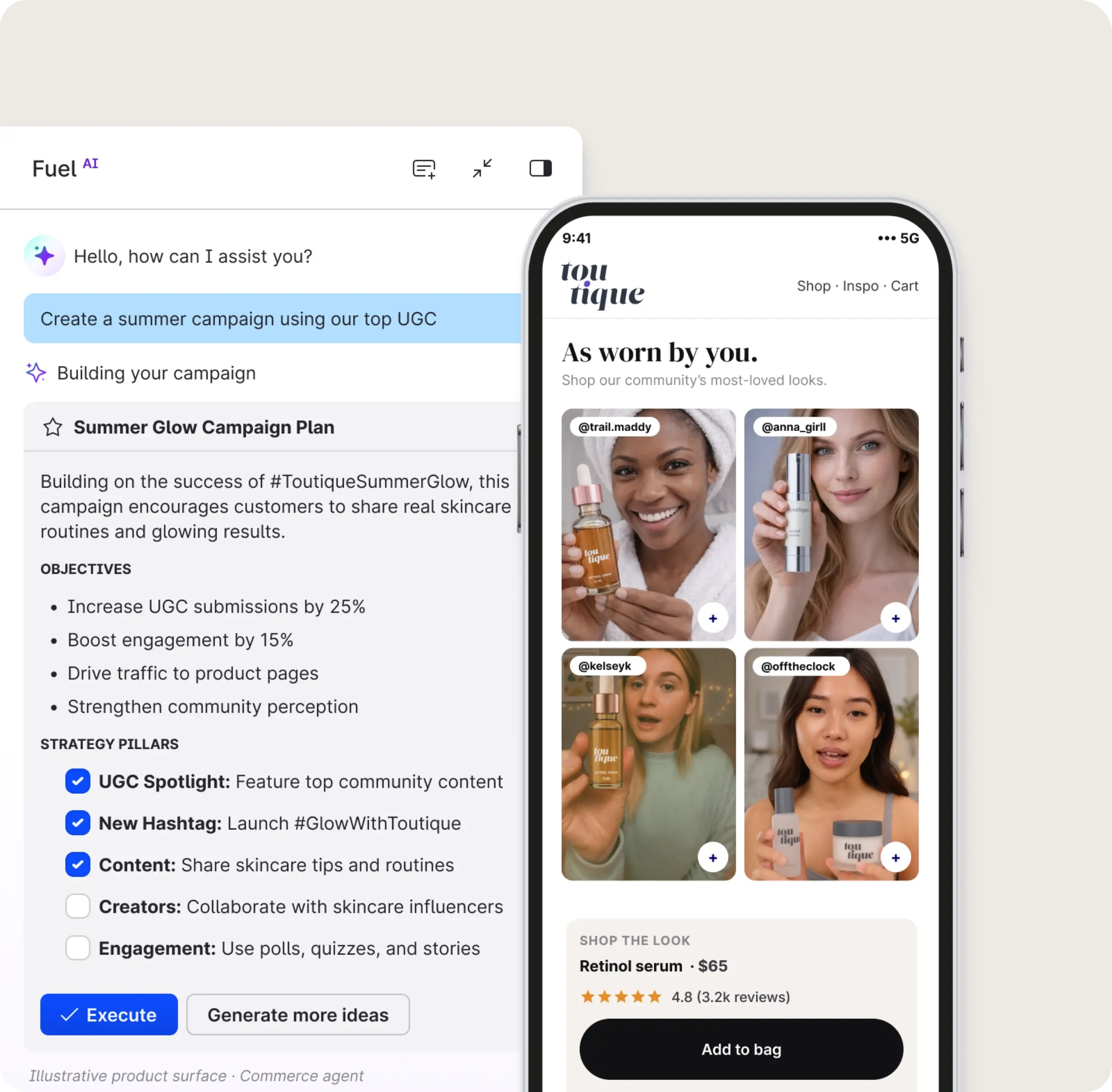
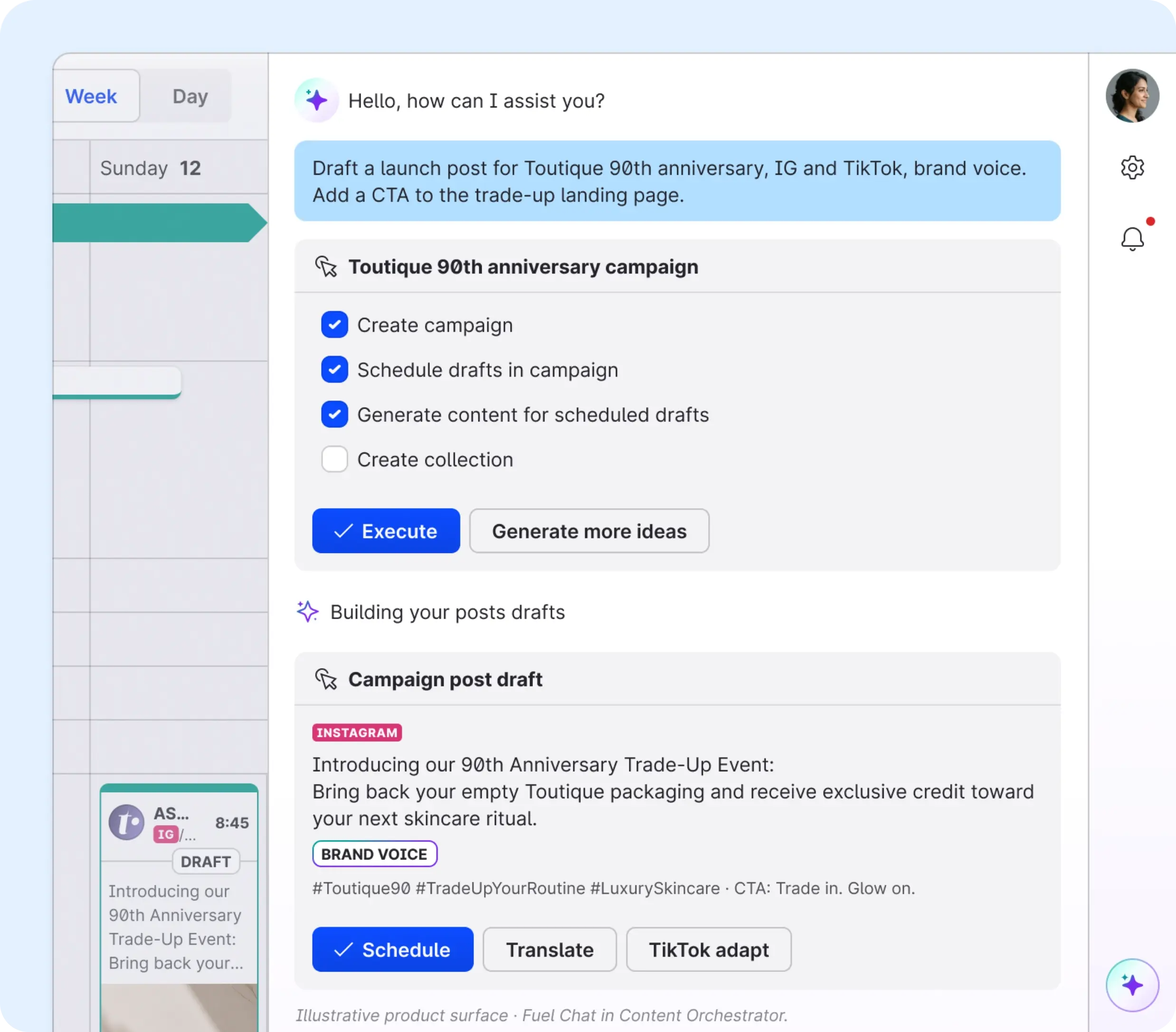
Fuel AI content orchestration

Scenario 2: The personalization ceiling

The CMS serves the same homepage content to every visitor. The DAM has thousands of assets built for different audience segments. The social tool is publishing segment-specific content.

Three tools, three separate personalization efforts, one disconnected experience for the customer.

How content orchestration changes this: Content orchestration reads the audience signal from the social layer and surfaces the matching CMS content and DAM asset for that segment, turning three isolated efforts into one connected one.

Trending insight: The State of Social Media Marketing 2026 report

82% of marketers say AI has improved productivity. See what's separating the ones getting real results from everyone else.

Download now

Scenario 3: The crisis publishing risk

A negative brand moment surfaces on social late in the evening. The CMS has a promotional post scheduled for 8am. The social tool has three more queued. Nobody’s awake to cancel any of it.

How content orchestration changes this: This is where content orchestration, operating as an Agentic AI system, actually earns its place: it detects the sentiment threshold being crossed and pauses all scheduled promotional content automatically, pending human review.

Neither the CMS nor the social tool is capable of making that call on its own, but the orchestration layer is.

Scenario 4: The content performance loop

Analytics shows a social post dramatically outperforming a benchmark. The insight sits in a dashboard. Nobody acts on it until the weekly review, three days later.

How content orchestration changes this: Content orchestration surfaces that signal in real time and can trigger a connected response: boosting the post, surfacing the related product in the commerce layer, or briefing care that inbound volume on this topic is likely to rise.

How does content orchestration work with your existing stack?

Short answer: it doesn’t replace any of it. But it does unify all of it.

Content orchestration is an integration and coordination layer. It can:

  • Read from your CMS, your DAM, and your publishing tool
  • Trigger actions in the commerce and care layer

It doesn’t store your content assets, manage your web pages, or replace your existing approval workflows. Instead, it works inside them and coordinates across them.

Three things make that possible:

  • API-based connections link the orchestration layer to the systems you already run, so it can read what’s happening in each one without requiring you to migrate anything
  • A unified data layer reads signals across those connected systems, so a change in one place (a campaign publishing, a sentiment spike) is visible to every other function at the same moment
  • And a governance model defines exactly what the orchestration layer can act on autonomously versus what always needs a person to approve first, which is the piece your architecture review will actually want to see

Fuel AI reads cross-channel data natively, which is what lets an agent acting on an Instagram comment see the same customer’s care history and order record without a human stitching the systems together manually.

That’s the specific mechanism that makes real-time coordination possible instead of theoretical.

Reporting sits above both orchestrators rather than inside either one. Emplifi Unified Analytics is the cross-channel reporting layer across Content Orchestrator and Service Orchestrator, reading from the same unified data model that powers the platform to give marketing, commerce, and care a single view of performance without separate reporting tools for each function.

What you should look for in a content orchestration platform

  • Native integration depth: Does it connect to your CMS and DAM through real API integrations, or does it require custom middleware to make anything talk to anything else?
  • Cross-function coordination: Can it actually trigger marketing, commerce, and care simultaneously, or does it only coordinate within one function and call that orchestration?
  • Governance model: What can it act on autonomously, and what always routes to a person? If the answer is vague, that’s the answer.
  • Data architecture: Does it create a genuinely unified customer context, or does it just move data between silos without connecting them?
  • Existing stack compatibility: Does it require ripping out your CMS or DAM, or does it sit alongside what you already have?

Final thoughts: Orchestration adds to your stack, it doesn’t replace it

Nothing in this comparison is an argument to rip out your CMS, your DAM, or your publishing tool. They’re doing exactly what they were built to do.

The gap is in the space between them, and that space is what content orchestration exists to close.

Content orchestration lets your existing stack:

  • Trigger a coordinated response across commerce and care the moment content goes live, instead of relying on someone to notice and chase it manually
  • Stay exactly as you’ve built it, connected through an integration layer rather than replaced by a new platform
  • Prove its governance model clearly, so IT knows exactly what runs autonomously and what needs sign-off

Emplifi connects to the tools you already run rather than asking you to migrate off them, so the coordination gap gets closed without a rebuild.

See how Emplifi’s orchestration layer connects to your existing CMS, DAM, and publishing stack. Get a demo of the Emplifi platform today.

Frequently asked questions

No. It reads from both and coordinates what follows across marketing, commerce, and care. Your CMS still manages your web content and your DAM still manages your assets; orchestration is the layer that connects them all in real time.

API-based connections to your existing systems, a unified data layer that reads signals across all of them, and a governance layer that defines what can run autonomously versus what needs human approval. None of it requires migrating off tools you already run.

It matters most where coordination gaps are most expensive, which tends to correlate with scale, more channels, more campaigns, more teams. But the underlying problem, tools working correctly in isolation while the customer experience stays fragmented, shows up at almost any size once more than one team touches the customer journey.

Content Orchestrator is one operational pillar within Emplifi Fuel. The overarching strategic framework is Autonomous CX (A-CX), the state in which Fuel AI orchestrates decisions and execution across marketing, commerce, and care on a single data model. Content Orchestrator and Service Orchestrator are the two execution layers through which A-CX is delivered.