Personalized marketing is the practice of using audience data such as demographics, interests, behavior, and past interactions to deliver messages and experiences tailored to each customer’s needs.
But with the rise of AI, personalization is evolving. Brands are moving beyond segment-based targeting toward hyper-personalization, using real-time data, sentiment, and interaction history to deliver individualized content, responses, and offers in the moment.
You’ve seen personalized content in action, whether it’s Netflix recommending your next binge-worthy show or a brand serving up a social ad that feels like it was made just for you. These experiences aren’t coincidences. They’re built on algorithms, insights, and a growing expectation from consumers that brands know them.
Today, AI can analyze thousands of real-time signals, from comments and clicks to sentiment and conversation context, and use them to shape content dynamically. Instead of planning personalization in advance, brands can now adapt it continuously based on how customers engage.
So what does all this mean for your brand’s social strategy? Let’s explore why personalization matters, and how to make it work on social media in 2026.
Your customers expect personalized content
Consumers aren’t simply open to personalized experiences — they expect them in 2026. Especially on social media, relevance is the baseline. Brands that deliver content tailored to a user’s interests, needs, and identity are far more likely to earn engagement, trust and, ultimately, sales.
According to Emplifi’s 2025 Consumer-Brand Social Engagement Survey, 65% of social media users say that content from real customers and followers is most likely to prompt a purchase, more than twice the influence of traditional influencer content. What do these user-generated posts have in common? They feel personal.
Posts that “feel geared toward people in my age group” influence 25% of all consumers, and up to 34% of Gen Z. Humor, visual appeal, and topicality also rank highly among the traits that make content feel relevant.
This preference for authentic, relatable content actually has a measurable impact on behavior. Emplifi data shows that consumers who interact with user-generated content are 2.4x more likely to make a purchase, reinforcing how strongly relevance and relatability influence decision-making.
The takeaway: Generic content gets ignored. To stand out, brands must treat audiences not as a monolith, but as individuals. And use data to deliver the right message, to the right person, at the right moment. Every time.
Increasingly, this expectation goes beyond content itself and extends to how brands respond.
Customers don’t just want to see relevant posts. They expect brands to understand context, respond quickly, and communicate in a way that reflects their specific situation. This is where hyper-personalization becomes critical, enabling brands to tailor not just what they say, but how and when they say it.
What personalized marketing unlocks for your brand
Personalized marketing goes far beyond just keeping up with consumer expectations. It’s also a key driver of business outcomes across the funnel. Shoppers who engage with UGC, for instance, spend 11% more per transaction, while brands that incorporate UGC see 3x higher repeat engagement.
Here’s what happens when brands get it right:
- Higher engagement: Content that reflects a user’s interests or identity is far more likely to earn likes, comments, and shares. The more relevant your post, the more visible it becomes, especially in algorithm-driven feeds.
- Better campaign performance: Personalization improves click-through rates, lowers paid media costs, and increases the likelihood that social users will take meaningful action.
- Stronger conversions: Personal content drives results. Consumers are more likely to buy when they feel seen, especially among younger generations. In our latest data, 42% of Gen Z say the look of a post influences their purchase decisions, and 34% say they’re more likely to buy when the post feels geared toward their age group.
- Deeper loyalty and advocacy: Personalized messages make customers feel understood, not marketed to. That connection builds loyalty, and loyal customers spread the word.
- Greater long-term ROI: Personalized marketing compels action today, but it also builds brand equity over time. It’s one of the few tactics that boosts both short-term wins and long-term growth.
Creating relatable content also has a huge impact with 51% of social media users driven to purchase if the post featured people like them.
Personalizing your marketing starts with understanding your audience
You can’t personalize what you don’t understand. If you want to deliver social content that feels relevant, timely, and valuable, it starts with getting a full picture of who your audience is and what matters to them.
That means going beyond basic demographics. Today’s best marketers use a mix of first-party data, social listening tools, and cross-channel social media analytics platforms to identify:
- Age, location, and interests
- Preferred platforms and content formats
- Follower behavior (likes, shares, DMs, tags)
- Which influencers or creators they engage with
- Where they are in the customer journey
This is how you move from general assumptions to audience intelligence, and it’s the foundation of any effective personalization strategy.
It’s also where the shift toward hyper-personalization becomes clear. Rather than relying on static audience segments, leading brands are using AI to build dynamic, real-time audience profiles. These profiles continuously update based on behavior, sentiment, and interaction history, allowing marketers to move from broad targeting to individualized engagement.
AI is now central to how personalization is delivered at scale. Tools like Emplifi’s Unified Social Media Analytics allow brands to analyze audience segments in real time, identify which content resonates by segment, and predict emerging trends.
More advanced AI capabilities can go even further by connecting audience insights directly to execution. By combining social listening, sentiment analysis, and interaction history, brands can tailor responses, content, and offers based on real-time context, not just past behavior.
And don’t overlook how your audience moves between channels. Social interactions, clicks, site visits, and cart behavior all tell a story. The more you can unify that data, the easier it is to personalize touchpoints across the customer journey rather than just within a single post.
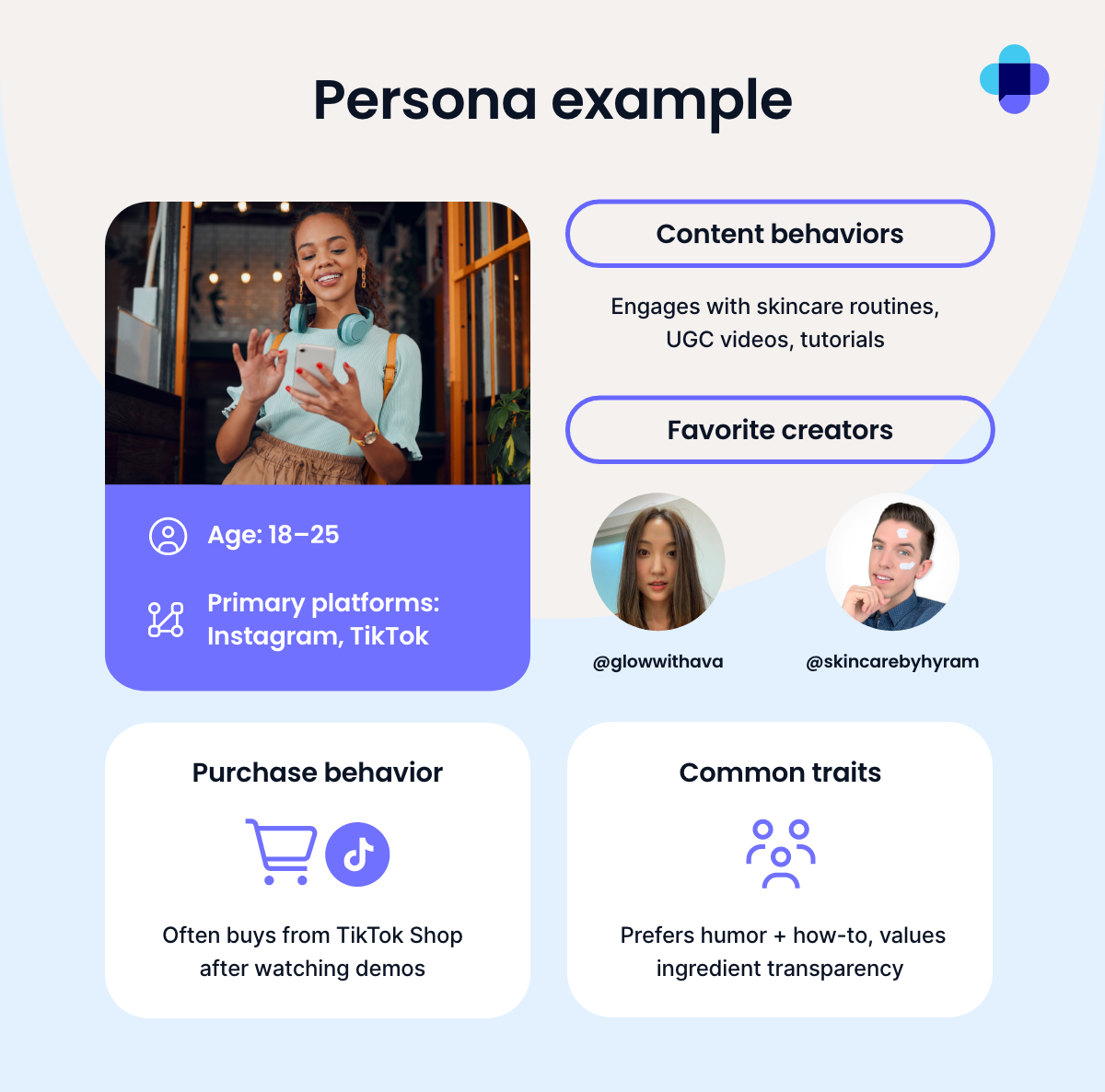
Example of a buyer persona profile
Here’s an example of a B2C buyer persona profile that can form the basis of a brand’s personalization strategy.
Sample audience segment: Trend-seeking Gen Z skincare fans
- Key attributes:
- Age: 18–25
- Primary platforms: Instagram, TikTok
- Content behaviors: Engages with skincare routines, UGC videos, tutorials
- Favorite creators: @skincarebyhyram, @glowwithava
- Common traits: Prefers humor + how-to, values ingredient transparency
- Purchase behavior: Often buys from TikTok Shop after watching demos
8 smart ways to personalize your social media marketing
Once you understand your audience, it’s time to take action. For personalization to be effective, you have to do more than say the right thing. You need to deliver the right message, in the right format, at the right time, to the right people. These eight tactics can help you scale personalized marketing across your social media strategy in meaningful, measurable ways.
1. Segment your audience by behavior, not just demographics
Don’t rely solely on age or location. Modern social media analytics tools give you insights into how your audience behaves: what they engage with, how often they buy, and what they care about. Use that information to build high-intent segments like frequent engagers, content sharers, repeat buyers, or first-time visitors. The deeper the behavioral insight, the more relevant your messaging can be.
2. Use AI to scale hyper-personalized content and interactions
AI doesn’t just help you produce more content. It enables you to adapt that content in real time. With tools like Emplifi’s Unified Analytics and AI Composer, brands can generate variations, adjust tone by audience, and tailor messaging based on engagement signals.
More advanced AI can also analyze customer context—such as previous interactions, sentiment, and behaviour—to dynamically shape responses, recommendations, and offers within social channels. This allows brands to move beyond content personalization and deliver truly individualized experiences at scale.
3. Customize your publishing schedule
Not all audiences are online at the same time. Use insights from each platform to time posts around your audience’s peak activity and don’t assume one schedule fits all. For example, Gen Z users may be more active on TikTok late at night, while Millennial parents may check Instagram during early mornings or lunch breaks. Even small timing shifts can boost visibility and engagement.
4. Feature UGC that reflects your audience
User-generated content (UGC) performs best when it feels like the viewer. That’s likely why 65% of consumers say customer and follower content is more likely to prompt a purchase than influencer content, according to Emplifi’s research. Reposting real customers with similar demographics or interests to your target audience makes your brand feel authentic and relatable – and reinforces the idea that “people like me” love your product.
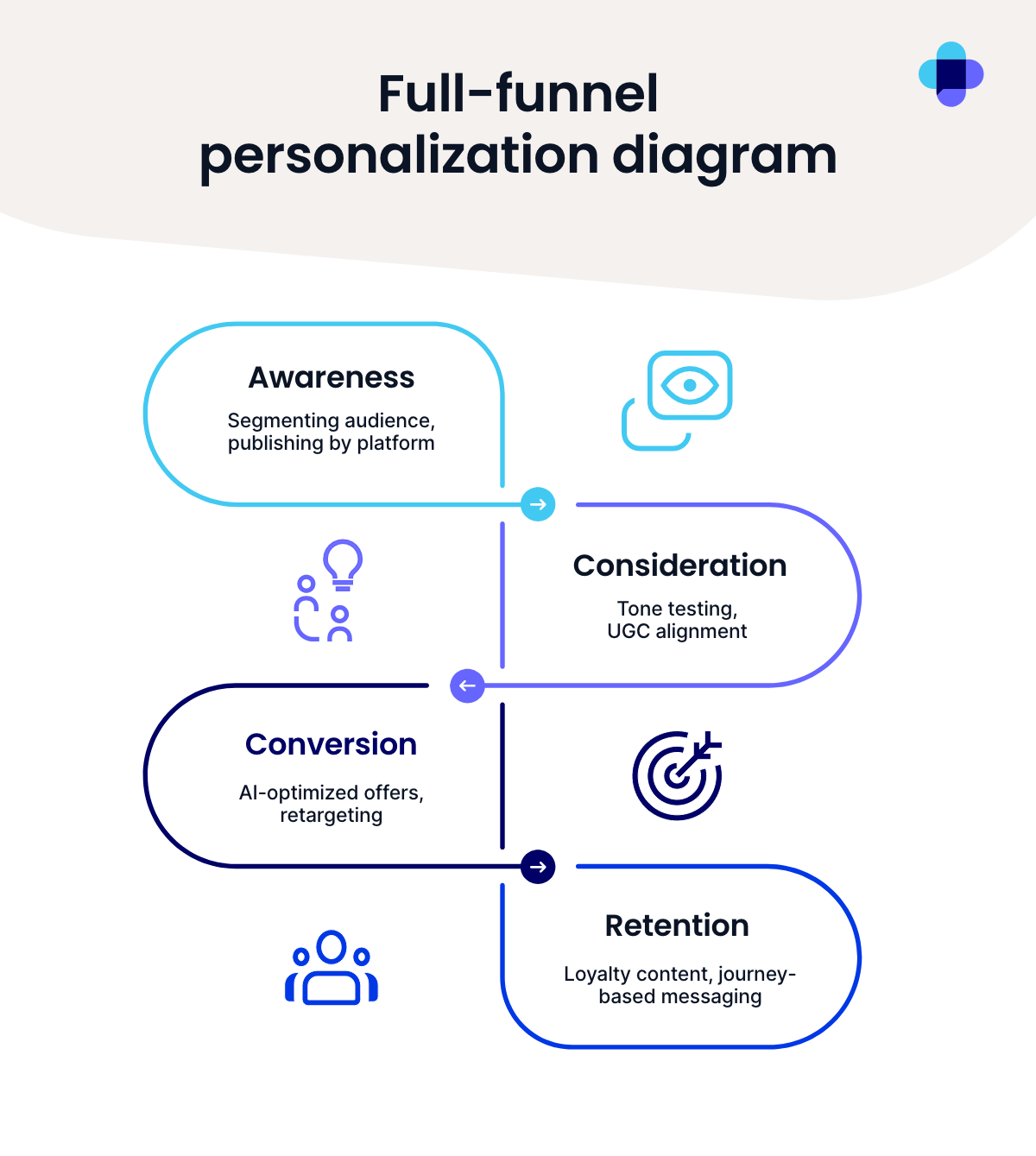
5. Personalize across the full customer journey
Personalization doesn’t stop at the first click. Tailor content for every stage of the journey, from awareness to conversion to loyalty. For example:
a. Awareness: Use topical, eye-catching content to introduce your brand.
b. Consideration: Share product demos, reviews, or comparison guides.
c. Conversion: Offer time-limited discounts or bundles.
d. Retention: Celebrate milestones, highlight tips for existing users, or launch loyalty-focused campaigns.
Many brands overlook retention, but social media is a powerful channel to build long-term brand love after the sale.
6. Vary your tone and message by segment
The same message won’t resonate equally with every group. Gen Z often responds to humor, informality, and lo-fi content. Boomers tend to value clarity, usefulness, and authenticity. Millennials love lifestyle storytelling and social causes. Tailoring your tone, length, format, and aesthetic by segment can dramatically improve engagement and sentiment.
7. Retarget based on social behavior
Every click, save, like, or comment tells you something — if you’re listening. The key question to ask after someone engages with a post is: “What does this tell us about them?”
Did they click because they’re ready to buy? Because they’re interested in seeing more content like that? Or simply because the post was entertaining or funny? Your answer should shape what, if anything, you show them next.
For example:
a. Someone who watches a product demo all the way through might be ready for a follow-up offer.
b. A user who comments on a new collection reveal might be primed for early access.
c. Someone who saves a behind-the-scenes video might want more content about your brand’s story or values.
Test different follow-up content to validate your assumptions and refine your retargeting logic over time. The most effective personalization doesn’t just react to behavior. It interprets the why behind it.
8. A/B test personalization tactics
Don’t assume — test. Run experiments to see which personalization tactics actually move the needle. Is your Gen Z audience more likely to click on funny videos or heartfelt testimonials? Do time-sensitive CTAs outperform evergreen messages for repeat buyers? The more you test and learn, the better you can tailor each campaign to perform at its peak.
From personalization to hyper-personalization at scale
As social media becomes more conversational, personalization is no longer limited to content planning. It extends into real-time interaction.
AI is enabling a shift toward what can be described as hyper-personalization at scale, where brands can:
- Analyze customer interaction history across channels
- Detect sentiment and intent in real time
- Adapt tone, messaging, and offers dynamically
- Respond instantly with context-aware communication
This evolution is being driven by advances in AI that connect insight directly to execution. Rather than relying on manual workflows, brands can now deliver individualized experiences across thousands of interactions simultaneously.
The result is a more responsive, relevant, and scalable approach to social media marketing.
Agentic AI and the shift to segment-of-one personalization
Traditional personalization works at the segment level. You build an audience “cart abandoners,” “Gen Z skincare fans,” “high-value repeat buyers,” and serve them a tailored message. That’s still valuable. But it’s a segment of many, not a segment of one.
Agentic AI changes that. Rather than applying a rule to a group, agentic systems analyze each individual’s real-time signals, their interaction history, current sentiment, the specific content they just engaged with, where they are in the purchase journey — and determine the right next action automatically. No manual workflow. No human in the loop for routine decisions.
In practice, this means a customer who DMs about a delayed order gets a response shaped by their loyalty tier, previous interactions, and the tone of their message; not a templated reply. A shopper who watches a product demo twice and then abandons the page gets a follow-up that reflects that specific behavior; not a generic retargeting ad built for an audience segment.
This is what Emplifi Fuel makes possible. Its agentic AI layer connects listening signals, customer data, and engagement history to execution — across care, commerce, and content, operating autonomously within guardrails that brands set. Teams define the rules; Fuel handles the responses at scale.
The result is personalization that doesn’t degrade as your audience grows. A brand with 50,000 social interactions a month can deliver individually relevant experiences across every one of them, without scaling headcount. That’s the practical difference between AI-assisted personalization and autonomous customer experience.
See how Emplifi Fuel powers agentic personalization at scale.
Real-world examples of personalized marketing in action
Personalization looks different for every brand, but the goal is the same: deliver content and experiences that resonate on an individual level. Here’s how three Emplifi customers are using personalized marketing on social media to drive engagement, loyalty, and impact.
Delta Air Lines: Personalizing care for millions of travelers
Delta uses Emplifi to manage millions of social interactions annually, not just efficiently, but personally. Their team listens to real-time traveler feedback across platforms, tailoring responses based on each customer’s unique situation. Whether it’s a traveler tagging them from an airport terminal or DMing about a delayed flight, Delta uses social listening and customer context to respond quickly, helpfully, and in a tone that matches the moment.
Why it works:
By combining scale with personalization, Delta strengthens trust with travelers and turns social media into a retention and loyalty channel, not just a place for complaints.
Domino’s: Blending automation and empathy for real-time engagement
Domino’s works with Emplifi to deliver fast, brand-consistent support across every major social platform. Their social team tailors messaging based on what customers are saying, where they’re saying it, and what tone fits the situation. This approach reflects a shift toward real-time personalization, where responses are informed not just by the message itself, but by customer context, history, and sentiment.
It not only increases the speed of responses, but it uses automation to route conversations smartly, while preserving the human voice their customers know and love.
Why it works:
Social care is marketing, and Domino’s ensures every reply reinforces the brand, turning service moments into brand-building opportunities.
Navy Hair Care: Using UGC to reflect the customer’s world
Rather than rely on influencer campaigns or branded photoshoots, Navy Hair Care fills its social feeds with content from real customers — people who look, speak, and live like the audience they’re trying to reach. This curated approach helps their posts feel more personal and trustworthy, while boosting engagement and community.
Why it works:
Emplifi’s 2025 consumer survey found that 65% of consumers are more likely to buy from posts featuring real customers than from traditional influencer content. Navy Hair Care makes that insight the core of its content strategy.
The path to personalized marketing starts with knowing your audience
In 2026, personalization is no longer just about targeting the right audience. It’s about responding to individuals in real time.
AI is making this possible by turning customer data, sentiment, and behaviour into immediate, actionable insight. The result is a shift toward hyper-personalization at scale, where brands can deliver relevant, context-aware experiences across every interaction.
Emplifi gives you the power to bring personalization to life at scale. From AI-powered insights to cross-channel engagement tools, we help brands deliver social experiences that feel personal, relevant, and human, no matter how large your audience is.
Ready to see how Emplifi can help your team scale personalization with impact? Let’s talk.