Automation done well makes a community feel faster and more responsive. Automation done badly makes it feel like nobody’s home. The difference comes down to a three-tier model: automate completely, AI-draft with human approval, or keep it human-only.
Picture this: A brand notices a rising volume in Instagram comments. They roll out automated replies to handle the surge.
Within 48 hours, a customer posts a heartfelt message about how the brand helped them through a difficult time.
The automated reply fires anyway: “Thanks for sharing! Visit our website for more.”
The post goes slightly viral, for all the wrong reasons. And the community manager is mortified.
In principle, the automation was right. It’s just that it was applied at the wrong time.
That’s the challenge with social media automation: knowing what to automate, what needs a human touch, and where to draw the line.
This guide is about drawing that line correctly before you flip the switch.
When people hear ‘automate community management,’ they often picture something closer to replacing the role entirely. But that’s not true.
Automation here actually covers four specific things:
None of that replaces the community manager. But it does free up their time for the work only they can actually do.
See what 1,650 consumers say about brand responsiveness, AI transparency, and what actually builds trust in customer care.
Every interaction a community manager handles falls into one of three tiers, and this framework is already how Emplifi structures agentic workflows for social teams.
Let’s look at what each one involves:
This is where automation should run without anyone needing to double-check it. That includes:
82% of marketers say AI has improved productivity. See what's separating the ones getting real results from everyone else.
This is where AI does the first pass, but nothing goes out without a person checking it first. Tier 2 activities could look like:

This is where judgment matters more than speed, and no amount of confidence scoring changes that. Human only responsibilities could include:
Your own tier boundaries will differ from another brand’s. For example, a luxury brand tends to draw Tier 3 more broadly than a high-volume FMCG brand handling thousands of routine queries a day.
Where exactly you draw each line is specific to your brand and your community.
There are three specific ways automation can go wrong, and they all boil down to the same issue: automation touching content it was never built to handle.
For example:
Different mechanisms, same lesson: once something’s public, ‘the bot did it’ isn’t a defense.
Emplifi’s research backs up why that matters; just over half of consumers say they’d stop buying from a brand entirely after one experience that felt inauthentic.
Here are the main ways automation damages community trust, with specific examples:
A customer posts about losing a parent and mentions that the brand’s product was part of how they got through the week.
The auto-reply fires within seconds: ‘Thanks for sharing! Visit our website for more.’
Sentiment detection should have flagged that post for human-only handling the moment ‘lost my dad’ appeared in the text, before automation ever got near it.
See what's actually moving the needle in 2026, sourced from over 200,000 brand accounts.
A customer posts a detailed, three-paragraph complaint about a damaged order, timestamps included.
The auto-reply that fires back: ‘We’re sorry to hear you had a problem, please DM us.’
No acknowledgment of a single detail they wrote. The replies underneath aren’t about the original complaint anymore, they’re about the tone-deaf response.
Complaints above a defined sentiment severity threshold need to route to Tier 2 or Tier 3, not Tier 1, before this happens.
A product safety concern starts trending at 9pm. By 10:15pm, a scheduled promotional post goes out anyway, because nobody thought to cancel the queue.
Now the brand isn’t just dealing with the original issue, it’s dealing with the repercussions of the scheduled post too.
This is the exact scenario Emplifi’s sentiment threshold system is built to prevent. Once volume and sentiment anomalies cross a defined threshold, the publishing queue stops and whoever’s on call gets pulled in before a scheduled post makes things worse.
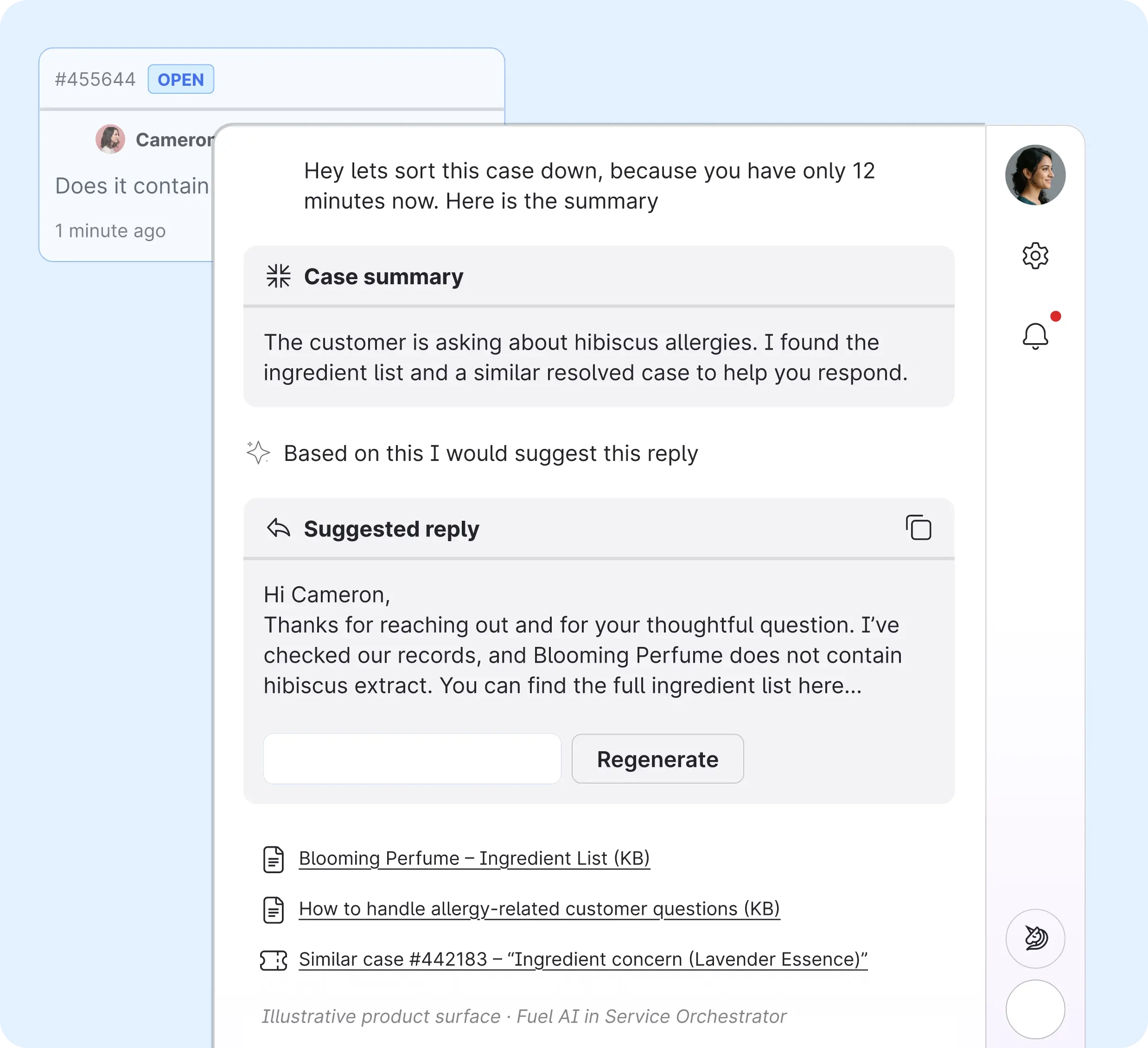
Emplifi’s community automation runs through Service Orchestrator, powered by Fuel AI, the platform’s agentic intelligence layer.
Rather than a standalone chatbot bolted onto a separate tool, the routing, triage, and escalation logic all run on one governed surface. Core capabilities include:
83% want disclosure when AI is involved. 71% say they’re satisfied with AI support. See the full picture of how consumer expectations around AI are shifting.
Domino’s shows what disciplined routing actually delivers.
Once case data got connected to a shared record instead of living in silos, cases that used to take over 15 minutes started taking under 5, a 53% reduction in handling time.
This is a human-agent operation working faster because the routing and case data are connected.
That’s exactly the kind of result Tier 1 and Tier 2 automation are built to deliver: speed and consistency on the routine work, so the community manager’s attention goes to the interactions that actually need it.
Automated community management is built to supplement a community manager’s role, not replace them completely.
Your human community managers will no longer have to:
What replaces that time?
Fewer hours are spent on triage, and the community manager role becomes instantly more valuable.
Get the boundaries right and automation disappears into the background. Get them wrong and it looks like nobody’s paying attention, right when someone needs to be heard most.
The three-tier model lets teams:
Emplifi’s sentiment thresholds and confidence-gated routing exist to make that line enforceable, not just a policy on paper.
See how Emplifi’s community management module sets up the three-tier model for your team. Get a demo of the Emplifi platform today.
Only if the tier lines are drawn in the wrong place. Automation applied to spam moderation and FAQ replies is invisible to the customer in a good way: faster, consistent, unremarkable. Automation applied to emotional or crisis content is what actually damages authenticity, and that’s precisely the content Tier 3 is built to protect.
Start conservative. Put more into Tier 3 than you think you need to, then loosen it as you build confidence in how the system performs in your specific community. It’s much easier to move an interaction type from Tier 3 down to Tier 2 later than to recover trust after something in Tier 1 should have stayed human.
Letting scheduled content and auto-replies keep running during a crisis. It’s Failure 3 for a reason, it’s the failure mode with the highest reputational cost, and it’s also the most preventable, since it just requires a sentiment threshold connected to your publishing queue.
No. It removes the repetitive triage work so the community manager can spend their time on judgment calls, relationship-building, and the interactions that actually need a person. See what implementing Agentic CX looks like end to end for more on how that rollout typically goes.