Blog
5 min read
Mar 30, 2026

What is autonomous customer experience (CX)? A 2026 guide to Agentic AI

Jordan Lukes Director of Content and Corporate Marketing

Key points

  • Autonomous CX uses agentic AI to predict customer needs and act in real time
  • It connects marketing, commerce, and customer care into a unified experience
  • It enables proactive engagement instead of reactive support
  • It helps organizations scale personalization and efficiency without increasing headcoun

The shift from reactive to proactive customer experience

In 2026, the traditional customer experience (CX) model, where customers initiate contact and brands respond, is no longer enough. Leading organizations are moving toward autonomous customer experience (autonomous CX): a model where AI systems anticipate needs, take action independently, and resolve issues before customers ask.

This shift is already underway. The AI customer service market was valued at $13 billion in 2023 and is projected to reach $83.8 billion by 2033, growing at a compound annual growth rate of 23.2%, according to Allied Market Research 

More compelling still, Gartner predicts that agentic AI will autonomously resolve up to 80% of common customer service issues within the next 24 months. Early adopters are already seeing measurable gains in efficiency, customer satisfaction, and operational scale.

In this guide, you’ll learn:

  • What autonomous customer experience is and how it differs from traditional CX
  • The key challenges autonomous CX solves
  • How agentic AI powers decision-making and automation
  • The core pillars of autonomous CX across marketing, commerce, and care
  • Real-world examples of autonomous CX in action
  • How to start implementing autonomous CX in your organization

Empower your teams

Free up agents to focus on complex issues while AI handles routine inquiries.

Talk to an expert

What is autonomous customer experience (CX)?

Autonomous customer experience (Autonomous CX) is the use of agentic AI systems to independently understand customer intent, make decisions, and take action across marketing, commerce, and customer care, without requiring manual intervention for every interaction.

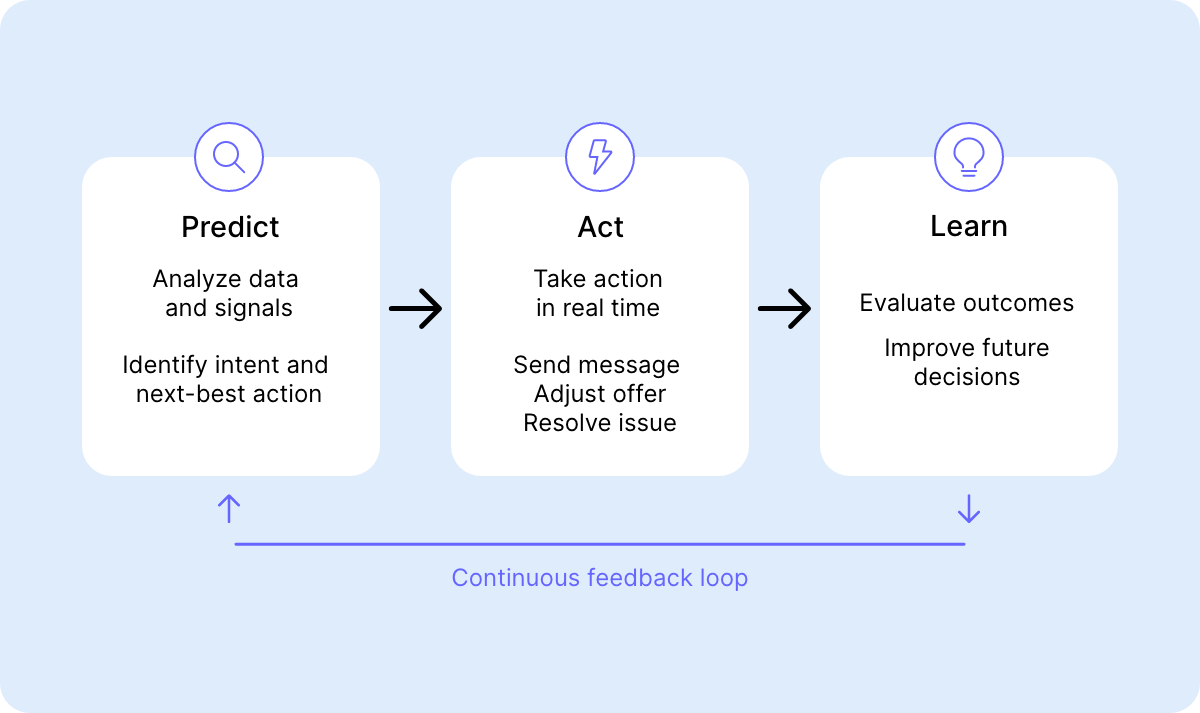
In practice, autonomous CX predicts what customers need, acts on their behalf, and continuously improves outcomes over time.

Unlike traditional automation, which relies on predefined rules, autonomous systems are goal-driven. They evaluate context, determine the best course of action, and execute it in real time.

Image breaking down the steps of what is autonomous CX.

The problem autonomous CX solves

Most customer experience operations today are still fragmented. Marketing, commerce, and customer care often operate in separate systems with limited shared context, which leads to inconsistent and reactive experiences.

This delay is increasingly unacceptable to customers. Roughly one-third of consumers expect responses within one hour, while only 8% are willing to wait as long as 48 hours—highlighting the growing demand for faster, more proactive service.

Three challenges tend to surface repeatedly:

1. Reactive service models – Customers must initiate contact before action is taken, which delays resolution and increases frustration.

2. Disconnected data and teams – Customer data is spread across platforms, resulting in disjointed interactions and inconsistent experiences.

3. Limited personalization at scale – Rule-based automation struggles to keep up with growing interaction volumes, leading to generic customer experiences.

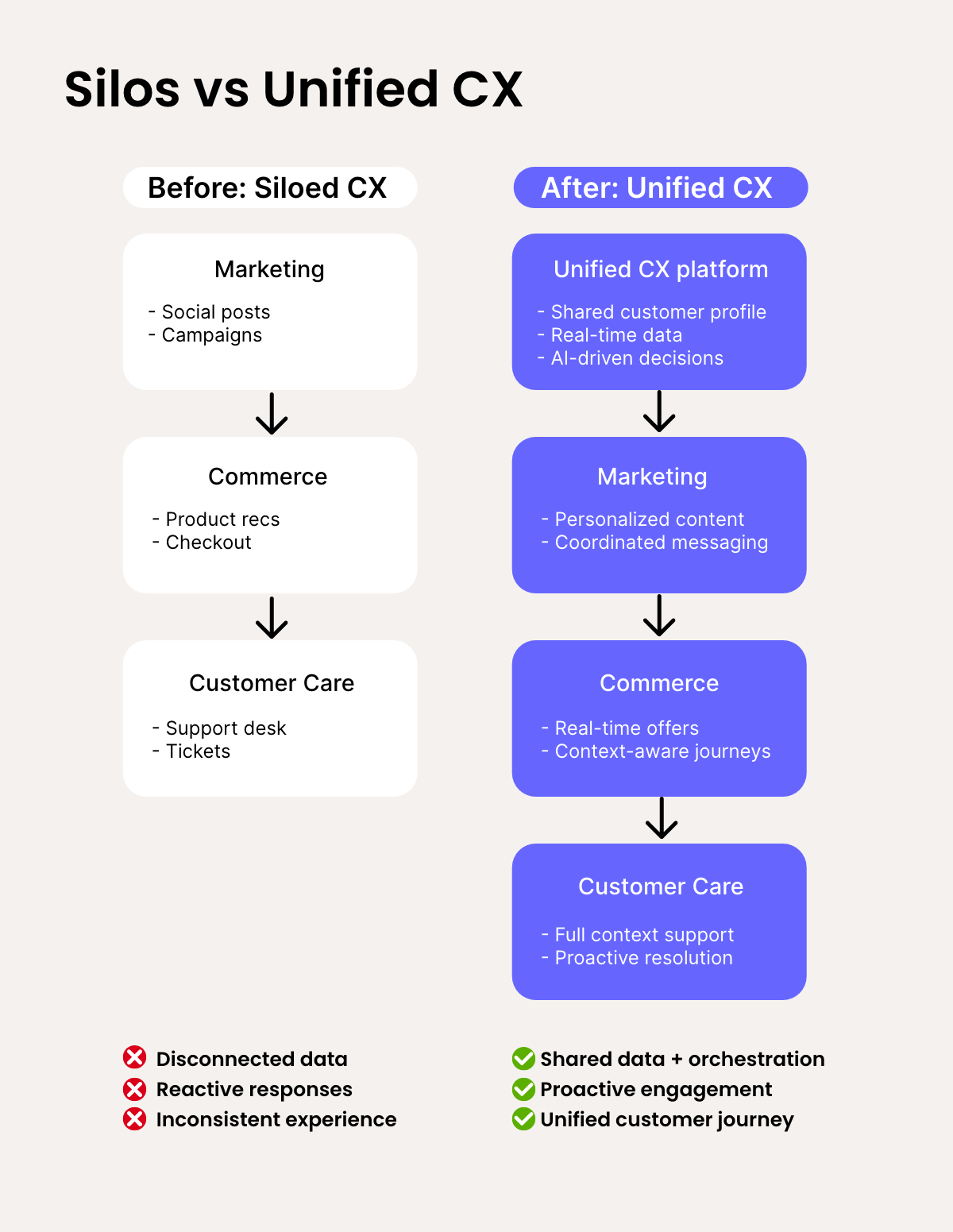
An image that shows siloed workflows without autonmous CX vs workflows that are unified with automnous CX implemented.

How autonomous CX works

Autonomous CX brings together several capabilities into a unified system.

At its core is agentic AI, AI that can pursue goals, make decisions, and execute multi-step actions. Instead of simply generating responses, these systems can resolve issues end to end.

This is supported by a unified data layer, which aggregates signals from across the customer journey, including social interactions, purchase history, support conversations, and behavioral data.

An experience orchestration layer ensures that actions are coordinated across channels, delivering the right message at the right time.

Over time, the system improves through continuous learning, while human oversight ensures governance and control.

Autonomous CX vs. traditional CX

Aspect Traditional CX Autonomous CX
Response model Reactive Proactive and reactive
Decision-making Human-driven AI-driven with human oversight
Channels Siloed Unified and orchestrated
Personalization Rule-based Dynamic and real-time
Scalability Limited by headcount Scales across millions of interactions
Learning Static Continuous improvement
Resolution time Hours or days Seconds or minutes

Benefits of autonomous customer experience

Organizations adopting autonomous CX are seeing measurable improvements across key metrics.

Resolution times decrease significantly, as AI can handle routine issues in seconds rather than hours. Customer satisfaction improves as support becomes more proactive and less dependent on customer initiation.

Operational efficiency increases, enabling teams to manage higher interaction volumes without scaling headcount. At the same time, real-time personalization improves conversion rates and supports stronger customer retention.

This is reinforced by consumer behavior: 60% of consumers say discounts or promotions directly influence their purchase decisions, making timely, personalized engagement critical.

The four pillars of autonomous CX

Autonomous CX is built on four interconnected pillars that work together to create a unified experience.

1. Autonomous marketing: AI supports content creation and optimization based on audience behavior and engagement patterns.

2. Autonomous commerce: Customer journeys are personalized in real time, improving discovery and conversion.

3. Autonomous customer care: Routine issues are resolved automatically, while complex cases are escalated with full context.

4. Unified orchestration: All interactions are coordinated across channels for consistency and efficiency.

Real-world examples of autonomous CX

While fully autonomous CX is still emerging, organizations are already moving in this direction by combining AI, unified data, and real-time orchestration.

In practice, organizations are applying these principles across industries:

  • Retail: Brands are beginning to personalize social commerce journeys dynamically, adapting recommendations, offers, and messaging based on real-time behavior.
  • E-commerce: Companies are shifting toward proactive service, identifying issues like delivery delays and resolving them before customers reach out.
  • Financial services: Organizations are using AI to detect patterns in customer feedback and trigger tailored communication at scale.
  • SaaS: Behavioral signals such as declining engagement are being used to identify churn risk early and initiate proactive retention efforts.
  • Travel & hospitality: Airlines, hotels, and travel platforms are using AI to manage disruptions, rebook customers automatically, and deliver real-time updates across channels.
  • Restaurants & QSR: Brands are automating order support, handling high-volume inquiries, and personalizing promotions based on location, preferences, and past behavior.
  • CPG (Consumer Packaged Goods): Companies are leveraging social listening and AI to respond to customer feedback, manage brand reputation, and drive personalized engagement at scale.

Why autonomous CX matters in 2026

Customer expectations continue to rise, while interaction volumes increase across channels. This is especially evident on social platforms, where about half of consumers have made a purchase via social media in the past 90 days and expect seamless support within those same environments.

At the same time, agentic AI has reached a level of maturity that enables reliable, scalable automation. However, human interaction remains important, 67% of consumers still prefer a human response in customer service, reinforcing the need for a hybrid model where AI handles scale and humans handle complexity.

Organizations that adopt autonomous CX now are better positioned to improve efficiency, enhance customer satisfaction, and stay competitive.

How Emplifi supports autonomous CX

Emplifi provides a unified agentic CX platform designed to support autonomous customer experience across marketing, commerce, and customer care.

Its AI capabilities are trained on large volumes of customer interactions, enabling a nuanced understanding of intent and sentiment. Built-in governance tools allow teams to maintain control, while unified orchestration ensures consistent experiences across the customer journey.

Book a demo of autonomous CX to explore how Emplifi unifies marketing, commerce, and care to deliver more connected customer experiences.

Frequently Asked Questions

Autonomous CX refers to AI-powered customer experience systems that can understand, decide, and act on customer needs in real time, without constant human intervention.

Unlike rule-based automation, Autonomous CX uses AI to learn from data, adapt to customer behavior, and continuously improve interactions across channels.

It enables faster response times, scalable support, personalized interactions, and improved efficiency, while reducing operational costs.

Emplifi combines AI, automation, and unified customer engagement tools to help brands manage conversations, personalize interactions, and scale support across social and messaging channels.

Emplifi provides real-time insights, analytics, and social listening capabilities, giving teams a complete view of customer sentiment, performance, and emerging trends.

Insights from Emplifi

Explore our latest blogs and comprehensive guides designed to help you master customer experience strategies and drive growth.

Ready to fuel your CX and social media marketing?

Discover how Emplifi boosts efficiency, increases revenue, and scales your social media marketing — whether you have a small team or a complex product. Let’s talk today.

What can you expect?

  • A partner who cares about your strategy and objectives
  • Live demo showing how we differentiate from the pack
  • No pressure, just advice
Get a demo

Outpace your competition with easy-to-use, innovative solutions

We’re recognized as a market leader in innovation, customer support, and ease of use from these organizations.