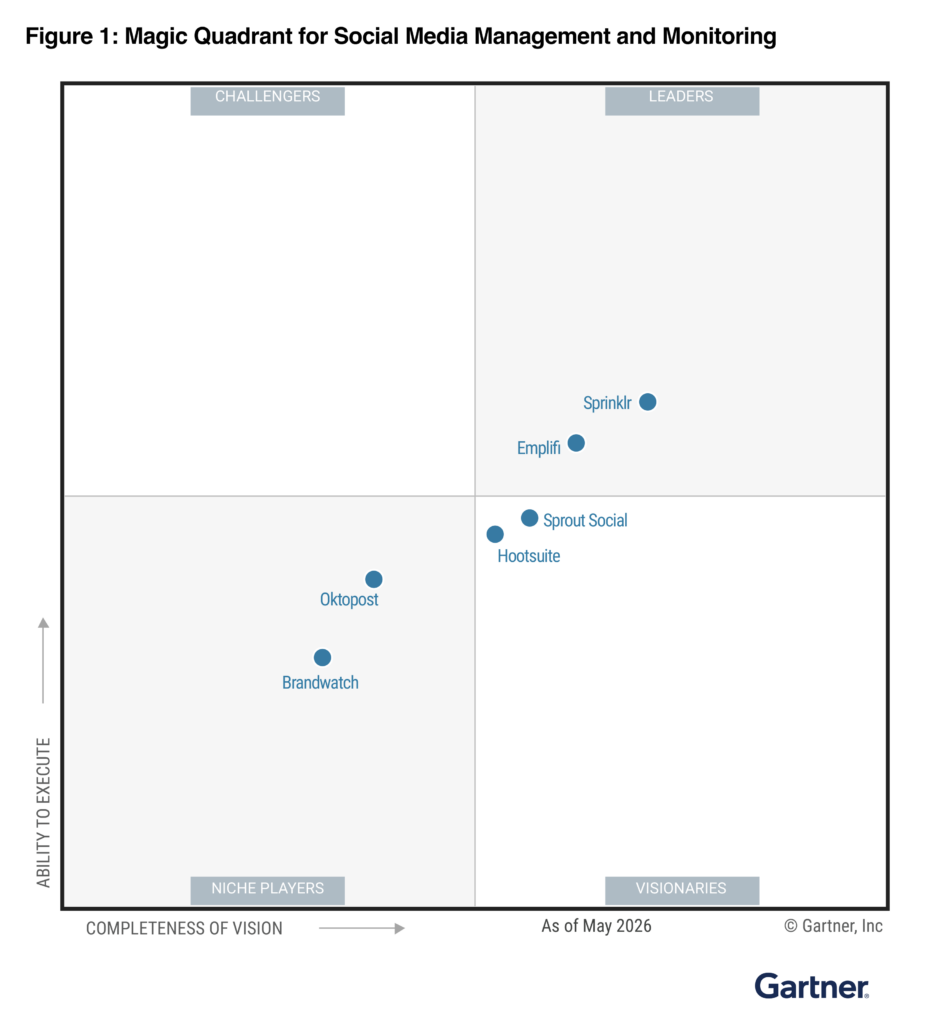
2026 Gartner® Magic Quadrant™

Emplifi named a Leader in the 2026 Gartner® Magic Quadrant™ for Social Media Management and Listening

Get the Report

Emplifi named a Leader in the 2026 Gartner® Magic Quadrant™ for Social Media Management and Listening Get the Report

Blog
10 min read
Jul 14, 2026

Agentic AI in social commerce: sell, serve, and retain in one conversation

Social commerce has always had a three-way tension: a brand needs to sell, serve, and retain. Historically, those required three separate tools, three separate teams, and three separate queues. Agentic AI resolves that tension by treating the social conversation as a single continuous thread that can handle all three, within one governed, connected workflow.

Gabriel Tay Director of Business Consulting at Emplifi
woman sitting on sofa with phone in one hand and credit card in the other

Key points:

  • A product post that generates 200 comments in 15 minutes is a revenue opportunity and a care risk at the same time, and most teams can only handle one
  • Agentic AI classifies every comment and DM by intent, handles the routine ones autonomously, escalates what needs a human, and tracks what converts to a purchase
  • Consumers who interact with UGC are 2.4x more likely to purchase and spend 11% more per transaction, and Agentic AI is what surfaces that content at the right moment
  • The post-resolution moment is the highest-intent point in the customer lifecycle, but it’s the one you might be leaving completely unworked

Picture this. A product post goes live on Instagram at 9am on a Tuesday. By 9:15, there are 200 comments: some asking about sizing, some asking where to buy, some tagging friends, one complaining about a previous order that arrived damaged.

Without Agentic AI, someone is manually sorting through all of it. Some comments get missed. The complaint sits unread. Three people who were ready to buy didn’t get an answer in time and moved on.

But with it, the system has already:

  • Classified each conversation by intent
  • Answered the sizing questions with accurate inventory data and a purchase link
  • Triggered a returns workflow for the person who left a complaint
  • Tracked the purchase intent

And all of it may have happened before your community manager finished their first coffee.

This is a significant shift for social commerce teams. This guide breaks down exactly how Agentic AI handles the selling, the serving, and the retaining, and what that means for the metrics your business actually cares about.

In this guide, you’ll learn:

  • How Agentic AI turns a social comment into a tracked sale
  • How it handles post-purchase care before a complaint becomes a review
  • How the resolution moment becomes the start of the next purchase
  • What this looks like specifically on Instagram and TikTok
  • Which commerce metrics move, and by how much
  • What your team needs to set this up

What does “sell, serve, and retain” look like as a single workflow?

Social commerce teams have always faced the same structural problem: the conversation that sells a product is the same conversation that handles the complaint about it, and the same conversation that could bring the customer back.

But the tools have never been connected, so the team has often had to choose which job to prioritize.

Agentic AI doesn’t choose. It reads the intent of every message and routes accordingly, inside a single connected workflow.

Here’s how each stage works:

1. Sell: Turning social intent into tracked revenue

Consumers who interact with UGC are 2.4x more likely to purchase and spend 11% more per transaction.

That lift is already sitting in your comments section, your DMs, and your live shopping events. But is it being acted on quickly enough?

When a customer comments “does this come in a size 10?” under a product post, that’s a declared purchase intent with a specific SKU attached.

An Agentic AI workflow:

  • Reads that intent and checks inventory in real time
  • Replies with the right size and a direct purchase link
  • If the size is out of stock, it offers an alternative or a back-in-stock alert

Carhartt is a clear example of what happens when customer content gets connected to a commerce workflow.

By using UGC on its product pages, Carhartt drove:

  • 85,000+ real customer interactions
  • A 27% conversion rate from gallery engagement
  • $150K in revenue attributed directly to customer-submitted content

The content that was already being created by customers became the engine that drove purchase decisions.

Our customers don't just wear Carhartt, they live in it. And they want to see that reflected back at them. That's why UGC is so powerful: it's their world, their reality, their stories.
Kaleena Ocasio
D2C Digital Content Specialist, Carhartt

The commerce metric this moves: conversion rate. Intent that would have gone unanswered converts because it got a relevant, accurate, fast response.

2. Serve: Resolving post-purchase issues before they become reputation risks

A customer posting “this arrived damaged” on social media is a care case and a commerce risk simultaneously. Left unresolved, it becomes a return, a negative review, and potentially, a lost customer.

But resolved in the same conversation, it’s a recoverable moment.

An Agentic AI workflow:

  • Detects the complaint and identifies the order
  • Initiates a replacement workflow within configured limits
  • Responds in the same channel the customer used

The case is resolved before the customer has had time to screenshot it, let alone post a follow-up.

According to Emplifi research, nearly half of customers (46%) will leave a brand after just two bad experiences. The speed of the resolution is what determines whether you lose or retain your customer and in a social commerce context, “speed” means minutes, not hours.

The commerce metric this moves: containment rate. Post-purchase complaints that get resolved autonomously, fast, in the right channel, before they escalate.

The Social Commerce Playbook

See how leading brands are turning social engagement into tracked revenue, with the UGC strategies, commerce benchmarks, and conversion data behind it.

Download now

3. Retain: Using the resolution moment to drive the next purchase

The same Emplifi research also found that 46% of customers say they won’t have a reason to leave after a bad experience, if the issue is resolved to their satisfaction.

In your current setup, you might close a complaint, update the record, and think no more about it.

But an Agentic AI workflow identifies successfully resolved cases, scores the customer’s lifetime value, and at the exact moment goodwill is highest, triggers a personalized incentive: a discount on the product category they bought from, a loyalty reward, or maybe even a personalized recommendation.

The resolution becomes the start of the next conversation, rather than the end of the last one.

The commerce metric this moves: repeat purchase rate. The loyalty loop that used to require a separate retention campaign now runs automatically off the back of a resolved case.

How does Agentic AI work specifically on Instagram and TikTok?

The sell-serve-retain workflow runs on any social channel, but Instagram and TikTok are where most social commerce volume lives, and buyer behavior is different on each.

Instagram

On Instagram, the purchase intent signal is often in the comment or the DM. For instance, a customer who tags a friend under a product post is signalling intent while one who DMs asking about availability is further along.

An Instagram Shopping integration means an Agentic AI workflow can surface the tagged product directly in the reply, with a checkout path that doesn’t require the customer to leave the app.

The care layer works the same way.

A DM complaint stays in the DM thread. The agent initiates the returns or replacement workflow in context, so the customer never has to repeat their issue in a different channel.

Trending insight: The State of Social Media Marketing 2026 report

82% of marketers say AI has improved productivity. See what's separating the ones getting real results from everyone else.

Download now

TikTok

On TikTok, the intent signal is faster and the window is shorter. 67% of TikTok users say the platform inspires them to shop even when they had no purchase intent, which means the person reading your product comment isn’t necessarily looking to buy, but they could be in seconds.

A product featured in a video can generate thousands of comments in minutes.

An Agentic AI workflow classifies that volume in real time, handles the product questions autonomously, and routes the complaints and the high-value purchase intents to the right place before the moment closes.

A TikTok Shop integration connects the conversation directly to a checkout path. A comment asking “where can I buy this?” gets a reply with a direct product link before the customer has scrolled past it.

The key difference between the two platforms:

  • Instagram buyers tend to be further along in the consideration phase
  • TikTok buyers are more impulse-driven, which makes response speed even more critical. The window between intent and scroll-past is measured in seconds, not minutes.

Which commerce metrics change when Agentic AI runs the workflow?

Here’s what moves when the sell-serve-retain workflow runs on Agentic AI:

Metric What changes Why
Conversion rate Intent that gets answered converts Product questions answered in minutes, not hours, with accurate inventory data and a direct purchase path
Average order value Agentic recommendations lift basket size Relevant recommendations surface at the moment of highest intent; consumers interacting with UGC spend 11% more per transaction
Containment rate Post-purchase complaints resolved before escalation Agentic workflows initiate returns and replacements autonomously, within configured limits, in the same channel
Repeat purchase rate The loyalty loop runs off resolved cases Post-resolution incentives triggered at the highest-intent moment in the customer lifecycle

Radio Flyer scaled UGC collection and shoppable galleries across channels with Emplifi and saw a 7x increase in conversion and a 12% lift in average order value. Ribble Cycles customers spent 36% more on average when they received personalized expert guidance through Emplifi’s live commerce solution.

Both required the same things: the right content, surfaced at the right moment, and connected to a checkout path.

What does your team need to set this up?

This workflow doesn’t run on a single tool. Four things need to be in place:

  • Product catalog sync: The agent needs real-time inventory data to answer a sizing question accurately. Without it, it can reply, but it can’t route to purchase
  • Social channel integration: The workflow has to operate inside Instagram, TikTok, and any other channel where the conversation is happening, not just in a back-end dashboard
  • Care workflow connection: Post-purchase resolution requires the agent to see the order, the customer history, and the account status. Without CRM connectivity, it can acknowledge the complaint but can’t do anything about it
  • Governance configuration: Which actions can the agent take autonomously? A replacement for a damaged item under a set threshold is an autonomous action. A large refund or a complex escalation is not. The line between those two needs to be defined in code before anything goes live

This is what Emplifi connects: the social channel, the product catalog, the commerce platform, and the care workflow, into a single layer where the agent can act across all four without manual handoffs between systems.

While Agentic AI assists, routes, and tracks, it doesn’t close every sale, and it shouldn’t. Human judgment still applies to complex cases, high-value escalations, and anything outside the configured governance model.

What changes is how much of the conversation that precedes those judgment calls now runs on its own.

What consumers actually expect from AI

83% want disclosure when AI is involved. 71% say they’re satisfied with AI support. See the full picture of how consumer expectations around AI are shifting.

Final thoughts: One conversation, three jobs

The sell-serve-retain tension in social commerce isn’t going away. A product post will always generate a mix of purchase intent, care requests, and everything in between.

What changes with Agentic AI is that all three can now be handled in the same conversation, with the same context, without a human manually sorting through the queue first.

  • Carhartt didn’t get 27% conversion from UGC by responding faster.
  • Ribble customers didn’t spend 36% more because the brand published more content.
  • Radio Flyer didn’t see a 7x conversion lift by adding headcount.

They connected the conversation to the commerce outcome, and let the workflow handle the gap in between.

Want to see what that looks like in your social commerce setup? Request an Emplifi commerce consultation and we’ll show you exactly where Agentic AI moves the needle in your customer journey.

Frequently asked questions

Agentic AI in social commerce is a governed workflow that reads the intent of every social conversation, handles the routine ones autonomously, and connects the outcome to a measurable commerce result. A product question becomes a purchase. A post-purchase complaint becomes a resolved case and a loyalty trigger. The workflow runs across selling, serving, and retaining in a single connected thread, without requiring separate tools or separate teams for each function.

It detects the complaint, identifies the relevant order, and initiates a returns or replacement workflow within configured limits, all in the same channel the customer used. Actions above a defined threshold pause for human review. The goal is resolution before the customer has time to escalate, because nearly half of customers will leave a brand after just two bad experiences.

On Instagram, purchase intent tends to come through comments and DMs from customers who are further along in their consideration. The workflow surfaces the right product, connects to Instagram Shopping, and handles care in the same DM thread. On TikTok, intent signals are faster and the window to act is shorter. Agentic AI handles comment volume in real time and connects purchase intent directly to TikTok Shop. The underlying workflow is the same; the pace and the intent signal are different.


At minimum: real-time product catalog sync, social channel integration across Instagram and TikTok, CRM connectivity for post-purchase care, and a governance model that defines which actions the agent can take autonomously versus which require human sign-off. Without all four, the agent can classify and respond, but it can’t close the loop from conversation to commerce outcome.