Blog
8 min read
Jun 03, 2026

How to build safe, governed agentic AI workflows

Safe agentic AI in customer care requires four layers of governance: RAG-based grounding to confine AI reasoning to approved knowledge, action-level boundaries that define what AI can execute autonomously, pre-LLM PII redaction to ensure GDPR and SOC 2 compliance, and sentiment-driven human escalation triggers. Together, these form what Emplifi calls Governed Autonomy, giving AI the power to act within unbreakable parameters.

Emplifi Team Social Media Marketing Experts

Key points:

  • An AI agent operating on a public social channel without governance can be a brand liability
  • Grounding AI reasoning to approved knowledge bases eliminates hallucination risk without sacrificing capability
  • Action boundaries define exactly what AI can execute autonomously and what requires human sign-off
  • Pre-LLM PII redaction is non-negotiable for GDPR, SOC 2, and PCI-DSS compliance in social and messaging channels

Enterprise AI is moving fast.

According to McKinsey’s Global Survey on AI, 47% of organizations have already experienced at least one negative consequence from AI use with inaccuracy, compliance failures, and reputational damage among the most commonly cited.

And yet adoption continues to accelerate, particularly in customer-facing functions where the stakes are highest.

Autonomous CX, the use of agentic AI systems to independently handle customer interactions across social, messaging, and digital channels, can bring significant efficiency gains to enterprise customer care teams, reducing cost-per-resolution while maintaining service quality at scale.

But autonomy without governance creates risk that grows in proportion to the volume of interactions the AI handles.

An AI agent acting on a customer message, whether on Instagram, WhatsApp, email, or live chat, is only one inaccurate response away from a public customer experience issue. Emplifi research shows that 60% of consumers worry that AI-generated responses may be inaccurate and in enterprise environments, that concern translates directly into compliance, legal, and brand risk.

The good news is that the risks are entirely manageable, provided the right framework is in place. Governance can’t be an afterthought. It needs to be built into every AI workflow from day one.

Here’s how to do it using four essential pillars.

What you’ll learn in this guide:

  • What cost-per-resolution means and how to calculate it for your operation
  • The difference between chatbot deflection and true autonomous resolution
  • Why delaying AI implementation is costing you more than you think
  • How to choose the right autonomous AI platform and build your business case

What is Governed Autonomy?

Governed Autonomy is a framework for deploying AI agents safely within enterprise customer care operations.

It’s the difference between plugging an API key into a general-purpose LLM and pointing it at your customer inbox, versus deploying a purpose-built orchestration layer, like Emplifi Fuel, that controls what the AI can do, and when it hands off to a human.

Without strict governance in place, your business could be at risk of reputational damage, customer dissatisfaction, and significant penalties under data protection laws such as GDPR.

For enterprise teams, the question isn’t whether to govern agentic AI, it’s how to do it without slowing down the business case for autonomous customer experience.

Team in office

See Governed Autonomy in action

Watch our product tour to see how well-governed workflows can enhance your customer care program

Watch now

Pillar 1: What makes an AI agent safe for customer care?

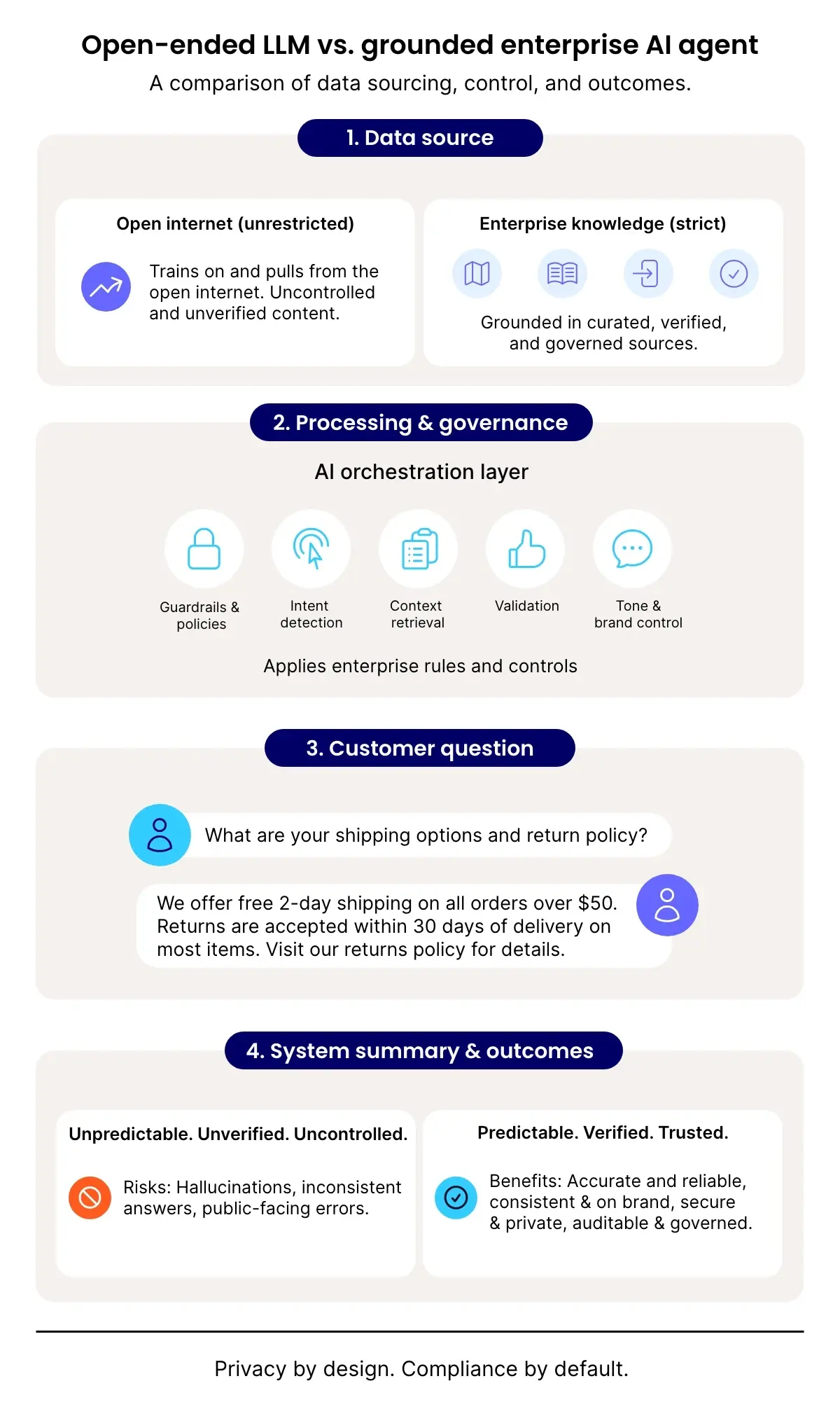
A consumer Large Language Model (LLM) like ChatGPT is designed to be helpful across any topic. You could ask multiple different questions about any number of topics, and in a matter of seconds, you’ll have a response.

That’s because their training material is the entire internet, and they use it to generate a reply.

While this is useful for general tasks, in a customer service context, it can be dangerous.

Ask an open LLM about your return policy, and it may generate a confident but inaccurate response that doesn’t reflect your approved policies. And on a public social channel, that hallucination is visible to everyone.

A grounded enterprise AI agent, on the other hand, works differently. It’s strictly confined to reasoning over your approved content, such as your:

  • Brand guidelines
  • Knowledge base
  • Product catalog
  • Policy documentation

This is called Retrieval-Augmented Generation (RAG).

Before the AI generates a response, it retrieves the relevant, approved information from your knowledge base and uses only that as the basis for its answer.

How this looks in practice: 

  • A global sportswear brand uses Emplifi to manage Instagram DMs. A customer asks: “Can I return these shoes if I wore them once outdoors?” 
  • Instead of the AI generating a friendly but costly guess, Emplifi’s RAG framework forces it to retrieve only the brand’s official Footwear Return Policy. 
  • The AI accurately responds that returns are accepted only for unworn items, maintaining exact compliance with corporate policy on a public-facing channel, without human intervention.

Emplifi’s enterprise Knowledge Base and BOT framework are built on this principle. Emplifi AI agents operate from approved enterprise knowledge sources rather than unrestricted public data.

Open ended LLMs vs enterprise AI agent

Pillar 2: Defining your AI agent’s boundaries

The moment an AI agent moves from conversation to execution, the stakes change again.

AI agents can issue refunds, update orders, modify accounts, and organize returns. Without clear governance, autonomous actions can introduce financial and compliance risk.

To minimize potential problems, you can define action-level guardrails that create clear, configurable boundaries between what AI can execute autonomously and what requires human approval.

Here’s how that could look:

  • Low-risk, high-volume actions: Password resets, order status updates, address changes on unshipped orders. AI executes automatically, instantly, 24/7.
  • Medium-risk actions: Refunds under a defined threshold (e.g. $50), subscription modifications. AI operates within predefined rules and is logged for audit.
  • High-risk actions: Refunds above threshold, account closures, compensation for complaints. AI freezes, flags to a human manager for approval, and waits.

How this looks in practice: 

  • A customer messages a retail brand on WhatsApp to request a change to their shipping address.
  • Emplifi’s AI agent checks the logistics system. The order hasn’t shipped, so the address is automatically updated in the CRM.
  • The same customer then requests a $75 refund for a late delivery. This exceeds the brand’s $50 autonomous threshold.
  • The AI pauses, and a prompt appears on the human manager’s dashboard: “Approve $75 refund request? [Yes / No].”
  • The manager approves in one click. The AI executes.

Emplifi Care implements this through Role-Based Access Control (RBAC) and configurable operational constraints, giving enterprise teams precise control over which actions are automated, which are supervised, and which are restricted entirely.

Write access to sensitive CRM fields can be completely locked down, ensuring AI agents can never modify data they shouldn’t touch.


Pillar 3: Data privacy, PII, and compliance in social DMs

Customers don’t think about data security when they’re frustrated. They type whatever they need to type to get their problem solved.

In social DMs, that sometimes means credit card numbers, home addresses, or national ID details are sent directly into a chat window on Instagram or WhatsApp.

If that data reaches a foundational AI model without being redacted first, you have a compliance problem.

Under GDPR, that could mean a significant fine. GDPR penalties since 2018 now exceed €7.1 billion, with €1.2 billion in fines issued in 2025 alone.

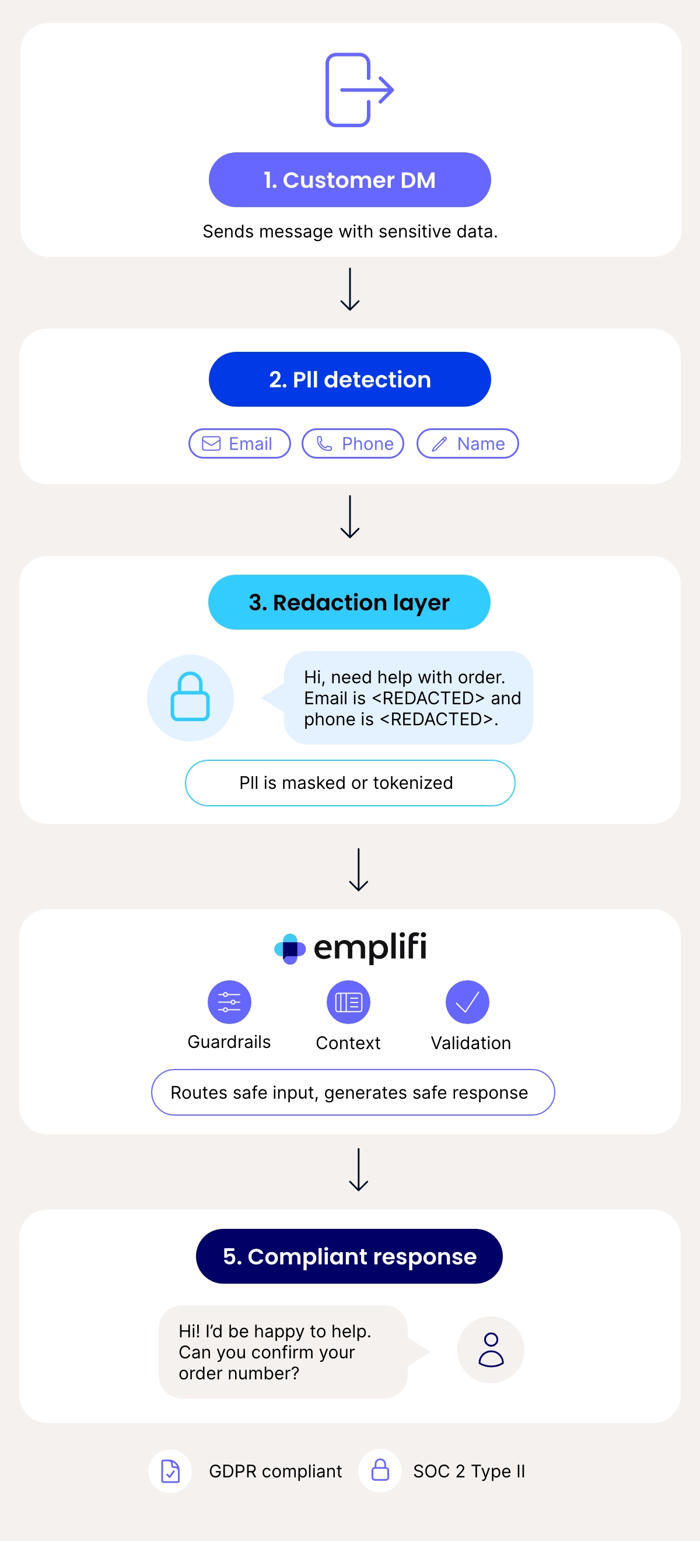
The solution is Pre-LLM Redaction, an orchestration layer that intercepts messages before they reach the AI model, strips out any PII it detects, and passes only the cleaned text forward.

Pre-LLM Redaction can catch:

  • Credit and debit card numbers
  • National ID and passport numbers
  • Home addresses and postcodes
  • Phone numbers and email addresses
  • Any other data pattern that triggers your compliance rules

How this looks in practice: 

  • A frustrated customer accidentally pastes their full 16-digit credit card number into an X (Twitter) DM to prove a billing error.
  • Before Emplifi routes that message to the LLM, its data security layer catches the numeric pattern. The text is instantly redacted to [REDACTED_CARD_NUMBER].
  • The AI sees only the complaint. The brand remains fully compliant with PCI DSS and GDPR. The core LLM never touches sensitive data.

Emplifi holds ISO/IEC 27001:2022 and SOC 2 Type 2 certifications. Client data is encrypted in transit and at rest, and is never used to train public AI models without explicit consent.

For enterprise teams navigating GDPR, PCI-DSS, and data sovereignty requirements, this is critical. Review Emplifi’s full security and compliance posture in the Trust Center.

PII redaction

Pillar 4: When AI should escalate to a human

Well-governed agentic AI should always know its own limits and never be left completely unsupervised.

When it works well, customers notice. According to Emplifi research, 71% of consumers report being satisfied with their AI support experiences.

But delivering a superior customer interaction is only achievable when the AI is properly governed and backed by a human failsafe, rather than left to operate without boundaries.

An unsupervised AI agent in a high-stakes customer environment is where things go wrong publicly.

Two mechanisms keep humans in control without requiring them to review every interaction:

  • Confidence scoring: Every AI response is assigned a confidence score based on how clearly it maps to an approved resolution path. If that score drops below a defined threshold (such as 90%), the agent pauses, and the conversation is silently routed to a human agent, with full context intact. The transition remains seamless for the customer. The human picks up exactly where the AI left off.
  • Sentiment analysis: If the AI detects a sharp shift in customer tone, such as escalating frustration, all-caps messages, language that signals a legal threat or a VIP complaint, it stops. The ticket is automatically flagged, prioritized, and pushed to a live agent’s queue.

How this looks in practice: 

  • A passenger messages an airline via Facebook Messenger about a delayed flight.
  • The AI starts troubleshooting. But the customer’s tone escalates: “THIS IS UNACCEPTABLE. I AM MISSING A WEDDING.”
  • Emplifi’s sentiment analysis flags the spike in negative emotion. The AI confidence score for a successful automated resolution drops below the threshold. The AI stops responding.
  • The ticket is silently transferred to a live agent’s queue with a full summary of the conversation so far, and the human takes over without the customer ever knowing a handoff happened.

Emplifi’s Unified Smart Inbox and Spike Alerts continuously grade incoming messages based on emotional tone, priority, and intent, sorting them by complaint type, VIP status, and legal sensitivity.

This gives the system a clear signal for when a situation needs a human.

Why governed AI is less risky than relying on humans alone

High-turnover human support teams introduce a significant risk of inconsistency. With contact centre attrition averaging 30–45% annually, there’s always a chance that a new agent on their third day might give a customer incorrect refund information or miss a PII disclosure.

A properly governed AI agent doesn’t go off-script. Every response is grounded in approved content, bounded by defined action limits, stripped of compliance risk, and backed up by a human failsafe.

91% of consumers want brands to disclose when they use AI

See more stats like this in our latest report

Download now

Final thoughts: Governance is what makes autonomous CX scalable

Autonomous AI can only create value when customers, employees, and compliance teams trust how it operates.

That trust doesn’t come from the model itself. It comes from the governance framework surrounding it: grounded knowledge sources, clear action boundaries, secure data handling, and intelligent escalation when human oversight is needed.

That’s the role Governed Autonomy plays inside Autonomous CX. By combining AI reasoning with orchestration, compliance controls, and human oversight, enterprise teams can scale customer support more efficiently, without increasing operational risk or compromising customer trust.

Ready to see how Governed Autonomy works in practice? Book a demo with an Emplifi solutions engineer — and explore how Emplifi Fuel can bring safe, governed agentic AI to your customer care operations.

Frequently Asked Questions

Governed Autonomy is the principle of giving AI agents the power to act within strictly defined, unbreakable parameters. It combines RAG-based knowledge grounding, action-level boundaries, pre-LLM PII redaction, and sentiment-driven human escalation to ensure AI operates safely on public-facing channels without compromising compliance or brand reputation. It is the foundational framework behind Emplifi Fuel, Emplifi’s autonomous CX platform.

Retrieval-Augmented Generation (RAG) is an architectural approach that confines an AI agent’s reasoning to a specific, approved knowledge base including your brand guidelines, policies, and product catalogs, rather than the full breadth of its training data. For customer-facing AI, this eliminates the risk of hallucinated policies, invented product specifications, or incorrect information being delivered to customers on public channels.

Emplifi’s orchestration layer intercepts messages before they reach the foundational AI model and automatically redacts any detected PII, including credit card numbers, addresses, and national ID data, replacing it with a redacted placeholder. This ensures compliance with GDPR, PCI-DSS, and SOC 2 across all social and messaging channels without requiring manual review. Full details are available in Emplifi’s Trust Center.

Emplifi holds ISO/IEC 27001:2022 and SOC 2 Type 2 certifications. Client data is encrypted in transit and at rest and is never used to train public AI models without explicit consent.

Insights from Emplifi

Explore our latest blogs and comprehensive guides designed to help you master customer experience strategies and drive growth.

Ready to fuel your teams with A-CX?

Discover what Emplifi can do for you. We turn small teams into large ones, and large teams into well oiled machines, but either way, we offer the rocket ship, you just need to jump on.

What can you expect?

  • A live walkthrough of Emplifi Fuel tailored to your specific social marketing, commerce, and care needs
  • A benchmark of how your brand performs against peers in your industry
  • A partner who understands your business, and 22,000 others
  • A concrete action plan to go from disjointed teams to A-CX
Get a demo

Outpace your competition with easy-to-use, innovative solutions

We’re recognized as a market leader in innovation, customer support, and ease of use from these organizations.