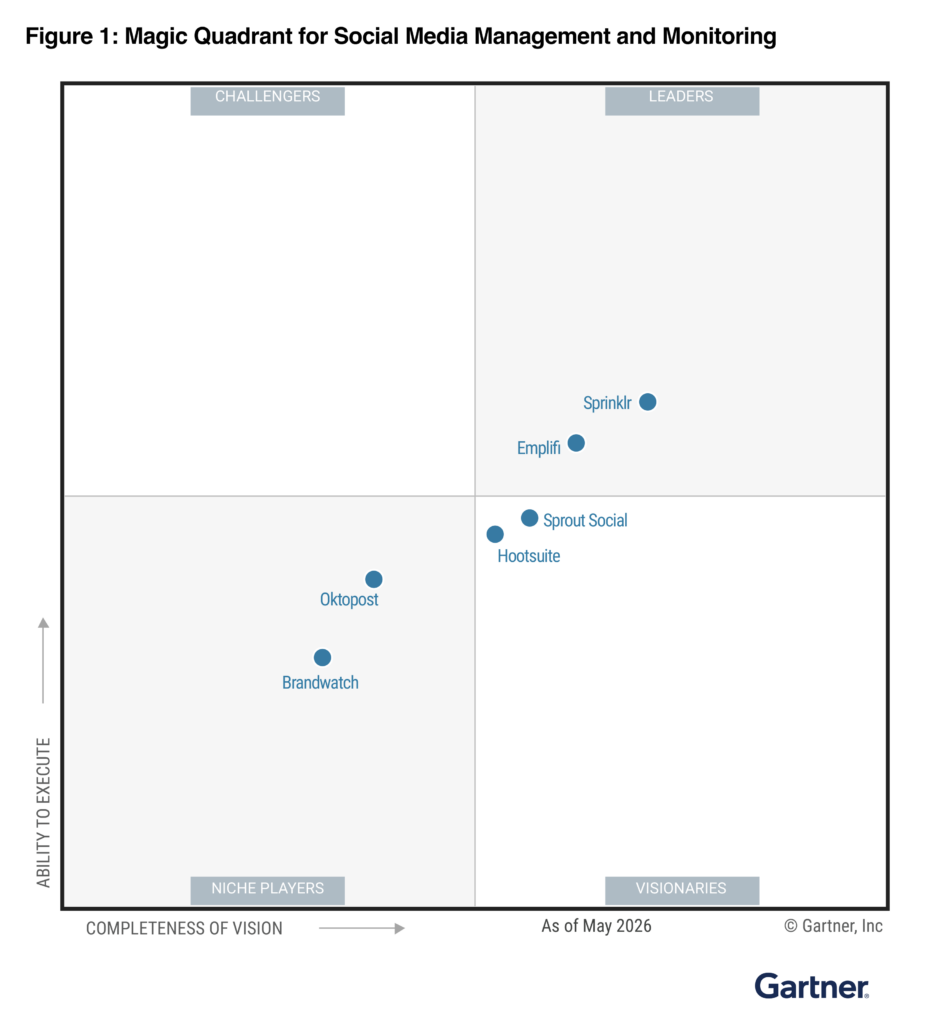
2026 Gartner® Magic Quadrant™

Emplifi named a Leader in the 2026 Gartner® Magic Quadrant™ for Social Media Management and Listening

Get the Report

Emplifi named a Leader in the 2026 Gartner® Magic Quadrant™ for Social Media Management and Listening Get the Report

Blog
8 min read
Jul 27, 2026

What is content orchestration in the age of Agentic AI? The complete guide for enterprise CX teams

Content orchestration is the real-time coordination of content across marketing, commerce, and care, so every customer-facing function is working from the same content at the same moment. Agentic AI is what makes that coordination possible without a human manually project-managing the handoffs between teams.

Gabriel Tay Director of Business Consulting at Emplifi
Woman with glasses looking at computer screen

Key points:

  • Content orchestration solves an operating model problem, rather than a publishing schedule problem
  • Three layers need to stay in sync: what goes out, what gets served, and what gets said
  • Emplifi’s Content Orchestrator and Service Orchestrator are built to plan, sequence, and govern that coordination
  • Content orchestration is one half of Autonomous CX, service orchestration is the other

There are two kinds of enterprise content operations:

  1. A campaign launches and marketing, commerce, and care move together: the hero creative goes live, the product page updates to match, and care already has answers ready for what customers are about to ask
  2. In the other, marketing publishes, commerce is still selling last quarter’s story, and care finds out the campaign existed at all from an angry comment in the mentions

If you’re still running the second kind, you’re not alone.

It’s common enough that 61% of marketing teams cite data silos as the top reason their campaigns fail to scale.

You might think that’s down to a communication issue.

But it’s actually down to a missing coordination layer: content orchestration.

In this guide, you’ll learn:

  • What content orchestration actually means, and why it’s bigger than a publishing calendar
  • Why Agentic AI is the technology that makes real coordination possible
  • Four specific failure patterns this creates, and what changes when they’re fixed
  • How Emplifi’s Content Orchestrator and Service Orchestrator work together
  • How content orchestration connects to the broader Autonomous CX model

What does content orchestration actually mean?

According to Emplifi’s own definition, content orchestration is the coordination, management, and delivery of content across channels, teams, and customer touchpoints to create consistent customer experiences.

Whereas content management focuses on storing and organizing assets, orchestration coordinates workflows to deliver those assets to the right audience at the right time.

It allows teams who are solving different problems to align on campaigns and present a unified approach to customers.

You can break content orchestration down into three layers:

  1. Content publishing layer: What goes out, such as social posts, ads, email, and web content. This is the layer you likely already have tooling for.
  2. Commerce surface layer: What gets served, including shoppable content, product recommendations, UGC displays, and product page content. This layer usually lives in a completely separate system from the first.
  3. Care response layer: What gets said, e.g. pre-approved response templates, escalation scripts, knowledge base entries. This layer is often the last to know a campaign has even launched.

You might currently manage all three in silos, with separate teams, tools, and timelines.

But the result is a widening gap between what marketing promises in a campaign and what the care team is equipped to deliver, if customers should complain.

AI changing social care

Trending insight: Digital Authenticity in the Age of AI

See what 1,650 consumers say about brand responsiveness, AI transparency, and what actually builds trust in customer care.

Download now

Why is Agentic AI the technology that makes this possible?

A traditional content management system coordinates assets. A content calendar coordinates publishing schedules. Neither one coordinates the experience across functions in real time, because neither was built to.

But Agentic AI changes what’s structurally possible.

Instead of a human manually alerting the commerce and care teams when a campaign goes live, the AI can treat “campaign published” as a signal that triggers connected actions within the system at the same moment.

For example:

  • The product page updates automatically to match the campaign that just went live
  • The care response library updates with campaign-specific FAQs
  • Inbound sentiment is monitored for campaign-related queries
  • An alert fires if response volume indicates unexpected negative feedback

This synchronized workflow brings commerce, marketing, and care into line so that every piece of content a customer sees matches their expectations.

The four content orchestration failures that cost enterprise brands

These four failures can show up in almost any enterprise running disconnected systems, and every one of them is avoidable.

Here’s what changes once the layers actually talk to each other:

1. The campaign-care gap

Let’s say your marketing team launches a 25% off promotion. Within a couple of hours, the care team receives 400 DMs asking whether it applies to existing orders, and there’s no prepared response.

Customers wait six hours for a reply, six times longer than the one-hour window a third of consumers expect. Three post publicly with complaints.

With content orchestration: The moment the campaign asset is approved and scheduled, the care response library updates with a pre-approved answer to the most predictable inbound questions before the first DM arrives.

2. The stale commerce surface

A new product line launches on social with strong creative. The product page still features last month’s items in the UGC gallery.

Customers who click through land on a disconnected experience.

With content orchestration: When the social campaign goes live, the connected commerce layer automatically surfaces matching UGC and shoppable content on the relevant product pages.

Trending insight: The State of Social Media Marketing 2026 report

82% of marketers say AI has improved productivity. See what's separating the ones getting real results from everyone else.

Download now

3. The crisis publishing error

A brand sentiment issue breaks on social at 9am. The social team spots it an hour later and starts managing the response.

At 10:15pm, a pre-scheduled promotional post goes out anyway, because nobody cancelled the queue.

With content orchestration: When sentiment monitoring detects the issue crossing a defined threshold, scheduled promotional content pauses automatically and the on-call team gets notified.

4. The launch velocity gap

A competitor announces a new product. Marketing wants to respond with content within 24 hours.

The approval and publishing workflow takes three days, and by the time anything goes live, the moment has passed.

With content orchestration: Pre-approved content frameworks for rapid-response publishing mean a competitive response can go out within the same news cycle, not three days after it.

In every case, the underlying failure is the same: a signal existed, but nothing connected it to the next action quickly enough, and the moment was lost.

Content orchestration eliminates the chance of that happening by harmonizing all aspects of your campaign, and bringing key stakeholders together.

How does Emplifi’s content orchestration work in practice?

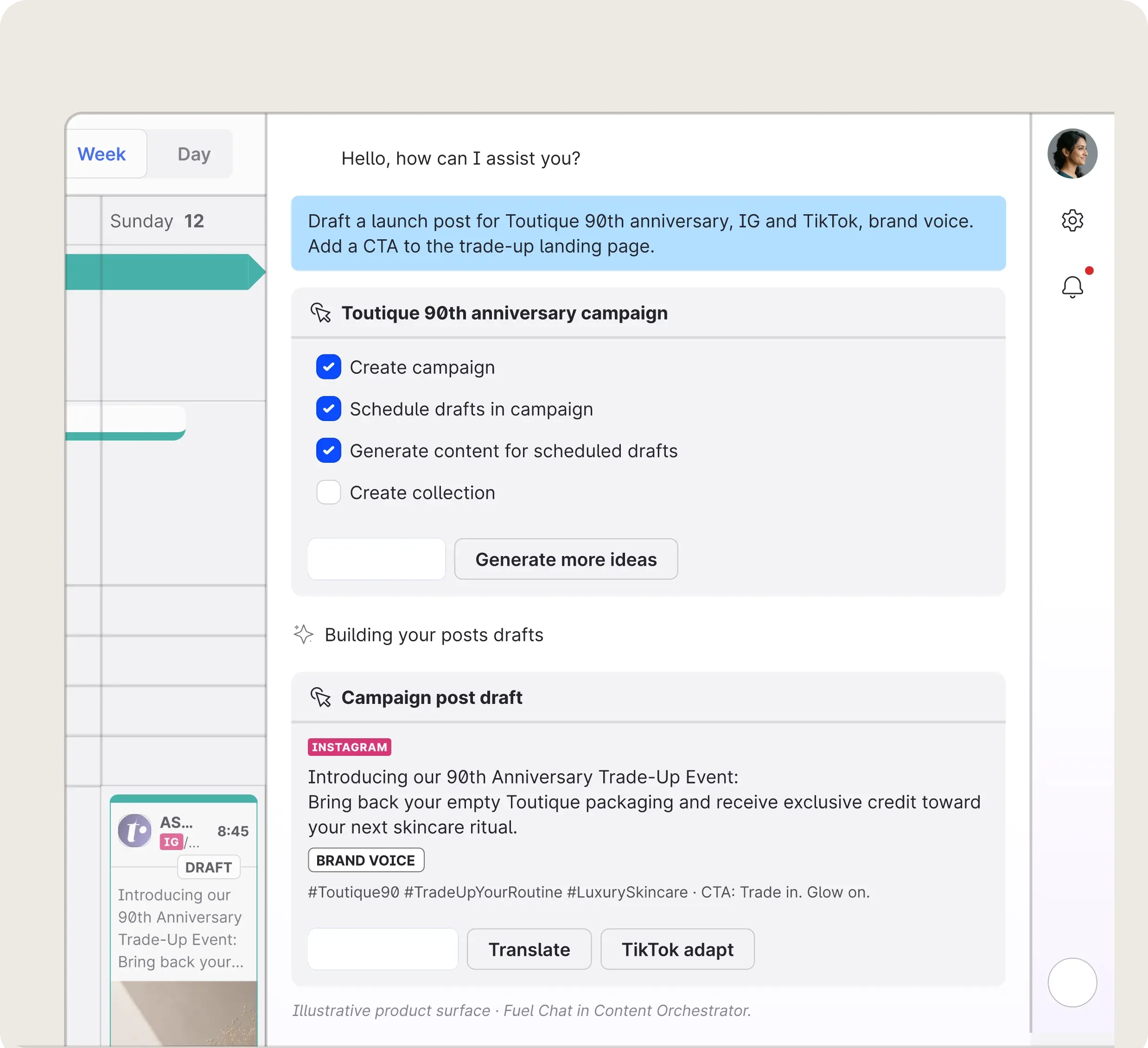
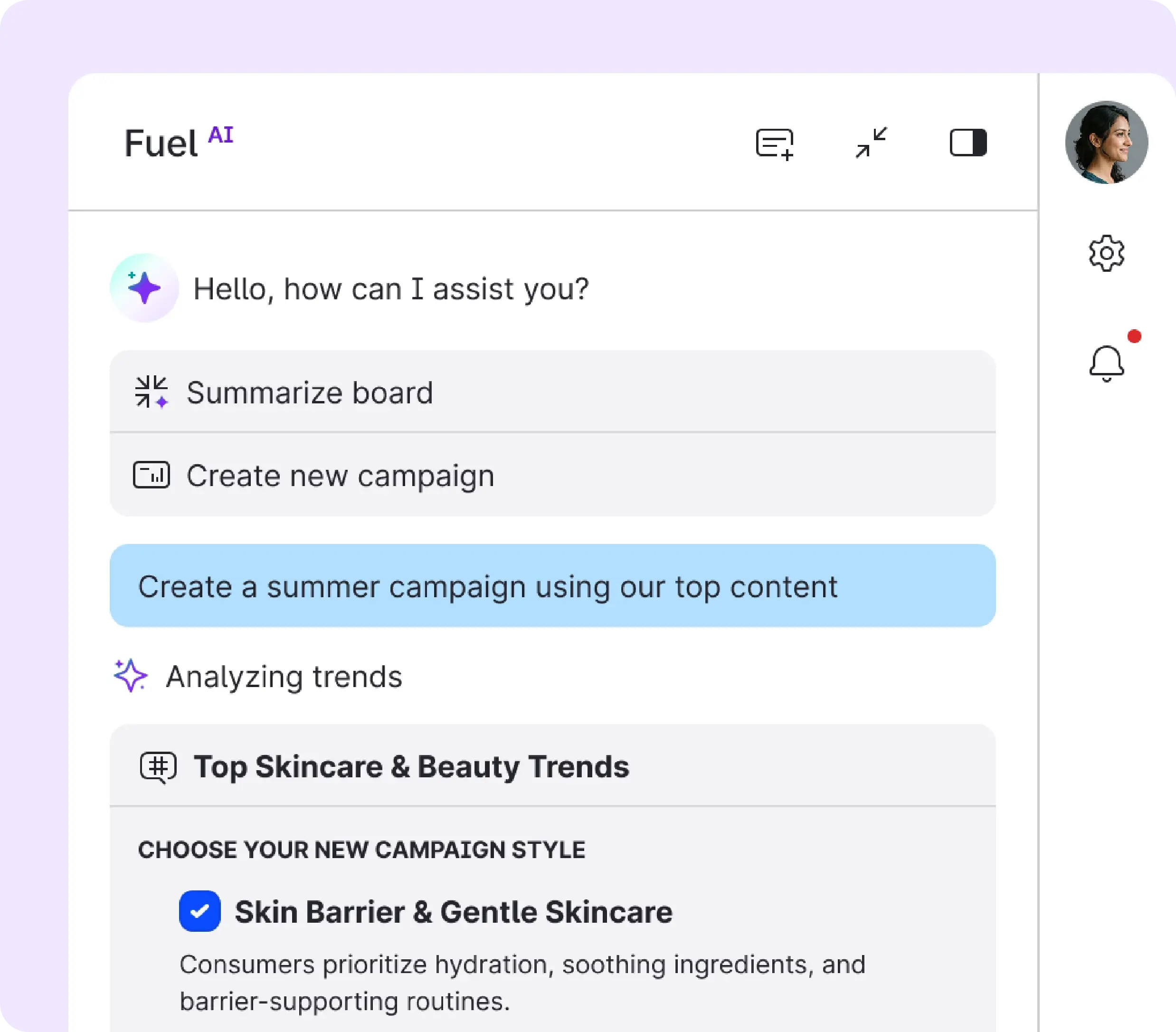
Emplifi’s Publisher, Community, Care, and Unified Analytics modules are built to connect through Fuel AI, rather than operate as separate tools.

Content Orchestrator sits upstream, where campaigns get briefed, approved, and sequenced across markets before a single post enters the queue.

Service Orchestrator picks up from there, managing the resulting conversation once content is live.

ASUS is a useful example of what unifying this kind of operation looks like at enterprise level.

With 145 team members running social channels across 70 markets, ASUS was drowning in data scattered across too many disconnected places, with days or weeks spent aggregating numbers just to answer “how did that campaign go?”

Bringing that operation into a single connected system replaced guesswork with a single source of truth.

We used to wait until the end of the month to reflect. Now we’re adjusting while the campaign is still live. That alone changes the tempo of how we work.
Jeff Lee
D2C Digital Content Specialist at Carhartt Inc

Fragmentation costs enterprises time and consistency, and connecting the systems is what fixes it.

Emplifi pro tip: None of this works without integrated tooling, connected data, and clear governance decisions about what the system can coordinate autonomously versus what needs a human to approve first. Build clear foundations before a full rollout to ensure maximum impact.

How does content orchestration connect to Autonomous CX?

Content orchestration and service orchestration are the two operational pillars of Autonomous CX.

  1. Content orchestration is how ACX manifests in the outbound layer, what goes out and what gets served.
  2. Service orchestration is how it manifests in the inbound resolution layer: what gets said and resolved once a customer responds.

Emplifi’s own experience orchestration guide makes the parallel argument from the care side: customer journey orchestration, the rules-based, predefined version most platforms still run on, was the model of the 2010s.

What replaces it is dynamic, AI-driven orchestration that adapts to real-time behavior instead of a fixed script.

Put the two pillars together, and that’s what it actually means to run Autonomous CX at enterprise scale: marketing, commerce, and care operating as one coordinated system, not three teams occasionally checking in with each other.

What consumers actually expect from AI

83% want disclosure when AI is involved. 71% say they’re satisfied with AI support. See the full picture of how consumer expectations around AI are shifting.

Final thoughts: Orchestration is the operating model, not the feature

Three functions telling three different stories to the same customer is a coordination gap.

And it’s the kind of problem that gets worse as the number of channels and campaigns grows.

Content orchestration lets teams:

  • Launch a campaign with commerce and care already reflecting it, instead of catching up hours or days later
  • Spend less time manually pinging other departments every time something goes live
  • Catch a sentiment shift or a stale surface before it turns into a public complaint

Emplifi connects the publishing, commerce, and care layers so coordination happens as part of the system, not as an extra task on someone’s to-do list.

See how Emplifi’s content orchestration connects across your marketing, commerce, and care stack. Get a demo with Emplifi today.

Frequently asked questions

No. A content calendar coordinates publishing timing. Content orchestration coordinates what happens across marketing, commerce, and care once that content actually goes live, which a calendar was never built to do.

Routine, low-risk coordination, like updating a care response library or surfacing matching commerce content, is well suited to automation. Higher-risk actions, pausing a live campaign, escalating a sentiment issue publicly, should route to a person for approval. The right balance depends on your governance model, not a one-size-fits-all default. For more on setting those boundaries, see how to build social media governance into the workflow itself.

Not necessarily, but it does require those tools to share data and workflows rather than operate in isolation. If your marketing, commerce, and care platforms can’t connect to each other, orchestration stays a manual process no matter how good each individual tool is. See how Emplifi’s automation and AI capabilities fit into an existing stack.

Sprinklr’s content orchestration content is a publishing and scheduling framework, planning, production, and distribution across platforms and markets. Emplifi’s approach treats content orchestration as an Autonomous CX capability that connects marketing content to commerce surfaces and care response readiness, not just to a publishing queue.