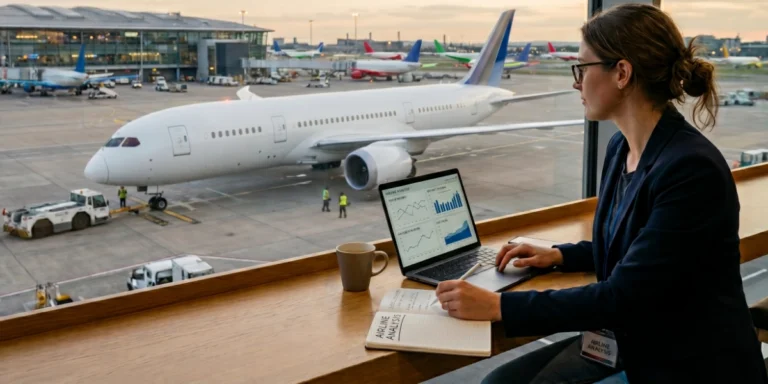
Airlines are entering a new era of customer service. Passenger demand is reaching record levels, with Airports Council International forecasting 10.2 billion passengers will travel in 2026 alone, and nearly double that by 2045. As travel volumes grow, so does the pressure to deliver fast, scalable customer care across every digital touchpoint.
Automation has evolved from a supporting tool to a core part of airline customer care operations. By mid-2026, AI was resolving up to 31% of Facebook direct message conversations without human intervention, allowing service teams to focus on more complex customer issues. At the same time, Instagram has emerged as airlines’ highest-volume customer care channel, underscoring the need for AI strategies that perform consistently across multiple platforms.
The data also highlights that peak travel season is the ultimate test of customer care operations. The most successful airlines are not those seeking to automate every interaction, but those combining AI with human expertise to deliver fast, accurate resolutions when demand and disruption are at their highest.
As passenger numbers continue to grow, the findings make one conclusion clear: airlines that invest in AI-powered, cross-channel customer care today will be better positioned to meet tomorrow’s customer expectations.
Airlines set the benchmark for social customer care
Before examining how automation is evolving, it is worth establishing where airlines stand relative to the general corporate landscape. On social comment response times, airlines consistently outpace standard brand categories across every major public platform.
Based on response-time data during the first half of 2026, airlines operate at a more accelerated pace than regular consumer brands, particularly on platforms like Instagram where real-time care is rapidly becoming the consumer standard.
| Platform (June 2026) |
Global Airline Median Speed |
All-Industry Average Brand Speed |
Performance Advantage |
| Facebook Comments |
1.19 hours |
11.50 hours |
~10x Faster |
| Instagram Comments |
0.46 hours (~27m) |
9.75 hours |
~21x Faster |
| X (Twitter) |
1.44 hours |
0.59 hours |
Seasonal Volume Shift |
Response time performance gap between the airline industry and other consumer-focused brands is not an accident. It reflects years of targeted investment in social care infrastructure, dedicated community management workflows, and increasingly, specialized AI-assisted response tools. The airline industry has set an operational standard that few sectors can match.
Automation is scaling and delivering results
The most significant development in airline social care over the past three years is the introduction of AI-powered tools that can automate customer care tasks, including responding to direct messages and managing customer inquiries.
In 2024, global airlines resolved approximately 2–7% of Facebook DM conversations exclusively through automated responses. By 2026, that figure has grown to between 25% and 31%, a roughly fourfold increase in three years. On Instagram, bot-only resolution has climbed from low single digits to between 9% and 20% across the first half of 2026, with March reaching 16.4% and June at 20.1%.
Combined across both platforms, global airlines are now resolving more than a quarter of all direct message conversations through automation alone, handling routine queries, flight status checks, and policy questions at scale without human agent involvement. This growth reflects a fundamental shift in how airlines are deploying AI. Automation is no longer a supplementary tool, it is becoming a core layer of the customer care operation.
Global Facebook Bot-Only resolution rate (2024 vs. 2025 vs. 2026)
Percentage of total responded DM sessions resolved exclusively by automated tools with zero agent Global Facebook Bot-Only Resolution Rate (2024 vs. 2025 vs. 2026)
Percentage of total responded DM sessions resolved exclusively by automated tools with zero agent touch.
| Month |
2024 Baseline |
2025 Baseline |
2026 Shift |
| Jan |
7.74% |
19.05% |
27.44% |
| Feb |
6.79% |
19.06% |
28.43% |
| Mar |
8.30% |
19.38% |
24.89% |
| Apr |
8.70% |
22.42% |
26.49% |
| May |
7.11% |
27.00% |
29.05% |
| Jun |
8.66% |
23.90% |
31.29% |
Global Cross-Channel AI Resolution Performance (2026)
Comparison of monthly bot-only resolution rates across leading messaging platforms.
| Platform |
Jan |
Feb |
Mar |
Apr |
May |
Jun |
| Facebook |
27.44% |
28.43% |
24.89% |
26.49% |
29.05% |
31.29% |
| Instagram |
8.86% |
12.36% |
16.43% |
20.94% |
20.89% |
20.08% |
Peak season: where AI investment is tested most
Passenger volumes peak between June and August, and with them comes a surge in customer care complexity. Flight disruptions, rebooking requests, compensation claims, and policy exceptions replace the routine queries that automation handles most effectively.
Flight disruptions in US aviation have become structurally more frequent. According to data from Hopper Technology Solutions (HTS), more than 58 million seats scheduled to depart from US airports were affected by significant disruptions in 2025, up from 50 million in 2019, and the frequency of significant disruption days has roughly doubled in the last six years.
This is the environment in which airline social care teams operate during peak season, and it is where the resilience of AI investment is truly tested.
The data shows that automation performance varies as travel demand and conversation complexity change throughout the year. During periods of disruption, airlines receive a greater share of rebooking requests, compensation claims, and policy exceptions, increasing the proportion of conversations that require human expertise. While some periods show temporary dips in bot-only resolution, others demonstrate that mature AI systems can maintain or even improve containment as automation capabilities evolve.
Rather than handling every interaction, effective AI identifies routine inquiries that can be resolved automatically while escalating more complex cases to human agents. The measure of AI maturity is not whether bots resolve every conversation, but whether the combined AI and human workflow continues to perform under pressure.
Seasonal Macro Trends in Automation Containment (2024–2026)
Tracking monthly variance to visualize historical containment drops during volatile travel windows.
| Month |
2024 (FB) |
2024 (IG) |
2025 (FB) |
2025 (IG) |
2026 (FB) |
2026 (IG) |
| Jan |
7.74% |
6.34% |
19.05% |
5.15% |
27.44% |
8.86% |
| Feb |
6.79% |
5.64% |
19.06% |
5.36% |
28.43% |
12.36% |
| Mar |
8.30% |
13.00% |
19.38% |
4.25% |
24.89% |
16.43% |
| Apr |
8.70% |
8.81% |
22.42% |
4.27% |
26.49% |
20.94% |
| May |
7.11% |
8.12% |
27.00% |
7.47% |
29.05% |
20.89% |
| Jun |
8.66% |
8.93% |
23.90% |
6.39% |
31.29% |
20.08% |
Instagram is emerging as the high-volume care channel
One of the clearest trends in the 2026 data is the growing importance of Instagram as a customer care channel, and the scale difference relative to Facebook.
In June 2026, global airlines handled a median of 673 Facebook DM sessions per brand. On Instagram, that figure was 2,096, more than three times higher. Instagram volumes have remained consistently high across the first half of 2026, ranging from 1,317 to 2,174 sessions per brand per month. Facebook volumes, while lower than Instagram’s high baseline, have shown steady growth year-over-year, moving upward from a median of 562 sessions in June 2024 to 673 sessions in June 2026 globally, with wider variation by region.
This channel shift reflects broader consumer behaviour. According to Emplifi’s own consumer research, 47% of frequent social media users turn to Instagram for customer service issues, and among younger audiences, Instagram is increasingly the first port of call for brand interaction of any kind. For airlines, this means that Instagram is where a growing share of the highest-volume, most time-sensitive conversations are happening—automation strategies need to reflect that.
Global Inbound DM Session Volume Breakdown (2026 Monthly)
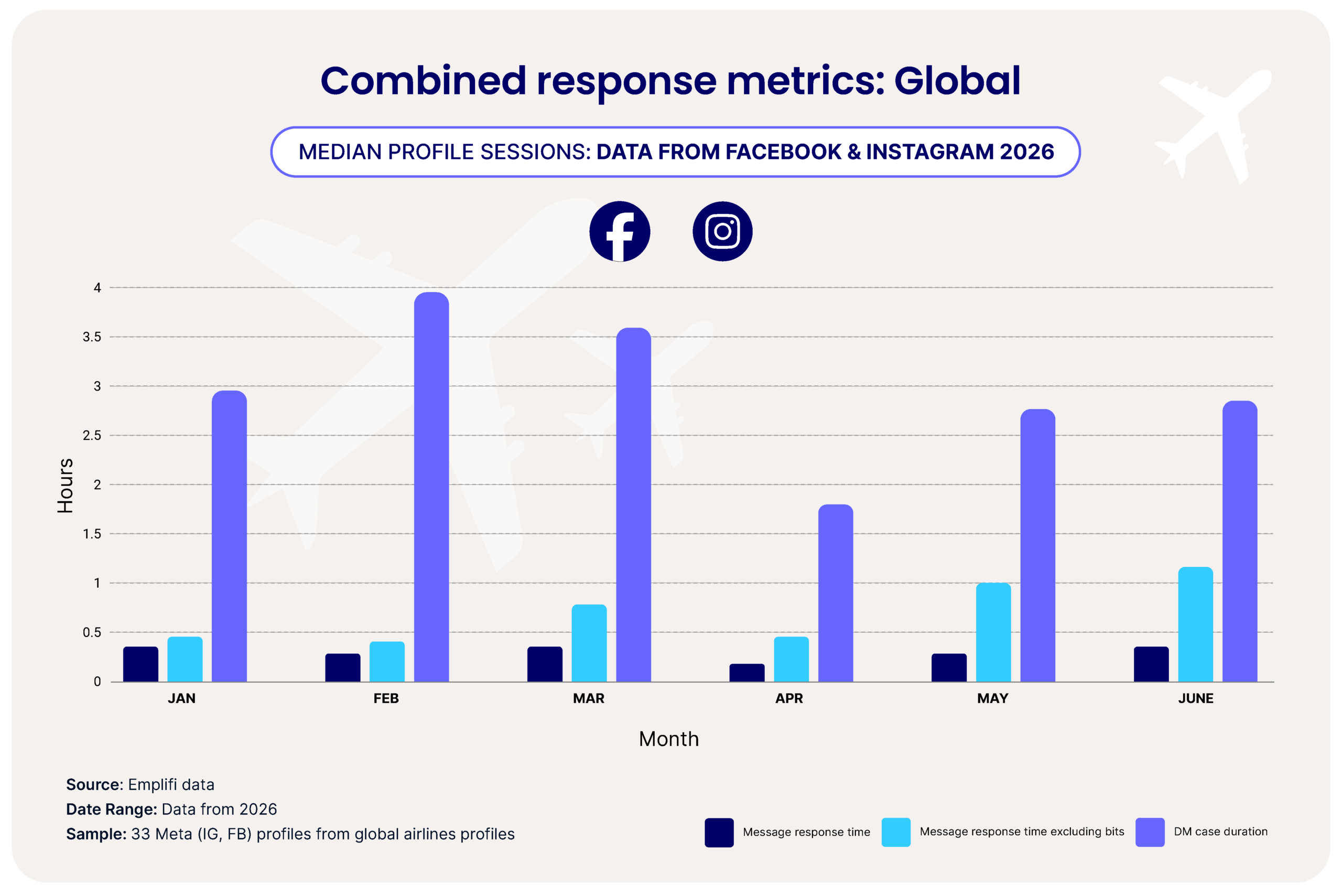
Median values showcasing the stark difference in user interaction weight by network.
X remains the fastest channel, with growing question volumes
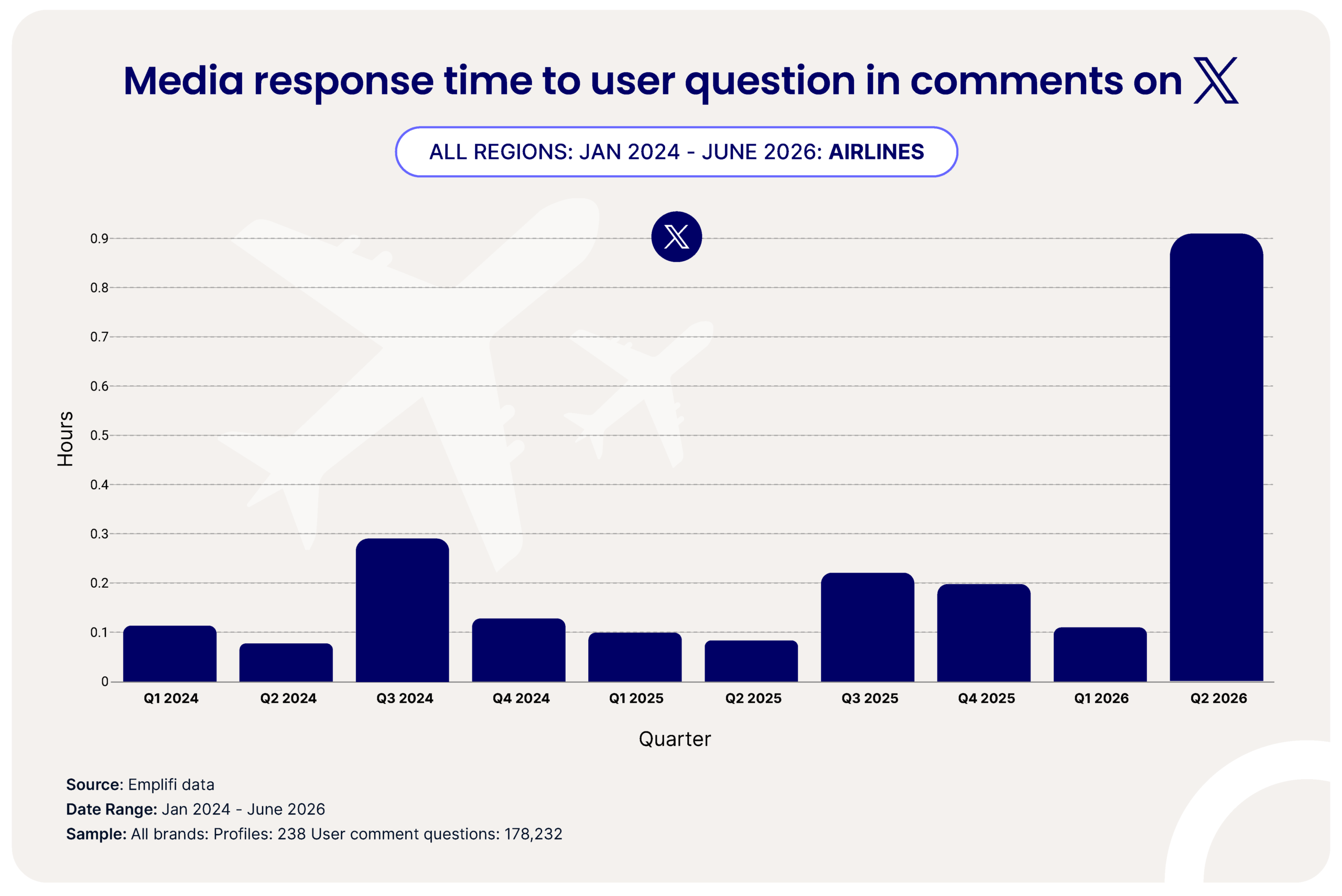
X (formerly Twitter) has long been the channel where airline customers expect the fastest responses. The data confirms that airlines continue to deliver remarkable speed, particularly early in the year where median response times started at a rapid 0.06 hours (under 4 minutes) in January 2026. But, as the year progressed into the busier spring and summer periods, response times on X lengthened to 0.92 hours in April and reached 1.44 hours by June.
Question volumes on X show a notable spike in March 2026, averaging 118.7 questions per airline brand, compared with roughly 12–30 questions in surrounding months. While the dataset does not identify the underlying cause, the increase illustrates how X continues to function as a real-time customer care channel during periods of heightened demand and rapidly changing travel conditions.
What resilient AI looks like across channels
The data across Facebook, Instagram, and X points to a consistent conclusion: the airlines delivering the best customer care outcomes are those that have built AI strategies designed to work across every channel, not just one.
On Facebook, automation is handling a growing share of DM volume, freeing human agents to focus on the complex, high-stakes conversations that peak season brings. On Instagram, the scale of conversation volume demands automation that can operate at pace. On X, speed remains the defining metric, and AI-assisted response tools are helping teams maintain it.
Consumer expectations align with this direction. According to Emplifi research, 51% of consumers say they care most about issue resolution, regardless of whether the response came from AI or a human. Recent Emplifi research reinforces this shift: 71% of consumers report being satisfied with AI-supported customer care experiences on social, even though most still prefer a human for more complex issues. The message is clear: customers do not need to know whether a bot or a person answered first, they need fast, accurate resolutions, with a seamless path to a human when the situation calls for it.
And 49% of consumers specifically identify travel as one of the industries that would benefit most from AI-powered customer service, which means the expectation of intelligent, effective AI is already embedded in how passengers think about the airline experience.
The commercial case is equally clear. Emplifi research shows that 59% of consumers purchased from a brand again after a positive resolution experience, and 45% say they are more likely to buy from brands that are responsive on social media during peak periods.
Looking ahead
Global passenger volumes are forecasted to reach 18.8 billion by 2045. The pressure on airline social care will only grow, in volume, in complexity, and in the expectations passengers bring to every interaction.
The 2026 data shows that the foundation is strong. Airlines lead every major industry on response speed. Automation is scaling rapidly across both Facebook and Instagram. And the brands that are investing in autonomous CX platforms that leverage AI to manage the customer experience across all channels and touchpoints, not just handling routine queries, but identifying intent, collecting context, and empowering agents to resolve complex cases, are building customer care operations that can hold up when it matters most.
Peak season is the industry’s most demanding stress test. The airlines that pass it consistently are those treating AI not as a cost-reduction tool, but as a customer experience investment.
About the methodology
Analysis is based on direct message and comment data from airline brand profiles on the Emplifi platform, covering January 2024 through June 2026. Data covers Facebook, Instagram, and X (formerly Twitter) across worldwide airline profiles. Bot-only conversation resolution rate reflects the share of responded DM sessions resolved exclusively through automated responses without human agent involvement. Industry response time comparisons are based on median Facebook comment response times across brands on the Emplifi platform. Consumer statistics are sourced from Emplifi’s 2025 Social Pulse Report, 2026 Consumer Survey Report, and Holiday Playbook Survey Research. Industry demand figures sourced from ACI World Airport Traffic Forecasts 2025–2054. Disruption data sourced from Hopper Technology Solutions via Fortune, May 2026.