Blog
12 min read
Jun 17, 2026

The social media manager's guide to Agentic AI: what it actually changes about your workflow

Agentic AI gives AI a goal and the authority to act on it. It observes signals, plans steps, executes across channels, and refines the result, instead of waiting for a human to prompt each task. For social teams, that shifts AI from a drafting tool into a system that handles routine community management, listening, and care under rules you define.

Emplifi Team Social Media Marketing Experts

Key points

  • Generative AI drafts when prompted, but Agentic AI works towards a goal end-to-end, then reports what it did
  • A three-tier triage model automates repetitive volume and routes judgment calls to people; that’s how Freshpet reduced call volume by 40% without sacrificing the personal touch pet parents expect
  • Autonomous social listening looks forward, flagging compounding trends before they peak rather than counting mentions after the fact
  • Agentic workflows connect care to commerce, turning a support conversation into a tracked path to checkout
  • Enterprise guardrails, such as policy caps, PII gating, and audit trails, encourage Legal, IT, and Procurement to sign off on the rollout


Your social team might already be using AI to draft captions, rewrite copy, and generate image prompts.

It saves time, but it doesn’t change how the work gets done.

The queue still fills up every morning. Community management still runs on manual effort. Care and commerce still live on separate tools, in separate teams, with no way to connect what a customer said to what they bought. This is what social CX actually is in practice for most teams; listening, care, and commerce, technically connected on paper but never actually working together.

That is the gap Agentic AI closes by taking ownership of routine work end-to-end under rules you define, while your team focuses on the decisions that actually need a human.

In this guide, you’ll learn:

  • How agentic AI differs from the generative AI your team is already using
  • How to restructure your workflow with a three-tier human-AI triage model
  • How autonomous social listening turns signals into action before a trend peaks
  • How to connect creator content and care conversations directly to revenue
  • What enterprise guardrails look like and why they’re what gets the rollout approved


How is agentic AI different from the generative AI you’re already using?

Generative AI is a tool you operate. You prompt it, it returns a draft, and you decide what happens next. Every output is one disconnected task, which is why most teams end up with a faster copywriter and the same fragmented workflow underneath.

But Agentic AI is given a goal and the authority to reach it. Inside the boundaries you set, an agent runs a loop: it observes the signal, plans the steps, acts across your connected tools, and refines based on the result.

Here’s how that looks in practice:

  • You receive an inbound message on Facebook from a customer waiting for their order
  • Generative AI drafts a reply when a person opens the case and asks for one.
  • But an agentic workflow reads the comment, classifies the intent, checks the order record, drafts and sends the response, logs the interaction, and escalates only if the case crosses a rule you wrote.

Here’s how Generative AI compares to Agentic AI at each step of the process:

Capability Generative AI assistant Agentic AI workflow
Trigger A person prompts it A signal, event, or business rule initiates the workflow
Scope of work One task, one output Works toward a defined goal from start to finish
Tool use Returns information or generated content Interacts with CRM, publishing, commerce, and business systems
Human role Operates the tool for each task Defines goals, permissions, and guardrails
Output A draft, recommendation, or response A completed and recorded business action
Failure mode Incorrect output requiring human review Controlled by governance rules, approval thresholds, and escalation paths

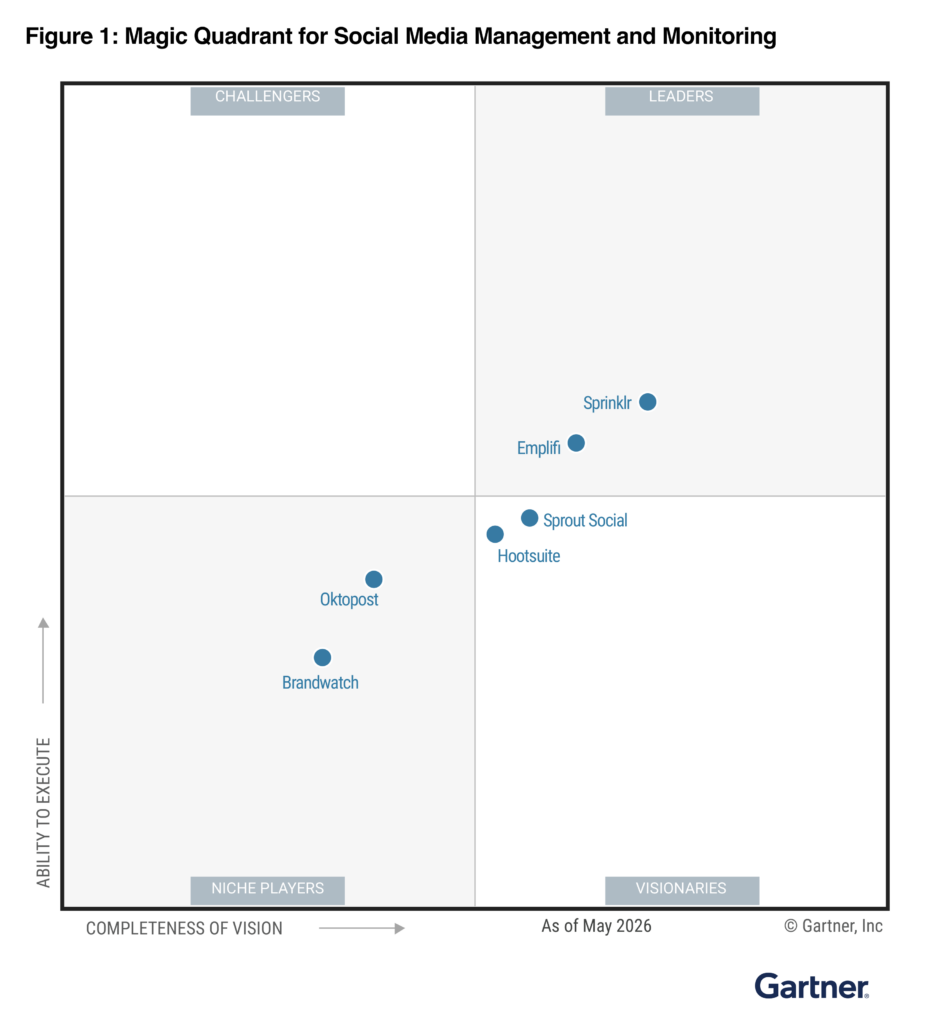
The market reflects how quickly Agentic AI is becoming a vital part of business workflows. Gartner forecasts that 40% of enterprise applications will embed task-specific AI agents by the end of 2026, up from less than 5% in 2025.

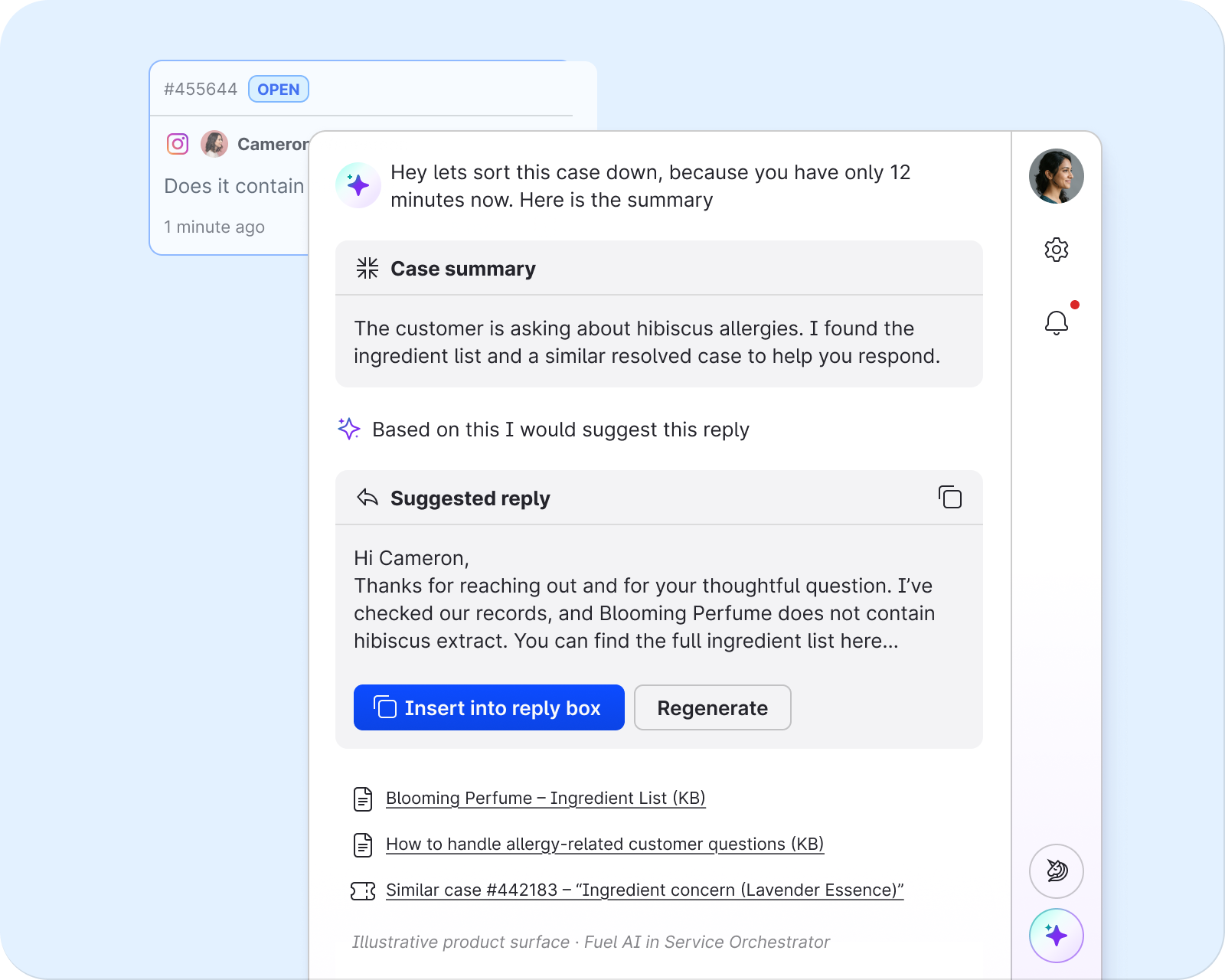
Emplifi Fuel is one key example of this. It’s the orchestration layer that makes this work across channels rather than within a single chat window.

Fuel AI reads cross-channel data natively, so an agent acting on an Instagram comment can see the same customer’s care history and order record without a human having to stitch the systems together.

That’s the difference between a clever assistant and a digital teammate that holds context.

Team in office

21% say a lack of internal AI skills is holding them back

Get the full breakdown.

Download now

How do you re-architect your workflow with a human-AI triage model?

Rather than replacing your team with Agentic AI, you should set up a triage model that sorts work by complexity and assigns each tier to the right operator: human or agent.

The best way to do this is to map your community management and social care volume into three tiers:

  • Tier 1, low complexity: FAQs, order status, store hours, password resets, and routine acknowledgements. Fully automated by agents at scale, with a confidence threshold below which the case moves up a tier.
  • Tier 2, moderate complexity: Sensitive complaints, multi-part questions, and replies that need a judgment call on tone. AI drafts the response and pulls in context; a human reviews, edits, and approves before it’s sent.
  • Tier 3, high complexity: Crises, legal exposure, influencer and partner relationships, and brand-voice judgment calls. Human-only, with the agent handling research and prep so the human agent can focus on the ultimate decision.

Here’s what this means for your team:

Your skilled practitioners stop spending their days on ticket routing and repeat answers; that’s Tier 1 work a machine handles faster and more consistently.

Tier Work type Owner What the human gains
Tier 1 FAQs, status checks, and routine enquiries Autonomous agents More time and fewer repetitive tasks
Tier 2 Sensitive replies and multi-step customer cases AI drafts, human approves Faster handling with full context already assembled
Tier 3 Crisis management, influencer issues, and brand judgment calls Human-led, AI-assisted More capacity for high-value conversations that require empathy and expertise

A good place to start is implementing Tier 1 with a narrow case set and a conservative confidence threshold, then widening the scope as the audit trail proves the agent’s accuracy.

AI workflow within Emplifi platform

Get a demo of the Emplifi platform to see how Agentic AI workflows can improve your social CX processes.

This model is already working in practice.

Freshpet used Emplifi to automate routine questions through FAQ bots called Scout and Chaser, while redirecting live agents to high-emotion conversations about pet nutrition and health.

The result was a 40% reduction in overall call volume and a 29% improvement in live-agent response times, without losing the empathetic touch pet parents expect.

What's really been important for us is making sure our consumer care experience can grow with us without losing the personal, empathetic touch that pet parents expect from our team.
Lisa Diehl
Senior Director of Consumer Care

How does autonomous social listening turn signals into action before a trend peaks?

Traditional social listening is essentially a backward-looking report.

You write boolean keyword queries, the tool counts mentions that have already happened, and an analyst reads the dashboard on Monday morning.

By the time a trend is big enough to show up in a keyword count, most of the lead time to act on it is already gone.

Autonomous social listening works differently. It uses cluster analysis and predictive models to group related conversations as they form, then surfaces compounding trends, sentiment shifts, and competitor weaknesses while they’re still building, not after they’ve peaked.

That early read is where the value sits.

When your team sees a trend forming, there’s still time to pivot paid spend, test new messaging, or brief product and R&D before the market catches up. The insight feeds directly into campaign execution rather than sitting in a report that nobody acts on until the next planning cycle.

Capability Traditional social listening Autonomous social listening
Method Boolean keyword queries Fuel AI-powered cluster analysis and predictive models
Time orientation Backward-looking; measures what happened Forward-looking; identifies signals as they emerge
Output Mention volume and sentiment reporting Emerging trends, sentiment shifts, and competitor opportunities
What you can do Report on trends after they happen Adjust spend, content, and messaging before trends peak
Visual content Misses many untagged brand mentions and UGC images Fuel AI helps surface untagged brand imagery and visual brand mentions

Two Fuel AI capabilities help close the gap left by keyword listening.

Its Signal Intelligence layer distills noisy signals into the clusters that actually matter, so your team isn’t wading through raw mention streams.

Fuel AI also powers autonomous UGC discovery to find untagged visual UGC where your product appears without a hashtag or handle, then route that content into a shoppable surface before it disappears in the feed.

The case for investing in this is strong. According to Emplifi’s 2026 State of Social Media Marketing Report, 82% of marketers say AI tools have improved their productivity, but most teams are still using AI reactively rather than predictively.

The shift from monitoring to early detection is where the real competitive edge lives.

91% of consumers want brands to disclose when they use AI

See more stats like this in our latest report

Download now

How do agentic workflows connect creator content directly to revenue?

If your team currently treats care and commerce as two completely separate jobs, it’s time to rethink your approach.

With separate tools, a support conversation lives in one queue while a storefront conversion lives in another system. Nobody connects the two, so the revenue a social interaction drives never gets attributed to it.

Agentic workflows change that with automated intent detection. When a customer asks “where can I buy this” under a creator post, an agent recognises purchase intent, surfaces the product, and turns the conversation into a tracked path to checkout.

What makes this a commerce conversation instead of a community one is attribution. Move the scoreboard away from follower counts and onto metrics a CFO actually recognises, such as:

  • Post-to-cart attribution: Connects each creator post to conversions on the product detail page, so contribution is measured accurately per partner.
  • Average order value lift: Reports creator-driven order value against your baseline, so high-return partners get funded and low-return ones get cut.
  • Commerce-connected UGC galleries: Link creator content and shoppable UGC to the storefront, so the path from a post to a closed order is one tracked motion.

The data on how UGC affects commerce outcomes is compelling.

Emplifi’s research shows that consumers who interact with UGC are 2.4x more likely to make a purchase, and shoppers engaging with UGC spend 11% more per transaction.

Across Emplifi’s social commerce client base, UGC contributes nearly $8 billion in annual revenue. That’s a care-to-commerce loop that produces real, attributable numbers rather than vanity metrics.

Carhartt is a good example of what this looks like in practice. The brand used Emplifi’s UGC platform to put its customers at the center of its digital experience, connecting Emplifi-powered displays and galleries to real community content across digital and in-store touchpoints.

The result:

  • 85K+ consumer engagements
  • A 27% conversion rate influenced by UGC gallery interaction
  • And $150K in directly attributed revenue

When attribution is tied to the cart, you can identify partners who secure revenue as well as reach.

Carhartt customers like seeing real people wearing our gear, which encourages them to buy with confidence. And I love how we can just provide all of it with the help of Emplifi.
Kaleena Ocasio
D2C Digital Content Specialist at Carhartt Inc

What guardrails make agentic AI safe for an enterprise rollout?

This is typically where the deal stalls.

Your legal team worry about AI hallucinations. IT worries about PII exposure. Compliance wants an audit trail before any agent touches a customer.

You need to address those three concerns head-on to align everyone on your Agentic AI project and ensure it’s a success.

It’s worth taking the risk seriously. Gartner research projects that over 40% of Agentic AI projects will be canceled by 2027 due to escalating costs, unclear business value, or inadequate risk controls.

That’s not a reason to wait. A platform like Emplifi lets you start with a narrow set of low-risk cases and expand at whatever pace your organization is comfortable with, rather than handing everything to an agent on day one. The teams hitting Gartner’s failure mode are usually the ones who skipped that step. The same pattern shows up whenever social operations scale faster than governance does.

To reduce the risk of this happening for your team, build governance into the architecture from day one, not as an afterthought.

Enterprise-grade Agentic AI needs three control layers:

  • Policy guardrails: Per-case caps, regional rules, and role-based permissions that bound what an agent can do, whom they can do it to, and how often. An agent that hits a cap escalates instead of improvising.
  • Data gating: A filter that strips PII before any prompt reaches a Large Language Model (LLM), so customer data stays inside your governed environment and out of the model context.
  • Observability: Immutable, human-readable audit trails on every agent action, plus a shadow mode that runs agents against real cases without sending output, so you can measure accuracy before you go live.

This is how each Agentic AI concern could be mitigated by your team: 

Concern Who raises it Control that answers it
Hallucinated or off-brand replies Legal, compliance, and brand teams Policy guardrails, confidence thresholds, and human approval for higher-risk interactions
PII exposure to a model IT, security, and privacy teams Data gating and PII redaction before information reaches the model
No record of what AI did Compliance, audit, and risk teams Immutable, human-readable audit trails for every action and decision
Unproven accuracy before launch Procurement, operations, and customer care leaders Shadow-mode testing and validation against live customer interactions

Shadow mode is the one that often gets overlooked.

It lets you point agents at your real Tier 1 queue, compare their proposed actions to what your team would have done, and quantify accuracy before a single automated reply goes out. That evidence is what turns a cautious “not yet” from Compliance into a scoped “yes, start at Tier 1.”

Brands already running this model are building real operational muscle.

Salomon used Emplifi Care to implement structured care workflows across its global operation, achieving a 45% reduction in response time and 70% faster case handoffs, with 99.8% of cases handled efficiently.

And Entel, Chile’s largest telecom, consolidated its social operations on Emplifi and cut response time by 75%, while growing overall social media views by 184% and interactions by 49%.

Neither of those results came from deploying an agent and hoping for the best. They came from defining the tiers, setting the thresholds, and proving accuracy before scaling.

With Emplifi, transitioning from Community to Care is seamless. I can simply flag an issue, like a warranty request, and with just one click, it's routed to the right team. It's really that easy. What used to take multiple steps now just flows effortlessly into the hands of the experts.
Salomé Mougel
Social Media Marketing Assistant, Salomon

Final thoughts: agentic AI is an operating model, not a feature

Prompt-based AI made individual tasks faster.

But an agentic workflow changes the shape of the work itself: common queries are answered by agents under your rules, listening looks forward, care connects to commerce, and your skilled people focus on the judgment calls that actually need a human.

The plan is straightforward:

  • Automate Tier 1
  • Supervise Tier 2
  • Reserve your people for Tier 3
  • And prove every step with an audit trail your governance team can read

According to Emplifi’s 2026 State of Social Media Marketing Report, 76% of social media marketers experience burnout at least occasionally, and 57% of social teams have six or fewer people.

The teams under the most pressure are exactly the ones who stand to benefit most from an agentic model, as long as they build it on a foundation of clear guardrails and verified accuracy. And with the right platform in place, a team of 5 can do the work of 50.

Ready to see where your team sits on the AI maturity curve? Request a complimentary assessment from Emplifi and get a clear path to Autonomous CX.

Frequently asked questions

Traditional marketing automation runs fixed ‘if-this-then-that’ rules written in advance, so it only handles the exact scenarios it was programmed for. An Agentic AI workflow is given a goal and figures out the steps itself, calling your connected tools to reach the outcome and escalating when a case hits a rule you’ve set. On Emplifi Fuel, that means an agent can read cross-channel context, act, and log the action rather than just firing a single pre-set sequence.

Start with data gating — a filter that strips personally identifiable information before any prompt reaches a Large Language Model (LLM), keeping customer data inside your governed environment. Pair that with role-based permissions that limit what each agent can access, regional policy rules that respect data residency, and immutable audit trails that record every action. Emplifi Fuel applies these controls at the orchestration layer, which is what gives Legal and IT the confidence to sign off before an agent touches a live customer record.

The team shifts from doing the routine work to governing the agents that do it. In practice, three roles tend to emerge: an AI operations lead who designs the triage tiers and tunes confidence thresholds; a quality reviewer who approves Tier 2 AI-drafted responses and audits agent accuracy; and a strategist who owns Tier 3 decisions like crises, influencer relationships, and brand judgment calls. Headcount doesn’t need to be cut. The work just moves up from tactical execution to oversight and strategy.

Autonomous social listening platforms like Emplifi use cluster analysis and predictive models to group related conversations as they form, flagging a sentiment shift while it’s still building rather than after it trends. That early warning is the mitigation; your team can brief stakeholders, pause scheduled content, and prepare a response before the issue peaks. Fuel AI distills the signal into the clusters that matter, so your team reviews a short list instead of a raw mention stream and can act much faster.

The three-tier triage model handles this well. Tier 1 cases like routine queries, order status, and FAQs, run through agents with policy caps and a confidence threshold that routes uncertain cases upward. Tier 2 cases get an AI-drafted response that a human reviews and approves before it goes out. Tier 3 cases (anything involving brand judgment, crisis management, or influencer handling) stay human-only. Brand voice stays consistent because agents operate within templates and guardrails your team writes.