Blog
8 min read
Apr 15, 2026

Implementing Agentic CX: A step-by-step guide to AI customer service

Agentic CX is a customer experience approach where AI systems resolve issues, trigger workflows, and automate actions in real time, reducing customer effort and improving outcomes without requiring multiple interactions.

Gabriel Tay Director of Business Consulting at Emplifi
Woman looking at Agentic AI screen

Key points:

  • Agentic CX enables AI to resolve customer issues and complete tasks in real time, reducing effort and improving outcomes.
  • Successful AI implementation starts with a controlled rollout, focusing on high-volume, low-complexity use cases before scaling.
  • Agentic CX allows organizations to deliver proactive customer service by detecting patterns early and acting before issues escalate.
  • AI enhances human agents by automating repetitive work and providing context, enabling teams to focus on complex, high-value interactions.

AI has played a role in customer service for years, with one main focus: speed.

With Emplifi’s research finding that 35% of consumers expect a response on social media within an hour, organizations have used AI to automate simple queries and route interactions more efficiently just to keep up.

That’s no longer enough.

Customers don’t just expect speed. They also expect resolution without effort. According to Salesforce, 79% of customers expect consistent interactions across departments, yet only 55% say it still feels like they’re dealing with separate teams rather than one company.

This is where Agentic CX changes the model.

For a deeper look at the shift behind this approach, see ‘What is autonomous customer experience (CX)? A 2026 guide to Agentic AI’. In this guide, we’ll focus on the practical side: how to implement Agentic CX step-by-step.

What you’ll learn in this guide

In this guide we cover:

  • What Agentic CX is and how it transforms customer service
  • How to roll out AI customer service safely and effectively
  • How to identify high-impact automation opportunities
  • How to deliver proactive, real-time customer support
  • How to measure performance and optimise over time

What is Agentic CX?

Agentic CX shifts AI customer service from simple responses to fully resolving queries.

Instead of guiding customers through the steps they need to take, AI does it for them by triggering workflows, completing tasks, and removing the effort required to resolve.

In practice, this means organizations can:

  • Resolve common issues automatically without back-and-forth
  • Detect problems early using customer and behavioral data
  • Trigger updates, escalations, or support actions in real time
  • Reduce customer effort by shortening the path to resolution

In summary: Agentic CX uses AI to turn insight into action, enabling faster, more proactive customer experience.

For CX leaders, the question is not whether to use AI, but how to implement it in a way that delivers real impact without adding risk or extra layers of complexity to customer workflows. 

Let’s see how you can create a clear, step-by-step plan to implement Agentic CX in your business. 

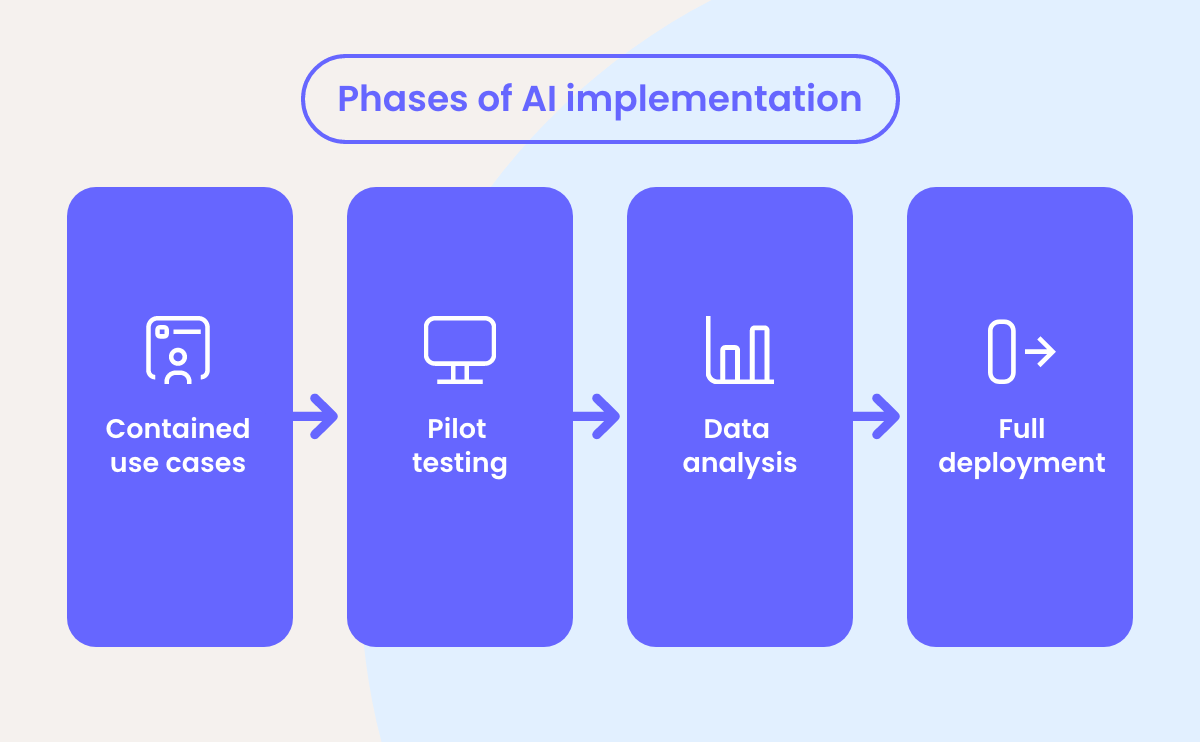
Phase 1: Set clear goals and assess your data

Phases of AI implementation

Before you start implementing Agentic CX, define what success looks like. Clear outcomes help set direction and prioritize use cases for your automated CX platform. 

Agentic CX should support both overarching strategic goals and operational aims. These include:

  • Faster response and resolution times, reducing wait times and backlog
  • Higher first contact resolution (FCR), minimizing repeat interactions
  • Lower cost per interaction, improving operational efficiency
  • Improved customer satisfaction (CSAT), reflecting overall experience quality
  • Reduced customer effort (CES) is often the strongest driver of loyalty

It’s vital to define these outcomes before you start. Without clear goals, it becomes difficult to measure performance or align teams.

1a) Assess data readiness

Agentic CX depends on connected, structured, real-time data. For many organizations, this is the biggest challenge to overcome at this stage of the process. 

Customer data is often scattered across CRM systems, helpdesks, social tools, and analytics platforms, with limited integration. This fragmentation makes it difficult to build a complete customer view or identify patterns.

To assess readiness, consider:

  • Whether customer interactions can be tracked across channels
  • How consistently are tickets and conversations categorized
  • Whether your knowledge base reflects current products, policies, and issues
  • How easily teams can access historical interaction data

If these elements are missing, address them first. Agentic systems rely on high-quality data to operate effectively.

1b) Identify high-impact use cases

Once you have clear goals and data in place, identify where Agentic CX can deliver immediate value.

Focus on understanding:

  • The most common reasons customers contact support
  • The highest-volume interaction types
  • The workflows that consume the most time

These insights help prioritize use cases that are both high-impact and feasible to automate early on.

Customer agent typing on laptop

Turn social customer care into your competitive edge

Our 20 minute product tour will show you how

Take a product tour

1c) Establish a baseline

Before making changes, be sure to capture current performance across your key metrics.

This baseline allows you to measure improvement and demonstrate ROI. It also highlights where performance is already strong and where the biggest opportunities exist.

Phase 2: Start with a controlled rollout

Rather than launching Agentic CX across all your workflows, a phased approach allows you to test, learn, and refine your strategy before scaling.

2a) Focus on predictable interactions

Start with high-volume, low-complexity interactions. These tasks follow clear patterns and are easier to standardize.

For instance:

  • Order tracking and delivery updates
  • Password resets and account access issues
  • Returns and refunds
  • Frequently asked product or policy questions

Choose interactions that represent a large share of your support volume and provide a strong foundation for automation.

Take your customer experience further

Explore how Autonomous CX builds on Agentic CX to deliver fully self-optimising, real-time customer experiences.

2b) Move from response to execution

Agentic CX stands out because it actually completes actions on behalf of the customer, rather than guiding them through the steps they need to take.

It can surface real-time tracking, initiate a return, or update an account. This improves customer satisfaction by speeding up resolution and reducing the amount of effort on their part.

You should focus on defining which interactions to automate and hone in on when issues should be escalated to human agents. Getting these boundaries in place ensures consistency while the system is being tested and refined.

2c) Build feedback into the process

Monitoring system performance in real scenarios helps identify areas for improvement.

Once your Agentic CX solution is launched, you should analyze key scenarios like:

  • Where automation fails or produces incorrect outcomes
  • Which interactions escalate unnecessarily
  • Where customers encounter friction or confusion

Use these insights to refine your existing workflows before expanding to more complex use cases.

Team members looking at laptop, checking their customer feedback

Map your customer journey with clarity

Learn how to visualize every touchpoint, identify friction, and create more seamless customer experiences.

Download template

Phase 3: Move from reactive to proactive customer care

Once you’ve laid the groundwork and your foundational workflows are stable, you can begin to scale and experience the full value of Agentic CX.

3a) Detect patterns across customer signals

Customer issues rarely appear without warning. They emerge as patterns across conversations, reviews, social channels, and behavioral data.

Agentic systems can analyze these signals in real time to identify recurring complaints, shifts in sentiment, and changes in customer behavior. This allows organizations to detect issues earlier and act before they escalate.

3b) Anticipate needs before they become bigger crises

The next step is to act on these signals before they become support requests, or even viral social media crises.

This might include:

  • Notifying customers about delays or disruptions before they reach out
  • Addressing common concerns publicly across channels
  • Providing guidance based on known issues or behaviors

Not only does this reduce inbound volume for your support team, but it also improves the customer experience by removing unnecessary effort.

Example of using an AI chatbot for customer service.

3c) Prioritize based on impact

Agentic CX enables more intelligent prioritization, where interactions can be ranked by:

  • Customer sentiment, with negative experiences, escalated faster
  • Customer value, ensuring high-value relationships are protected
  • Frequency of issues, allowing recurring problems to be addressed quickly

This allows resources to be focused where they matter most. When an issue is identified, the system can trigger workflows, update content, notify teams, or communicate with customers automatically.

Phase 4: Empower human agents

Agentic CX is not about replacing agents – far from it. It’s actually about enabling them to work more effectively and focus on higher-value interactions.

Gartner research has recently revealed that as AI becomes a key part of customer support workflows, human roles are evolving. Nearly 80% of organizations are planning to transition agents into new positions, and 84% are adding new skills to agent profiles.

Whereas traditional support models often require agents to spend significant time on repetitive tasks, such as triaging tickets or searching for information, Agentic CX removes much of this overhead, allowing agents to operate with greater speed and clarity.

And with two-thirds (67%) of consumers preferring a human response over AI in customer service, AI can assist, but a human touch remains crucial.

4a) Improve routing and prioritization

AI can analyze incoming interactions and route them based on urgency, complexity, sentiment, and customer value.

This ensures that high-priority issues are surfaced quickly and handled by the most appropriate agent, reducing manual triage and therefore improving response times. This is detrimental to customer satisfaction. According to Emplifi consumer research, if a brand takes more than 24 hours to respond to a social media DM, they risk losing a third of customers.

4b) Provide real-time context and guidance

Agentic systems surface relevant information at the point of interaction, including customer history, previous conversations, and suggested next steps.

54% of consumers abandon a brand when forced to repeat their issue multiple times, so having this context can be critical to delivering a superior customer experience.

The real-time guidance that AI can provide allows agents to focus immediately on resolution rather than searching for context, improving both speed and consistency.

4c) Enable seamless handoffs

Customers expect a consistent experience across channels.

Agentic CX ensures conversations can move between AI systems and human agents without losing context.

Freshpet used Emplifi to implement AI-driven customer service, supporting increasing demand while maintaining a high standard of care.

By automating routine interactions and improving routing, the organization reduced call volume by 40% and improved live agent response times by 29%. Agents were equipped with better context, enabling them to resolve issues more effectively.

This approach allowed Freshpet to scale its support operation without compromising on quality.

Emplifi supports us every day, in everything that we do. Our spokes on the wheel are integrated with (Emplifi) Agent, making it easy for our teams to enter the correct data, which in turn helps with accurate reporting. Many critical decisions within our organization are made based on the information collected, and being able to run accurate reporting. The integrated Emplifi tools help us do that easily.
Lisa Diehl
Consumer Care

Phase 5: Measure and optimize your strategy

Agentic CX is not a one-time project. It requires ongoing measurement and refinement to deliver long-term value.

5a) Track performance across key metrics

Focus on the metrics you defined at the outset and connect them to real business outcomes to clearly demonstrate the impact of Agentic CX.

This includes:

  • Reduced operational costs through automation
  • Increased customer retention driven by better experiences
  • Higher customer lifetime value

5c) Continuously refine and scale

Agentic CX systems improve over time, but only with active management.

This involves updating knowledge bases, refining workflows, incorporating feedback, and monitoring performance trends. As confidence grows, organizations can expand into more complex and proactive use cases.

Final thoughts: Agentic CX is transforming customer service for the better

Agentic CX represents a fundamental shift in how customer service is delivered.

It enables organizations to move from reactive support to proactive, execution-led experiences.

Over time, this transforms AI from a supporting tool into a core part of how customer experience is delivered.

Agentic CX requires more than standalone tools. It depends on connected data, unified workflows, and real-time insights across every customer touchpoint.

Emplifi brings social media management, customer care, and analytics together in one platform, helping teams manage interactions and deliver consistent customer experiences at scale.

Explore how Emplifi can support your Agentic CX strategy – get a demo today. 

Agentic CX is an AI-driven approach to customer service where systems don’t just respond to queries but take action to resolve them in real time. This includes triggering workflows, completing tasks, and reducing customer effort without requiring multiple interactions.

Traditional AI and chatbots focus on answering questions or routing requests, while Agentic CX focuses on execution. Instead of guiding customers through steps, Agentic systems complete actions on their behalf, enabling faster, more seamless resolutions.

Agentic CX helps organizations reduce customer effort, improve resolution times, increase first contact resolution, and deliver more proactive support. It also lowers operational costs by automating repetitive tasks and improving efficiency across teams.


Emplifi supports Agentic CX by bringing social media management, customer care, and analytics together in one platform. This enables teams to automate workflows, unify customer data, and deliver real-time, context-aware support across channels.

Agentic CX can be applied across industries including retail, e-commerce, SaaS, telecom, and financial services – anywhere organizations need to manage high volumes of customer interactions and deliver fast, consistent support.

Insights from Emplifi

Explore our latest blogs and comprehensive guides designed to help you master customer experience strategies and drive growth.

Ready to fuel your CX and social media marketing?

Discover how Emplifi boosts efficiency, increases revenue, and scales your social media marketing — whether you have a small team or a complex product. Let’s talk today.

What can you expect?

  • A partner who cares about your strategy and objectives
  • Live demo showing how we differentiate from the pack
  • No pressure, just advice
Get a demo