2026 Gartner® Magic Quadrant™

Emplifi named a Leader in the 2026 Gartner® Magic Quadrant™ for Social Media Management and Listening

Get the Report

Emplifi named a Leader in the 2026 Gartner® Magic Quadrant™ for Social Media Management and Listening Get the Report

Blog
10 min read
Sep 18, 2026

How to Build a Digital PR Strategy That Travels on Social

A digital PR strategy that travels on social runs PR and social as one campaign: briefed together from the first idea, planned across launch, live response and follow-up, and measured on one scorecard of reach, mentions, share of voice and sentiment.

Joe Wade Founder, Don’t Panic

Short-form video will run the content agenda in 2026 for 73% of marketers, according to Emplifi’s State of Social Media Marketing 2026. That’s where people now watch, share and make up their minds about you. Yet most PR still turns up there like an afterthought and wonders why nobody claps.

It’s all too common for brilliant coverage to die in a day because nobody planned what happened next. The pattern never changes. PR builds the story, wins the hit, hands the assets to social at launch, and hopes.

Hope is not a plan.

A digital PR strategy that travels on social runs as one campaign, briefed and measured together.

Building a Digital PR Strategy at a glance

  • A digital PR strategy earns the coverage, mentions and links that build your reputation and your search visibility, treating social as an input to the idea from day one.
  • In a digital PR strategy that travels, PR and social run as one campaign, briefed together from the first idea, with both teams answering to one goal.
  • Social listening should shape a digital PR brief from the start, showing what an audience already argues about and shares before the idea is set.
  • A digital PR campaign has a full social life in three acts: the launch, the live response, and the follow-up that keeps it moving for days after the coverage lands.
  • Shared PR and social measurement tracks reach, mentions, share of voice and sentiment across earned and social together, on one scorecard both teams own.
  • Most integrated campaigns fail at the handoff: an idea built for the press release is passed to social only at launch, too late for the feed.

What is a digital PR strategy?

Reputation and visibility are earned, not bought. A digital PR strategy is the plan for earning them across search, media and social: the coverage, mentions, links and conversation that make a brand worth talking about.

Where social media marketing posts your own content on your own channels, digital PR earns other people’s attention, and that attention carries more weight because someone chose to give it.

Treat social as an input to the idea, feeding the concept from the first sketch.

Why PR and social can’t be separate tracks

A story breaks in the press, then lives or dies on social, where the audience actually is. The coverage is only a starting gun; what happens next, the sharing, the clipping, the arguing, decides whether it travels at all. Split PR and social into separate tracks and you leave that to chance.

We learned that early. Our film for Save the Children, Most Shocking Second a Day, was built to be passed on.

It got over 23 million YouTube views in under a week, reported across national coverage at the time, because the idea was built to move from one person to the next, and it did.

Run PR and social as separate tracks and each one chases its own scoreboard. PR wants the outlet and the link; social wants the post and the save.

Between the two scoreboards, the question that decides it gets lost: did the story move? One team, one campaign, one goal keeps it in view.

Why brief PR and social together from the start?

The brief is where integration is won or lost. Let PR write it alone and the idea bends towards the outlet: a sharp hook, a quotable line, a stat a journalist can lead on. That’s fine for the inbox and dead on arrival in a feed, which is why PR and social have to write it together.

Put social in the room from the first idea and three things change. The concept gets pressure-tested for sharing before anyone spends a penny. The assets get planned feed by feed, cut for each platform while the idea is still on the whiteboard.

The third change is the one that pays. Follow-up content, the stuff that keeps a story alive for a week, is already in the plan, ready to run the day the coverage lands.

I’m not saying social should own the brief. I’m saying both should write it.

PR knows what a journalist will bite on. Social knows what a person will share. You get both only when both are briefing the idea from the first line.

How does social listening sharpen the creative and PR brief?

Before you decide what to say, social listening tells you what your audience already argues about, shares and cares about. It hands the brief hard evidence: the words real people use, the fights they’re already having, the moments a brand can walk into without getting laughed out. Too often it gets switched on only at launch, just to count mentions.

Used properly, listening feeds the idea. It shows the formats and the creators an audience actually trusts, and the moment a brand can credibly show up. AI-powered social listening, like Emplifi’s, reads those patterns across millions of posts, which no focus group of eight people in a room ever could.

That intelligence belongs in the creative brief and the PR brief at the same time. If the audience is sceptical of a claim, PR reframes the story and social plans content that meets the doubt head on. The brief ends up written in the audience’s language: what they will actually accept, in the words they already use.

How do you plan a campaign’s full social life?

Most campaigns get one push, then silence. A full social life runs in three acts: the launch, the live response and the follow-up, each with an owner and a slot booked before launch. Pay for the first act and forget the other two, and stories spike on Monday then vanish by Wednesday.

The launch act is content built for the feed itself, cut for the platform it lives on from the first edit: vertical, legible with the sound off, made to stop a thumb. Planning that spread of native assets across channels is where AI-assisted publishing and scheduling, like Emplifi’s, earns its keep.

The live act is the response. A story lands, people reply, question and pile in, and the first hour decides whether momentum builds or curdles.

This needs a senior owner who can answer in real time. One prioritised inbox for every comment, DM and mention, like Emplifi’s, is the difference between joining the conversation and watching it happen without you.

The follow-up act is momentum. Reaction content, creator collaborations and the second data drop belong in the plan on day one, ready to fire the moment the spike hits.

What should shared PR and social measurement look like?

PR and social should answer to one scoreboard: reach, mentions, share of voice and sentiment, measured across earned and social together, from one source of truth. When PR counts coverage and links while social counts posts and saves in separate views, integrated campaigns quietly fall apart. One shared number turns two dashboards into a verdict both teams own.

Consolidating cross-channel data into one view, the way Emplifi’s unified analytics does, is what makes that shared number possible, so both teams work from the same figures.

Then add the number most PR reports still miss: search and AI visibility. Earned coverage increasingly decides whether a brand gets cited in AI answers, and the digital PR tactics that build third-party authority now do double duty as a search play. Brands are 6.5x more likely to be cited by AI search through third-party sources than through their own domains, which is the number that drags earned media onto the search scorecard.

Measure reach, mentions, share of voice, sentiment and citation together. That’s the campaign’s real score.

A digital PR campaign that travelled on social

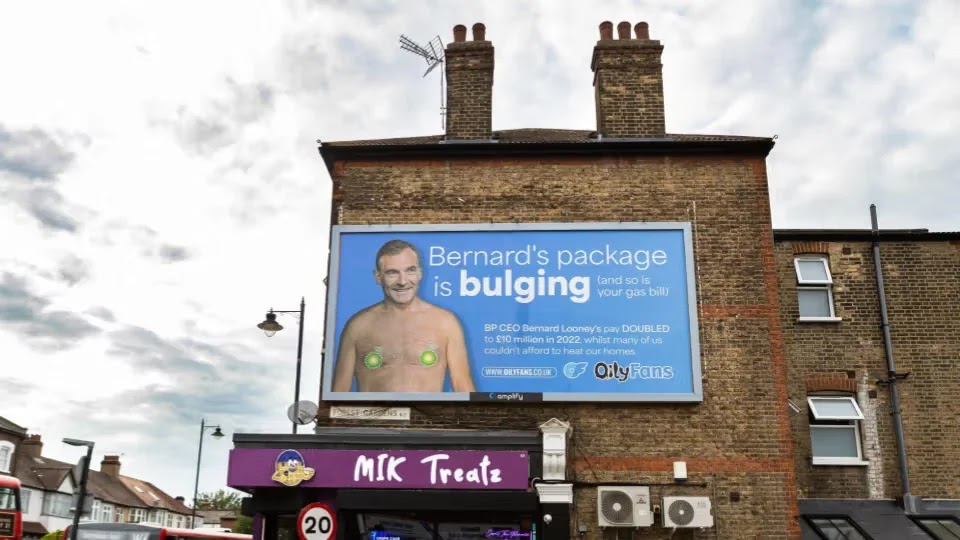
The clearest example I can give is our own. In 2023 we worked with Global Witness on OilyFans, a campaign that hijacked a live cultural moment and rode it straight across social. It started as a billboard sting and was built, from the first sketch, to move in the feed.

We took over the exact London billboard sites OnlyFans had used, and swapped the ads for a topless shot of BP’s chief executive and a line about the size of his pay packet.

OilyFans billboard of BP's topless CEO, 'Bernard's package is bulging', Don't Panic's digital PR campaign

The target was executive pay: a BP boss pocketing millions while families couldn’t afford to turn the heating on.

Then it moved. A digital ad van circled Downing Street during a ministerial meeting with energy firms, and the stunt spread on its own, topping Reddit and running hot on X and Instagram inside a day.

It travelled because it was built to travel. The billboard was the press hook. The feed was always the plan.

Where PR-and-social strategies go wrong

Every failure here traces to one root: two jobs run as a relay when they should be one team. PR and social strategies break when the idea is built for the press release, the audience turns up as an afterthought, and the plan stops dead at launch day. These are the ones that do the most damage:

  1. The handoff. PR builds the campaign, then lobs the assets over the wall at launch. Built for the inbox, the idea lands in the feed and just lies there.
  2. Listening as a rear-view mirror. Teams switch on social listening to count mentions after the fact, when it should have shaped the idea before a word of the brief was written.
  3. One launch, no life. The plan pays for launch day and nothing after. Momentum needs day three, day five, day ten, and none of it is booked in.
  4. Two scoreboards. PR measures coverage and links, social measures posts and saves, and the number that decides it, whether the story travelled, needs a scoreboard of its own.
  5. Chasing the outlet, forgetting the audience. The campaign plays to the journalist’s inbox and forgets the person who has to care enough to hit share.

Run PR and social as one team

The fix is a decision, and it costs nothing: run PR and social as one team that writes the brief together, plans the whole campaign together, and answers to one number. Start on the next campaign and put both teams in the first briefing.

Ask one question of every idea before it’s signed off: how does this travel once the coverage lands? If nobody in the room can answer, the idea needs another pass. Send it back.

Then measure it as one campaign: reach, mentions, share of voice, sentiment and citation, in one view both teams own. Coverage and links on their own will always undersell an integrated campaign, because they only ever saw half of it.

This is how we think about earned media work at Don’t Panic London, where each story is built to move people from the first sketch.

Frequently asked questions

Digital PR earns other people’s attention: coverage, mentions and links on media and creator channels you don’t own. Social media marketing posts your own content on your own channels. The split is ownership and endorsement, and the strongest strategies run both as one campaign, so credibility earned elsewhere travels on the channels you control.

The 4 C’s of PR most people use are Clear, Concise, Credible and Compelling. A message has to be all four to earn coverage and, harder still, to travel once it’s out. On social the fourth C settles it: a message has to be worth sharing, or it travels nowhere.

Yes. Media coverage is still the credibility engine of a digital PR strategy. An independent outlet vouching for your story is worth more than anything you publish about yourself. Coverage opens the door, and social decides how far you travel through it.

Digital PR supports AI search visibility by building the third-party mentions and links that AI engines lean on when they pick who to cite. Brands get cited far more through independent sources than their own domains, so earned coverage now feeds the answers directly. Quietly, digital PR now doubles as a search strategy.

Ready to fuel your teams with A-CX?

Discover what Emplifi can do for you. We turn small teams into large ones, and large teams into well oiled machines, but either way, we offer the rocket ship, you just need to jump on.

What can you expect?

  • A live walkthrough of Emplifi Fuel tailored to your specific social marketing, commerce, and care needs
  • A benchmark of how your brand performs against peers in your industry
  • A partner who understands your business, and 22,000 others
  • A concrete action plan to go from disjointed teams to A-CX
Get a demo