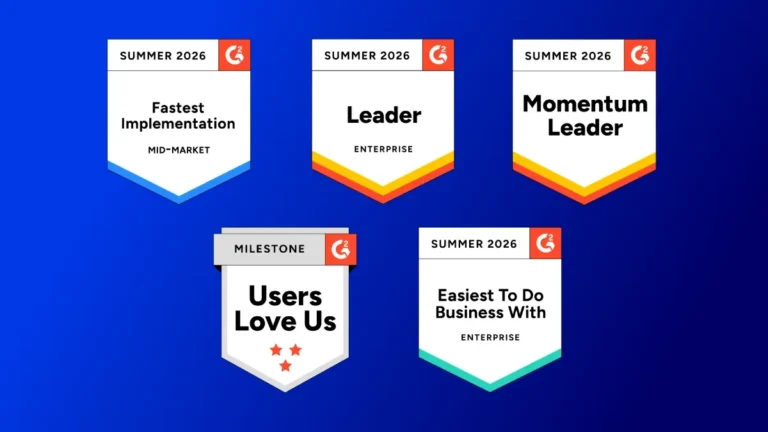
This post breaks down exactly what the G2 recognition verifies and backs it up line by line with what actual Emplifi customers, from nonprofits to global enterprises, said in their own words.
Enterprise buyers are drowning in vendor claims that all sound the same: easiest to use, best support, most comprehensive platform. Without independent proof, those claims are just copy on a landing page, and picking the wrong CX platform means months of failed rollout, frustrated teams, and budget you can’t get back.
A G2 badge isn’t awarded by a panel of judges or purchased through a media package. It’s calculated from verified reviews submitted by actual users of a product, weighted by satisfaction scores, market presence, and the volume of feedback a company receives over time. That’s a meaningfully different bar than a vendor writing its own case study.
For an enterprise buying committee evaluating a CX orchestration system, this matters because the review base spans exactly the roles who’ll actually use the platform day to day: social media managers running dozens of brand accounts, customer care leads triaging incoming messages, and executive sponsors accountable for the ROI. Reading across dozens of Emplifi reviews, a pattern shows up fast: customers consistently single out responsiveness, ease of onboarding, and the ability to consolidate scattered tools into one place.
That pattern is exactly what a badge like this is designed to surface. It’s not a claim about what Emplifi says it does. It’s a record of what buyers, after actually living with the product, say it delivered.
Ask any enterprise buyer what actually breaks a vendor relationship, and it’s rarely the software itself. It’s what happens when something goes wrong and support goes quiet. That’s the exact fear the Emplifi review base repeatedly puts to rest.
Nonprofit teams, agencies managing dozens of client accounts, and global brands all point to the same thing: a support experience that feels proactive rather than reactive. Customers describe being notified of platform changes before they happen, having their feature requests actually incorporated into the roadmap, and getting hands-on help building out complex analytics dashboards rather than being pointed to a help article.
For teams already stretched thin managing fragmented tools and fragmented data, that kind of support isn’t a nice-to-have. It’s the difference between a platform that adds friction and one that removes it.
“The customer service is the best part of Emplifi.”
— Danielle S., Administrator, The Humane Society of the United States

One of the clearest signals in the review data is how well Emplifi holds up across radically different team sizes. A freelance social media manager overseeing 250-plus handles and hundreds of community managers describes the same core benefit as a global hospitality brand managing three separate company accounts: a single, trainable interface that doesn’t buckle under scale.
That consistency is harder to achieve than it sounds. Most platforms either optimize for small, nimble teams or for sprawling enterprise deployments, but rarely both. Reviewers describe onboarding new team members with minimal ramp time, switching between dozens of brand profiles without losing context, and generating reports that used to take hours in a fraction of the time.
For a buying committee weighing whether a platform will still work after the team doubles or the brand portfolio expands, that scalability is exactly the kind of proof a badge alone can’t convey. The reviews do it instead.
“Emplifi’s interface is easily adaptable, trainable and perfect for large and remote teams.”
— Andi B., Administrator, Freelance

Analytics are only useful if you can trust the numbers underneath them. That’s a recurring theme among reviewers who evaluated multiple social media management platforms before choosing Emplifi, and it’s one of the more understated reasons the recognition holds weight.
Enterprise teams managing accounts across regions and business units need labeling and data consistency they can defend in front of leadership. One reviewer, working across an entire organization’s social accounts, called out this exact point: data pulled directly from each platform’s API rather than a vendor’s own estimation layer. That kind of accuracy becomes non-negotiable once dashboards are feeding board-level reporting.
It’s a quieter differentiator than customer support or ease of use, but for teams tired of reconciling conflicting numbers across fragmented tools, it’s often the deciding factor.
“We have tested multiple social media management platforms and the key functionality of labels and the fact that data is not inflated and taken directly from each social media platform was key to our decision.”
— Natascha S., Administrator, Mid-Market

Scaling a CX platform across a global enterprise introduces a different set of problems: multiple markets, multiple languages, and dozens of stakeholders who all need visibility into the same social presence without duplicating effort. This is where the recognition tracks most closely with what large, multi-market organizations report.
One reviewer at a major international retail group described the platform as essential for exactly this reason: a single overview of content across every managed page, automated labeling that removes manual tagging work, and monthly analytics delivered without needing to stitch together data from a dozen regional accounts. That kind of centralization is what turns a sprawling, fragmented social operation into something a small central team can actually govern.
It’s a pattern that shows up again and again among enterprise reviewers: the value isn’t just publishing content faster, it’s finally having one coherent view of a brand presence that used to live in disconnected spreadsheets and separate logins.
“Essential tool for global management. Totally recommend”
— Mário C., Administrator, METRO AG
A G2 badge doesn’t guarantee a platform is right for your specific team, but it does answer the buyer question that matters most before you ever get on a demo call: has this vendor actually delivered for organizations like mine? The review evidence behind Emplifi’s recognition says yes, repeatedly and across very different use cases, from nonprofit teams with tight budgets to enterprise brands managing hundreds of accounts.
What stands out most isn’t any single feature. It’s the consistency of the experience reviewers describe: responsive support, an interface people can actually learn quickly, and data that holds up under scrutiny. Those are the fundamentals that determine whether a CX platform gets fully adopted across a team or quietly abandoned six months after launch.
If you’re building a shortlist, treat the badge as a starting point for due diligence, not the end of it. Read the reviews behind it, look for patterns that match your own team’s priorities, and weigh them against what a vendor tells you directly.
“The ease of use, along with the simplicity and intuitiveness of the interface, has made my overall experience delightful.”
— WILL Y., Visiting Angels

A badge earns its meaning from the reviews behind it, and the evidence behind Emplifi’s recognition points to a consistent pattern: responsive support, an interface teams can actually adopt at scale, and data enterprise leaders can defend. For buyers trying to separate real proof from vendor claims, that pattern, told in customers’ own words, is the strongest signal available before you sign a contract.