Agentic AI transforms customer experience by autonomously executing real-world use cases such as resolving support issues, personalizing commerce, and preventing churn, turning fragmented interactions into seamless, outcome-driven journeys across the entire CX stack.
For the past few years, most conversations about AI in customer experience have focused on generating better responses, faster content, and smarter recommendations. But a more important shift is now underway.
AI is no longer just generating answers. It’s taking action.
Agentic AI represents this shift. Instead of suggesting what a team should do, it executes workflows end-to-end: identifying a problem, gathering context, making decisions within defined guardrails, and completing the task.
This is the difference between:
According to Emplifi’s 2026 consumer research, today’s customers don’t simply accept brand messaging; they actively verify it across channels, comparing reviews, experiences, and responses before making decisions.
At the same time, expectations are rising:
In this guide, you’ll learn:
This shift isn’t just technological, it’s operational.
For years, the data needed to deliver better customer experiences has already existed. Customer interactions, purchase history, social signals, support conversations — all of it has been captured across systems. The challenge was never access to data. It was the ability to connect it, interpret it, and act on it fast enough to matter.
AI changes that. Agentic CX represents a new model where that fragmented data is no longer just analyzed, it’s activated. Instead of sitting alongside workflows, AI now operates across the entire customer journey, using real-time context to take action as events happen.
What makes this possible is AI Orchestration, the coordination of data, decisions, and execution across systems. It allows signals from one part of the journey to immediately influence actions in another, creating a level of continuity that wasn’t previously achievable.
| Capability | Generative AI | Agentic AI |
| Core function | Creates content and responses | Executes actions and workflows |
| Output | Text, images, suggestions | Resolved issues, completed tasks |
| Workflow | Single-step | Multi-step, goal-driven |
| Decision-making | Human-led | Autonomous within guardrails |
| Systems | Siloed | Cross-channel and integrated |
This is what enables a truly unified experience.
Customer interactions are no longer handled as isolated moments. They become part of a continuous system, where insights from one touchpoint immediately inform actions in the next.
The result isn’t just better communication. It’s a customer experience that feels connected, responsive, and consistent at every stage.
| Consumer Behavior | What It Means for CX |
| 79% read 3+ reviews before buying | Trust must be continuously reinforced |
| 84% expect fast response times | Speed is a core experience driver |
| 91% expect AI transparency | Automation must be visible and governed |
| 85% will pay more for authentic brands | Authenticity directly drives revenue |
All of this can sound abstract until you see how it plays out in real scenarios.
Agentic AI isn’t a single feature or tool. It’s a system that continuously detects signals, applies context, and takes action across the customer journey. The result is not better recommendations, but completed workflows that would otherwise require multiple teams and systems.
The following examples show how this works in practice.
Each use case follows the same pattern:
Together, they illustrate how agentic AI turns fragmented interactions into connected, outcome-driven experiences.
A product post begins receiving an unusual spike in negative comments.
Traditionally, this would take hours to detect and even longer to respond, often after the issue has already gained visibility. But in a real-time environment, delays are increasingly costly — only 8% of customers are willing to wait 48 hours for a response, leaving little margin for slow detection or reaction.
With agentic AI, the process is immediate.
The system detects anomalies in sentiment and volume using social media listening, identifies the root cause, pauses scheduled content, drafts a response, and routes affected customers to care teams.
| Step | Traditional Approach | Agentic AI Action |
| Detection | Manual monitoring | Detects sentiment and volume spikes instantly |
| Diagnosis | Manual analysis | Identifies root cause via clustering |
| Response | Delayed drafting | Generates context-aware response |
| Coordination | Team handoffs | Pauses content and routes issues automatically |
| Resolution | Reactive | Contains the issue before escalation |
Outcome: Instead of reacting after damage is done, brands contain issues early. Response time drops from hours to minutes, and the risk of a reputational crisis escalating is significantly reduced.
Learn more about listening, community, and care in one product tour
A customer posts: “Where is my order?”
In most cases, this would enter a support queue and wait for an agent to pick it up. But expectations have already shifted; one-third of consumers expect replies to tags and DMs within one hour. Delays aren’t just inconvenient; they directly impact how responsive and reliable a brand feels.
Based on predefined policies, it generates a response with a specific delivery update and applies a small compensation credit. The message is sent through the same channel, and the interaction is logged and resolved in the CRM.
This is a clear example of Autonomous Customer Service where resolution doesn’t depend on handoffs between systems or teams.
| Step | Action |
| Trigger | Customer asks “Where is my order?” |
| Context | AI retrieves order and shipping data |
| Decision | Identifies delay and applies policy-based compensation |
| Action | Sends response and updates CRM |
| Resolution | Issue resolved instantly without escalation |
Outcome: The customer receives a complete, accurate answer in seconds without needing to follow up. At the same time, support volume is reduced, resolution consistency improves, and operational effort shifts away from repetitive inquiries toward higher-value cases.
Customer intent doesn’t appear as a single action; it builds through behavior.
A customer follows a brand for promotions, engages with a product post, and clicks through to view details. These signals matter because 64% of consumers follow brands for promotions, sales, and discounts, and nearly half of social media users have purchased social media in the past 90 days. At the same time, trust plays a critical role — 65% of consumers say user-generated content influences their decisions, and they trust real customer content more than influencer posts.
Agentic AI connects all of these signals in real time.
Instead of treating engagement, browsing, and messaging as separate events, it identifies when intent is building and responds within that moment. It surfaces relevant products, prioritizes offers or promotions, and delivers a personalized, shoppable experience directly within the platform — whether that’s a social reply, a product link, or a native checkout experience.
This matters because higher-value decisions are no longer linear. Customers validate across multiple sources, compare options, and respond to relevance, timing, and proof.
| Customer Signal | What’s Happening | How Agentic AI Responds | Impact |
| Follows or engages with brand | Early interest in products or promotions | Identifies preference patterns and prioritizes relevant content | Keeps brand top of mind |
| Interacts with product content | Active exploration | Surfaces personalized product recommendations and related items | Increases relevance |
| Views product or clicks through | Evaluation phase | Pulls product data, availability, and pricing in real time | Reduces friction |
| Sees reviews or UGC | Trust validation | Highlights customer content and social proof dynamically | Builds confidence |
| Asks a question or comments | High purchase intent | Triggers immediate response with shoppable links or offers | Drives conversion in the moment |
Outcome: Conversion rates increase by capturing intent while it’s still active, reducing drop-off between discovery and purchase. At the same time, average order value improves by combining personalization with the two strongest purchase drivers on social: relevance and promotion.
Content planning is typically a manual, batch process: review performance, decide what to post, build a calendar, and repeat.
But on social, performance doesn’t operate in weekly cycles. Consumers expect relevance in the moment, whether they’re following brands for promotions, product updates, or content that reflects current trends.
Agentic AI replaces that static process with a continuous system.
| Stage | Traditional Approach | Agentic AI Action |
| Performance analysis | Reviewed weekly | Continuously monitors engagement, formats, and timing |
| Content planning | Manual decisions | Generates and ranks content based on predicted performance |
| Scheduling | Fixed calendar | Publishes automatically when confidence thresholds are met |
| Optimization | Post-campaign review | Adjusts content strategy in real time |
Instead of waiting for a reporting cycle, the system is constantly identifying what works and acting on it — generating content options, prioritizing high-performing formats, and adapting timing based on audience behavior.
Outcome: Planning shifts from a manual, time-intensive process to a continuous, data-driven system. Teams spend less time coordinating and more time guiding strategy, while content performance improves through faster iteration and better alignment with real-time audience behavior.
A customer starts a conversation on Instagram, then switches to website chat to continue.
In most cases, that context is lost. The customer has to repeat the issue, and the agent starts from scratch.
This disconnect is increasingly common as customers move between platforms: 55% of frequent social media users turn to Facebook for service and 47% to Instagram, often using multiple channels within the same journey. At the same time, 58% say it’s important to see brands respond to customers on social media, raising expectations for both continuity and speed.
Agentic AI removes that break in continuity. Instead of treating each interaction as separate, the system maintains a unified view of the customer, tracking conversation history, sentiment, and actions across channels in real time.
| Moment | Traditional Experience | Agentic AI Action |
| Customer switches channel | Conversation resets | Identifies customer and retrieves full interaction history |
| Agent receives request | Limited or no context | Surfaces prior messages, sentiment, and status |
| Next response | Customer repeats issue | Continues conversation from last step |
| Resolution | Slower, fragmented | Faster, continuous resolution |
The interaction doesn’t restart — it continues. What was said, what was promised, and what still needs to happen all carry forward automatically.
This is enabled by Customer Journey Orchestration, where every touchpoint shares the same context instead of operating in isolation.
Outcome: Customers no longer need to repeat themselves, reducing frustration and speeding up resolution. At the same time, agents operate with full context from the start, improving efficiency and delivering a more consistent experience across channels.
A long-term customer hasn’t purchased in months. Recently, they submitted a complaint through social, stopped engaging with brand content, and mentioned a competitor in a post.
Individually, these signals are easy to miss. Across systems, they rarely get connected.
This is where churn typically happens, quietly and without intervention. In fact, 52% of consumers say they would stop buying from a brand after an inauthentic experience, often without giving the brand a chance to recover.
Churn prediction, the system identifies patterns across behavior, support interactions, and engagement data to flag the customer as at risk. Instead of waiting for the customer to leave, it triggers a coordinated response — prioritizing their support request, generating a tailored retention offer based on past purchases, and scheduling a follow-up to ensure the issue is resolved.
| Signal | What It Indicates | Agentic AI Action |
| Complaint or negative sentiment | Frustration | Prioritizes case and escalates response |
| Drop in engagement | Disengagement | Flags reduced interaction patterns |
| Mention of competitor | Consideration risk | Triggers retention workflow |
| Inactivity or missed purchases | Churn likelihood | Generates personalized offer or follow-up |
Instead of reacting to churn after it happens, the system intervenes while there is still an opportunity to recover the relationship.
Outcome: At-risk customers are identified and engaged earlier, increasing the likelihood of recovery. This strengthens customer retention, improves lifetime value, and reduces the cost of reacquiring lost customers.
Across these scenarios, three patterns define why agentic AI is transforming customer experience.
Response time drops from hours to seconds across every use case. This isn’t just operational efficiency, t directly shapes perception. Customers increasingly judge brands by how quickly they respond, making speed a core signal of reliability and trust.
Agentic AI doesn’t just increase output — it standardizes it. High-volume interactions are handled with the same level of context, quality, and responsiveness every time, without requiring additional headcount.
None of these outcomes happens in isolation. They depend on unified systems across marketing, commerce, and customer care. Without that connection, AI can generate insights. With it, AI can execute across the entire journey.
Together, these patterns reflect a broader shift in how customer experience operates — from reactive to proactive, fragmented to unified, and assisted to autonomous. Agentic AI doesn’t just surface what’s happening. It ensures something is done about it.
Agentic AI represents a fundamental shift in how customer experience is delivered.
The role of AI is moving beyond assisting teams to executing outcomes: resolving issues, guiding decisions, and optimizing interactions in real time.
At the same time, customer expectations continue to rise. Speed, consistency, and authenticity are no longer differentiators; they are baseline requirements.
As Emplifi’s research shows, authenticity is not just a messaging strategy; it is an operational standard.
The brands that lead in the autonomous era will not be those that communicate the most. They will be the ones who act the fastest, connect systems the best, and deliver consistent, outcome-driven experiences at scale.
Transform your customer experience with agentic AI powered by Emplifi. Get a demo today.
Agentic AI is AI that autonomously executes multi-step workflows to achieve CX outcomes such as resolving support issues, personalizing interactions, and preventing churn without requiring manual intervention.
Generative AI creates content like responses or recommendations, while agentic AI takes action by executing workflows across systems to resolve issues and complete tasks end-to-end.
Common use cases include resolving order inquiries automatically, detecting and containing social media crises, personalizing social commerce experiences, optimizing content performance, maintaining cross-channel context through customer journey orchestration, and preventing churn.
Agentic AI is effective because it combines real-time signal detection, coordinated execution across systems, and continuous learning to improve outcomes over time — often powered by AI orchestration across marketing, commerce, and care.
Discover how Emplifi boosts efficiency, increases revenue, and scales your social media marketing — whether you have a small team or a complex product. Let’s talk today.
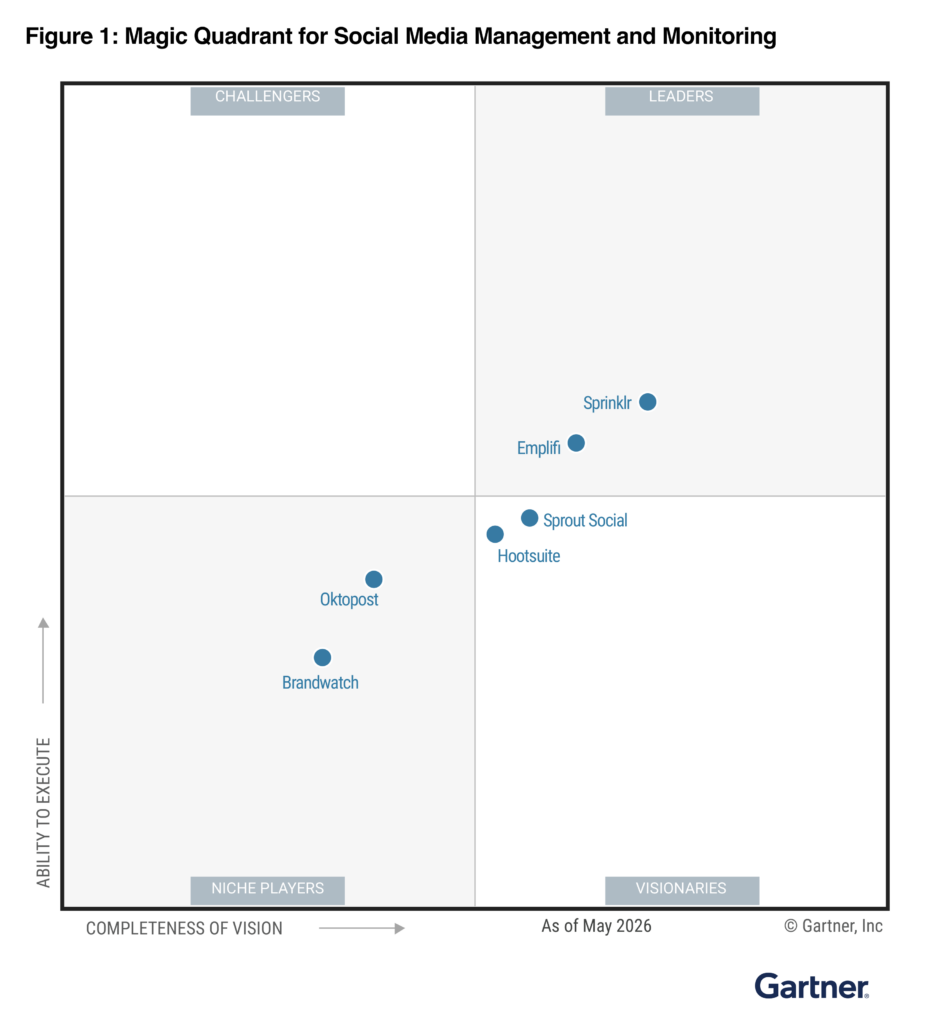
We’re recognized as a market leader in innovation, customer support, and ease of use from these organizations.