Customer churn signals often show up in social conversations before a customer cancels or stops buying. They could be a complaint that goes unanswered, sentiment that slowly turns negative or a comparison with a competitor. Watch for five signal types, then connect each one to a care, escalation or account response, so someone can reach the customer while there’s still time to change the outcome.
A customer doesn’t always announce they’re about to leave.
They might post a complaint that gets no reply, compare you with a competitor, then go quiet.
In Emplifi’s 2025 Social Pulse survey, 70% of consumers said they’d leave a brand after just two bad experiences, and nearly a quarter said they’d stop buying after one.
Social listening can pick up these customer churn signals earlier, so your care team can step in before a customer leaves.
Here’s how to spot the signs and act before it’s too late.
In this guide, you’ll learn:
Think of these five signals as clues rather than ultimate verdicts.
One signal on its own won’t tell you a customer is about to leave, but when several appear for the same customer or topic, it’s best to take a closer look.
Here are the five to watch for:
Sometimes a customer doesn’t have one big complaint. Their tone just gets a little more negative with each post, over two to four weeks.
No single message would make you look twice, so you won’t catch it by reading one post at a time.
That’s why it helps to look at sentiment trends in Emplifi Listening for the topics that matter most, and watch for steady movement in one direction.
Then there’s the customer who used to like, comment on or share your content. They’ve suddenly gone quiet. This one is tricky, because nothing really happens to alert you.
The signal is the missing activity, so to spot it you’ll need each account’s past engagement to compare against.
You may also see a customer start mentioning a competitor, whether in passing or as a direct comparison.
Emplifi’s social listening platform can track competitor names alongside your own, so you can see who’s talking about switching and why.
If a positive mention of a competitor comes alongside falling sentiment toward your brand, that’s a customer to prioritize.
Think about the customer who complained, got no reply or an unhelpful one, and hasn’t been in touch since.
It’s tempting to assume the problem went away, but the silence can mean they’ve given up.
Review unanswered complaints in your care reporting, and work through them first.
Remember that speed matters: Emplifi’s Social Pulse research warns that a brand that takes more than 24 hours to answer a DM risks losing a third of customers.
Finally, watch for the same feature or fault coming up across several posts over two weeks or more.
One complaint is easy to dismiss, but a repeat points to a product that isn’t meeting needs, so share it with the product team as well as care.
Emplifi Listening groups your mentions by topic, so repeated complaints about one issue show up as a trend, and you don’t have to review each post individually.
| Signal | What it looks like | Where to spot it | First move |
|---|---|---|---|
| Sentiment deterioration | Tone gets more negative over two to four weeks | Sentiment trends in Emplifi Listening | Watch for steady movement in one direction |
| Engagement withdrawal | A customer who used to like, comment or share goes quiet | Engagement history for each account | Compare against that account’s usual activity |
| Competitor mentions | A customer mentions a competitor, in passing or in a direct comparison | Competitor tracking in Emplifi Listening | Prioritize customers who praise a competitor while sentiment toward you falls |
| Unresolved complaints | A complaint got no reply or an unhelpful one, then silence | Unanswered complaints in your care reporting | Work through these first |
| Recurring product frustration | The same feature or fault comes up across posts for two weeks or more | Topic trends in Emplifi Listening | Share it with the product team as well as care |
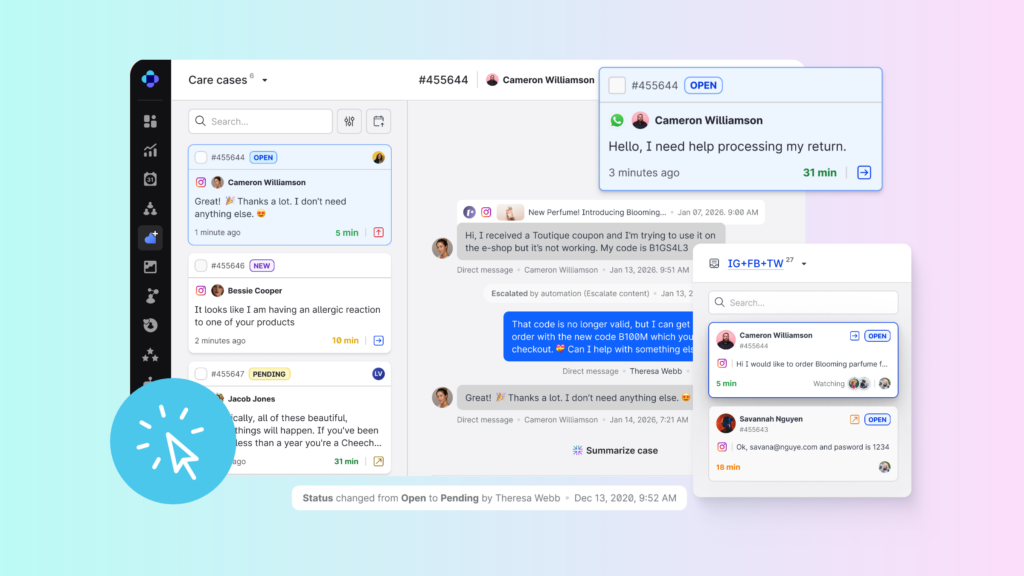
We’ll show you how a churn signal from Listening can reach your care team, with the full conversation history in one case.
No team can read every mention of a big brand. AI does the first pass on signals like falling sentiment and repeated complaints, then a person decides what to do. In Emplifi Listening, that first pass works like this:
That’s where churn prediction starts: AI flags the pattern, and your own retention data shows whether it predicts churn for your customers.
Spotting a signal is only half the job. The other half is making sure it lands with someone who can do something about it.
Where it goes depends on who the account is, so here are three routes:
Say you’ve spotted a customer whose complaint went unanswered. The best move is to reach out before they contact support, and to offer a resolution, which means getting the signal to your care team.
In Emplifi, critical mentions from Listening can be escalated to Emplifi Care manually, or routed through Flow Automations once they surface in Community. In Emplifi’s customer care solution, the full conversation history sits in one case, so whoever picks it up isn’t starting from scratch.
When you do reach out, keep it human. In Emplifi’s 2026 survey of 1,650 consumers in the U.S. and U.K., 81% said a human tone matters in service interactions.
Some customers come with a big audience, and a frustrated post from them can travel a long way. They deserve a faster, more senior reply.
Start by deciding what counts as a high-follower account for your brand, then give those accounts their own priority queue.
Emplifi Community’s AI Priority Scoring ranks incoming messages so the most urgent conversations surface first.
Sometimes the account behind a social post is a named enterprise customer. A complaint from a key account can be an early warning on account health, so it belongs with the account manager, not the general care queue.
That depends on your CRM system recognizing the account.
If you use Salesforce, Emplifi Care can link a customer to their Salesforce contact and create a Salesforce case from a Care case, so the account team can pick it up in the CRM.
Once you start reaching out, you’ll want to know whether it’s making a difference.
The simplest way is to compare customers you flagged and contacted against a group you didn’t, then look at three measures:
Then put a number on it.
Multiply the customers you retained by their average customer value to get an estimate of the revenue you kept. It’s an estimate, so label it that way and show the assumptions behind it.
Compare against flagged accounts you couldn’t reach in time, or roll the outreach out by region or segment, so the comparison group forms without leaving anyone unsupported.
Emplifi Unified Analytics covers the social and care side of the picture. Retention and revenue data will come from your CRM system or billing system.
Retained revenue is also one input to a social program’s wider ROI case, alongside the reports that show social’s contribution to revenue.
Say your team has a dashboard that shows a churn signal. The signal is there, but someone still has to notice it, decide who owns it and reach out, and that’s where signals tend to get lost. Connecting listening to care shortens that path, because the signal can reach the team that can act on it, with the full conversation history in one case.
Listening and Care sit together in the Emplifi Fuel platform, with Fuel AI, the agentic intelligence layer, beneath them.
For a care leader, that means fewer handoffs between tools. For a marketing leader, it means you can review the signals and the outreach that followed side by side in Emplifi Unified Analytics, with your retention data added alongside.
Customers often leave clues on social before they go, and those clues are easy to miss when they sit in a dashboard no one owns.
The good news is you don’t need to watch everything.
Choose the signals that matter most for your customers, give each one a clear destination, and measure the result against a comparison group.
To recap:
Emplifi Listening and Emplifi Care bring detection and response together, so a signal can reach the team that can act on it.
Curious how listening and care could work together for your team? Get a demo and we’ll walk through what it would look like for your brand.
Churn signals are patterns in social conversations that can come before a customer leaves, such as a complaint that goes unanswered, sentiment that turns gradually negative, a comparison with a competitor, a drop in engagement, or the same product issue raised repeatedly.
AI can help surface patterns in large volumes of social conversations that a team couldn’t read by hand. Whether a pattern predicts churn for your brand is something to test against your own retention data, so treat the signals as prompts to investigate, not predictions.
Send it to the team that can act. Consumer accounts go to care for proactive outreach, high-follower accounts go to a priority queue, and enterprise accounts go to the account manager. In Emplifi, critical mentions from Listening can be escalated to Emplifi Care manually, or routed through Flow Automations once they surface in Community.
Compare retention for flagged accounts you contacted against a comparison group, and track time to churn and resolution rates. Take retention data from your CRM or billing system, and use Emplifi Unified Analytics for the social and care side.
Customer churn is when a customer stops buying from or using a brand. It’s the opposite of customer retention, and social conversations can show some of the warning signs before it happens.
Social listening tracks what customers say about your brand, your products and your competitors. It can’t predict churn on its own, but it helps a team spot falling sentiment, unanswered complaints and competitor comparisons early, then route each one to someone who can act. To compare tools, see the social listening guide.
Churn signals are the triage step of a social media retention strategy. They tell you which customers need attention first, so outreach goes where it can still change the outcome.