






2026 Gartner® Magic Quadrant™

Emplifi named a Leader in the 2026 Gartner® Magic Quadrant™ for Social Media Management and Listening

Get the Report

Emplifi named a Leader in the 2026 Gartner® Magic Quadrant™ for Social Media Management and Listening Get the Report

Blog
8 min read
Sep 29, 2026

How social listening drives better customer experiences, from brand monitoring to CX action

You might already use social listening to track brand mentions and customer concerns. The bigger opportunity is a listening tool that acts on what it finds. One signal can trigger the next step in the right team’s workflow, connecting marketing, commerce, and care. For example, a spike in negative sentiment can pause a scheduled campaign and escalate related cases to your care team at the same time.

Emplifi Team Social Media Marketing Experts
Woman looking at her phone, holding coffee cup

Key points

  • Five signal types (sentiment spikes, trending topics, competitor mentions, positive UGC, and product feedback) each point to a different team and a different action
  • Marketing, commerce, and care all pull from the same signals, just for different purposes
  • Emplifi’s intelligence layer, Fuel AI, is what closes the loop without a manual routing step, classifying intent and severity, then sending the signal where it needs to go
  • Crayola detects and responds to emerging trends 90% faster since connecting listening directly to publishing

There’s a difference between simply monitoring what happens on social, and acting on what you find.

For example:

  • A social listening tool that tells you sentiment dropped 8% this week is monitoring.
  • A social listening tool that gets that drop in front of the care team before volume spikes, or turns a trending topic into a content brief before a competitor gets there first, is doing something with the signal instead of just recording it.

That second scenario is dependent on social listening, publishing, and care running on one data model.

This is how Emplifi works, with its intelligence layer, Fuel AI underpinning every action.

Here’s how that looks across marketing, care, and commerce.

In this guide, you’ll learn:

  • The five signal types worth tracking, and what each one actually means for your teams
  • How listening signals turn into marketing decisions in real time
  • How the same signals connect to commerce, UGC, product feedback, and competitive intelligence
  • How listening creates proactive care instead of reactive care
  • How Fuel AI closes the loop between signal and action without someone manually routing it

The five signals, and where each one goes

Every mention, comment, DM, and review your brand receives on social media is a signal.

Your social listening tool is likely already picking up hundreds of them a week, whether or not anyone’s acting on them.

But not every signal means the same thing. And treating them all the same is how you lose the useful ones among the noise.

Here’s what each one is and where it should be routed:

Signal type What it means Where it goes
Sentiment spike (negative) Something’s going wrong right now Care response, product team alert
Trending topic (brand-adjacent) A content opportunity forming Marketing, content response
Competitor mention (comparison) Competitive intelligence Positioning response
UGC (brand-positive) A commerce opportunity Rights-cleared repost
Product feedback (functional complaint) A product signal, not just a complaint Product team, care workflow trigger

Some social listening tools will simply identify which of these just happened.

Whereas others, like Emplifi, are able to route it to the right team or have an AI agent act on the signal directly.

What social listening actually changes for marketing

Listening isn’t just for care and crisis response. The same signals feed marketing decisions in real time.

Here’s what that looks like in practice with Emplifi:

Trend-reactive content

A topic starts rising in your category before it’s on anyone’s calendar:

  • Emplifi Listening surfaces the moment
  • Fuel AI’s trend detection scores it
  • And a flex slot opens in the Unified Campaign Calendar with a draft already populated

When Crayola started using Emplifi’s trend detection, it changed the team’s entire workflow. Crayola now detects and responds to emerging trends 90% faster, and processes content overall 80% faster.

Emplifi lets us pick up on behavior we wouldn't have caught otherwise. That kind of signal is gold for our cross-functional teams. We're not just reacting anymore. We're listening with purpose using Emplifi. And that's showing up in how we connect, how we plan, and how we build loyalty over time.
Brittany Mehalick
Social Media Engagement and Trends Manager at Crayola

Campaign performance adjustment

Sentiment on a live campaign can turn negative mid-flight. If it does, your social listening tool can catch it while there’s still time to do something about it.

It means you don’t have to wait until the campaign wraps to change course. You can do it while there’s still time for the campaign to be saved, instead of spending money on a campaign that’s generating negative comments.

Audience insight

Language inside your own community can shift before anyone official notices. It could be:

  • A new way people describe a use case
  • A concern nobody’s flagged yet
  • A word that starts showing up in comments that wasn’t there last month

Without the right social listening tool in place, that shift might be picked up by someone on the off-chance, or it could be completely missed.

Fed properly into the next brief instead, it becomes something the whole team can act on.

This is one piece of a bigger picture: marketing, commerce, and care all pull from the same listening signals, just for different reasons.

What social listening actually changes for commerce

Commerce usually finds out about a signal last, after marketing’s already reacted and care’s already handled the fallout.

These three moments put it in the loop directly:

UGC identification

A positive UGC mention with real content attached is worth more than a like.

It’s usable, sellable material sitting in someone’s feed, waiting for someone to notice it.

Fuel AI scans tagged and untagged customer posts and matches each one to the exact SKU using visual recognition, so nothing worth using gets missed.

Once it’s flagged, the rights side runs the same way: permission requests, creator approvals, and a complete audit trail, handled automatically, so a usable piece of content doesn’t sit unclaimed.

Product feedback loop

The same complaint about the same issue, showing up across social and reviews, needs attention.

Once listening classifies it and analytics quantifies how often it’s coming up, that becomes a structured signal the product team can act on directly.

Competitive intelligence

When a competitor’s customers are complaining about something specific, that’s a positioning opportunity showing up in someone else’s mentions before it shows up in yours.

If you’re only focusing on monitoring your own brand name, you might miss the chance to exploit gaps in your competitor’s product. The right social listening tool will identify the gaps, and present them as opportunities for your team to get ahead.

Nano-influencer in front of camera

Nearly $8B in annual revenue from customer content

See what UGC is actually worth once it's scaled across all your marketing channels

Download now

What social listening actually changes for care

You don’t want to find out about a problem when volume is already increasing rapidly and your team are overwhelmed.

These three shifts get ahead of that:

Pre-spike staffing

A sentiment shift is the thing to catch before volume makes it obvious that there’s a problem.

Once volume starts to build dramatically, the moment to get ahead has usually already passed. Spike Alerts flag that shift in real time, continuously grading incoming messages by tone, priority, and intent.

Hardee’s turned exactly this kind of alert into an opportunity.

Notified after hours that a viral moment was building, the team responded the next morning and grew their follower base by 8,000, generated more than 8 million impressions, and picked up almost 18,000 retweets, all from catching the signal early.

I think it was a successful play for all of us, showing that we're listening to consumers and plugged in.
Brent Waible
Senior Media Manager at CKE Restaurants, Hardee's & Carl's Jr

Complaint pattern classification

The same complaint from ten different customers looks like ten separate messages until something groups them together.

Classify each one by intent and sentiment as it comes in, and what originally looked like noise turns into a pattern.

Tune Talk is a real example of what that classification does at volume. Using Emplifi’s sentiment classification and AI priority scoring, the team improved positive sentiment by almost 20% even as incoming messages more than quadrupled, still clearing every message daily instead of falling behind.

Emplifi gives us the ability to control and monitor our brand performance and campaigns. It has also made it convenient for us to work in a more systematic way with the dashboard in place. The dashboard is easy to navigate between social platforms and provides a clear breakdown on each platform, sentiment, and priority of incoming messages.
Fara Hasan
Head of Communications & Content

VIP customer identification

A high-follower account expressing frustration is a different priority than the same complaint from an anonymous one.

The business cost of getting it wrong is substantially different; one bad experience shared with 200,000 followers doesn’t stay contained the way the same complaint from an account with 40 followers does.

Account-level prioritization means a listening tool checks follower count and influence alongside sentiment, so a VIP complaint routes as a priority automatically.

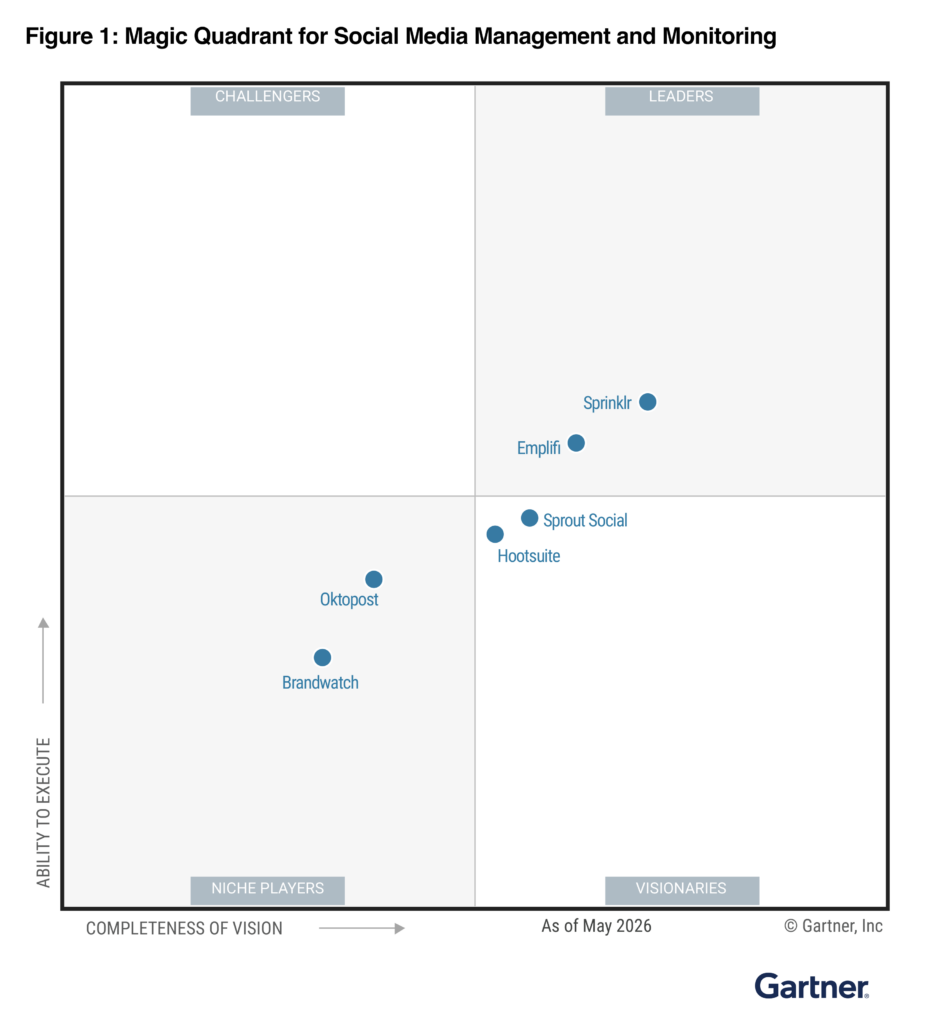
Named a Leader in social listening

See how Emplifi was evaluated on Completeness of Vision and Ability to Execute to be named Leader in Gartner’s Magic Quadrant 2026

How the Fuel AI layer works

If a human has to manually route every signal we’ve just explored, you’ll soon find a bottleneck will start to form.

But an intelligence layer like Emplifi’s Fuel AI runs it automatically, so there’s no waiting around.

Here’s how:

  1. A signal gets detected
  2. Fuel AI classifies its intent and severity
  3. It routes to the correct team or triggers a response automatically
  4. The outcome gets measured in the analytics layer
  5. That result feeds back into how the listening configuration works next time

This is exactly how airlines are now using AI to resolve up to 31% of Facebook DM conversations with no human intervention, responding up to 21 times faster than average.

The signal doesn’t just get routed faster. In qualifying cases, it gets resolved without waiting for a human to be available at all.

Final thoughts: Monitoring tells you. Action does something about it.

Social listening tools can read signals but whether they act on it is a different matter.

Here’s what it takes to close that gap:

  • Each of the five signal types points to a different team and a different action
  • Marketing, commerce, and care read the same signals for different reasons
  • Fuel AI closes the loop automatically: classify, route, measure, feed back

Emplifi Listening is where this starts.

Team looking at social listening stats on Emplifi dashboard

Ready to see what your own signals would trigger across marketing, commerce, and care?

Get a demo and we'll walk through it against your actual social data.

Get a demo

Frequently asked questions

A tool that tells you sentiment dropped 8% this week is monitoring, it’s recording what happened. The bigger opportunity is a signal that triggers the next step automatically: a spike in negative sentiment pausing a scheduled campaign, or a trending topic becoming a content brief before a competitor gets there. Emplifi Listening is built to do that, not just log what happened.

It classifies each signal by intent and severity as it comes in, a sentiment spike reads differently from a trending topic or a piece of UGC, and routes it to the right workflow based on what it actually means, not just where it showed up. That’s the same classification layer behind Emplifi Care‘s Tier 1 resolution and the commerce team’s UGC identification, one signal, read once, acted on by whichever team it’s actually relevant to.

One tool can feed all three, and probably should. The same trending topic that becomes a content brief for marketing might also be a product signal for commerce or an early warning for care. Splitting listening across separate tools per team means each one only sees a fraction of what’s actually happening. See our Social CX strategy guide for how marketing, commerce, and care connect on one shared signal.

Track it the same way you’d track any care or marketing program, response time, resolution rate, and whether a signal genuinely changed an outcome rather than just getting logged faster. Our social care KPIs guide covers the specific metrics worth watching once listening is feeding directly into your teams’ workflows.

Ready to fuel your teams with A-CX?

Discover what Emplifi can do for you. We turn small teams into large ones, and large teams into well oiled machines, but either way, we offer the rocket ship, you just need to jump on.

What can you expect?

  • A live walkthrough of Emplifi Fuel tailored to your specific social marketing, commerce, and care needs
  • A benchmark of how your brand performs against peers in your industry
  • A partner who understands your business, and 22,000 others
  • A concrete action plan to go from disjointed teams to A-CX
Get a demo