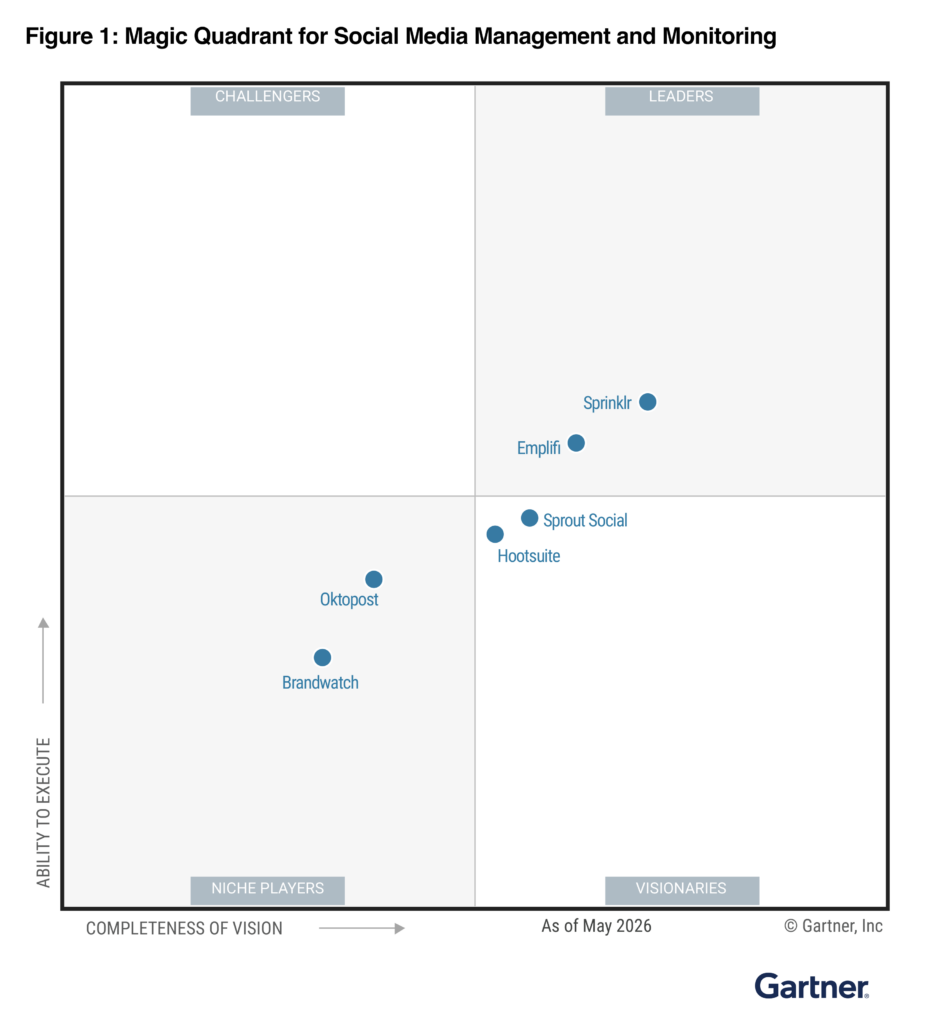
2026 Gartner® Magic Quadrant™

Emplifi named a Leader in the 2026 Gartner® Magic Quadrant™ for Social Media Management and Listening

Get the Report

Emplifi named a Leader in the 2026 Gartner® Magic Quadrant™ for Social Media Management and Listening Get the Report

Blog
13 min read
Aug 10, 2026

How to evaluate enterprise social media management platforms: A decision framework

To evaluate enterprise social commerce platforms, assess five areas in order: (1) whether AI is native to the catalog, rights, and review workflows or exists as a separate module; (2) your team’s current commerce maturity stage; (3) capability depth across UGC, shoppable media, ratings and reviews, and creator commerce; (4) how well the platform connects visual content directly to conversion rate lift and average order value; and (5) whether the vendor can demonstrate real product data streams and live catalog synchronization, not just polished demo mocks.

Jordan Lukes Director of Content and Corporate Marketing

Key points

  • The defining evaluation question is not “do you have AI? but whether AI is embedded natively inside visual discovery, rights clearance, and catalog tagging workflows. 
  • Your team’s commerce maturity stage should determine which capabilities you prioritize. There are four distinct stages, from fragmented manual content sourcing to AI-driven commerce orchestration, each requiring a fundamentally different platform profile.
  • For D2C and retail brands, commerce capabilities should outweigh publishing features. A platform without UGC activation, product catalog integration, and review syndication may improve operational efficiency but will fail to drive measurable revenue impact.
  • The most expensive platform decisions are rarely caused by missing features. The right evaluation is about finding the platform that performs when operational scale and catalog complexity increase, not the one with the longest checklist.

Evaluating the best social commerce platform is one of the most high-stakes decisions a retail or e-commerce leader will make in 2026. The wrong choice means years of fragmented visual assets, manual rights bottlenecks, and AI capabilities that cannot connect UGC to product pages at scale. The right choice turns social content into measurable revenue infrastructure.

This guide provides a structured decision framework for evaluating platforms across the dimensions that truly matter for enterprise commerce: AI architecture, operational maturity, UGC and shoppable media capabilities, ratings and reviews, creator commerce, analytics and attribution, governance, and vendor credibility.

If you manage shoppable UGC, ratings and reviews, and creator content across regional brand sites and retail channels, and are under pressure to connect digital content directly to conversion rates and average order value, this framework is built for you.

The core decision: unified commerce platform or best-of-breed stack?

Before evaluating individual capabilities, enterprise commerce teams need to answer a structural question: should you consolidate onto a single unified platform, or continue building a best-of-breed stack of specialized tools?

Both approaches are defensible. The answer depends on where your operational complexity sits today.

Choose a unified platform if:

  • AI is fragmented across separate point tools and cannot share data across workflows
  • You manage commerce across multiple brands or regions
  • Licensing rights and permissions are scaling poorly
  • Revenue attribution requires too much manual reconciliation

Choose a best-of-breed stack if:

  • Your team relies on highly unique, retail-specific workflows a single platform cannot replicate
  • Your team is small, local, and operationally lean
  • Existing point integrations already work well

The most important variable is not feature depth. It is about whether AI can operate natively across your commerce workflows: visual discovery, rights-clearance outreach, SKU catalog tagging, and review syndication. Fragmented stacks create AI execution gaps that compound at scale.

For a deeper look at how the unified versus best-of-breed decision plays out in practice, see five benefits of integrating social commerce for mature brands.

Bottom line: AI-powered attribution is what separates meaningful revenue tracking from manual spreadsheet reconciliation. Whether you are a D2C brand or a multi-region retailer, this is the difference between social commerce as a cost center and social commerce as a growth engine.

Assess your commerce maturity before you evaluate vendors

Signing a contract for capabilities your team is not ready to use is expensive shelf-ware. Different maturity stages require fundamentally different platforms.

Use this four-stage model to identify where your team sits today.

Stage 1: Fragmented content

What the team looks like: A lean team manually sourcing UGC, sending DMs for rights clearance, and using separate platforms for reviews and creator programs.

What breaks: Scale and speed. Rights approvals get missed, catalog tagging is slow, and product pages lack fresh content.

What to prioritize: Centralized UGC discovery, automated rights workflows, and real-time catalog matching. Evaluate platforms with AI-native architecture now to avoid being locked out of AI capabilities later.

Stage 2: Partially integrated

What the team looks like: An e-commerce team with partial integrations between UGC galleries and the core e-commerce platform.

What breaks: PDP conversion speed. Sourcing and publishing high-performing content for specific SKUs is manual and delayed.

What to prioritize: Content-to-product mapping automation and AI-enabled review curation. Confirm your current tools can support AI-native workflows before expanding into new channels.

Stage 3: Unified commerce

What the team looks like: A mature digital team operating from a unified system where UGC, creator campaigns, and review syndication are centrally managed.

What breaks: Operational overhead. The volume of incoming customer assets and regional localization demands create manual curation bottlenecks.

What to prioritize: AI-powered visual recognition to instantly match assets to SKUs, and predictive content placement. Focus on deeper adoption of existing capabilities before adding new tools.

Stage 4: AI-driven commerce orchestration

What the team looks like: Commerce operations function as a strategic revenue engine, with AI optimizing workflows across the entire organization.

What breaks: Deeper enterprise integration. Visual proof is siloed from ERP, inventory systems, and business intelligence data.

What to prioritize: BI tools, ERP connections, and API-first ecosystem interoperability. Enterprise-wide integration and intelligence distribution matter more than incremental commerce-specific features at this stage.

What to evaluate in UGC and shoppable media

UGC is the visual fuel of digital conversion. The right platform determines whether your team spends its days chasing creator permissions or focusing on high-level visual merchandising strategy.

Enterprise UGC platforms and shoppable media evaluation should cover three areas:

AI-driven visual orchestration

AI should automate the time-consuming process of scanning, cataloging, and tagging customer media, not just act as an asset folder. Evaluate for:

  • Computer vision that automatically tags and matches logos, items, and styles in UGC photos to your product catalog SKUs
  • AI content scoring and UGC engagement analytics to surface high-converting images
  • Automated creator consent tracking, region-specific permission templates, and expiration enforcement to reduce legal risk

Centralized storefront execution

Separate visual repositories across regions or brands create inconsistent experiences and duplicate work. Evaluate for:

  • Master product catalog feed integration with Shopify, Salesforce Commerce Cloud, SAP, and other platforms
  • Dynamic, shoppable on-site galleries, PDP widgets, and social storefront modules
  • Seamless multi-region content routing and local compliance rules

Governance and visual brand control

Public-facing UGC must meet strict brand guidelines and compliance requirements. Evaluate for:

  • Role-based permissions and global rights audits to track asset licenses
  • Crisis-control content pause features
  • Dynamic multi-region rights sourcing to ensure compliance across international IP laws

Scale matters here. For enterprise organizations managing localized storefronts across multiple regions, automated catalog synchronization and strict brand safety controls should outweigh almost every other UGC criterion. An advanced AI engine means little if out-of-stock products are still displaying shoppable UGC on live PDPs.

For a deeper look at how enterprise brands are operationalizing UGC at scale, see turning customer content into shoppable revenue.

What to evaluate in ratings and reviews

Enterprise brands no longer just display ratings and reviews. They treat customer feedback as active SEO fuel, an automated retail syndication network, and a direct line of consumer intelligence.

A modern ratings and reviews platform should create value in three ways:

  1. Collect beyond stars — Visual reviews, community Q&A, and checkout comments capture richer signals than star ratings alone and increase purchase confidence at the point of decision.
  2. Turn signals into action — AI-powered NLP instantly groups reviews into product trait summaries, highlights defect detection spikes, and filters profanity and spam automatically.
  3. Dominate organic search — Seamless JSON-LD injection delivers Google Rich Snippets and Seller Ratings. Continuous keyword-laden customer text populates PDPs automatically. Star ratings feed directly into Google Shopping campaigns to lower average CPC costs.

Enterprise reviews also require broader ecosystem syndication. Evaluate for:

  • Retail syndication to partner networks such as Walmart and Target
  • Native apps and plugins for Salesforce B2C Commerce, Shopify, SAP Commerce, and BigCommerce
  • Zero-code visual layout widgets that load without hurting Core Web Vitals
  • Full API capabilities for custom review collection forms and PDP visual layouts

Products with 50 or more reviews convert significantly better. Faster review velocity improves retail discoverability. Review insights strengthen both marketing and product decisions simultaneously.

See what to look for in an AI-powered social commerce platform

Get the buyer’s guide to discover the capabilities that can help you turn social engagement into measurable revenue.

Download now

What to evaluate in creator and influencer commerce

Influencer management at enterprise scale is no longer about reach. It is about attribution. Creator programs increasingly operate as measurable revenue channels, and the platform you choose determines whether you can prove that ROI.

Evaluate creator commerce capabilities across three dimensions:

Attribution and ROI tracking

  • Can the platform connect specific creator assets and campaigns directly to cart conversions and average order value?
  • Does it support performance-based creator payment models tied to attributed revenue rather than follower count?
  • Can influencer codes, affiliate links, and review analytics be tracked in one place?

AI-driven creator performance scoring

  • Does AI surface which creator assets are driving conversion lift before you amplify them with paid spend?
  • Can the platform automatically route high-performing UGC into shoppable galleries, PDPs, and paid social creative?

Rights management at scale

  • Can the platform automate outreach and consent for thousands of creator assets simultaneously?
  • Does it track consent templates, regional permissions, and expiration windows without manual oversight?

According to Emplifi benchmarks, brands using shoppable UGC see 2x higher conversion rates. Influencer-acquired customers generate 30% higher lifetime value. And UGC drives 9.8x stronger conversion impact than traditional branded content, but only when AI-powered activation makes those workflows executable at scale.

What to evaluate in analytics and attribution

Commerce credibility in 2026 relies on proving that visual investments directly drive purchases. Vanity engagement metrics do not justify budget. Revenue attribution, conversion rate lift, and syndication reach do.

Evaluate analytics capabilities across four dimensions:

Single source of truth

  • Are marketing, engagement, commerce, and product catalog data connected in one reporting layer?
  • Can the platform deliver an 80% reduction in reporting time through AI-automated analytics workflows, not just platform consolidation?

Multi-touch attribution

  • Does the platform provide visibility into how specific visual assets, reviews, and creator campaigns directly influence cart conversion?
  • Can you track direct conversion rate lift and average order value on specific SKUs?

Predictive analytics

  • Can the platform forecast performance trends of creative assets before launching them on high-traffic PDPs?
  • Does it surface AI-generated visual merchandising tips based on real-time commerce data?

Competitive intelligence

  • Does the platform provide share-of-voice, audience growth, and visual benchmarking tracked directly against market competitors?

For a broader look at how marketing leaders are building social commerce analytics that connect to revenue, see what to prioritize in social commerce strategy in 2026.

What to evaluate in governance, rights management, and global scale

For enterprise commerce organizations operating across multiple brands, regions, and digital storefronts, automated governance turns regulatory and visual licensing complexity into scalable checkout infrastructure.

The most common failure points at scale are manual rights approval bottlenecks, siloed and inconsistent revenue reporting, copyright and GDPR compliance exposure, duplicate visual sourcing across regions, and out-of-stock product displays on live PDPs.

Evaluate governance capabilities across four areas:

What governance must support

  • Role-based permissions and global usage rights
  • Dynamic visual approval workflows
  • Global catalog safety controls
  • Immutable digital asset audit trails
  • Localized storefront content routing

Infrastructure the platform must connect to

  • E-commerce platforms such as Salesforce, Shopify, and SAP
  • Product Information Management (PIM) feeds
  • DAM systems, BI tools, and workflow APIs

Scalability under pressure

  • Can the platform handle high-volume visual ingestion surges during peak shopping periods?
  • Does it support automated real-time inventory updates and instant cross-retailer review syndication?
  • Does it meet enterprise security and encryption standards?

Enterprise commerce operations stall when content rights, catalog integrations, and syndication scaling are treated as disconnected tasks. The most robust commerce platforms unify visual assets, compliance safeguards, and real-time inventory synchronization into a single system.

Red flags to watch for in vendor evaluations

Enterprise commerce buyers consistently make the same mistakes. Watch for these six signals during your evaluation process.

AI disconnected from core commerce workflows. If AI only exists as an external generative copywriting block or a separate demo module, it is not embedded where it needs to be. Ask specifically: is AI embedded natively inside visual discovery, automated rights clearance outreach, and product trait sentiment tagging?

Content and social proof fragmentation. Feature checklists can look complete on paper while workflows break between separate software tools. Ask whether your merchandisers can run influencer campaigns, collect reviews, license UGC, and push it to PDPs from a single hub.

Demo-driven evaluations. Front-end galleries and PDP widgets often look impressive in sales pitch mocks but do not reflect live data complexities. Ask vendors to demonstrate real product data streams, live catalog status checks, and real-time rights records during the evaluation itself.

Weak or siloed attribution models. If ROI metrics rely on top-of-funnel vanity data such as social post likes and impressions rather than cart actions, the platform is not built for commerce accountability. Ask what logic models support their analytics and whether they can track direct conversion rate lift on specific SKUs.

Hidden operational costs and technical debt. Upfront license costs can look low while the small print reveals massive tier gates. Ask what requires custom engineering, manual maintenance, additional headcount, or hidden fees for retail syndication networks.

Superficial API and catalog integration claims. “We integrate with everything” often masks high-latency, manual batch-file transfers. Ask specifically whether catalog and stock synchronization engines operate in true real-time or via once-per-day batch updates.

For more on what separates genuine AI integration from marketing claims, see how agentic AI is transforming social commerce operations.

A framework for your evaluation scorecard

When building your formal evaluation, weight criteria against your maturity stage and business model, not against a generic feature checklist.

For D2C and retail brands, commerce capabilities should outweigh most publishing features. Prioritize in this order:

  1. UGC sourcing, rights management, and activation
  2. Revenue attribution from social to purchase
  3. Ratings and review syndication
  4. Product catalog integrations and real-time inventory sync
  5. Creator and influencer commerce tracking
  6. Governance, compliance, and global scale controls

For B2B enterprises, social commerce means proving pipeline influence and revenue contribution from content engagement. Prioritize attribution depth, CRM integration, and analytics visibility over shoppable experiences and retail workflows.

For both, the defining evaluation question remains the same: is AI native to the catalog, rights, and review workflows, or does it exist as a separate module?

Next steps

This framework covers the strategic and operational criteria that matter most for enterprise social commerce platform evaluation. For a deeper dive into capability-by-capability requirements, vendor red flags, and real-world examples of brands using AI-native commerce workflows, download the full Buyers Guide for Social Commerce Leaders 2026.

Already know what you need? Book a demo with an Emplifi expert today. 

You may also be interested in:

Frequently asked questions

Look for a social commerce platform that connects UGC, ratings and reviews, creator marketing, product catalogs, revenue attribution, and rights management. For enterprise brands, AI should be built directly into these workflows to automate tasks such as visual discovery, product tagging, content curation, rights clearance, and performance analysis.

AI in social commerce can help brands discover and categorize user-generated content, match visual assets to product SKUs, analyze reviews and customer sentiment, identify high-performing creator content, and automate commerce analytics. The most effective platforms embed AI directly into commerce workflows rather than offering it as a separate tool or add-on.

A unified social commerce platform is typically better suited to brands managing multiple regions, large volumes of UGC, complex rights management, and fragmented reporting. Best-of-breed tools may make more sense for smaller teams with specialized workflows and integrations that already work well. The key consideration is whether data and AI can operate effectively across your entire commerce workflow.

Compare social commerce vendors based on UGC sourcing and activation, revenue attribution, ratings and review syndication, product catalog integrations, creator commerce, AI capabilities, governance, and scalability. Go beyond feature checklists by asking vendors to demonstrate live product data, real-time catalog synchronization, rights records, and measurable conversion attribution.

Insights from Emplifi

Explore our latest blogs and comprehensive guides designed to help you master customer experience strategies and drive growth.

Ready to fuel your teams with A-CX?

Discover what Emplifi can do for you. We turn small teams into large ones, and large teams into well oiled machines, but either way, we offer the rocket ship, you just need to jump on.

What can you expect?

  • A live walkthrough of Emplifi Fuel tailored to your specific social marketing, commerce, and care needs
  • A benchmark of how your brand performs against peers in your industry
  • A partner who understands your business, and 22,000 others
  • A concrete action plan to go from disjointed teams to A-CX
Get a demo

Outpace your competition with easy-to-use, innovative solutions

We’re recognized as a market leader in innovation, customer support, and ease of use from these organizations.

Gartner Logo