2026 Gartner® Magic Quadrant™

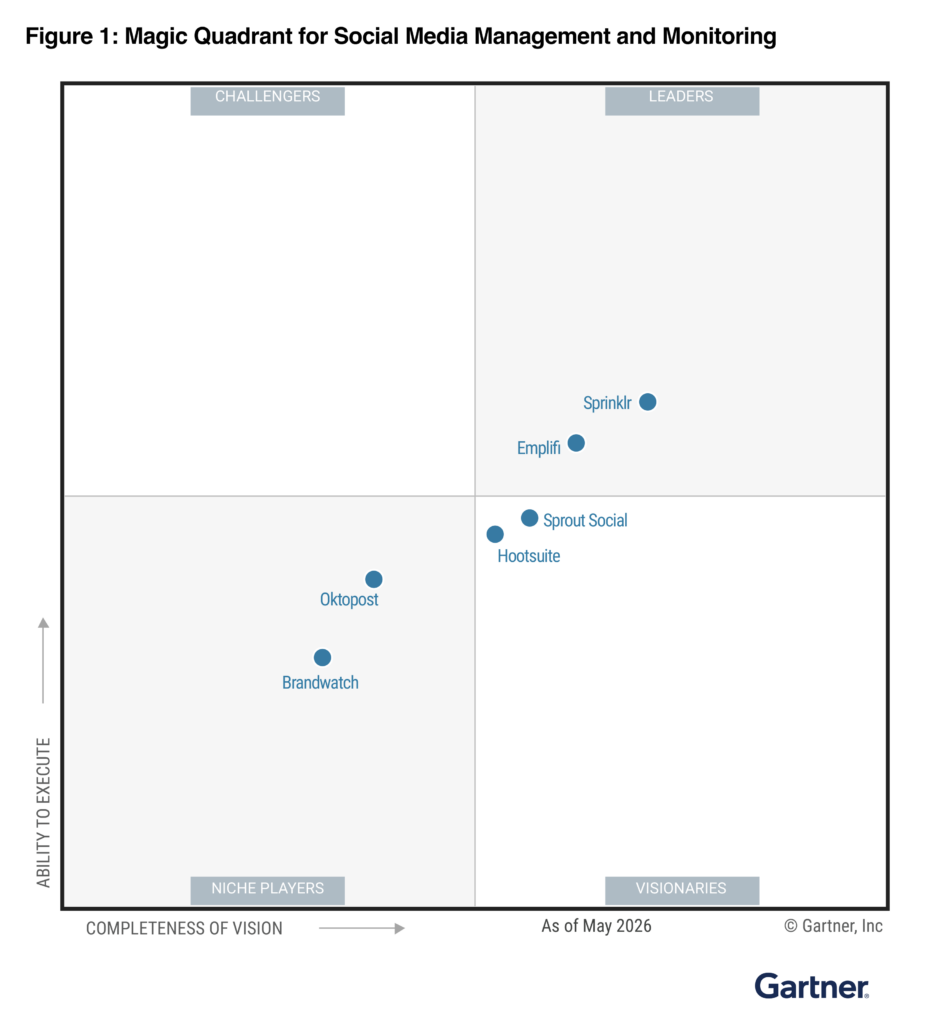
Emplifi named a Leader in the 2026 Gartner® Magic Quadrant™ for Social Media Management and Listening

Get the Report

Emplifi named a Leader in the 2026 Gartner® Magic Quadrant™ for Social Media Management and Listening Get the Report

Blog
16 min read
Oct 08, 2026

How retail brands grow their social media audience

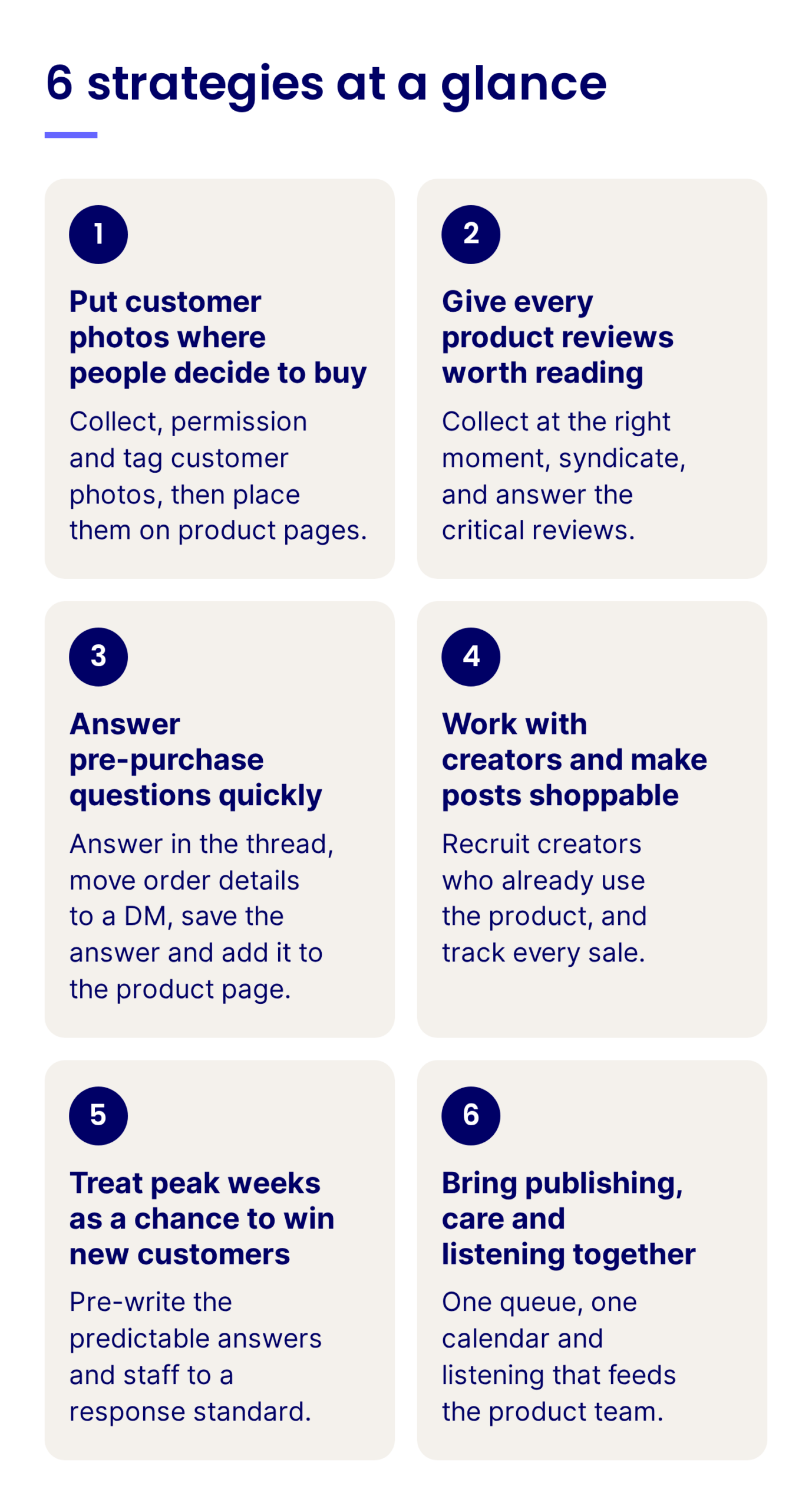
The fastest way to grow a retail social media audience is to put customer photos, reviews and fast answers where shoppers decide, then use creators and peak weeks to reach new buyers. Six strategies do the work: customer photos in the purchase path, reviews for every product, quick answers to pre-purchase questions, creators and shoppable posts, peak weeks treated as acquisition, and one system for publishing, care and listening.

Jordan Lukes Director of Corporate Marketing
A shop associate arranges white sneakers on a display plinth as a phone on a tripod films them in a bright shoe store.

Retail has an unusual advantage on social: shoppers do a lot of the talking. They post the new boots on a muddy trail, film the unboxing, ask in the comments whether a jacket runs small, and review the order the week it arrives.

That openness is the heart of retail social media. The proof that sells a product already sits in your customers’ camera rolls, reviews and questions, and growing brands put it on the product page, in the feed and in the DMs, close to the moment someone decides to buy.

For many shoppers, that moment happens on social itself. Emplifi’s Peak Season 2026 research, a survey of more than 1,600 shoppers in the US and UK, found that 62% have bought a product directly through a social media platform.

That puts the feed, the comments and the product page on the same path to checkout.

This guide is written for social media, ecommerce and digital marketing leaders at retail and ecommerce brands, and for the care leads who carry the queue through peak weeks. It builds on our social media marketing playbook for retail brands with six strategies, channels, AI, measurement and a 30/60/90-day plan, including a fast track for teams whose peak weeks are close.

Why social is different for retail brands

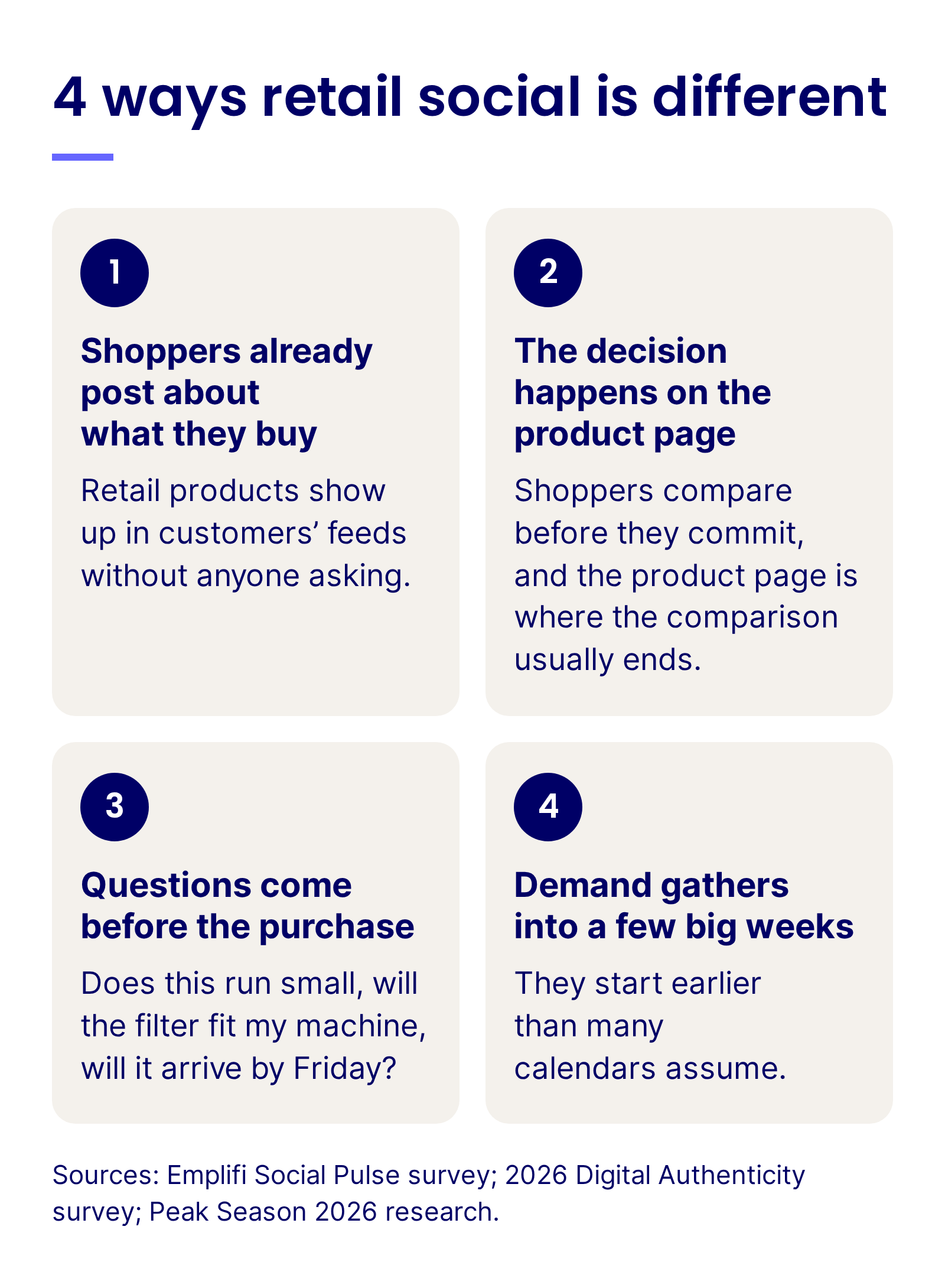
Four things set retail brands apart from most other categories on social, and each one shapes how a growth program works.

4 ways retail social is different: shoppers already post about what they buy, the decision happens on the product page, questions come before the purchase, and demand gathers into a few big weeks

1. Shoppers already post about what they buy. A new jacket, a kitchen haul, a bracelet stacked on a wrist: retail products show up in customers’ feeds without anyone asking. In Emplifi’s Social Pulse survey of nearly 1,000 US social media users, 65% said user-generated content influences them, against 14% for celebrity content. Since that content exists anyway, the work is collecting it, asking permission and putting it where it helps the next shopper.

2. The decision happens on the product page. Shoppers compare before they commit, and the product page is where the comparison usually ends. Emplifi’s 2026 Digital Authenticity survey of 1,650 US and UK consumers found 63% rate user reviews among the most authentic types of online content, second only to search results. Real reviews and real photos on that page give a shopper something to believe at the moment they need it.

3. Questions come before the purchase. Does this run small, will the filter fit my machine, will it arrive by Friday? In Emplifi’s Peak Season 2026 research, 57% of shoppers said they have reached out to a brand on social for customer support at least once. Many of those conversations start before checkout, so the person answering is helping someone decide.

4. Demand gathers into a few big weeks. Year-end holidays, back to school, Ramadan, national days and sale events pack a large share of the year’s shopping into short windows, and they start earlier than many calendars assume. The same research found 49% of consumers start thinking about peak season shopping before November, and one in five begin before September.

Where retail social programs often get stuck

The same four challenges come up again and again in retail and ecommerce social programs. Most of them come from how the work is organized, which makes them fixable.

Promotions carry most of the feed. In the Social Pulse survey, 64% of consumers said they follow brand accounts for news about promotions, sales and discounts. Offers earn the follow, and they deserve a regular slot. When the feed is almost entirely discounts, people have little reason to stay between sales, and they learn to wait for the next one.

Customer content gets collected, then sits still. In The State of Social Media Marketing 2026, 82% of more than 560 marketers rated UGC as important to their strategy, and 31% actively encourage and incorporate it. Plenty of teams have thousands of tagged photos and no routine for asking permission, tagging products or getting the best ones onto product pages.

Reviews lag behind the catalog. New products arrive every week, and the newest ones usually have the fewest reviews. A shopper comparing two similar items will often pick the one with more people vouching for it, which leaves new launches at a disadvantage until reviews catch up.

Social, care and ecommerce often work separately. Social sees the question, care owns the order system and ecommerce owns the product page. Half of the marketers in the same survey said they want more joint planning across teams. When those teams plan apart, a sizing answer given in a DM rarely reaches the product copy, and the next shopper has to ask again.

Six retail social media strategies for audience growth

The six strategies below build on each other. Starting with one or two and adding the rest as the workflow matures is a perfectly good way in.

1. Put customer photos where people decide to buy

Customer photos do their best work next to the buy button. A shopper looking at work pants, a bracelet or a stand mixer wants to see it on someone like them before adding it to the cart. So collect, permission and tag customer photos, then place them on product pages.

Carhartt built its digital storytelling around real customers. The team pulls tagged and hashtagged customer posts from Instagram, curates them into galleries by season, product line and theme, and uses AI-powered search to find exactly the shot it needs, whether that’s a lineman in a blizzard or a welder in a workshop. Kaleena Ocasio, D2C Digital Content Specialist at Carhartt, puts it simply: “Carhartt customers like seeing real people wearing our gear, which encourages them to buy with confidence.”

Carhartt’s “Go do Carhartt stuff today” carousel credits each photo to the person who took it, so any follower can picture their own shot in the next one.

Carhartt: A 27% conversion rate from UGC gallery engagement, and $150,000 in revenue driven by user-submitted content.

The pattern holds well beyond one brand. In Emplifi’s Q1 2026 benchmarks, drawn from thousands of US brand accounts, brands using Emplifi UGC recorded conversion rates on UGC 6.73 times higher than on non-UGC content.

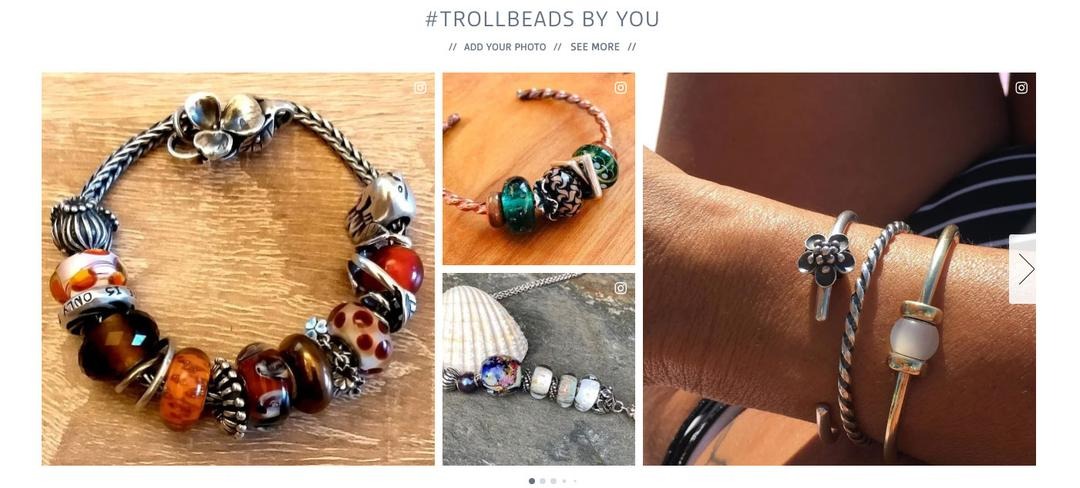
Product tagging is what turns a nice photo into a shopping path. Trollbeads, the Copenhagen jewelry brand, sells beads that customers combine in endless ways, which is hard to show in a studio shot. Matching each customer photo to the right products in its catalog brought a 12% increase in average order value, and across its customer content program, time on site rose 31%.

Trollbeads website gallery titled #Trollbeads by you, with Add your photo and See more links above customer photographs of beaded bracelets and bangles, each marked with an Instagram icon

Trollbeads’ gallery shows how other customers combine the beads, which answers every shopper’s question: what will this look like with the beads I already own?

A few habits help customer content work harder:

  • Start with the products that sell. Put galleries first on the product pages with the most traffic and the fewest real-life photos.
  • Ask for rights as you collect. Request permission when you gather content, and keep consent records in one library the web, paid and email teams can all use.
  • Tag the product in the photo. Link each image to the item it shows, so a shopper can go from photo to cart without searching.
  • Reuse what converts. A customer photo that performs on a product page is worth testing in paid social and post-purchase email, too.

Measure this: Track conversion rate and average order value on product pages with customer content, alongside the same pages without it. Comparing the two gives you the clearest view of what customer photos add.

2. Give every product reviews worth reading

Reviews are the other half of the proof, and the hardest part is coverage. Catalogs grow faster than reviews do, so collect at the right moment, syndicate and answer the critical reviews. Gemplers, the farm and home supply retailer, shows how far syndication alone can go.

Gemplers: 97% of its reviews come from syndication, and monthly review volume is up 232%.

Brands Gemplers stocks, including Carhartt, YETI and Under Armour, share their reviews to its product pages automatically. Carhartt alone syndicates hundreds of reviews per product to Gemplers, with no manual work on the retailer’s side.

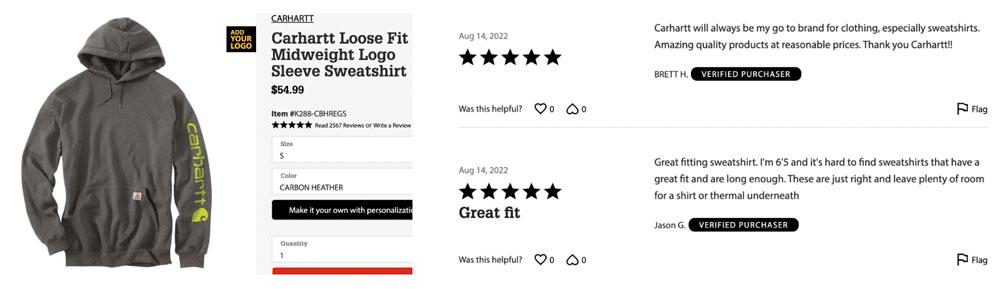
Gemplers product page for a Carhartt Loose Fit Midweight Logo Sleeve Sweatshirt, with size and color options beside five-star reviews from verified purchasers

A Carhartt sweatshirt on Gemplers’ site arrives with the brand’s syndicated reviews attached, so shoppers read what verified purchasers say about fit on the page where they pick a size.

Collection matters just as much. Sur La Table switched to mobile-first review request emails with one-click authentication and a short path to submit, and its average star rating rose from 4.1 to 4.5. Timing helps, too: a review form inside the post-purchase email or SMS, sent once the product has had time to prove itself, asks when the customer has something to say.

From there, work the gaps product by product, starting with items that get traffic and have few reviews. Brands can syndicate reviews to the retailers and marketplaces that stock them, and retailers can bring vendor reviews onto their own pages. Reply to the critical ones: a calm answer to a two-star review about fit, with the fix explained, reassures the next reader.

Video of real people using a product does a similar job on social, especially when it answers the question shoppers worry about most.

Vessi gave its waterproof shoes to the team at Capilano Suspension Bridge Park in North Vancouver and posted their verdict after a rainy week. People who stood in the rain all week are a believable answer, and the collab carries the post to the park’s followers.

3. Answer pre-purchase questions quickly

Many retail comments and DMs are sales conversations in disguise. Someone asking whether a boot runs narrow, whether a foundation shade leans warm or whether an order will arrive before a birthday is close to buying, and a quick, specific answer often settles it.

Speed matters. The Social Pulse survey found 32% of consumers expect a direct message response within one hour. Few retailers can staff an expert for every product in a big catalog, which is why many share the work with the people who already own it.

Sur La Table’s Community Q&A sends each new question to customers who have already bought the product, and 90% of questions receive an answer, with a median time to the first answer of under an hour. Seattle Coffee Gear uses the same questions as product research. “If we notice that the same question is coming up regularly, we can use that insight to update the content on the product page,” says Kelli Rognlie, Senior Marketing Manager.

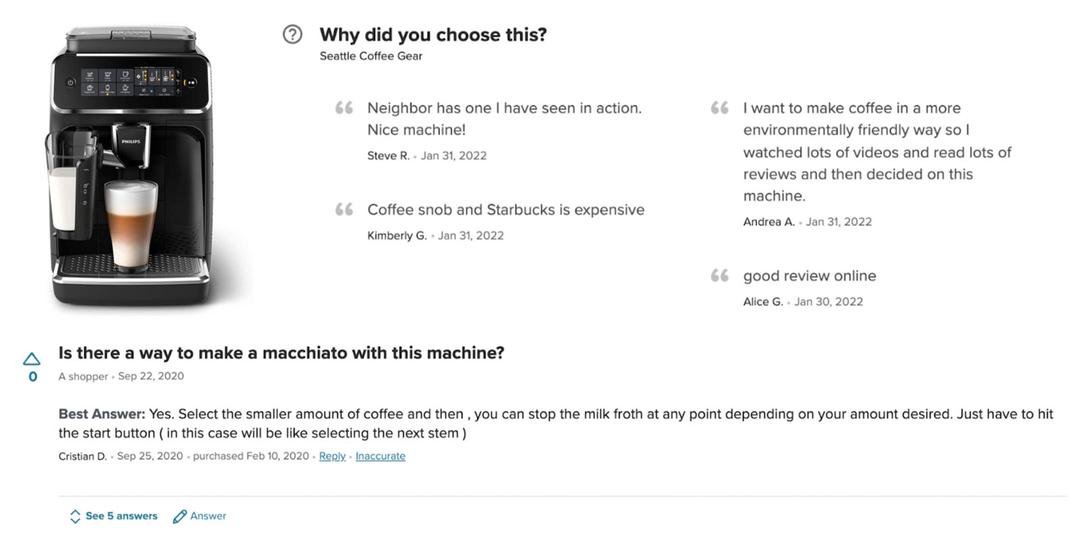
Seattle Coffee Gear product page for a Philips espresso machine, showing short customer answers to “Why did you choose this?” and a shopper question, “Is there a way to make a macchiato with this machine?”, with a best answer from a verified owner

On Seattle Coffee Gear’s product page, buyers explain why they chose the machine and an owner answers whether it makes a macchiato. Each answer keeps helping every shopper with the same doubt.

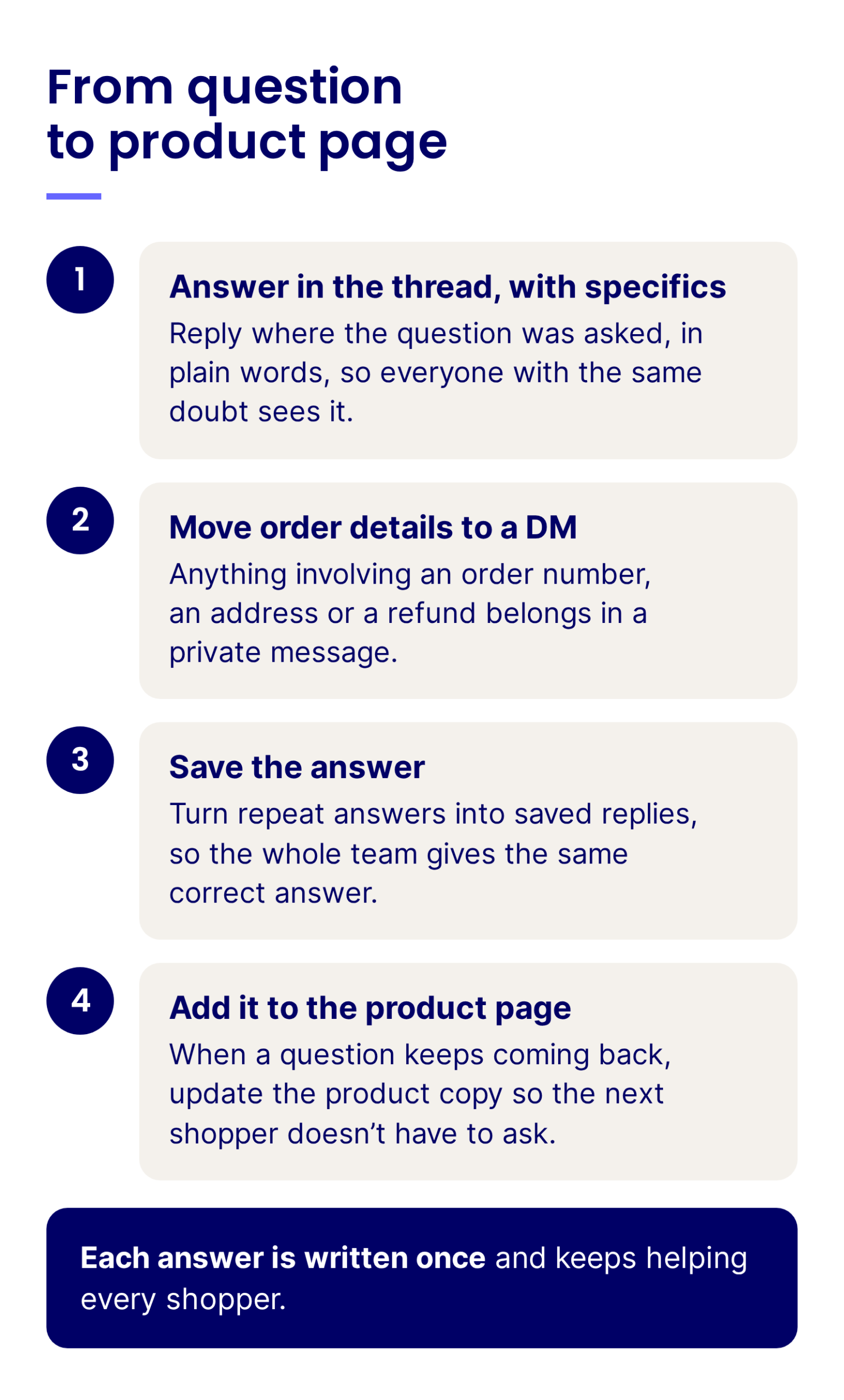
A simple routine keeps answers fast and consistent:

  • Answer in the thread, with specifics. Reply where the question was asked, in plain words, so everyone with the same doubt sees it.
  • Move order details to a DM. Anything involving an order number, an address or a refund belongs in a private message.
  • Save the answer. Turn repeat answers into saved replies, so the whole team gives the same correct answer.
  • Add it to the product page. When a question keeps coming back, update the product copy so the next shopper doesn’t have to ask.

From question to product page, a four-step routine for pre-purchase questions on retail social: answer in the thread with specifics, move order details to a DM, save the answer, and add it to the product page

Video answers work well, too. A short Reel that leads with the answer reaches the people who never ask, and the comments become a natural place for the next question.

Sur La Table opens this Reel’s caption with the fix: if the shot pulls too fast, grind finer, and if it pulls too slowly, go coarser. Viewers get the useful part before the video starts.

4. Work with creators and make posts shoppable

Creators introduce a product to people who don’t follow you yet, in a voice those people already trust. Marketers are leaning in: in The State of Social Media Marketing 2026, 67% plan to boost their influencer budgets. Programs work best when they recruit creators who already use the product, and track every sale.

Instagram Collabs are one of the most direct ways to reach a creator’s audience. In Emplifi’s H1 2026 analysis of Instagram collab posts, accepted collaborations, where the creator publishes and invites the brand as co-author, reached more than 5x the amplification (shares and reposts) of non-collab posts in ecommerce and retail.

Some of the best creators are already customers. Sur La Table’s The Kitchen Table is a brand ambassador program for home cooks, hosts and food lovers, open to people with 500 or more followers, with commission on the products they recommend.

Sur La Table features baker @pastrywithjenn and invites viewers who love to bake to join The Kitchen Table. One ambassador at work is the recruiting pitch.

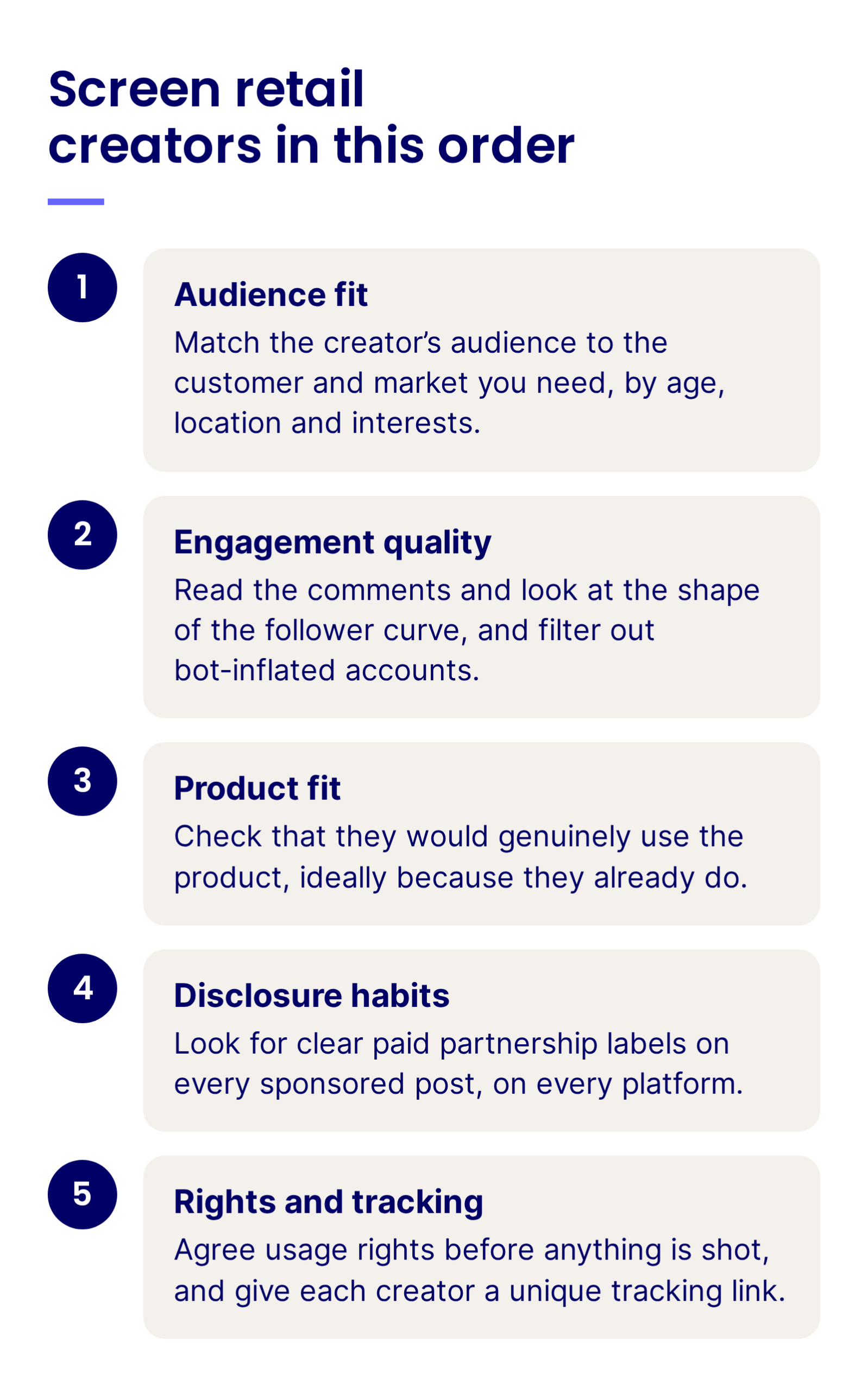
A consistent screening order keeps a creator program manageable. Run each creator through the same steps before anyone shoots anything:

  • Audience fit. Match the creator’s audience to the customer and market you need, by age, location and interests.
  • Engagement quality. Read the comments and look at the shape of the follower curve, and filter out bot-inflated accounts.
  • Product fit. Check that they would genuinely use the product, ideally because they already do.
  • Disclosure habits. Look for clear paid partnership labels on every sponsored post, on every platform.
  • Rights and tracking. Agree usage rights before anything is shot, and give each creator a unique tracking link.

Creator screening order for retail brands: audience fit, engagement quality, product fit, disclosure habits, then rights and tracking

Making the post shoppable closes the loop. Product tags, a link-in-bio storefront and creator links shorten the path from scroll to cart, and tracking links show which creators drive sales. Walmart and Sur La Table both ask viewers to comment a keyword, SHARE or “dialed in”, to get the featured products, which turns a passing view into a request the brand can answer.

Walmart asks viewers of this snack Reel to comment one word, SHARE, to get the picks. Each comment is an easy first step for the viewer and tells the brand who wants the products.

5. Treat peak weeks as a chance to win new customers

Peak weeks bring the year’s biggest wave of new shoppers, and of questions. In the Peak Season 2026 research, nearly nine in 10 consumers expect a response within 24 hours during peak season, and shipping and product defects top the reasons they get in touch, each cited by 40%.

Every reply in those weeks is visible to the next shopper with the same question, which makes peak service part of acquisition. A first-time buyer who gets a fast, friendly answer about a delivery cutoff has a good reason to come back after the season ends.

Most peak volume is predictable: shipping cutoffs, returns, gift receipts and order tracking. Pre-write the predictable answers and staff to a response standard, with saved answers and a response target per channel set before the season and checked daily. Out-of-stock comments need their own reply, with a restock date or a similar item that keeps the shopper with you. Keep public replies public, since other shoppers read them. If your peak weeks are close, the fast track at the start of the plan below puts these steps first.

Local moments matter as much as the global ones. Ramadan, Diwali, Singles’ Day or a national day can matter more in a market than the global sale events. For Saudi National Day, the Sept. 23 holiday that marks the unification of the kingdom in 1932, Bath & Body Works Arabia answered the obvious gift question before anyone asked it.

Bath & Body Works Arabia’s caption, in Arabic and English, opens with the question its shoppers are asking, “Looking for a special fragrance for Saudi National Day?”, and answers it with a top five.

Peak weeks also bring a flood of unboxings, gift reveals and first-wear photos. Asking for rights while the posts are fresh fills next season’s product pages with customer photos.

6. Bring publishing, care and listening together

Retail signals pile up fast: a run of “does this come in half sizes?” comments, a jump in returns for a jacket that fits small, a dozen “when is this back in stock?” replies under one Reel. They’re most useful when the people who publish, answer, buy and build the products all see them: one queue, one calendar and listening that feeds the product team.

Vessi, the Vancouver waterproof footwear brand, runs an entirely organic social program with a two-person team. Listening queries surface pain points like “wet socks” in real time, tags turn comments into themes from size requests to product praise, and a 90-day searchable archive gives the team proof for leadership and product feedback.

Vessi: The two-person social team cut daily comment and DM handling time in half with listening queries, tags and saved replies.

Tags that track requests such as half sizes give the product team hard numbers on what customers want. The team even built an April Fools’ joke about “barefoot” Vessis from real customer comments, which landed because followers recognized their own requests.

Vessi’s launch post for the Weekend Neo closes with “we heard you. The Weekend Neo is available in half sizes.” For the people who asked in the comments, the product itself is the reply.

Connecting social and care pays off in speed. Salomon manages more than 80 social channels in one place, and its social team flags messages about warranties or product availability and routes them straight to the customer service agents who can resolve them. Since moving that work from community management into a connected care workspace, Salomon has cut response time by 45%, and case handoffs are 70% faster.

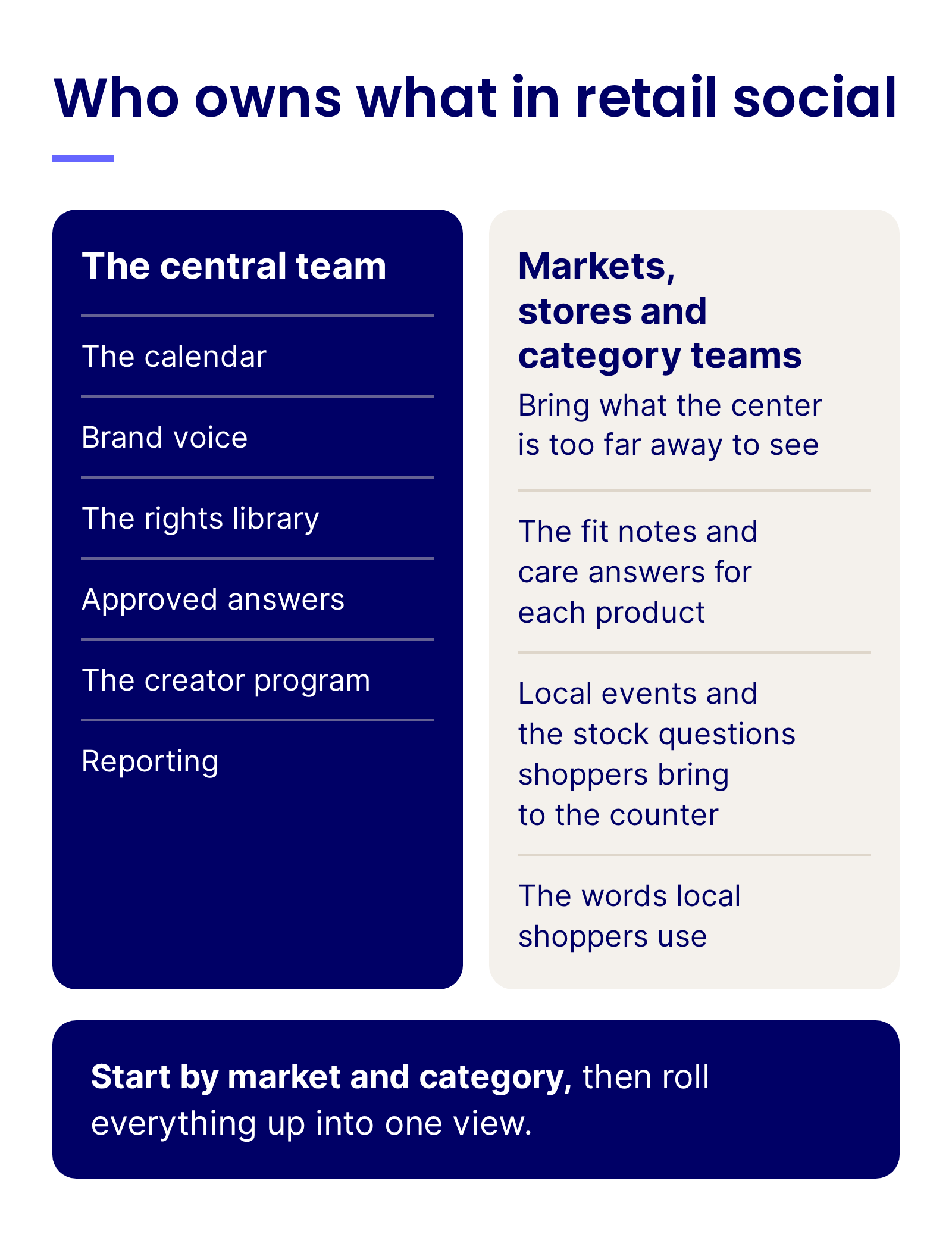
Agree who owns what before a sizing complaint or a stock question lands. The central team usually owns the calendar, brand voice, the rights library, approved answers, the creator program and reporting. Markets, stores and category teams bring what the center is too far away to see: the fit notes and care answers for each product, local events and the stock questions shoppers bring to the counter, and the words local shoppers use.

Who owns what in a retail social program: the central team owns the calendar, brand voice, rights library, approved answers, creator program and reporting, and markets, stores and category teams own the fit notes and care answers for each product, local events and stock questions, and the words local shoppers use

For reporting, start by market and category, then roll everything up into one view. Put follower growth for each category launch beside its conversion rate and its top return reasons, so a sizing problem shows up in the same report as the campaign that sent the traffic.

Six retail social media strategies at a glance: put customer photos where people decide to buy, give every product reviews worth reading, answer pre-purchase questions quickly, work with creators and make posts shoppable, treat peak weeks as a chance to win new customers, and bring publishing, care and listening together

Channels and formats: where to put your effort

Each platform plays a slightly different role in retail and ecommerce social media. The table maps each channel to its main job, the formats that perform well and a common pitfall.

Platform Primary role Best formats Common pitfall
Instagram Discovery, customer proof, creator collabs Reels, Carousels, Collab posts Posting studio product shots only, with no customer or creator content in the mix
TikTok New audiences and creator-led discovery Short video, creator content Running creator posts with no product link or tracking
Facebook Community, live shopping, paid reach Live video, Reels, feed ads Leaving product and order questions in the comments unanswered
YouTube and Pinterest Search-led research and planning Reviews, how-to video, idea boards Publishing once and never updating the answers
Reddit and communities Honest comparison Answered threads, clearly labeled brand replies Treating threads as an ad channel
Product pages, retailer sites and marketplaces Final proof before checkout Customer photo galleries, reviews, Q&A Managing reviews and Q&A separately from social
Private messaging Pre-purchase questions and order help DMs, keyword replies, saved replies Leaving DMs unstaffed during peak weeks

Instagram is usually the main discovery and proof surface. In Emplifi’s Worldwide Social Media Benchmarks: Ecommerce Q2 2026, ecommerce brands posted a median engagement rate near 1.90% on Instagram, against roughly 0.45% on Facebook. Reels earned a median of 38 interactions per post, Carousels 31 and single images 18, so a mix of short video and swipeable product stories tends to work best.

TikTok is where many new customers first meet a brand. Median brand follower counts on TikTok grew by more than 200% year over year in Emplifi’s Social Media Benchmarks 2026, the fastest growth of any platform. Creator-led videos that show the product in use, with a clear link to buy, make the most of that reach.

Facebook still carries community, live shopping and a lot of paid reach. In the same Ecommerce benchmarks, Live Video led organic Facebook performance at a median of 22 interactions per post, and the Facebook feed led paid placements on click-through rate at 1.62%, with a median cost per click of $0.30. A monthly live demo or Q&A earns its slot.

YouTube and Pinterest serve shoppers who research and plan. Reviews, how-to videos and idea boards keep answering questions for months, so update the most-watched ones when a product changes and link them from the product page.

Reddit and other communities are where shoppers go for a second opinion. In the Peak Season 2026 research, 73% said they have searched Reddit before purchasing a product. Listening there shows what people really think, and a clearly labeled brand reply with a straight answer is usually welcome.

Product pages, retailer sites and marketplaces are where this proof gets used, often on pages the brand doesn’t own. Syndicated reviews and shoppable customer photos carry it to every place the product is sold.

Private messaging is where many pre-purchase questions and most order questions end up. Saved replies for sizing, delivery and returns, plus a clear response target, keep those conversations moving toward checkout.

Matching content to the purchase decision

A common gap is publishing the same product post to everyone, whatever stage of the decision they are in. Someone browsing for ideas needs something different from someone choosing between two sizes.

Decision stage What the shopper needs Best content type Primary channel
Discovering Ideas and a reason to look closer Creator Reels, Collab posts, gift guides TikTok, Instagram
Comparing Proof from people like them Customer photos, reviews, answered questions, community threads Product pages, Instagram, Reddit
Buying Quick answers and an easy path to checkout Answered DMs, shoppable posts, keyword replies DMs, Instagram, product pages
After purchase Help with the order and a reason to come back Fast care, how-to content, review and photo requests DMs, email, Instagram

Each stage has a number behind it. At the discovery stage, 39% of shoppers in the Peak Season 2026 research said they discover holiday gift ideas on social platforms like TikTok, Instagram, YouTube and Facebook. When they compare, 79% read three or more reviews before buying, according to the 2026 Digital Authenticity survey.

At the buying stage, speed decides a lot: 45% of shoppers in the Peak Season research said they are much more likely to purchase from brands that are responsive on social. After the purchase, good service keeps paying off, and 59% of consumers in the Digital Authenticity survey bought from a brand again after a positive resolution experience.

AI in retail social media: where it earns its place

Shoppers are already using AI to shop. In the Peak Season 2026 research, 66% said they have used AI tools at least occasionally to research products or find gift ideas. They are more cautious about AI in the content itself: only 41% said they trust AI-generated product images.

That makes AI most useful behind the scenes, where it helps a lean team find, sort and answer faster, and makes disclosure important wherever it shows. In Emplifi’s AI in Social Media: Consumer Expectations research, a survey of nearly 900 US consumers, 60% said they want to know when they’re interacting with AI.

H&M’s runway carousel says in the caption that only AI-labeled visuals contain AI-generated elements, and marks those frames with a small AI label, so shoppers know which images show the real clothes.

Where AI works well in a retail social program:

  • Finding the right customer photo. Searching a content library by product, scene, color or mood turns thousands of collected posts into a shortlist for the next product page.
  • Summarizing reviews. Review summaries condense hundreds of opinions into themes a shopper can scan, such as “runs small” or “holds up in the wash”, and show your team what to fix.
  • Triage in peak weeks. Sorting comments and DMs into where-is-my-order, sizing, returns and stock questions, so each one reaches the right person first.
  • First-line drafts from approved answers. Suggested replies about shipping cutoffs, exchanges or fit, drawn from your saved answers and reviewed before sending.

Some calls should stay with a person, and a useful test in retail is whether a wrong answer would cost the shopper money, a bad reaction to a product or a wasted return trip:

  • Refunds and exchanges outside the standard policy
  • Ingredient, allergy and skin-reaction questions on beauty and personal care products
  • Product safety issues and recalls
  • Pricing errors and promotion mistakes
  • Upset customers whose complaint is going public

Agree on disclosure wording before AI-drafted replies go live. On an order or returns thread, a short line works: “We use AI to help us reply faster. A person checks anything about your order or refund.” Label AI-generated product images and marketplace listings just as plainly, close to the image, so shoppers know which photo shows the real product.

On Emplifi, this work runs on Fuel AI, the agentic intelligence layer built into the platform, with AI included. It finds rights-cleared customer content, routes and summarizes cases and drafts replies, while approval gates your team configures keep a person in charge of anything that touches an order, a refund or a product claim.

How to measure what matters

Follower counts are a useful start. Ecommerce and merchandising leaders usually want to see how social connects to conversion and revenue, and a fuller report shows the proof and service work that gets shoppers there. The tiers below run from audience to business outcome.

Metric tier What to measure Benchmark to use
Audience growth Net new followers by market and platform, and the unpaid share of growth Worldwide Ecommerce benchmarks, or a regional Ecommerce edition where one exists
Engagement quality Engagement rate, shares and saves per reach, by format The Ecommerce Q2 2026 medians in the channels section above
Customer content Permissioned photos collected per month, share of top products with customer photos Your own pages with and without customer content
Reviews and Q&A Review coverage by product, average rating, answer rate on shopper questions Your trend line by category
Care performance First response time by channel, resolution rate, response time in peak weeks Suggested target: one hour for most DM questions
Business outcome Conversion rate and average order value on pages with customer content, revenue attributed to social and to creators, top return reasons by product Your own pages with and without customer content, by category

Q2 2026 Ecommerce benchmarks are published for Worldwide, Asia Pacific, Australia and New Zealand, and Latin America. Teams in other markets can compare against the Worldwide edition and check the benchmark search for new regional editions.

The Bath & Body Works Arabia results below show the community and care tiers tracked together. Add conversion and average order value on pages with customer content, the figures an ecommerce leader usually asks about first.

What Bath & Body Works Arabia did

The challenge. Bath & Body Works Arabia, which serves Bath & Body Works shoppers across the Middle East, saw customers move more of their questions, feedback and product research into direct messages. The team needed to scale engagement on social while bringing response times down, including through peak periods such as sales campaigns and holidays.

What they did. The team brought direct messages into one place with Emplifi Community, added answer templates for repeat questions, and set a goal of responding to every customer inquiry within seven hours. The templates proved especially useful during Ramadan, when the team works reduced hours. Agents answer questions, recognize intent and offer personalized recommendations in the same workflow, and the brand credits Emplifi’s Link in Bio tool, used for its influencer collaborations, with follower growth and more website traffic.

Bath & Body Works Arabia’s Summer Surprise giveaway, in Arabic and English, asks followers to comment their favorite fragrance and tag three friends, which pulls new people into the comments.

“It’s the blend of technology and personal touch that defines our customer success experience,” says Mahmoud Zammar, Marketing Executive at Bath & Body Works Arabia.

The result. A 25% increase in community size and a 38% reduction in response time, with 83% positive sentiment in the comments. With agents answering product questions and pointing shoppers to the ecommerce site, the community team has become part of how the brand sells.

Your 30/60/90-day plan

If peak weeks are close: start here

When your busiest weeks are only weeks away, do these four things first. The full plan below builds on them once the rush is over.

  • Write saved answers for shipping cutoffs, returns, gift receipts, order tracking and out-of-stock items, starting from last season’s most common questions.
  • Set a written response target for each channel, and check it every day of the season.
  • Bring comments, DMs and reviews into one queue, with routing for order, sizing and stock questions and a clear escalation path.
  • Run a short rehearsal with everyone on the queue before the first big sale weekend.

First 30 days: map what you have

Before building anything new, find where your proof and your questions already are. Most retail programs have this data somewhere, so the first month brings it to the surface.

  • Rank your top 50 products by revenue, then list how many reviews and customer photos each one has. The products with traffic and thin proof are your starting brief.
  • Audit tagged content: how much you have, how much is permissioned, and which teams can use it today.
  • Map every place a question arrives (comments, DMs, product page Q&A, reviews, retailer sites and marketplaces) and note who answers each one and how fast.
  • Pull the 20 questions shoppers ask most, from care tickets, DMs and product Q&A, and the top return reasons for your best sellers.
  • Shortlist three creators or customer ambassadors using the screening order above.
  • Mark the peak weeks and local moments for each market on one calendar.

Days 31–60: build the engine

With the gaps mapped, the second month is about putting proof and answers where shoppers decide.

  • Publish shoppable customer photo galleries on the 10 product pages with the most traffic and the fewest real-life photos.
  • Switch on post-purchase review requests, and set up review syndication with your largest retail partners or vendors.
  • Extend your saved replies to the top 20 questions, and add the answers, including fit notes, to the matching product pages.
  • Publish your first accepted Collab Reel with a shortlisted creator, with a tracking link in place.
  • Build out the one-queue setup: add product page Q&A and retailer reviews, set routing rules for every question type, and track response time against your targets each week.

Days 61–90: show the results

The third month translates what you’ve built into the language ecommerce leaders use: conversion, order value and revenue.

  • Publish a report comparing conversion rate and average order value on pages with customer content against pages without it.
  • Turn what the fast track and your last peak taught you into a written peak playbook: response targets, pre-written answers, out-of-stock replies, escalation paths and staffing.
  • Send the first monthly social report by market and category, rolled up into one view.
  • Benchmark your engagement against the Worldwide Ecommerce figures or your regional edition, and put next quarter’s targets in writing.

Give shoppers the proof they’re already looking for

A retail social media strategy works best when the brand makes room for its customers. The photo a lineman took on a job site and the answer an owner gave a stranger about making a macchiato do more selling than another studio shot.

Most of the work is operational. Ask for rights when you collect a photo, let reviews travel to the retailer pages and marketplaces where the product sells, and move the fit notes from your DMs into the product copy before peak weeks start. The fast track or the first 30 days of the plan above are a good place to begin.

If you run this on Emplifi, each piece has a home. Emplifi UGC finds customer photos with AI Visual Search, handles the rights requests and tags each image to a product for shoppable galleries, and Emplifi Ratings and Reviews collects reviews from post-purchase emails and syndicates them to retail partners such as Walmart and Google Shopping. Emplifi Community and Emplifi Care bring comments, DMs, reviews and live chat into one queue with routing, while Emplifi Influencers vets creators and tracks their sales, Emplifi Publisher keeps one calendar across markets, and Emplifi Listening surfaces the requests and complaints worth acting on.

Your shoppers are already doing much of the talking, so the next step is giving their words a place where the next shopper decides to buy.

Already an Emplifi customer? Talk to your Customer Success Manager.

Frequently asked questions

The fastest route is to put what customers already create, their photos, reviews and questions, next to the buy button, then use creators and peak weeks to reach shoppers who don’t follow you yet. Shoppable posts, a clear response standard for busy weeks and one shared view across publishing, care and listening keep that growth going.

Shoppers post about products without being asked, compare options on the product page and ask questions right before they buy, which makes social media for retailers a sales channel as much as a brand channel. Customer content and fast answers become the main growth levers, and demand gathers into a few peak weeks, so service capacity matters as much as the content calendar.

Instagram usually comes first, because ecommerce brands earn more engagement there than on Facebook, and Reels, Carousels and Collab posts reach new shoppers. TikTok is the fastest-growing platform for new audiences, Facebook carries community, live shopping and paid reach, and Reddit is where shoppers go for honest second opinions. Product pages and marketplaces belong in the same program.

Enough permissioned photos to put a gallery on every product page that carries real traffic, starting with the best sellers. Collect continuously, request rights as you collect, tag each photo to the product it shows, and keep every permission in one shared library. Carhartt and Trollbeads show what shoppable customer content can do on product pages.

With a written response target per channel, saved answers for shipping, returns and out-of-stock questions, and one queue for comments, DMs and reviews. Keep public answers public so other shoppers can read them, move order details to DMs, and route warranty or product issues straight to the team that can resolve them.

Yes, for finding customer photos, summarizing reviews, triaging peak-week questions and drafting replies from approved answers, with a person reviewing before anything is sent. Refunds outside policy, ingredient and allergy questions, safety issues and upset customers stay with people. It’s also good practice to disclose AI use in replies and label AI-generated images clearly.

It should cover follower growth by market, engagement against the Ecommerce benchmark, shares and saves per reach, review coverage and answer rate, first response time by channel, and conversion rate and average order value on pages with customer content. Together, those measures show leaders how social connects to proof, service and revenue.

Insights from Emplifi

Explore our latest blogs and comprehensive guides designed to help you master customer experience strategies and drive growth.

Social media benchmarks for ecommerce brands

Emplifi's latest quarterly social media benchmarks for ecommerce brands, by region.

The retail marketer's guide to peak season 2026

Exclusive research from 1,600+ global consumers on how shoppers discover, research, and buy during the holiday season. See what consumers expect this...

The ultimate social media marketing playbook for retail brands

Discover how today’s top retail brands are turning social media into powerful digital storefronts.

Ready to fuel your teams with A-CX?

Discover what Emplifi can do for you. We turn small teams into large ones, and large teams into well oiled machines, but either way, we offer the rocket ship, you just need to jump on.

What can you expect?

  • A live walkthrough of Emplifi Fuel tailored to your specific social marketing, commerce, and care needs
  • A benchmark of how your brand performs against peers in your industry
  • A partner who understands your business, and 22,000 others
  • A concrete action plan to go from disjointed teams to A-CX
Get a demo