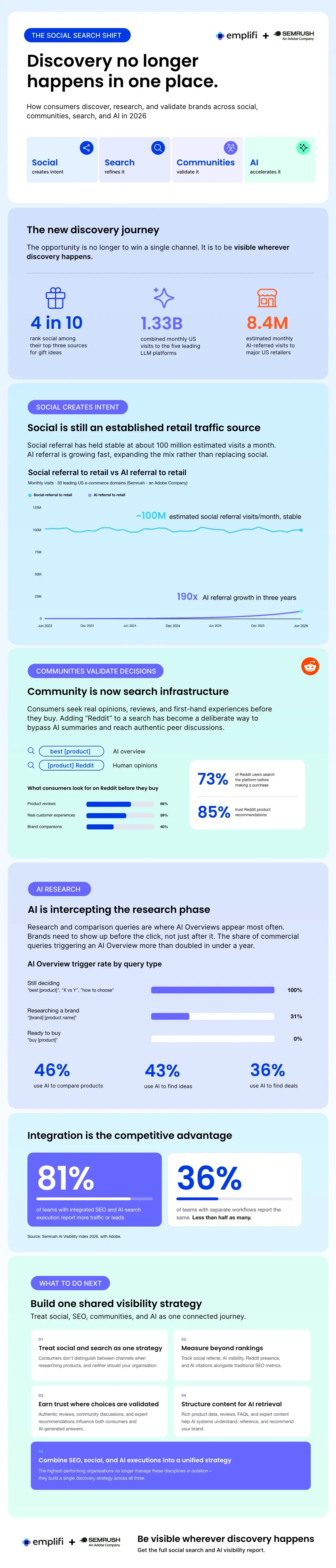
Inside the data: the consumer discovery journey in 2026 runs across four channels, and each one does a different job. Emplifi and Semrush, an Adobe company, combined a survey of 1,638 US and UK consumers with traffic and AI search data to map it. Social creates intent, search refines it, communities validate it, and AI accelerates it. Here is what that means for marketing, social, and SEO leaders.
AI-referred visits to major US retailers reached 8.4 million a month in June 2026. Social still sends about 100 million, the same level it has held for three years. Discovery is adding channels, not swapping them.
Emplifi surveyed 1,638 consumers across the US and UK to understand how people find and vet brands in 2026. Semrush added its traffic, keyword, and AI search data. Shoppers move between social feeds, search engines, online communities, and AI assistants before they decide, and each channel plays its own part.
We pulled the most important data from our full Social Search and AI Visibility Report into one infographic on the consumer discovery journey. Below, we break down what it means for your brand.

Source: Emplifi and Semrush, 2026.
Discovery no longer happens in one place. Shoppers move between four channels, and each one has a number behind it:
Search still leads that research step, yet two in three shoppers start somewhere else, from marketplaces and brand sites to social apps, AI tools, and forums.
What this means for marketers: A single-channel plan misses most of the journey. Map where your buyers get ideas and where they check them, then make sure your content answers the same questions in each place.
See how every stage of the discovery journey performs, from the first social post to the sale.
Social referral traffic to retail has held at about 100 million estimated visits a month for three years, across 30 leading US ecommerce domains. Brands can plan around that number.
AI referral is the fast mover. AI-referred visits to the same retailers grew from 44,000 a month in June 2023 to 8.4 million in June 2026, roughly 190 times in three years. Even after that growth, AI sends a fraction of the visits social does.
What this means for social teams: Report social referral traffic beside organic search as a dependable acquisition channel, and fund it that way. Build content around the jobs people bring to social, such as finding ideas and comparing options. Then check that a search for the product you featured lands on a page that answers the next question.
Before they buy, consumers look for opinions from people who already own the product. Reddit shows how strong that habit is. Among Reddit users, 73% search the platform before making a purchase, and 85% trust its product recommendations. Reviews, first-hand experiences, and brand comparisons are what they look for most.
Many shoppers now add “Reddit” to a search when they want opinions from other buyers. For the keyword data behind that habit, read our full analysis of social search and AI visibility.
What this means for brand and community teams: A shopper who opens a community thread is usually testing a shortlist, and the replies decide which brands stay on it. Find the communities where your category gets discussed, note the doubts that come up about your products, and answer those doubts on your product pages and in your support replies.
Emplifi Listening monitors conversations across X, TikTok, YouTube, Reddit, and millions of news sites, so your team sees what buyers say beyond your own channels.
Two-thirds of consumers have used AI tools to research products or find gift ideas, and one in four uses them frequently. Comparing products (46%) and finding ideas (43%) are the most common tasks. AI tools are already the first stop for 11% of shoppers researching a product.
Google’s AI answers sit at the same stage. In a directional Semrush sample of 50 US commercial and product queries from June 2026, research and comparison queries triggered an AI Overview in every case, while ready-to-buy queries did not. Our webinar guide explains how social content gets cited by AI.
What this means for SEO and content teams: Plan content for the comparison moment, when a buyer has narrowed the field to two or three options. Put a clear, quotable answer to the most common comparison question at the top of each key product page, and support it with real customer reviews and user-generated content.
According to the Semrush AI Visibility Index 2026, with Adobe, 81% of teams with integrated SEO and AI-search execution report more traffic or leads, against 36% of teams with separate workflows.
Every shift in this data touches both social and SEO. Shoppers cross between channels as they research, so the teams that reach them need a shared view of the journey.
What this means for marketing leaders: Pick the buyer questions that matter most and give each one an owner across social, SEO, and content. Report the results together, with social and AI referral traffic next to search rankings, so budget follows the whole journey.
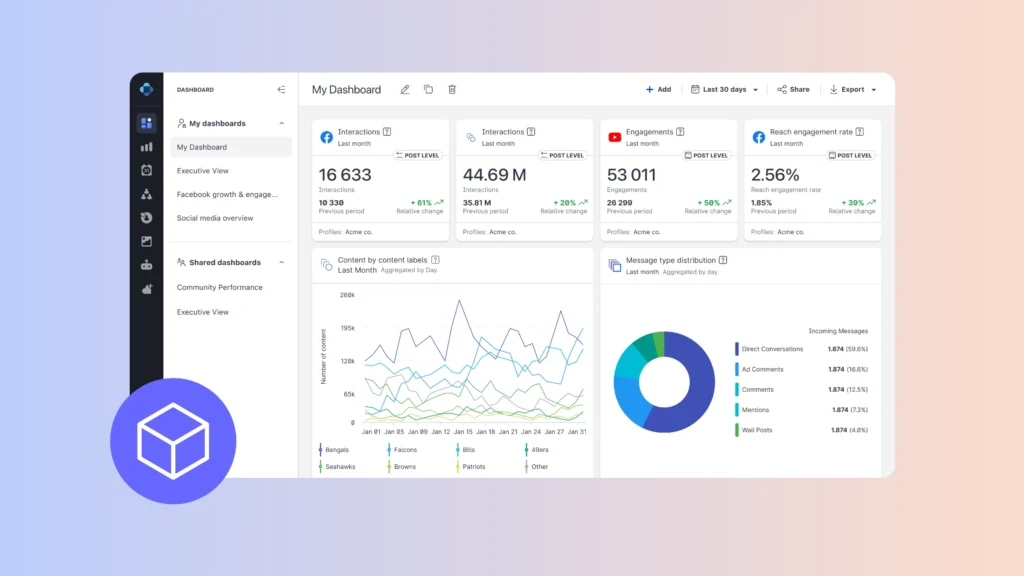
Emplifi Unified Analytics combines social, commerce, and care metrics in custom dashboards, so every team reports from the same numbers.
Your buyers already treat social, search, communities, and AI as one path. Plan for it as one. Four places to start:
For the complete data set, including social referral traffic by platform, the Reddit keyword comparison, and the full playbook, download the Social Search and AI Visibility Report.
Plan one discovery strategy that your social, SEO, and content teams own together.
Talk to an Emplifi expert about connecting social, search, and community insight into one discovery strategy.
Methodology: Emplifi surveyed 1,638 consumers in the US (n=785) and UK (n=853) with Alchemer from April 14 to May 1, 2026. Semrush, an Adobe company, provided modeled estimates from its traffic, keyword, and AI search data, sampled from June 2023 to June 2026.
The consumer discovery journey is the path a buyer takes from first noticing a product to deciding to buy it. In 2026 it runs across social platforms, search engines, online communities, and AI assistants instead of a single channel. Social media listening shows brands the conversations and questions that shape each step.
A shopper might spot a product in a creator video, search its name to check price and specs, read reviews in a forum, then ask a generative AI assistant to compare the final two options. Those steps map to the four stages: social creates intent, search refines it, communities validate it, and AI accelerates it.
Social is the stage where many shoppers first pick up ideas. Four in 10 consumers rank social platforms among their top three sources for gift ideas, and social referral traffic to 30 leading US retail domains has held at about 100 million estimated visits a month for three years. Our guide to optimizing social content for search shows how to keep those posts findable.
Communities are where shoppers test a shortlist against the experience of people who already bought. Threads, reviews, and forum answers can confirm a choice or knock a brand out, and buyers read them as independent advice. Sentiment analysis on those conversations shows how buyers feel about your brand and your competitors.
They are more than twice as likely to report gains. According to the Semrush AI Visibility Index 2026, with Adobe, 81% of teams with integrated SEO and AI-search execution report more traffic or leads, against 36% of teams with separate workflows. The Social Search and AI Visibility Report sets out five principles for bringing that work together.
Start with where buyers get ideas: check which social posts drive referral traffic. Then list the questions they search, the communities where they compare options, and the prompts they bring to AI tools. Track social referral, AI referral, and citations beside rankings, and bring those numbers into shared social media analytics dashboards.