The only constant of the Instagram algorithm? Change. The algorithm has undergone several iterations since its introduction to the feed in 2016. If your goal is to expand your reach in 2026, you need to understand the latest iteration of the Instagram algorithm inside and out, without losing sight of the number one priority: your audience.
Fast Answer: There is no single “Instagram algorithm.” Instead, Instagram uses a collection of AI-driven classifiers across its surfaces (Feed, Stories, Reels, Explore) that prioritize original content, watch time, and direct shares (sends) based on official Meta guidelines.
Numerous complex factors influence how the algorithm distributes content and how users consume it. It’s tempting to want to “beat” the Instagram algorithm, but it’s much more useful to think about working with it. By understanding how it works, you will have the information you need to drive genuine engagement on your Instagram accounts.
What we think of as “the algorithm” is actually a collection of algorithms, classifications, and processes. Each of Instagram’s surfaces—Feed, Stories, Reels, Explore, and Suggested Accounts—has a separate AI-driven process for classifying and distributing content.
Each algorithm analyzes thousands of data points, called ranking signals, based on a user’s browsing pattern and interaction history. The top ranking signals used to evaluate each piece of content include:
Information about the post (format, popularity, timestamp)
Information about the author (how often users interact with you)
The audience’s general activity (what formats they prefer)
The audience’s specific history of interacting with you
Here’s how Meta explains the process for what shows up in a user’s main feed:
“The Instagram Feed AI system automatically orders the posts in your feed by predicting what you will find most valuable and relevant. These predictions are based on a variety of factors, including what and whom you’ve followed, liked, or engaged with recently.”
The core process works in 4 steps:
Gathers available posts from accounts the user follows (removing anything violating Community Guidelines).
Leverages signals, such as the type of content, who created the post, and content quality.
Makes predictions based on a user’s previous activity to determine what they want to see most.
Ranks posts by a score, displaying the “top-scoring” posts first while ensuring a diverse mix of content formats.
Meta uses a similar process for Stories and for the Reels tab, and another process for the Explore page.
What each of them has in common is prioritizing original, engaging content that users are most likely to want to see in their feeds, based on past behaviors and actions.
Adam Mosseri, head of Instagram, has shared that there are two types of ranking on the platform:
Mosseri explains: “For both, the top three signals that matter most for ranking are watch time, likes, and sends. So when looking at your insights, pay close attention to average watch time, likes per reach, and sends per reach.
One nuance: likes are slightly more important for connected content, and sends are slightly more important for unconnected content.”
Essentially, Instagram aims to gauge how effectively you’re serving your existing audience and attracting new followers. This makes it all the more important to have audience-first strategy where you create content that’s tailored for the people you want to reach.
Unlike previous iterations that relied heavily on hashtags or basic engagement metrics, the 2026 algorithm employs advanced machine learning to examine visual elements, on-screen text, and video content with unprecedented depth.
Following Meta’s aggressive updates to penalize aggregator accounts, the 2026 algorithm heavily rewards originality and relationships. Content from accounts with which users have meaningful, 1:1 interactions receives maximum priority placement. These interactions include:
Direct message (DM) conversations and shares
Sustained comment exchanges
Story replies
Cross-platform engagement across Meta’s ecosystem
Because the 2026 algorithm places such high value on direct messages and quick comment exchanges, brands are under pressure to respond instantly. Handling this influx of 1:1 interactions can quickly overwhelm social teams, which is why forward-thinking brands are leveraging autonomous CX to scale their responsiveness. This ensures you maintain those crucial algorithmic engagement signals around the clock without ever losing the human touch.
Recent technical updates include customized Notes with enhanced visual options, locked posts functionality, voice message transcription in DMs, and support for 3:4 aspect ratio photos.
Instagram recommends using its native editing tools for creating content. While it doesn’t explicitly state that the algorithm prefers this, it tracks with the platform’s emphasis on original content, rather than reposts of content created for other platforms.
Just as there is not one single algorithm to master, there’s no single “trick” that will bend the Instagram feed to your will. The algorithms are smart, and so are users.
Rather than focusing on how to beat the system, you can increase your visibility by owning the space in the Venn diagram where your audience’s desires and the algorithm’s priorities overlap.
Original content is the undisputed king in 2026. You can utilize features like trending audio, but you must add your own creative spin. Instagram has actively rolled out [“original” labels or badges] for posts it identifies as unique to the platform, ensuring original creators get the reach they deserve over accounts that simply curate or repost.
Focus on content that encourages conversation and sharing. What makes your audience respond thoughtfully in the comments? What compels them to hit the “send” button to share the post with friends?
Start by analyzing your metrics and utilizing social listening tools like Emplifi Listening to gain a deeper understanding of what your audience craves. When those conversations do spark, having an autonomous CX platform working in the background ensures every fan feels heard instantly, turning casual commenters into loyal brand advocates while feeding the algorithm exactly the high-value interaction data it wants.
You can also sustainably scale your content by repurposing UGC: resharing it, tagging the original creator, and adding your brand’s unique context.
Delta is a great example. They often collaborate with influencers, showcase brand partnerships, and share content directly from their community. Take the Reel below, which a user originally posted of her pilot dad on his last flight. By tapping into authentic emotion and community storytelling, it generated over 600,000 views and more than 38,000 comments.
The airline also regularly shares dazzling videos of destinations worldwide from customers, influencers, and crew members to inspire future travelers. UGC that shows authentic, stunning travel content is a fantastic way to motivate people to start planning a trip. Weaving diverse community content into its branded posts, Delta consistently shares fresh and authentic content across its Instagram profile.
Before the Instagram algorithm became the sophisticated, AI-driven system it is today, hashtags were one of the primary ways that Instagram filtered content. If users wanted to search for skincare tips, #skincare was a good bet.
Today, there are more complex systems at work, but hashtags, used strategically, can still make an impact.
Rather than overstuff captions with keywords and dozens of hashtags, choose a single keyword and 3-5 hashtags that relate specifically to the content. This strategy will help surface your content to people searching from other platforms, such as Google or ChatGPT, while keeping it engaging for your current followers.
In addition to limiting hashtags, also consider:
You can also use hashtags to find and engage with other users, which will help increase engagement across your account and signal to the algorithm that users interact with your content.
And other engagement tactics, such as responding quickly to direct messages, commenting when your brand is tagged, and showcasing fans of your brand will go a long way in improving your reach on the algorithm.
Reels remain one of the top-performing content types on Instagram. In 2024, Reels accounted for 38% of brand content, with an average engagement rate of 2.2%, surpassing TikTok’s 1.7%.
The more engagement your content gets, the better placement future content will get with the algorithm. Utilize Reels to ask questions, share polls, invite collaboration, and share UGC. Because Reels show up in multiple places (Feed, Stories, Reels tab, and Explore page), they’re an effective way to test ideas and see what resonates with your audience.
Static posts and carousels are still important, however. The algorithms for the Feed and Explore surfaces, for example, aim to show users a mix of content types, making it essential to maintain a diverse mix, even with a Reels focus. You can also test messaging and trends across various content formats to determine what works best.
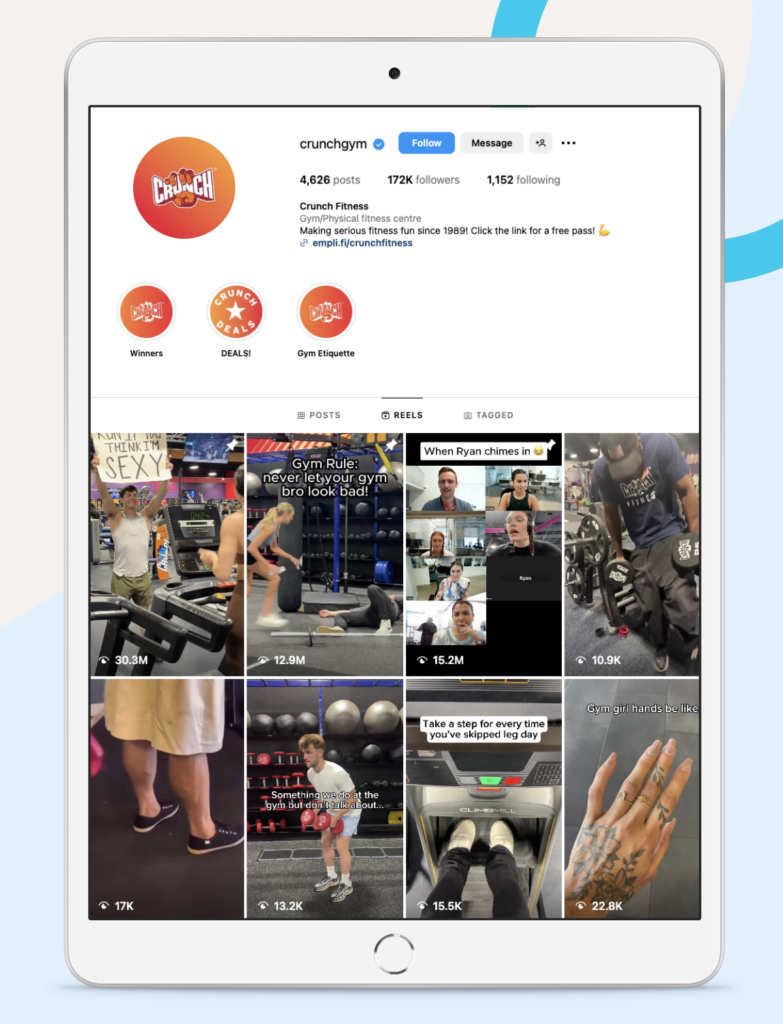
Crunch Fitness has found social success by experimenting with different formats on Instagram, both from their corporate account and individual franchise accounts, too. While their strategy leans heavily on Reels, they still make space for single-image and carousel posts in the feed, and also rely on UCG and featuring their customers at the franchise level.

Here are actionable steps to stay ahead of the algorithm:
Audit your content mix weekly. Review your analytics to identify which content types (Reels, carousels, static posts) generate the highest engagement for your specific audience. Adjust your content calendar to favor top performers while maintaining variety.
Implement the relationship-first principle. Dedicate 20-30 minutes daily to meaningful community engagement – respond to DMs within hours, reply thoughtfully to comments, and engage with your followers’ content. These interactions directly signal the algorithm to prioritize your content in their feeds.
Create a testing framework. For each of your content pillars, develop A/B tests for captions, posting times, and visual elements to optimize their effectiveness. Track performance metrics that matter most according to Adam Mosseri, the Head of Instagram: watch time, likes per reach, and sends per reach.
Develop a native content workflow. Use Instagram’s built-in creation tools whenever possible, as that helps signal that the content is original to the platform. Set aside time to experiment with new features as they launch.
Stay algorithm-informed. Follow @creators and Instagram’s official channels for algorithm updates.
Success on Instagram isn’t about outsmarting the algorithm – it’s about aligning your social media strategy with what both the platform and your audience value.
Develop a content mix that prioritizes originality while leveraging Instagram’s native tools. Create Reels that invite genuine engagement through questions and collaboration opportunities, but don’t abandon static posts and carousels, since the algorithm rewards diversity. Content that generates DM conversations, thoughtful comments, and shares will naturally receive preferential treatment.
Most importantly, build authentic relationships with your audience. Respond quickly to comments and DMs, showcase user-generated content, and create opportunities for two-way communication. As Instagram’s algorithm evolves, the brands that prioritize genuine connection over quick tricks will outperform those chasing shortcuts. Remember: work with the algorithm by putting your audience first, and the visibility will follow.
Ready to make smarter moves on social media? See how Emplifi can help your team cut through the noise and lead with confidence by getting a personalized demo.