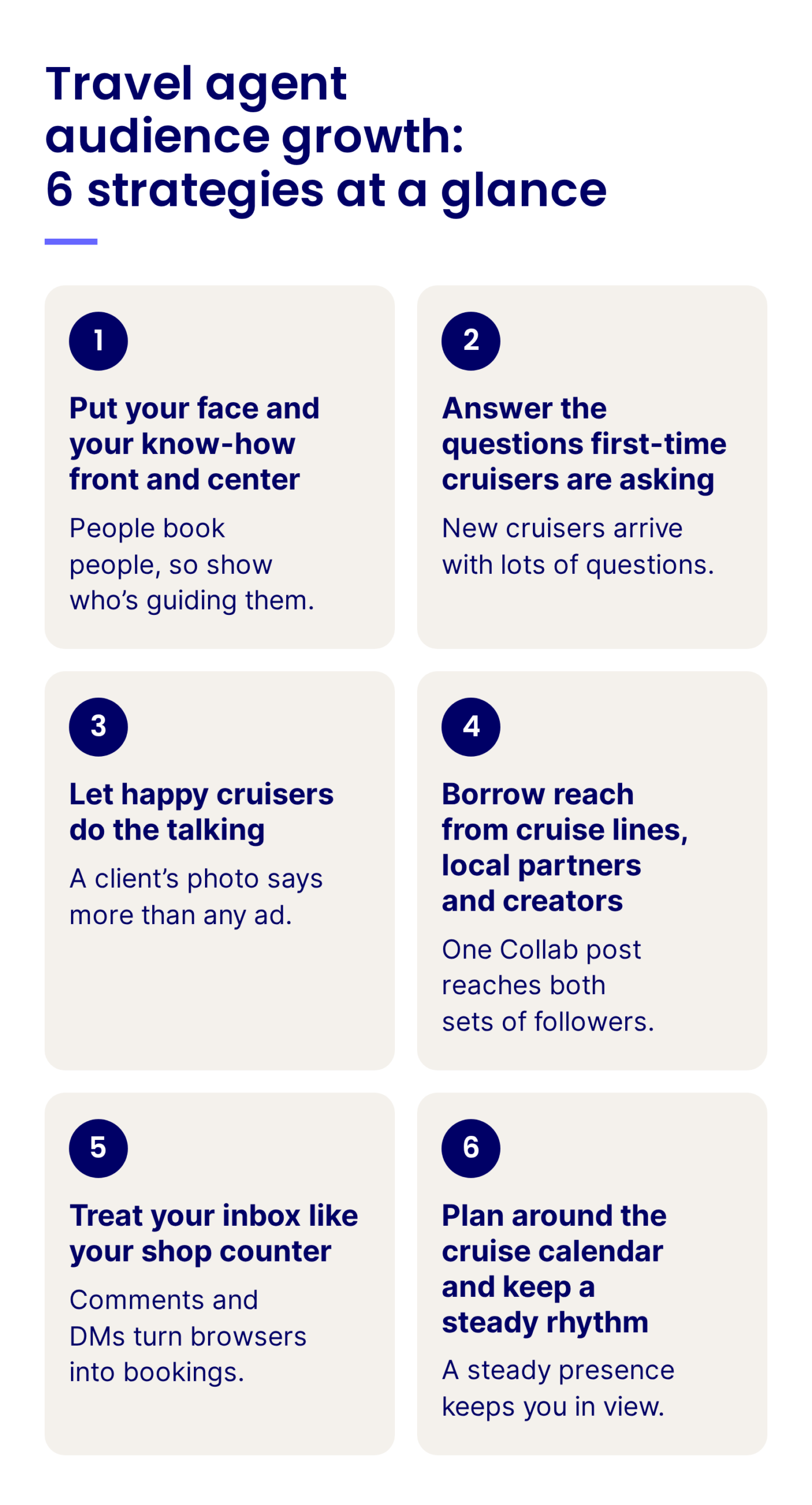
Travel agents grow their social media audience by showing the expert behind the bookings and answering the questions new cruisers ask before they book. Six strategies do the work: put your face and know-how front and center, answer first-time cruise questions, let happy cruisers do the talking, borrow reach from cruise lines and local partners, treat your inbox like your shop counter, and plan around the cruise calendar.
More people went cruising in 2025 than in any year before, many of them new to it and younger than the brochure suggests. When they start looking for someone they trust to help them book, social media for travel agents is how they find you.
In a survey by insurer Markel Direct, 84% of UK small business owners and tradespeople who use social media for their business said they win some work there, and six in 10 could point to a job won from a single post.
This guide walks through six strategies, each sized for one agent or a small team:
The examples focus on cruise, where an agent’s advice counts most, though most of it works for any holiday you sell. It’s written in plain words for high street agents, homeworkers, independent agencies and branch teams.
You’ll also find channel advice, what to post at each booking stage, where AI helps, what to measure and a 30/60/90-day plan.
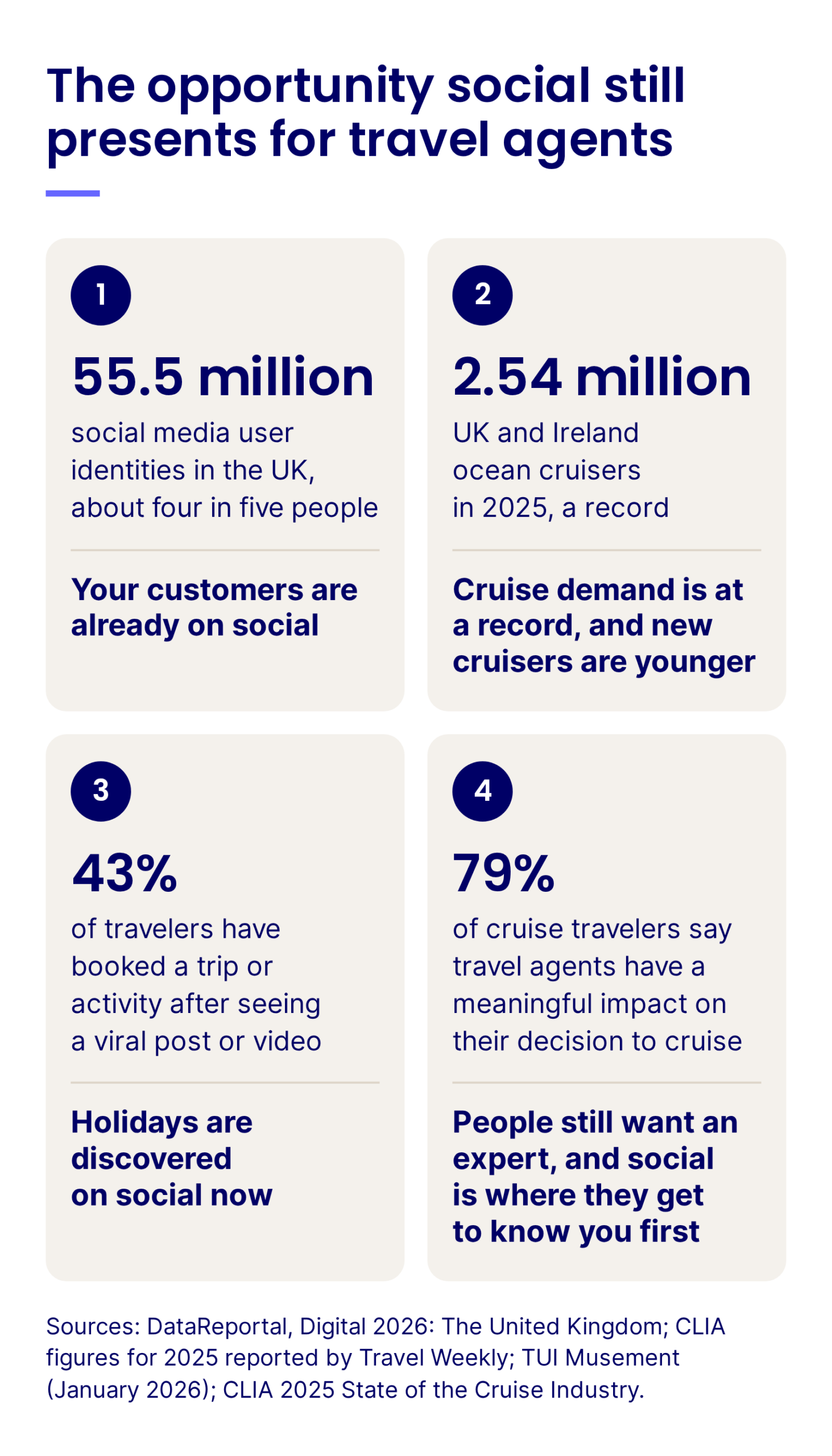
Four trends make the case that social media still offers travel agents a real and growing opportunity.

1. Your customers are already on social. In the UK, DataReportal counts 55.5 million social media user identities, about four in five people (an identity is an account, and one person can have several). Worldwide, DataReportal counts 5.79 billion, with 294 million added in a single year. Whoever your next cruise client is, the odds are they’re already scrolling.
2. Cruise demand is at a record, and new cruisers are younger. A record 2.54 million people from the UK and Ireland took an ocean cruise in 2025, according to CLIA figures reported by Travel Weekly. Worldwide, passengers reached a record 37.2 million, and about one third of cruisers are under 40, according to CLIA’s State of the Cruise Industry report. For younger cruisers especially, CLIA notes that capturing and sharing the trip online is a big part of the appeal.
3. Holidays are discovered on social now. In a TUI Musement study across the UK, Spain and Italy, 43% of travelers said they had booked a trip or activity after seeing a viral post or video. Emplifi’s own data points the same way: Emplifi’s Social Media Benchmarks research found Instagram shares per reach rose by more than 150% in a year while median reach (how many people see a post) fell 30 to 40%. In plain words, people sending a post to friends and family now carries it further than the platform’s own reach does.
4. People still want an expert, and social is where they get to know you first. In CLIA’s State of the Cruise Industry report, 79% of cruise travelers said travel agents have a meaningful impact on their decision to cruise, and only friends and family have more sway. In ABTA’s Holiday Habits research, 41% of UK holidaymakers said they felt more confident having booked through a travel agent or tour operator, up on the year before.
The same four challenges come up again and again for small travel businesses. Each one has a practical fix.
Posting only deals and brochure images. Offers matter, and they deserve a regular place in your feed. When almost every post is a price and a stock photo of a ship, though, your page starts to look like everyone else’s, and followers have little reason to stop scrolling until the next sale. A mix of advice, stories and offers gives people a reason to stay.
No time, so posting happens in bursts. Clients come first, as they should. Social gets squeezed into quiet afternoons, so a page goes silent for three weeks and then posts five times in a day. A short, steady rhythm usually works best, and a little planning makes it possible.
The person disappears behind the logo. Many agency pages read like a company talking, even when the business is one person with 20 years of cruise experience. Your knowledge, your ship visits and your face are what set a local agent apart, and they’re often missing from the feed.
Messages wait, and leads go cold. A question about a cabin or a deposit arrives as a DM (a direct message, the private inbox on Instagram, Facebook or TikTok) on a Saturday night, and by Monday the person has booked somewhere else. When nobody owns the inbox, warm leads quietly slip away.
The six strategies below build on each other, and none of them needs a big budget. Start with one or two, and add the rest as they become habits.
People book people. A cruise has lots of moving parts, and most travelers want to know who is guiding them through it. In CLIA’s consumer research, 63% of people who had cruised in the previous 12 months used a travel advisor to book.
Social is the easiest place to show who that advisor is. Emplifi’s own consumer research backs this up: in Emplifi’s Digital Authenticity survey of 1,650 US and UK consumers, 93% said authentic engagement builds trust. On social, authentic usually means a real face and a real voice. Studio lighting is optional; a phone and a little confidence will do.
A few ideas that suit almost any agent:
Reels, Instagram’s short vertical videos, are a natural fit for all four, and the same clips work on TikTok and Facebook.
UK creators Ben and David talk straight to camera about their seven-night sailing from Southampton through the Norwegian fjords, in a Collab with Celebrity Cruises that the caption labels as an invited ad. Two people chatting in their cabin answer what viewers most want to know, what the trip felt like, and any agent can film the same kind of clip on a ship visit.
Try this: Film one 60-second ship or cabin tip this week and put your name in the first line of the caption. Then compare the comments and messages it brings with your last offer post.
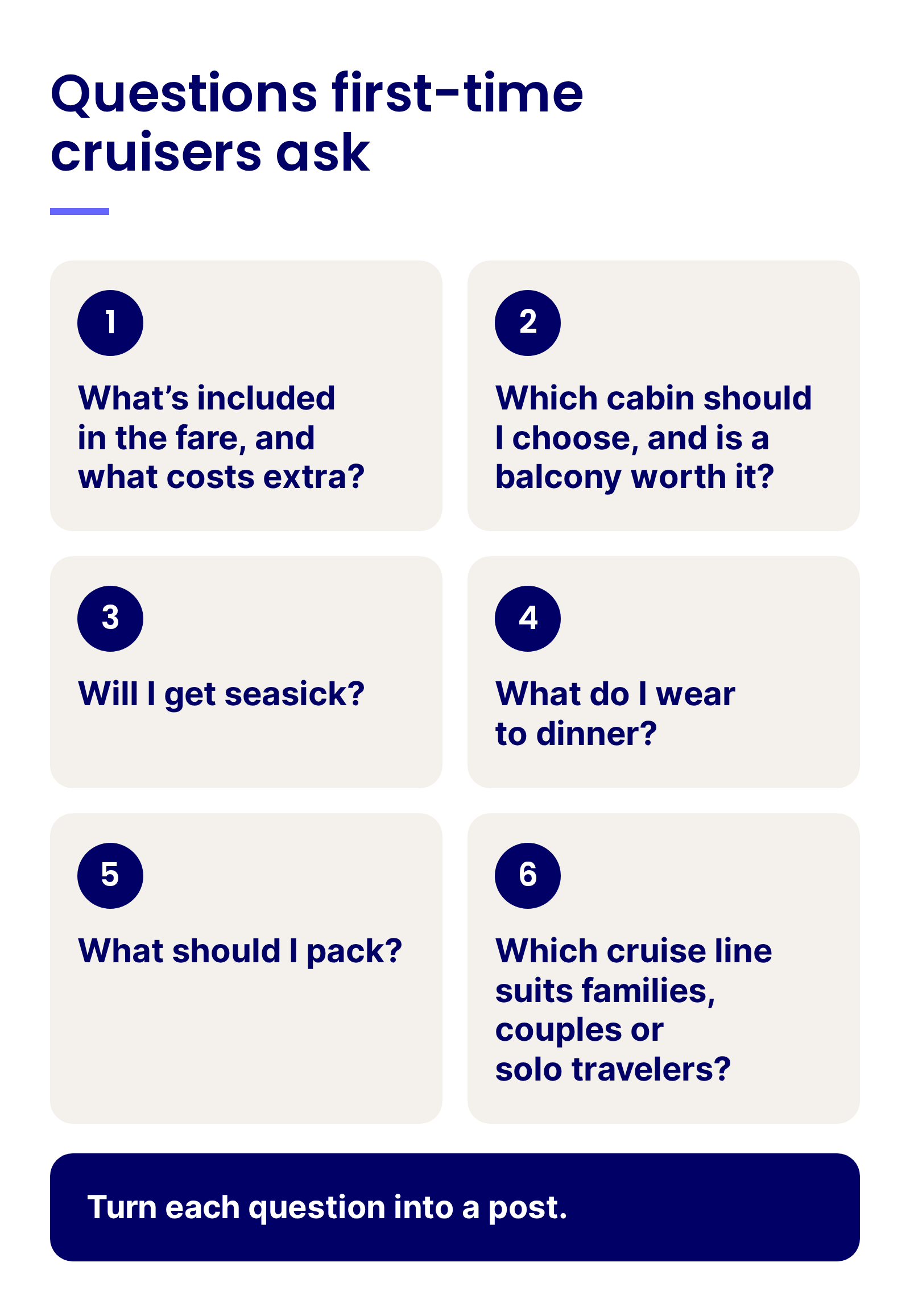
New cruisers arrive with lots of questions, and that is good news for an agent. In CLIA’s consumer research, about three in four people who have never cruised said they are open to taking a first cruise.
They all wonder about the same things, and the agent who answers clearly becomes the person they come back to:

Turn each question into a post. A Carousel (a post of several images people swipe through) works well for comparisons like inside, outside and balcony cabins, and a Reel suits anything people need to see, like the walk from cabin to pool.
Emplifi research: Emplifi’s Social Media Benchmarks found Reels and Carousels earn about 44% more engagement (likes, comments, shares and saves) than single images on Instagram.
Make posts people want to save and send. As the Emplifi benchmark finding above shows, a forwarded post keeps traveling, so aim for cabin guides people send to the person they’ll sail with.
Travel creators Charlotte and Cory list seven things that surprised them on their first cruise, a Mediterranean sailing with Princess Cruises, in a Collab post tagged #PrincessPartner. Each slide answers a worry a first-timer has before booking, and the closing question, “Have you cruised before?”, pulls other people’s experiences into the comments.
Your clients come home with hundreds of photos and plenty of stories, and many of them love to share. A TUI Musement study found 73% of travelers share their holidays on social at least occasionally. A client’s photo from their balcony in Santorini, with a line about how you found them that cabin, says more about your service than any ad.
Marketers call this user-generated content, or UGC: photos, videos and reviews made by customers rather than by the business. It carries real weight. Emplifi’s own Social Pulse survey of nearly 1,000 US social media users found 65% trust customer content more than influencer posts.
A simple routine keeps it friendly and fair:
Measure this: Each month, note how many client photos and reviews you collect, and ask every new client how they found you. A client story shared months ago often brings in bookings long after the post. Those two habits show whether happy clients are bringing you new ones.
P&O Cruises reposts a guest’s photos from a Norwegian fjord call and thanks her by handle in the caption. Naming her in the caption gives the guest a reason to share the post with her own followers, and shows other cruisers how to get featured.
You don’t have to build an audience on your own. Instagram’s Collab posts let two accounts publish one post together, so it appears on both profiles and reaches both sets of followers.
Emplifi research: In Emplifi’s analysis of Instagram collab posts, Travel & Hospitality stood out: nearly 60% of profiles in the sector publish a mix of their own collabs and ones they accept from partners, more than any other industry analyzed.
Three kinds of partner work well for a small agency:
Before you partner, check that their followers live near you or look like your clients, and agree in writing how each of you can use the content. If you pay a creator or give them a free or discounted trip, the UK’s CMA guidance for content creators and the ASA’s influencer guide say the post must be clearly labeled as an ad, and that responsibility includes you.
Kuoni and Bluewater shopping center in Kent co-author this Reel about what happens when you visit Kuoni’s store there. As a Collab post it reaches the shopping center’s local followers as well as Kuoni’s, the people most likely to walk in.
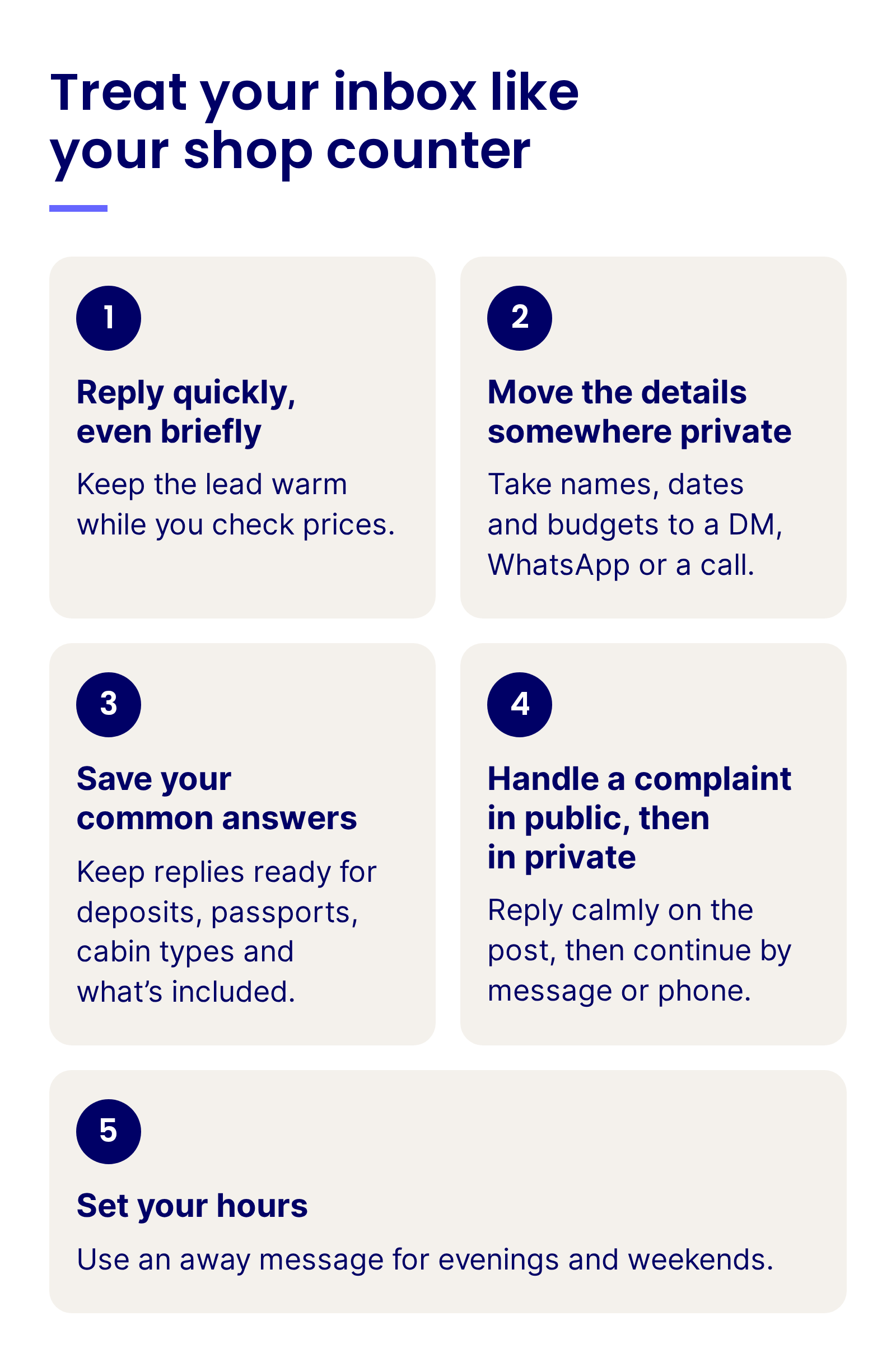
If someone walked into your branch with a question, you’d look up and say hello. Your social inbox deserves the same welcome, because comments and DMs are where browsers turn into bookings.
Emplifi research: In Emplifi’s Social Pulse survey of US consumers, 32% said they expect a reply to a direct message within one hour.
An hour is a high bar for a small business, so aim for a fast first reply and a clear next step. A simple routine that everyone in the business follows looks like this:

WhatsApp deserves a special mention. It’s the UK’s favorite social platform, according to We Are Social, and the free WhatsApp Business app adds a business profile, quick replies and away messages, which covers most of the routine above. Messages on WhatsApp, texts and social DMs all fall under the ICO’s electronic marketing rules, so only send offers to people who have asked to hear from you, or to past clients you’ve given a simple way to opt out.
Princess Cruises shares eclipse day at sea and closes with a single ask: send us a DM to explore the voyages. Posted on eclipse day itself, the DM ask catches people at the peak of their excitement and starts a private conversation that a person can turn into a booking.
Cruise has a rhythm of its own, and planning around it saves last-minute scrambling. People in the UK spend 16 hours and 13 minutes a week on social media, according to We Are Social, so a steady presence keeps you in view between the big moments too.
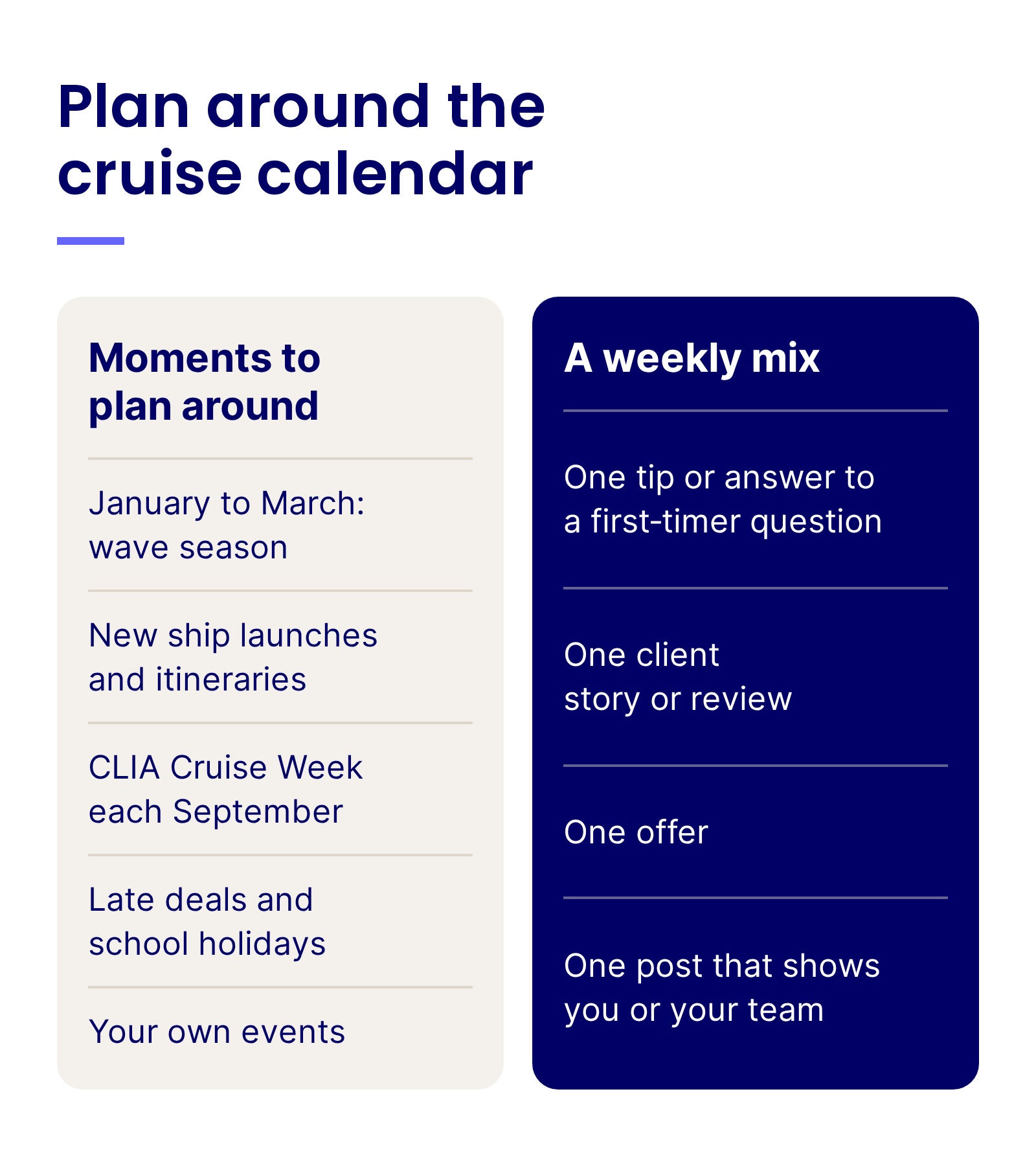
The moments worth marking on your calendar:
As Andy Harmer, managing director of CLIA UK & Ireland, has said of the week: “Even small activities can have a real impact.”
P&O Cruises gives four plain reasons to book next year’s cruise now, from a better choice of cabins to spreading the cost. Every reason is practical, and the pay-monthly point answers the cost worry before anyone has to ask.
Batching keeps a steady rhythm manageable: set aside one afternoon a month, draft the month’s posts and schedule them with the free planner Meta offers for Facebook and Instagram pages. A simple weekly mix looks like this:

Reuse what cruise lines publish, too: share a line’s new-ship video with your own take on who you’d book on it. An AI writing tool speeds up the captions, as the AI section below shows.
MSC Cruises counts down to the first sailing of its new ship, MSC World Asia, with a six-months-to-go Reel. Framing the launch as a countdown turns one announcement into a run of reminders, each a ready-made post an agent can share with a note on who the ship suits.

You don’t need to be everywhere. Most small agencies do best with two or three channels done well. The table maps each channel to its main job, the formats that work and a common pitfall to watch for.
| Platform | Main job | Best formats | Common pitfall |
|---|---|---|---|
| Inspiration, ship and cabin tours, client stories | Reels, Carousels, Stories, Collab posts | Posting only brochure images and price graphics | |
| Facebook, including groups | Local community, events, recommendations | Posts, events, local groups, live Q&A | Leaving comments and recommendations unanswered |
| TikTok | Reaching newer and younger cruisers | Short phone-shot tips, cabin tours | Copying trends with no cruise advice in them |
| Conversations that turn into bookings | Business app chats, a Channel for updates | Sending offers to people who never asked for them | |
| YouTube | Longer ship tours and explainers | Ship walkthroughs, Q&A videos | Filming once and never updating |
| Google Business Profile and reviews | Being found and trusted locally | Reviews, photos, updates | Leaving reviews without a reply |
Instagram is the natural home for cruise inspiration. Stories (short posts that disappear after 24 hours) suit quick updates from a ship visit, while Reels and Carousels carry your tips. Pin your first-timer guide, a client story and how to book with you to the top of your profile, so new visitors see the best of you first.
Facebook is often where your local community already gathers. In the UK it drives 69% of the website visits that come from social media, according to We Are Social, so link posts to your offers page. Local groups and your own event listings bring in people nearby, and a monthly live Q&A on cruise questions is a friendly way to meet them.
TikTok reaches the newer, younger cruisers CLIA describes. Hashtags like #CruiseTok and #CruiseLife have collectively drawn hundreds of millions of views, CLIA notes, and short, honest videos fit the platform well: a cabin tour, a packing tip, a port you love. Being useful and being yourself is what works there.
WhatsApp is where conversations become bookings. People in the UK open it 17.5 times a day on average, according to We Are Social. Use the Business app for one-to-one chats, and consider a WhatsApp Channel (a one-way broadcast people choose to follow) for offers and news, so you only message people who asked to hear from you.
YouTube suits longer ship tours and the answers people watch before they commit. The average UK session on YouTube lasts 10 minutes 20 seconds, the longest of the major social apps, We Are Social reports. A 10-minute walkthrough of a ship you know well keeps working for months.
Your Google Business Profile is your shop window in local search. When someone searches for a cruise travel agent near them, your reviews, photos and opening hours appear alongside the map, so ask happy clients for a review and reply to every one, good or bad. For an independent agent, a Google Business Profile that shows reviews, photos and opening hours next to the map is often what tips a local searcher into calling rather than booking online.
A cruise booking happens in stages, and people need different things at each one. The table maps what to post at each stage, and where.
| Stage | What the traveler needs | What to post | Where |
|---|---|---|---|
| Dreaming | Ideas and a reason to look closer | Ship and port Reels, client stories | Instagram, TikTok |
| Researching | Clear answers to first-timer questions | Carousels, Q&A videos, cabin guides | Instagram, YouTube, Facebook |
| Comparing and deciding | Proof, and a person to trust | Reviews, client stories, fast replies to questions | Google, Facebook, DMs |
| Booked and counting down | Reassurance and excitement | Packing tips, countdowns, pre-cruise hotel and excursion ideas | WhatsApp, Instagram Stories |
| Back home and rebooking | A reason to sail again with you | Welcome-home messages, review requests, next-trip ideas | WhatsApp, email, Facebook |
Dreaming often starts with a single post someone stumbles on. Researching is where people dig in, and younger cruisers are especially thorough. “These guests are doing their homework; they’re exploring social media, reading reviews, and leaning into peer recommendations before they ever hit ‘book now,’” Stephen Hopkins, vice president of growth at Virgin Voyages, told CLIA.
When people compare, they also watch how you treat others. Emplifi’s Social Pulse survey found 58% of US consumers say it’s important to see brands respond to customers on social media. After booking, there’s often more to offer. In CLIA’s cruise research, 64% of recent cruisers stayed at least one night in the port city before or after their cruise, so a countdown post about pre-cruise hotels is helpful and good business.
Back home, the relationship pays off. Nearly 90% of cruisers say they intend to sail again, the highest level CLIA has recorded, according to its latest State of the Cruise Industry report. A welcome-home message, a review request and a first idea for next year keep you as the person they book with.
Travelers are starting to plan with AI. ABTA’s Holiday Habits research found the share of UK holidaymakers using AI for holiday inspiration doubled in a year to 8%, and reached 18% among 25 to 34 year olds. Internet search and recommendations from friends and family are still the most common ways people choose, and a personal recommendation is exactly what an agent offers.
Customers are open to AI help in travel, as long as a person is close by. Emplifi’s own AI in Social Media: Consumer Expectations survey of nearly 900 US consumers found 39% named airlines and travel booking among the industries where AI-powered customer service would most improve their experience. The same Emplifi research found 47% would rather wait longer for a more human, empathetic response.
For a small agency, AI works best as a drafting helper:
Some things stay with you, because they’re the reason people book with an agent:
Be open about it, too. Emplifi’s Digital Authenticity research found 91% of US and UK consumers expect brands to disclose AI use in marketing. A short line is enough, such as “I use AI to help draft some posts, and every recommendation comes from me,” and any AI-generated image deserves a clear label so nobody mistakes it for the real ship.
Princess Cruises announces that travelers can now explore its cruises inside ChatGPT. The slides walk through real requests and answers, such as a week in Alaska from Seattle, so followers see exactly what the AI does before they try it.
You don’t need a dashboard. A few numbers, checked once a month in a notebook or a simple spreadsheet, tell you what’s working:
Judge by the trend over three months, since a single great week can mislead.
If you’re part of an agency group or a head office team that tracks more, Emplifi publishes quarterly social media benchmarks by industry and region, which show how brands in each sector perform on each platform.
The challenge. TUI fly Belgium, a Belgian leisure airline and tour operator brand, was losing hours to manual reporting, and choosing which posts to boost with paid budget was, in the team’s words, a guessing game.
What they did. Automated reporting turned a four-hour job into seconds, and Emplifi’s AI-powered Performance Prediction showed which posts were already resonating, so the team put its budget behind those.
TUI fly Belgium lets its cabin crew’s own selfies tell the story, with a thank-you to the crew member who took them. Photos the crew took themselves put real faces on the airline, and a post that already draws likes and comments on its own is the natural candidate for a small boost.
The result. According to the customer story, reporting time fell by 75%, comments on boosted posts rose by 150%, and cost per engagement (what the team paid for each like, comment or share) dropped by 81.5%.
The lesson for a small agency. When you have a little money to promote a post, put it behind one that’s already earning saves, shares and messages on its own.
First 30 days: look and set up
The first month is about seeing what you already have and getting the basics in place.
Days 31–60: build the habit
With the basics done, the second month is about publishing things people come back to. Each item below exists by day 60.
Days 61–90: grow and repeat
The third month turns what worked into a routine you can keep.
What wins cruisers over is personal and practical: a tip filmed on a ship visit, a client’s photo shared with permission, a quick reply on a Saturday night. Start with the first 30 days of the plan above and build from there.
For agency groups and franchise networks running many branch accounts, Emplifi Publisher keeps every branch on one shared calendar, and Emplifi Community brings comments and messages into one inbox.
The opportunity social offers travel agents is real, and it’s still growing. The agents who show up, helpfully and as themselves, are the ones people book.
See how your travel brand’s engagement and content mix compare to the Travel & Hospitality brands in Emplifi’s benchmark set. Get your free social media assessment.
Already an Emplifi customer? Talk to your Customer Success Manager.
Travel agents grow their social media audience by showing the person behind the business and answering the questions new cruisers ask. Short videos from ship visits, clear first-timer guides, client photos shared with permission, Collab posts with cruise lines and local partners, fast replies in the inbox and a steady posting rhythm built around the cruise calendar do most of the work.
Yes, social media is still worth it for travel agents, because the audience keeps growing, cruise demand is at a record and many travelers now discover holidays on social. Most cruisers still value an agent’s advice, and social is where they get to know you first. In a UK survey of small business owners and tradespeople who use social media for their business, most said they win some of their work there.
The simplest way to sell cruises on social media is to help first and offer second. Answer first-time cruiser questions in Reels and Carousels, show your own ship visits, share happy clients’ photos with permission, and reply to messages quickly. As a rule of thumb, make about one post in four an offer, timed around wave season, launches and late deals, and move interested people to a DM, WhatsApp or a call.
A good week of social media for travel agents includes one helpful tip or first-timer answer, one client story or review, one offer and one post that shows you or your team. Batch the posts in one afternoon a month, schedule them, and spend a few minutes each day replying to comments and messages, which is where many bookings start.
A travel agent Instagram account works best with short Reels from ship visits, Carousels that answer one cruise question each, client photos shared with permission and the occasional offer. Pin a first-timer guide, a client story and how to book with you to the top of your profile, and use Collab posts with cruise lines or local businesses to reach new followers.
Cruise social media takes a small travel business around one afternoon a month to plan and schedule posts, plus a few minutes a day for replies. Film short clips on ship visits and fam trips as you go, reuse cruise line content with your own commentary, and let an AI tool draft captions that you then rewrite. A few steady posts a week is plenty.
Yes, travel agents can use AI for social media as a drafting helper for captions, saved replies and post ideas, as long as a person checks every fact. Recommendations, prices, health and travel document questions and complaints stay with the agent. It’s also good practice to say plainly when AI helped and to label any AI-generated image.
Discover what Emplifi can do for you. We turn small teams into large ones, and large teams into well oiled machines, but either way, we offer the rocket ship, you just need to jump on.