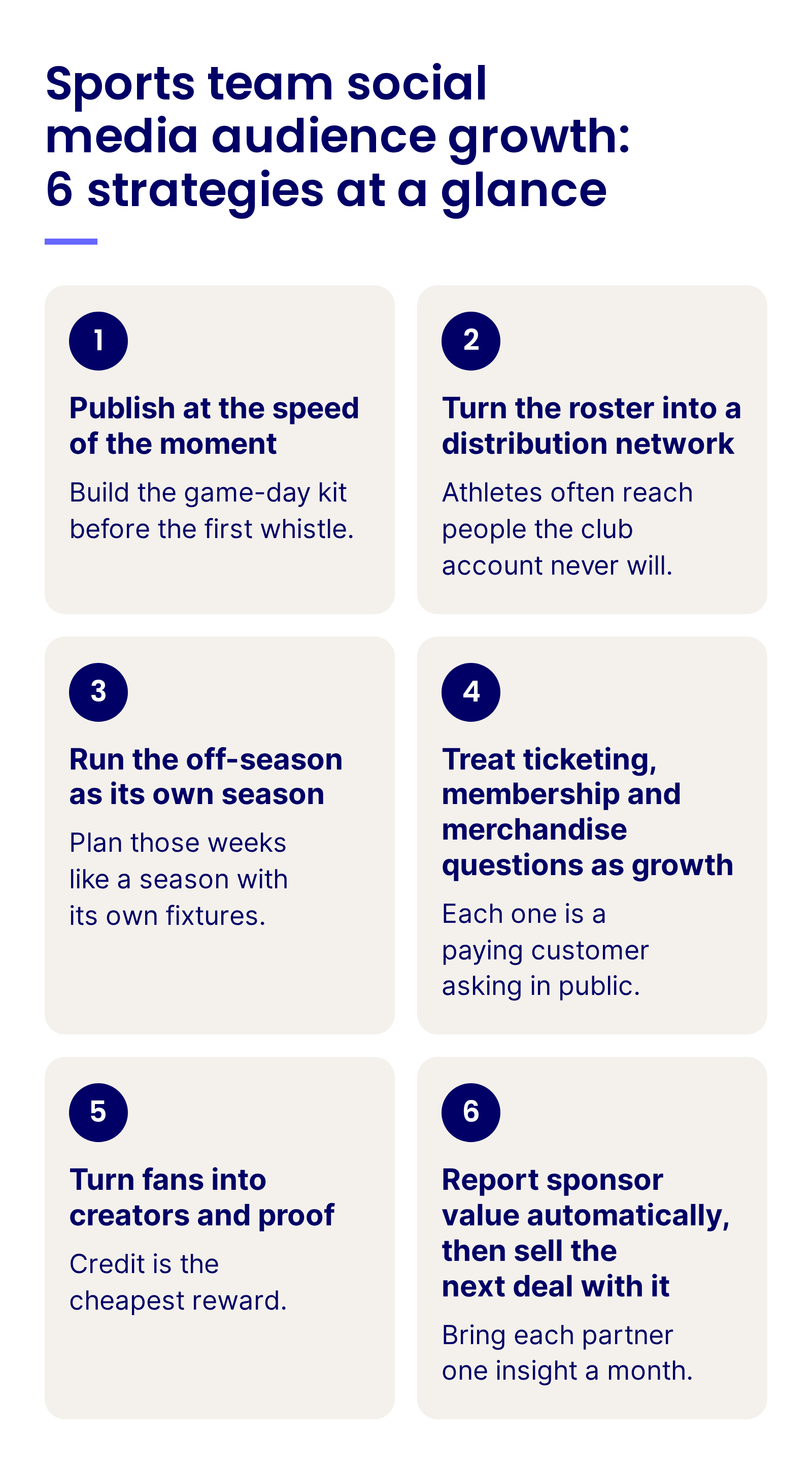
Sports team social media audience growth comes from turning the spikes around every game, fight or race into followers who stay all year. Six strategies help: publish at the speed of the moment, turn the roster into a distribution network, run the off-season as its own season, treat ticketing, membership and merchandise questions as growth, turn fans into creators and proof, and report sponsor value automatically.
The winning score comes with seconds left on the clock. Within a minute, the club’s mentions start to climb, the scorer’s own account fills with replies, and a fan asks in the comments whether there are still tickets for the next home game.
For the next hour, that account has the attention of people who don’t follow it yet. Sports teams start with fans who already care, so the work is to be ready when the moment comes and to give the new arrivals a reason to stay after the final whistle.
Most clubs, leagues and sports brands already have the passion, and the accounts that keep growing prepare around it. Emplifi customer UFC, for example, uses a leaderboard that shows which fighters are gaining traction, so its team can push the right fighter in the right market.
This guide is for social media, digital content and fan engagement leaders at clubs, leagues and sports organizations, and for the agencies that work alongside them.
Four realities of the sports calendar shape what works on social.

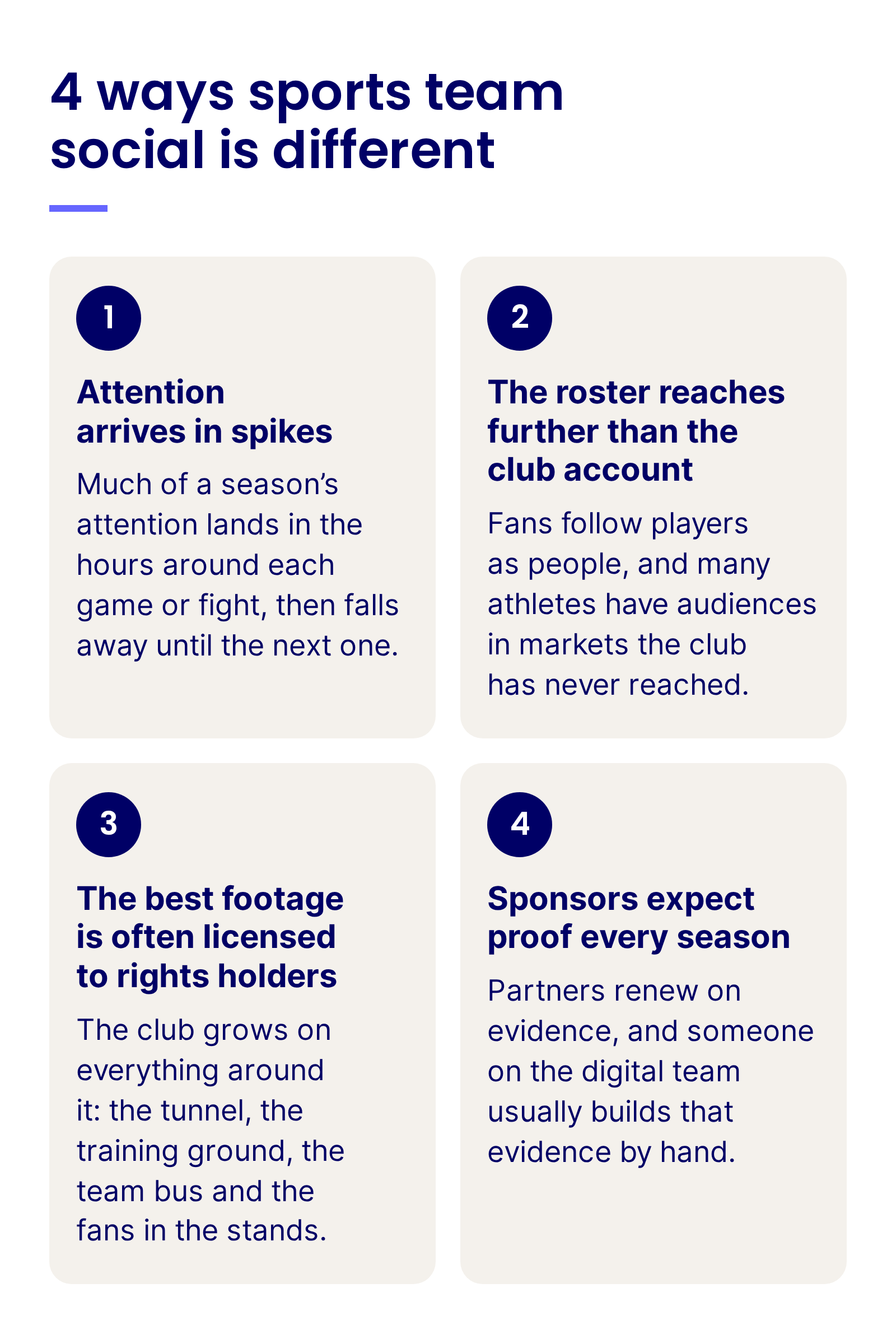
1. Attention arrives in spikes. Much of a season’s attention lands in the hours around each game or fight, then falls away until the next one. For its Global Fan Report, Emplifi tracked more than 20 million public conversations across X, Instagram, Facebook and YouTube during a single global football tournament, and a team that is ready in those windows reaches people who don’t follow it yet.
2. The roster reaches further than the club account. Fans follow players as people, and many athletes have audiences in markets the club has never reached. That reach moves when a player is traded, transferred or retires, so the club earns it again every season.
3. The best footage is often licensed to rights holders. Broadcasters and leagues frequently hold the rights to game action, so the club grows on everything around it: the tunnel, the training ground, the team bus and the fans in the stands.
4. Sponsors expect proof every season. Partners renew on evidence, and someone on the digital team usually builds that evidence by hand, partner by partner, while the season is still running.
See how Emplifi helps sports teams publish fast, answer fans and report partner value from one place.
These stuck points usually come from how the work is split between content, partnerships, ticketing and the players’ own teams, which makes them fixable.
Game-day posts wait for approval. The result is in, but the graphic needs a sign-off from someone who is watching the game, and by the time it posts the feed has moved on.
Players and the club post separately. An athlete shares a great moment on their own account and the club reposts it hours later, so each audience sees only half of the story.
The off-season gets whatever is left. Content plans follow the fixture list, so the weeks without games get a countdown graphic and old highlights, just when other teams and other sports are courting the same fans.
Ticket and shirt questions get lost in the noise. On an on-sale morning, a fan whose checkout failed waits behind hundreds of reactions to the latest signing, and the answer arrives after the seats are gone.
The first two strategies carry most of the growth on game days, and the other four keep it going between them.
The minutes after a goal, a knockout or a buzzer-beater are the cheapest reach a sports account will ever get, and they fade fast. Teams that win those minutes decide almost everything before the game starts, so the person in the window only has to fill in a template and press publish.
Paris Saint-Germain works this way. In Emplifi’s interview with the club’s Digital Content Analyst, the team describes preparing for several outcomes with pre-approved templates, so that “no matter what happens on the pitch, our response is instant and authentic.”
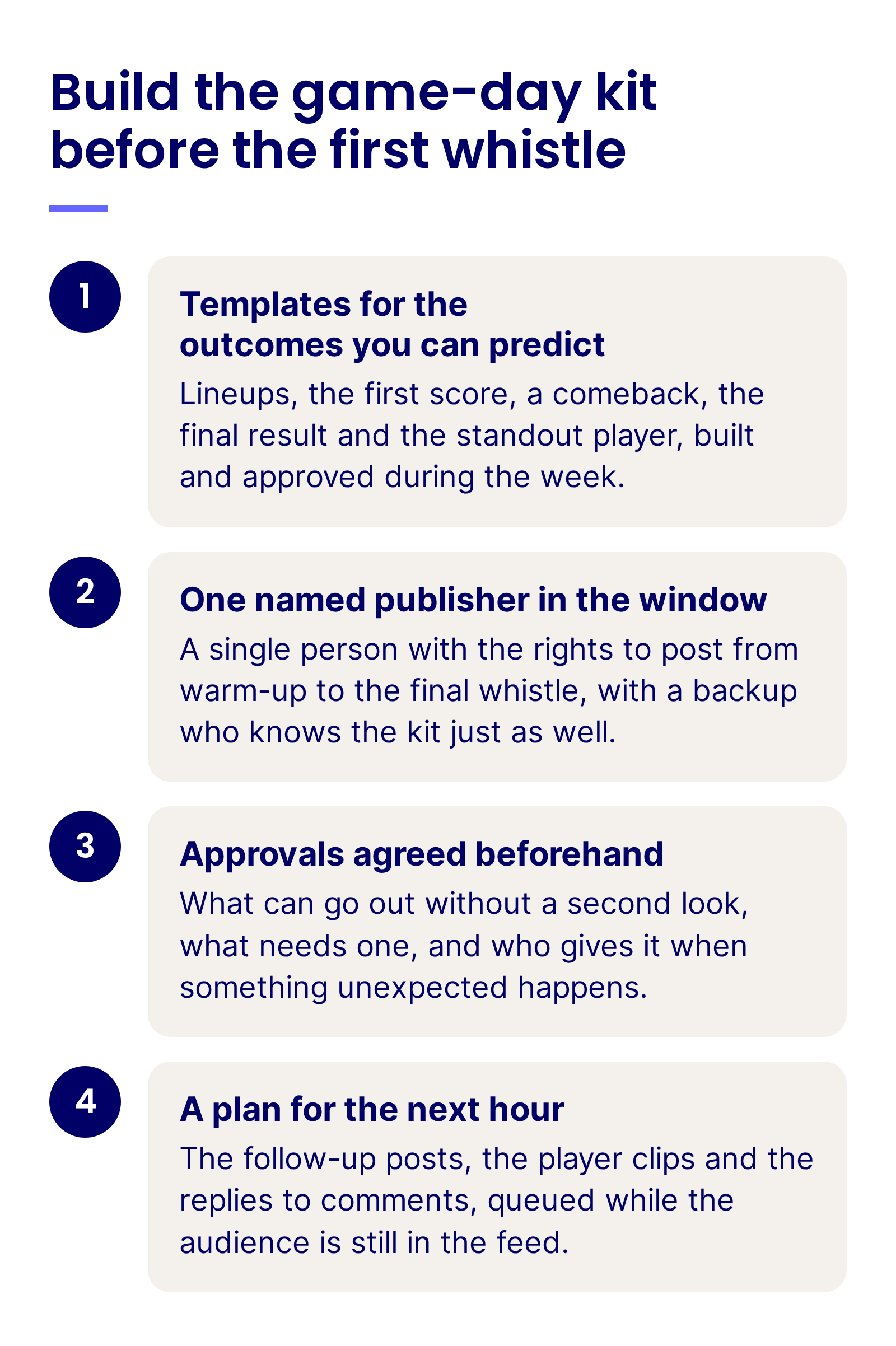
Build the game-day kit before the first whistle. It holds four things:

The same kit works for a signing, a contract extension or a draft pick, moments fans also follow as they happen. Add a co-author slot to each template too, so the player’s account can publish the post with the club.
UFC Canada and Michael Malott co-publish his flag-draped celebration on the night of his main-event win, while fans are still reacting to it.
Speed lands best in a voice fans recognize, and for many teams that voice is funny. Emplifi’s Marketing Across Generations research found that “Gen Z craves interactive and entertaining content,” and Natascha Sturm, Senior Data Analyst at Emplifi customer G2 Esports, puts the team’s social presence in plain terms: “It’s how we connect with and entertain our fans, in addition to memeing ourselves and our competition.”
Wrexham AFC shows how little a playful post needs. A light pun before a game needs no result and no footage, and it still sounds like the club.
Wrexham AFC introduces a player named Ollie to a dog in a club shirt called Ollie Dogbone, a pun that works before a ball is kicked.
Write down what the club jokes about and what it never jokes about, then put caption options in that voice into the kit, so the publisher never has to be funny on demand:
Try this: Build the kit for your next three home games, then compare the time from the final whistle to the result post with the three games before.
Athletes often reach people the club account never will: fans in their home country, followers of their own sponsors, friends who came for the person and stayed for the sport. The simplest way to share that reach is an Instagram Collab, where one post appears on the club’s account and the athlete’s at once.
Emplifi’s analysis of Instagram collaborations found that “collab posts generate more shares and reposts across every vertical analyzed,” and that “the biggest gains come from accepted collaborations, where a creator or partner publishes the post and invites the brand to join as a co-author.” For a team, that often means letting the player publish and inviting the club in.
The Arizona Cardinals and kicker Chad Ryland co-publish his game-winning kick as the game ends, so the moment reaches the team’s fans and his own followers at once.
Then decide which player to push, and where. Rank athletes by audience growth and by market as well as by their sporting profile, and match each one to the market you want to grow: a homegrown player for the local audience, an international signing for the country they come from. Emplifi’s guide to social listening in sports marketing explains how listening surfaces “real-time shifts in fan sentiment during key moments,” and the UFC case below shows how a leaderboard makes the call quicker.
Watch the sentiment around each player as well as the traction, so the club sees early when a name is drawing abuse or controversy, before it puts more reach behind them.
UFC and Jasmine Jasudavicius publish her win as a Collab, so one post reaches both audiences, and the caption asks fans who she should face next.
Give players a reason to say yes:
Measure this: Track follower growth in each target market in the week after a Collab, next to the same market’s growth in weeks without one.
Attention can drift in the weeks when the account posts a countdown graphic and last season’s highlights, and for a combat sport, a tour or an esports team the same gap opens between events.
Plan those weeks like a season with its own fixtures. A weekly series that needs no game footage gives fans something to come back for: the academy, the kit room, the community work, a player’s life away from the stadium, archive stories told by the people who were there. In the same PSG interview, the club says collaborations beyond football, in music, fashion or lifestyle, “often resonate even more with fans during the off-season,” and that “some non–match content has outperformed match-day posts.”
G2 Esports tours the creator villa where its team makes content between competitions, a behind-the-scenes series that keeps the feed personal without any game footage.
Interactive formats keep the conversation two-way when there is no result to talk about: polls on the new kit, quizzes on club history, a player answering questions live. They also give the quiet weeks a reason to open the app.
The Atlanta Hawks line up their jerseys in a grid and ask fans to pick only one, a simple question that fills the comments with friendly debate.
Emplifi’s session on understanding the summer sports audience is worth an hour before the quiet weeks, because it shows how to read spikes in fan sentiment when other sports fill the calendar.
Map the quiet weeks before the season ends. The draft or transfer window, the kit launch, a preseason tour and the community calendar give most weeks an anchor moment, and the series fills the gaps around them, so the plan is ready on the first day after the last game.
Give the off-season its own targets, measured against your in-season average, and report them weekly, so the quiet months get the same attention in the review as the busy ones.
Some of the most valuable messages a team receives arrive on its busiest days: a season ticket holder whose seat has moved, a fan whose checkout failed on an on-sale morning, a parent asking whether the shirt will arrive before a birthday. Each one is a paying customer asking in public, and Emplifi’s Social Pulse research found 32% of consumers expect a direct message response within one hour.
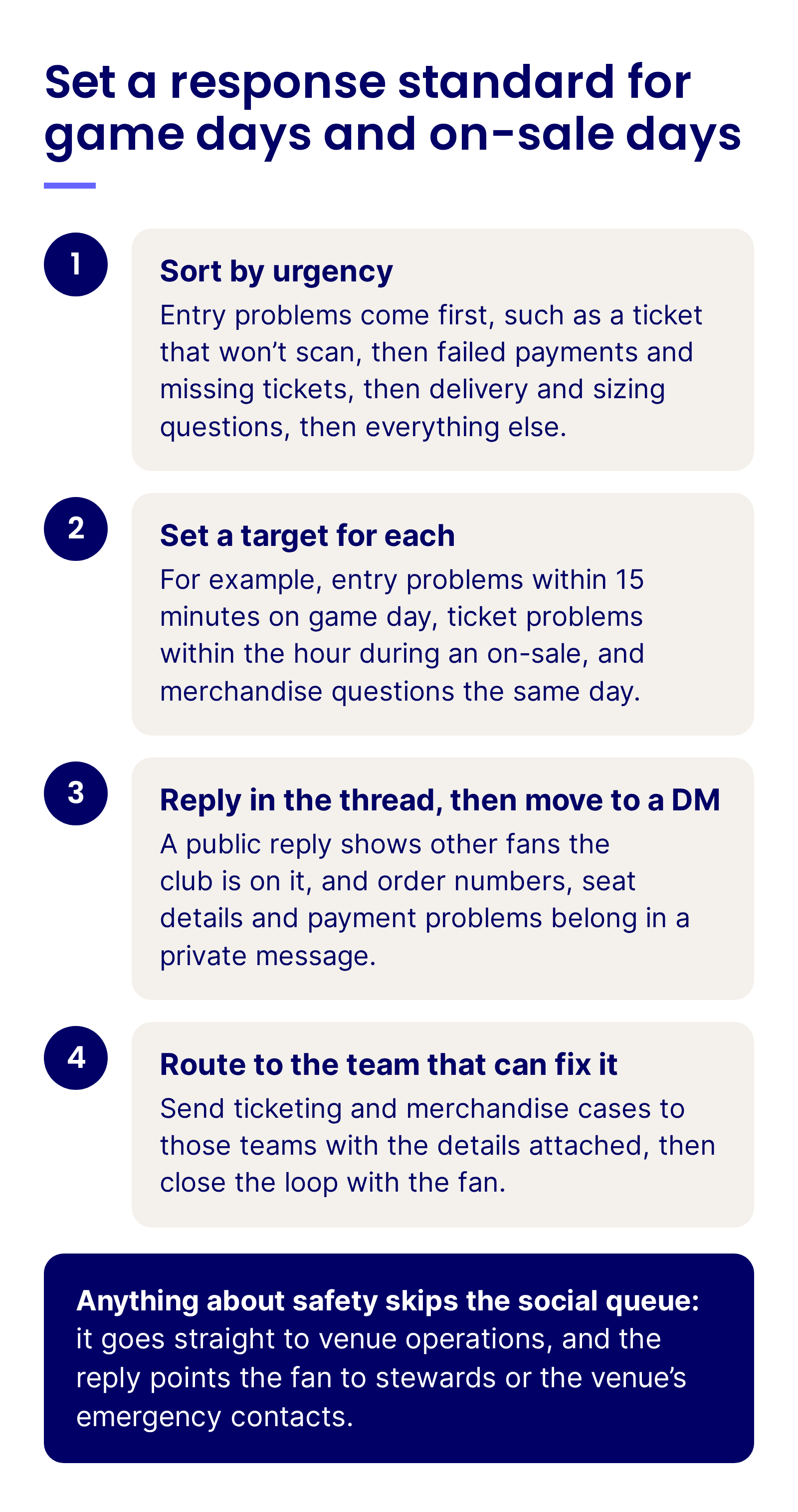
Set a response standard for game days and on-sale days, and staff it to those hours:

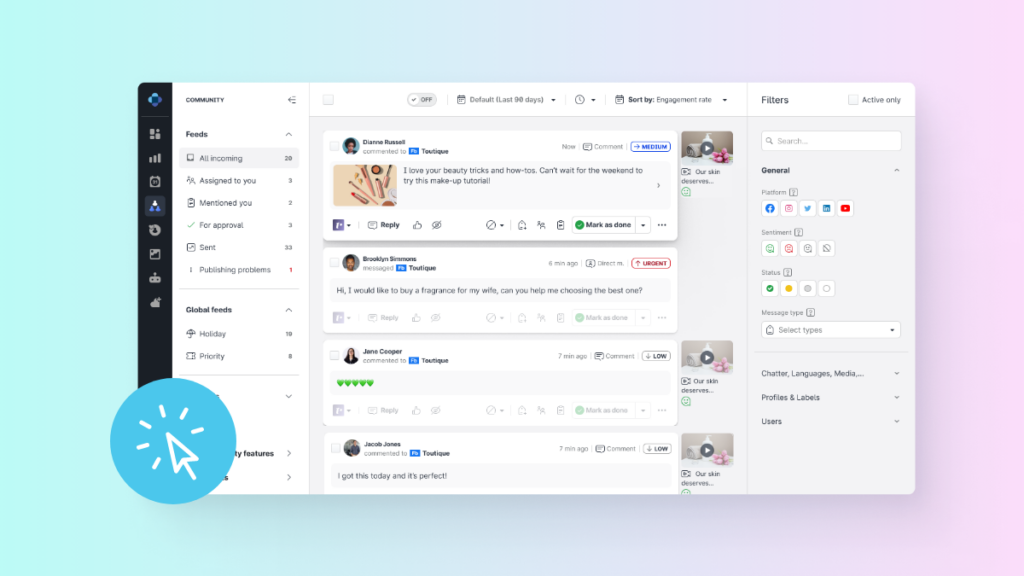
Emplifi Community brings comments, DMs and mentions into a shared inbox, so the standard is visible to everyone who answers.
The Unified Inbox product tour walks through managing comments, DMs and mentions from every channel in one place.
Agree in advance which messages become a case for the ticketing or merchandise team, and keep the commercial questions apart from the banter. A comment about the referee can wait until the morning, and a fan stuck outside the stadium gate gets an answer first.
UFC opens ticket sales for its last card of the year with the fight card and the date on the image and a link in bio, so the on-sale post doubles as a preview.
Every on-sale and merchandise post is also a sales post, so make it traceable. Give each one a tracked link, keep a link-in-bio page with the next home games and the latest drop, and flag the fans who comment and share most for the season-ticket renewal campaign. Shape the offer for the fan who sees it, too: in Emplifi’s Marketing Across Generations research, 34% of Gen Z said they are more likely to purchase when content feels targeted to their generation.
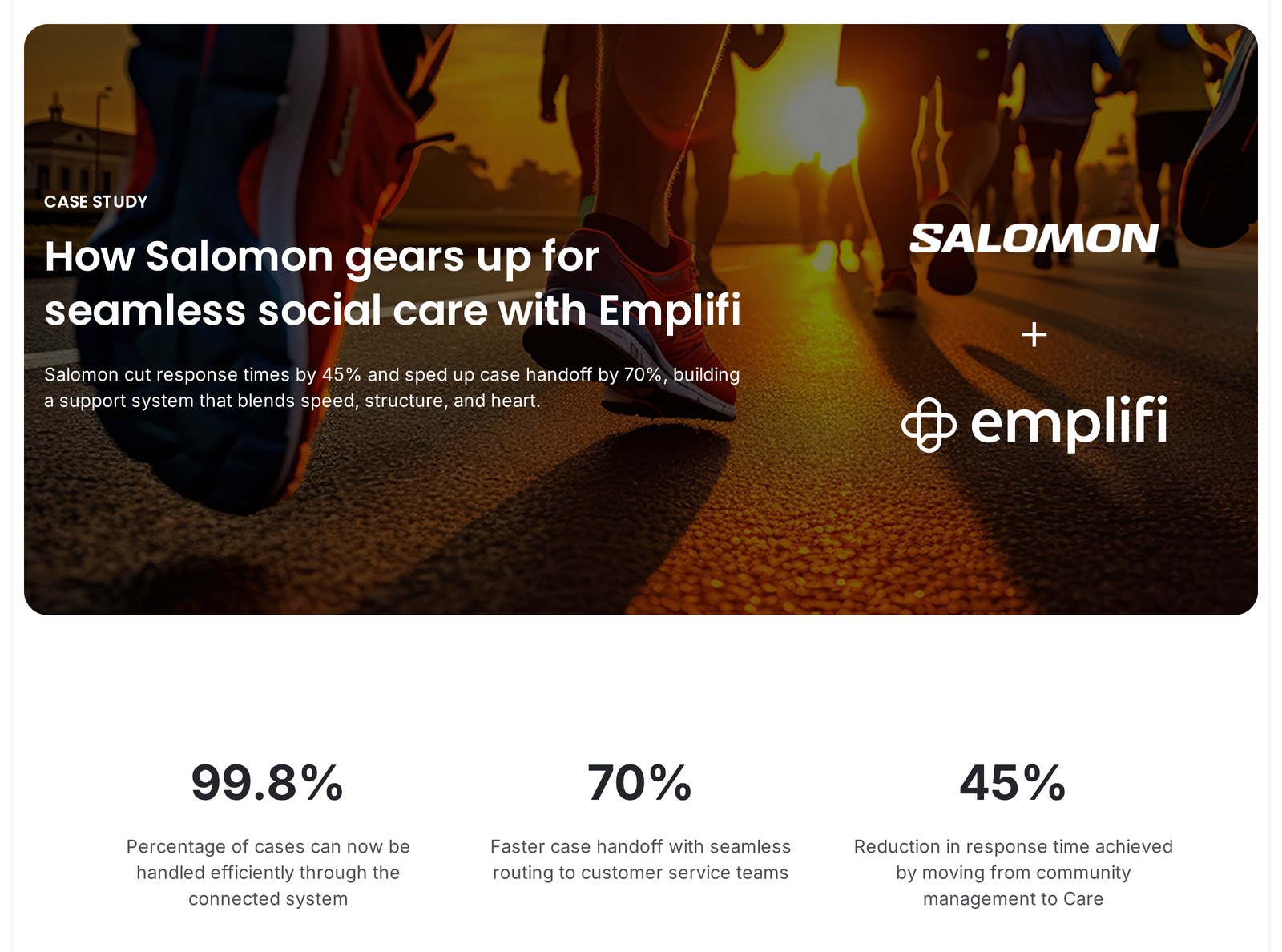
Salomon, the outdoor and sports gear brand, faces the same routing problem with more than 80 social media channels connected to Emplifi, even though it isn’t a team. It moved from community management to Emplifi Care, so questions about warranties or product availability go straight to the right support team.

The Salomon customer story on emplifi.io.
Its social CX playbook explains how the team keeps that support fast and personal across its accounts.
Salomon: A 45% reduction in response time after moving from community management to Emplifi Care, with case handoffs 70% faster.
If an agency or a ticketing partner answers some of these messages, write the standard into its brief and ask for the same weekly report.
Measure this: Track first response time for ticketing and merchandise messages on their own, looking at on-sale mornings and the hour after each game separately, and track ticket and merchandise sales from those tracked links by post and by account.
Fans film the walk to the stadium, the songs in the stands, the view from the upper tier and the first game in a replica shirt. Most of it never reaches the club’s channels, because nobody asked.
Ask for rights when you find a post worth using, with a short comment that links to the terms and a reply to confirm. Once a fan agrees, tag the post by game, section and theme, so it can appear in the game recap, the membership campaign and the end-of-season video. Keep a record of each permission, with the post, the date and where it can be used, so a clip from this season can return in next season’s ticket campaign without a second request.
Take extra care with images of children and young fans: ask for a parent’s or guardian’s permission, leave out names and other identifying details, and crop the image or skip it when you are unsure.
A fan campaign gives people a reason to post in the first place. Give it one hashtag, one clear ask and a reward fans value, such as a feature on the main account, a signed shirt or a place at an open training session.
The NHL shares painted pumpkins of a team’s mascot and players under a seasonal hashtag, credits the artist in the caption and asks fans to pick a favorite.
Credit is the cheapest reward. Tag the fan creator, keep their words where you can and give them reach, and the next post often arrives without asking. Some fans grow into creators with real audiences; treat them as partners, with a brief and a clear #ad label when money or tickets change hands.
The Arizona Cardinals make their costumed fans the stars of a game-day carousel, captioned “Best fans in the best place.”
Build part of the fan content around identity as well as results: the city, the colors, the songs, the family tradition of going to games together. That content still works after a losing run, when highlight posts are hard to find.
Try this: Pick one home game and ask for rights on the 25 best fan posts from the stands. Use the approved ones in the recap and compare its engagement with your last three recaps.
Sponsor reporting is often treated as a cost of doing business. Built by hand, it arrives late and eats the social team’s week. Built automatically, it becomes something the commercial team sells with.
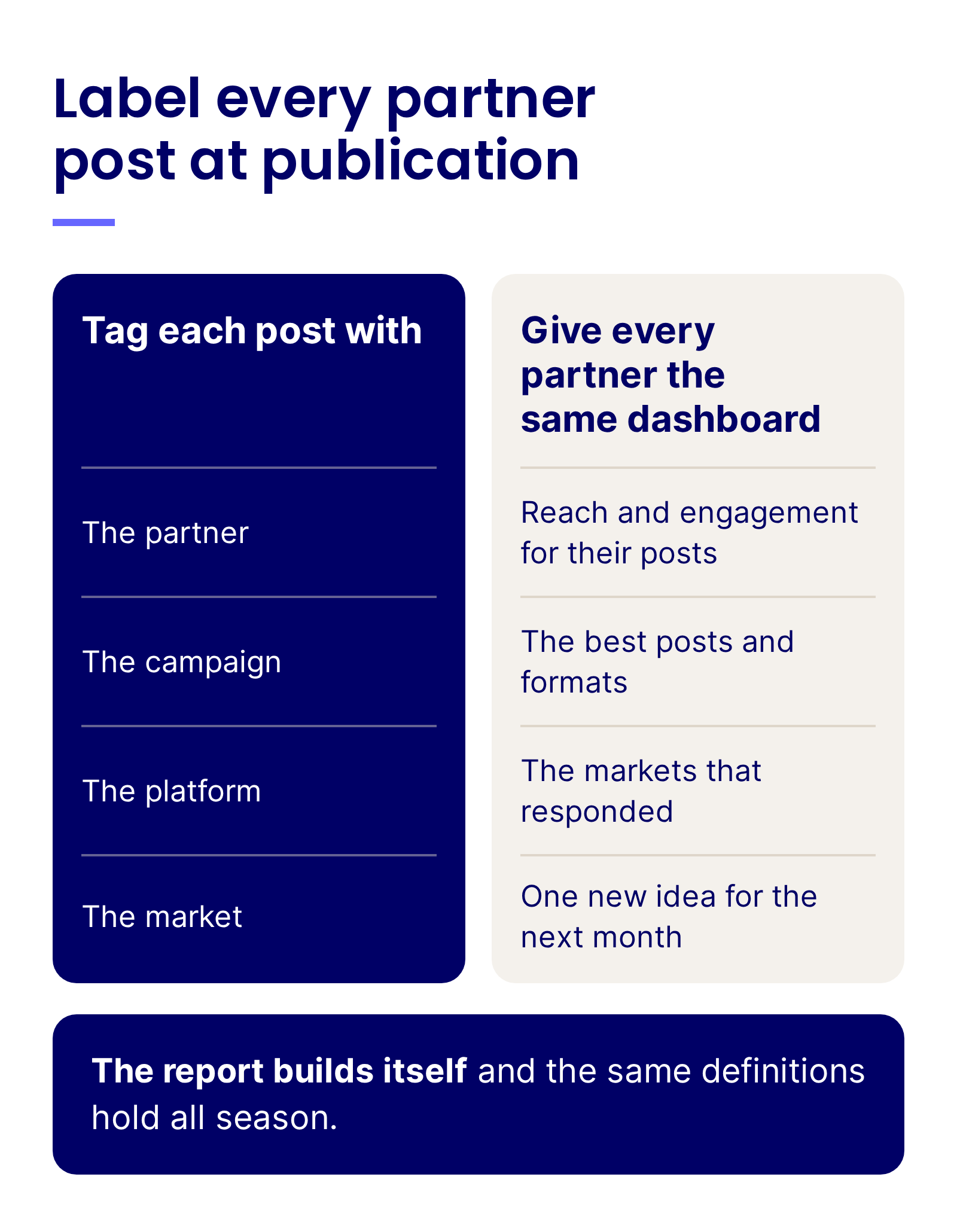
Label every partner post at publication. Tag each post with the partner, the campaign, the platform and the market as it goes out, so the report builds itself and the same definitions hold all season. Then give every partner the same dashboard on the same schedule: reach and engagement for their posts, the best posts and formats, the markets that responded, and one new idea for the next month.

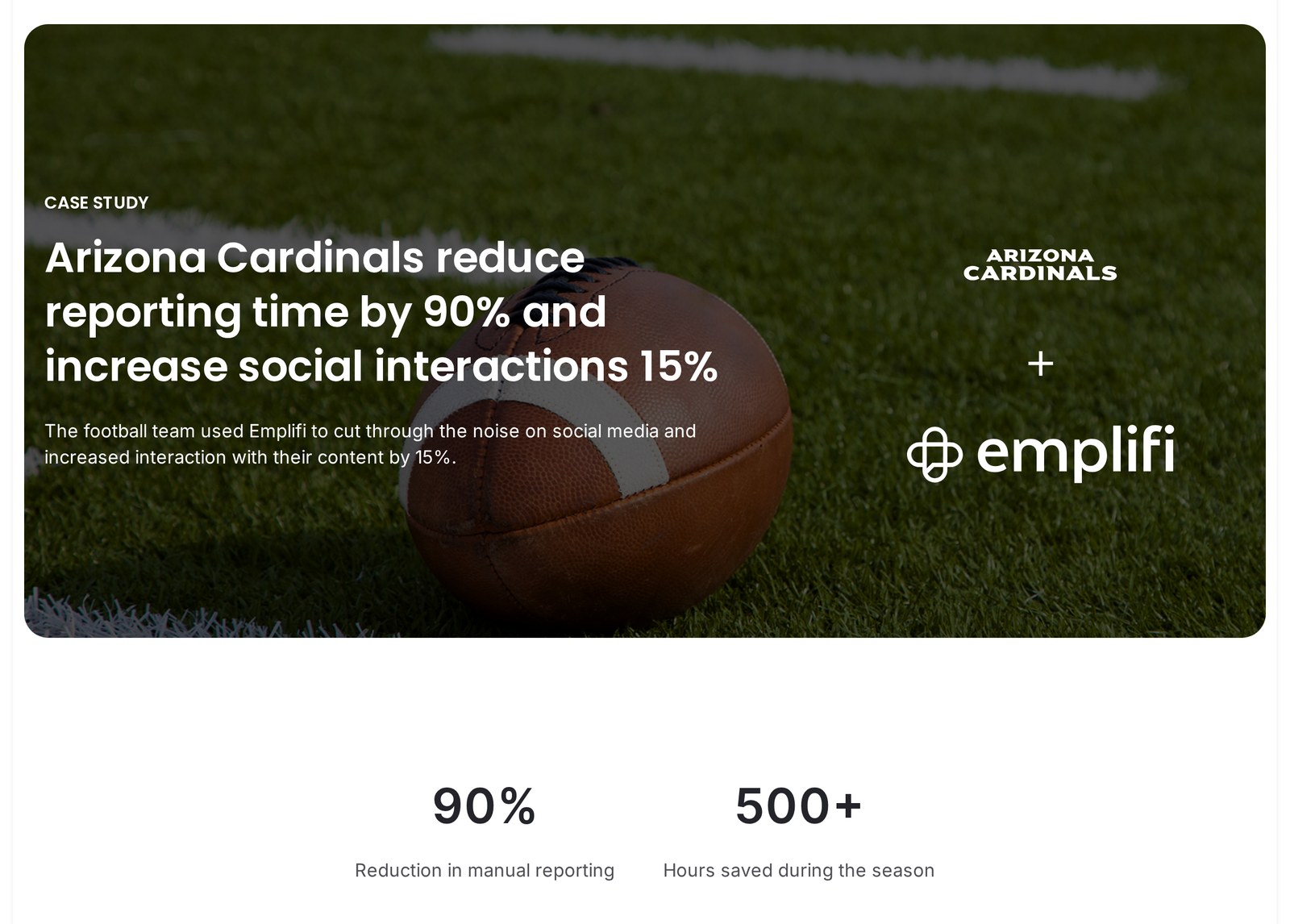
The Arizona Cardinals used to build weekly sponsor reports by hand through the season. With automated post labeling and report generation in Emplifi, the team now shares quick, consistent numbers with the people who sell and run the partnerships.

The Arizona Cardinals customer story on emplifi.io.
“Emplifi provides us with quick, standardized reports that allow us to speak more intelligently about the data we’re presenting to our business development and activation teams,” says Zach Galia, Director of Digital Content.
Arizona Cardinals: A 90% reduction in manual reporting and over 500 hours saved during the season, with insights on the effectiveness of 350+ sponsor campaigns and an over 15% increase in overall interactions with their content.
The same labels show what fans want. Labeling showed the Cardinals that standings and power rankings graphics kept landing among their top three posts on every channel. “Now, we ensure the rankings posts go out every Monday or Tuesday after a Sunday win,” says Galia.
The Arizona Cardinals and partner SeatGeek surprise a fan on their birthday at the stadium, so the sponsor appears inside a moment fans enjoy watching.
At G2 Esports, the team set up about 100 rules and conditions that label content automatically, from campaigns to memes and banter to game coverage, and the data team pulls insights from the automated reports so the social team can tailor campaigns for each platform.
Emplifi’s Content Labeling tools help teams “organize, automate, and analyze content at scale”: custom labels on posts and comments, automated categorization, and benchmarks across topics, campaigns and competitors.
The content labeling product tour shows custom labels and automated categorization at work on posts and comments, ready for reporting and benchmarks.
Bring each partner one insight a month, such as the format or market that did best for them. A partner who hears something new every month is easier to renew.

Each platform does a different job for a sports team, from the clip that finds new fans to the live stream that gathers the ones you have.
| Platform | Primary role | Best formats | Common pitfall |
|---|---|---|---|
| Game-day reach and athlete Collabs | Carousels, Reels, Collab posts, Stories | Posting the same highlight every other account has already shared | |
| TikTok | Reaching new and younger fans | Short behind-the-scenes clips, player personality, trends | Waiting for sign-off until the trend has passed |
| YouTube | Long-form stories and the archive | Documentaries, press conferences, Shorts | Posting only clips, with nothing longer for fans who want the whole story |
| Live build-up and reaction, and the local community | Live video, Reels, community posts | Using it only for links to the club website | |
| X or Threads | Live commentary and breaking news | Short text, GIFs, quick reactions | Arguing with fans in public |
| Private messaging and communities | Ticket, membership and merchandise problems, and superfan groups | DMs, broadcast channels, member groups | Leaving an entry problem in the DM queue during the game |
| Honest fan discussion | Answers from a verified account, AMAs with players or staff | Posting promotions in a team subreddit without reading its rules |
Instagram carries game-day reach and athlete Collabs for most clubs. In Emplifi’s quarterly Sports Clubs benchmarks, drawn from Emplifi’s category for sports clubs worldwide (4,499 Facebook pages and 2,370 Instagram profiles), the median sports club’s Instagram post earned 767.5 interactions at the end of the July to September quarter, more than 10 times the 73 on Facebook. Carousels led with a median of 847 interactions per post, ahead of Reels and single images, so a game-day photo set or a player Reel is a strong default.
TikTok is the growth channel. Median follower counts for brands on TikTok increased by over 200% year over year in Emplifi’s annual social media benchmarks, more than on any other platform, and short, personality-led clips are what find people who have never followed the club.
YouTube is the home for long-form: documentaries, press conferences and the archive, for fans who want the whole story.
Facebook keeps its own strength in live. In the same Sports Clubs data, Live Video and Reels ran almost level on Facebook, at medians of 93 and 89 interactions per post, and live is still a rare format there, so the build-up before a game and the reaction after it are worth going live for.
X is at its best for live commentary and breaking news, so keep posts quick and conversational. Threads plays a similar role for teams whose fans have moved there.
Private messaging is where ticket, membership and merchandise problems end up, with order numbers and seat details nobody should share in public. Member groups and broadcast channels give superfans a closer line to the club.
Most big teams have a subreddit, usually run by fans, where supporters break down every game, every signing and every rumor. Volunteer moderators set the rules, and posts that read like ads get removed.
That makes Reddit a place to listen first. Emplifi’s brand guide to building community on Reddit says strong Reddit participation “starts with listening”:
Borrow the language and leave the posts alone: the way fans describe a player or a rivalry on Reddit can shape your captions, and their posts stay theirs.
A fan’s relationship with a team moves through stages, and social plays a different part in each.
| Stage | What the fan needs | Best content type | Primary channel |
|---|---|---|---|
| Discovering | A player, a moment or a story worth following | Short clips, athlete Collabs, creator content | TikTok, Instagram, YouTube Shorts |
| Choosing to follow and attend | A reason to commit and an easy way to buy | Schedules, ticket on-sale posts, game-day guides, fan stories | Instagram, Facebook, the club website |
| Game day | Live updates and quick help | Live posts, results, venue information, fast replies | X or Threads, Instagram Stories, DMs |
| Staying through the off-season and renewing | A reason to stay close between games | Series, interactive posts, member offers, renewal reminders | Instagram, YouTube, member communities |
Discovery runs on short video. In WSC Sports’ Generational Fan Study, a survey of 1,050 US fans, 62% of fans discovered a new team, player or league through short-form video, which is why the first row leans on clips and athlete Collabs.
Renewal depends on how the club handles problems along the way. Emplifi’s Social Pulse research found 46% of consumers leave brands after two bad experiences, and a season ticket holder with two unanswered questions is a renewal at risk.
Game days bring more comments, DMs and mentions than any team can read, and AI is most useful in exactly that window.
AI takes the most pressure off sports teams in four places:
Other calls stay with people on the team:
Emplifi research: In AI in Social Media: Consumer Expectations, a survey of nearly 900 US consumers, 60% want to know when they’re interacting with AI, and 40% stopped engaging with a brand after a negative AI interaction.
Fan bases span generations, and so do their expectations. In Emplifi’s Marketing Across Generations survey, 81% of Boomers expect a human to answer when reaching out to a brand, versus 53% of Gen Z.
Settle on a disclosure line before any AI-drafted reply goes out, such as “Our fan services team uses AI to draft some replies, and a person answers anything about tickets, safety or players.”
When something serious breaks, such as an injury, an arrest or a death in the club family, stop the scheduled posts before a cheerful countdown goes out. In Emplifi Listening, Spike Alerts notify the team when the number of mentions jumps, and they can watch for positive spikes too, such as a player trending after a big night. When a spike signals risk, the Crisis Kill Switch lets the team pause all scheduled Emplifi Publisher content instantly.
On Emplifi, Fuel AI, the agentic intelligence layer built into Emplifi Fuel, runs in the background, flagging anomalies, sentiment spikes and opportunities, and builds reports from a plain-language request, so the team hears that a player is trending in a new market while there is still time to post about it.
A useful sports report starts with followers by market and links them to game days, partners and revenue.
| Metric tier | What to measure | Benchmark to use |
|---|---|---|
| Audience growth | Followers gained by market and platform, with target markets reported apart from the home market | Emplifi’s quarterly Sports Clubs benchmarks, worldwide |
| Game-day performance | Time from the final whistle to the result post, and engagement per game | Your own season average |
| Engagement quality | Interactions, shares and comments per post, by format | The post-type medians in Emplifi’s quarterly Sports Clubs benchmarks |
| Off-season retention | Engagement between seasons or events, against the in-season average | Your previous off-season |
| Fan care | First response time on tickets, membership and merchandise, and cases closed | Your response standard, checked on game days and on-sale days |
| Partner value | Reach and engagement per partner, posts labeled at publication and reporting hours saved | Each partner’s previous season |
| Business outcome | Ticket, membership and merchandise sales from social links and codes | Your ticketing and ecommerce data |
Count the reporting hours saved as well. They are the hours that go back into content, and your Customer Success Manager will help you set the baseline.
UFC shows what happens when a sport this busy builds its decisions on that kind of data.
The challenge. UFC produces a nonstop stream of content across continents, cultures and time zones, and its leadership made social media a driving force for the business. “Our CEO sees social media as more important than traditional media,” says Aziz Bawany, Senior Director of Digital Media & Product at UFC. The team, though, was tracking fighter performance by hand, checking social stats hourly and compiling data manually, in a sport where hype drives viewership.

The UFC customer story on emplifi.io.
What they did. With Emplifi’s listening and analytics, UFC’s digital team tracks fan buzz in real time and sees which fighters and moments are catching fire in which markets. At the center sits a fighter leaderboard, powered by Emplifi’s flexible reporting, that began as a post-event report and now informs matchmaking decisions, marketing strategy and how new stars are discovered and amplified around the globe.
“Before, our team manually checked every fighter’s social following, tracking growth by hand. Now, I just pull up the leaderboard and instantly see who gained the most traction. What used to take hours is now done in seconds,” says Hailey Carroll, Social Media Coordinator at UFC.
The leaderboard tells the team where each fighter’s audience is growing, and the content follows. “With 42 events a year and fighters competing globally, we need data to see who’s breaking through,” says Bawany. “Emplifi allows us to spot rising stars, track engagement trends, and push the right talent in the right market at the right time.”
UFC co-publishes with its UFC Europe account a carousel of Christian Leroy Duncan playing basketball before his weight cut, putting the fighter in front of the account’s European followers.
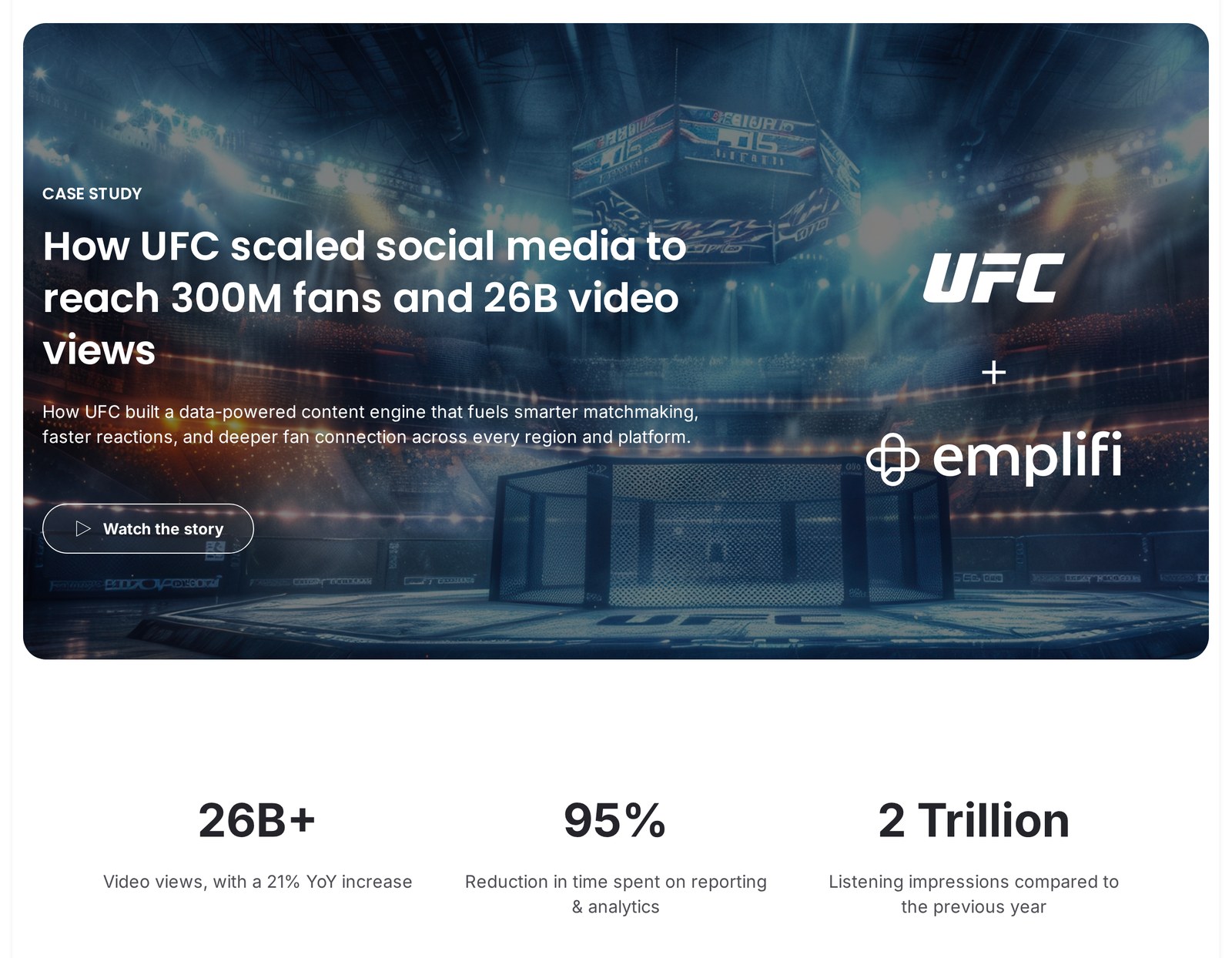
The result. UFC now has 300M+ total followers across its social platforms, has gone from top 20 to top 10 among global sports leagues by community size, and is now a top 5 sports league in the U.S. by digital audience.
UFC: More than 26 billion video views, up 21% year over year, a 95% reduction in time spent on reporting and analytics, and 2 trillion listening impressions.
If your next big home game or event is close: start here
With that game or event only weeks out, start here.
First 30 days: map what you have
Start with an honest look at the season so far.
Days 31–60: build the engine
The second month turns the first game’s work into habits.
Days 61–90: show the results
In the third month, put the numbers in front of the people who sell the season.
The winning score at the start of this guide only grows the audience if the club is ready for it before the game starts. If your next big home game or event is close, begin with the fast track; if not, with the first 30 days.
On Emplifi, Emplifi Publisher schedules the season across club, team and regional accounts, with approval workflows, a built-in Link in Bio and automatic UTM tracking. Emplifi Care routes ticketing and merchandise cases to the teams that solve them, and Emplifi Unified Analytics turns labeled posts into partner and season reports.
Before your next home game, pick the three results you can predict, build their posts, and name the person who will press publish.
Already an Emplifi customer? Talk to your Customer Success Manager.
Attention arrives in spikes around games and events, the roster often reaches more people than the club account, the best footage is frequently licensed to broadcasters, and sponsors expect proof of value every season. Our guide to social media marketing for sports teams covers the channel basics behind each of those.
A game-day content kit holds approved templates for the outcomes you can predict, one named publisher for the game window, approvals agreed in advance and a plan for the hour after the final whistle. Add caption options in the club’s voice, with the humor guardrails written in, and a co-author slot for player Collabs.
A Collab puts one post on the club’s account and the athlete’s at the same time, so it reaches both audiences at once and the conversation gathers in one place. Match each player to the market you want to grow, let them publish moments they already film, and measure follower growth in that market afterward.
Plan the off-season as a season of its own, with a weekly series that needs no game footage, interactive posts such as polls and kit votes, and fan content built around identity. Off-season fan engagement works best with its own targets, measured against the in-season average and reviewed every week.
Set targets by topic: entry and safety problems at the venue within minutes on game day, ticket problems within the hour during an on-sale, and merchandise questions the same day. Staff game days and on-sale mornings to match, and track the standard like any service level, as our guide to SLA management for social customer care describes.
Let AI sort messages, spot trending players and draft routine answers on tickets and entry times for a person to check. Keep player welfare, injuries, discipline, abuse, safeguarding and commercial promises with people, and tell fans when AI drafted a reply, because most consumers want to know when they’re interacting with AI.
Measure followers by market and platform, with target markets reported apart from the home market, then add engagement per game, off-season retention, response times on tickets and merchandise, and partner value. Sponsor reporting for sports teams works best when posts are labeled at publication, so the same data serves the partner and the season review.
Discover what Emplifi can do for you. We turn small teams into large ones, and large teams into well oiled machines, but either way, we offer the rocket ship, you just need to jump on.